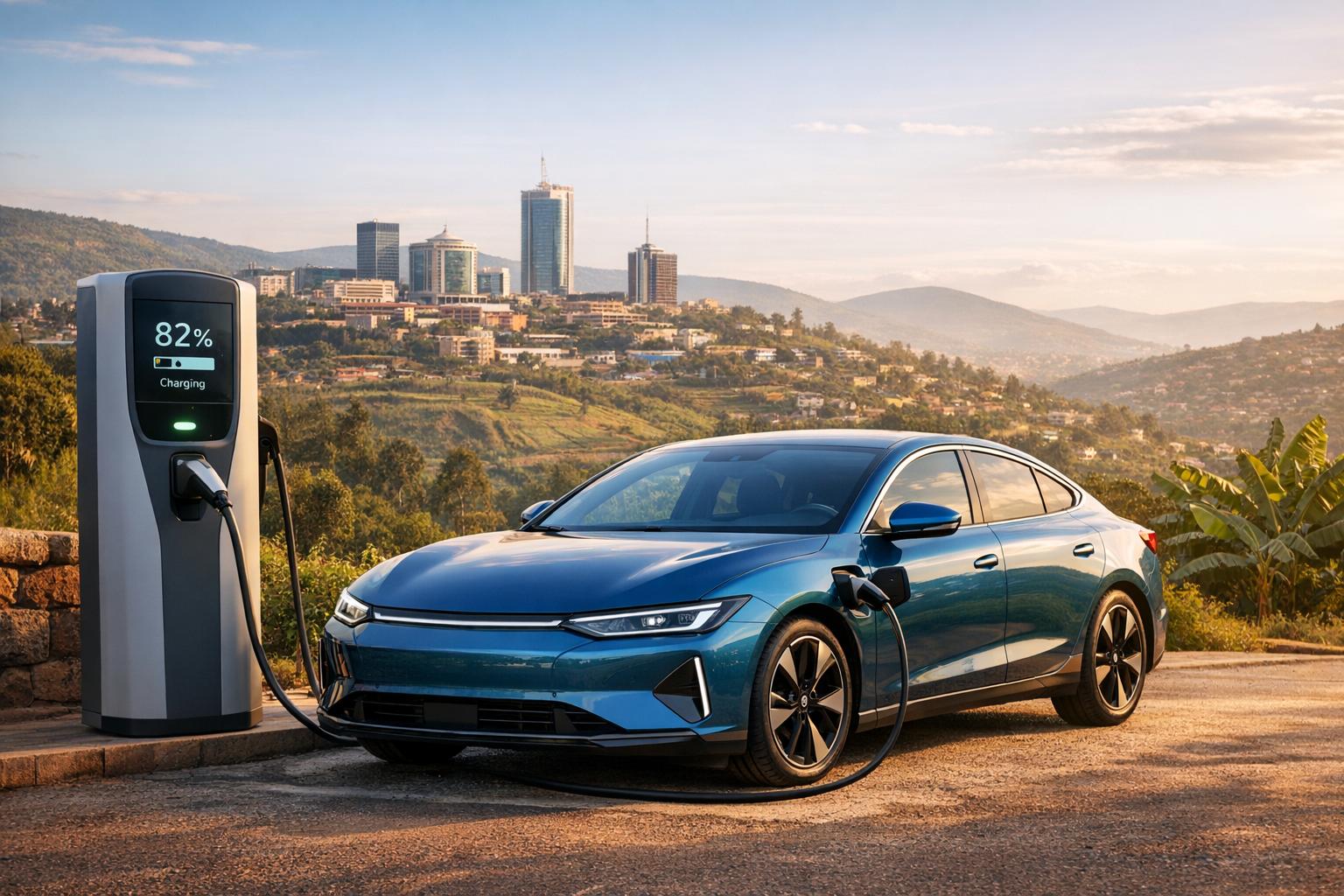
Rwanda’s EV market is booming in 2026, with over 7,000 electric and hybrid vehicles on the road. Thanks to government incentives like 80% import duty reductions, full VAT exemptions, and subsidized charging rates ($0.10 per kWh), EV ownership is now cost-effective. With charging infrastructure rapidly expanding, Kigali alone has nearly 200 stations, and EVs save owners an estimated $3,160 over five years compared to gas-powered cars.
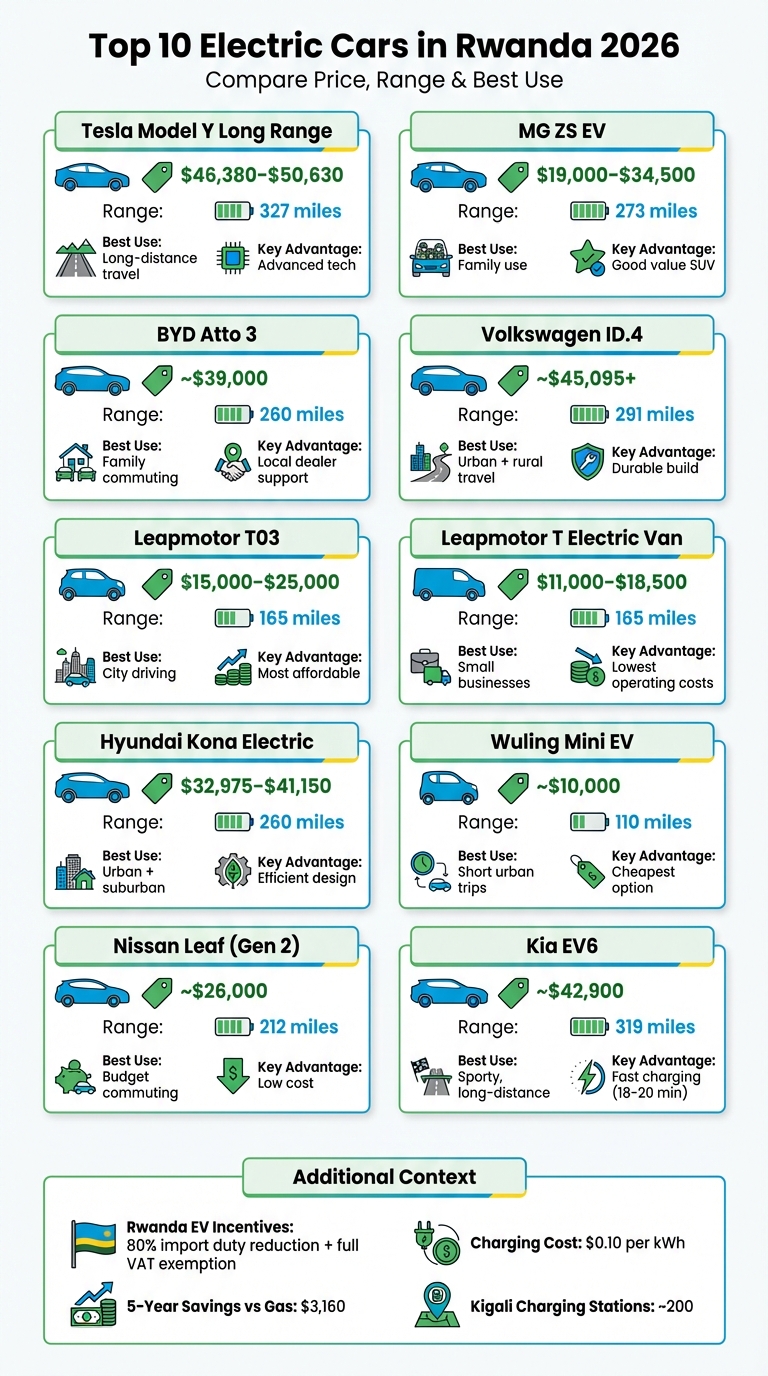
Here’s a quick guide to the top 10 EVs for Rwandan drivers, based on range, cost, and performance:
- Tesla Model Y Long Range: 327 miles, $46,380–$50,630. Great for long trips but pricey.
- BYD Atto 3: 260 miles, ~$39,000. Reliable and family-friendly.
- Leapmotor T03: 165 miles, ~$15,000–$25,000. Affordable for city use.
- Hyundai Kona Electric: 260 miles, ~$32,975–$41,150. Compact and efficient.
- Nissan Leaf (Gen 2): 212 miles, ~$26,000. Budget-friendly, but older tech.
- MG ZS EV: 273 miles, ~$19,000–$34,500. SUV with good range.
- Volkswagen ID.4: 291 miles, ~$45,095+. Well-built, versatile SUV.
- Leapmotor T Electric Van: 165 miles, ~$11,000–$18,500. Perfect for small businesses.
- Wuling Mini EV: 110 miles, ~$10,000. Ultra-affordable for short trips.
- Kia EV6: 319 miles, ~$42,900. High-end, fast charging, sporty.
Quick Comparison:
| Vehicle | Price (USD) | Range (Miles) | Best Use | Main Advantage | Limitation |
|---|---|---|---|---|---|
| Tesla Model Y Long Range | $46,380–$50,630 | 327 | Long-distance travel | High range, advanced tech | Expensive |
| BYD Atto 3 | ~$39,000 | 260 | Family commuting | Local dealer support | Mid-range price |
| Leapmotor T03 | ~$15,000–$25,000 | 165 | Kigali city driving | Affordable | Limited range |
| Hyundai Kona Electric | ~$32,975–$41,150 | 260 | Urban + suburban | Compact, efficient | Tight rear seating |
| Nissan Leaf (Gen 2) | ~$26,000 | 212 | Budget commuting | Low cost | Older charging tech (CHAdeMO) |
| MG ZS EV | ~$19,000–$34,500 | 273 | Family use | Good SUV value | Slower charging |
| Volkswagen ID.4 | ~$45,095+ | 291 | Urban + rural travel | Durable, versatile | Software issues |
| Leapmotor T Electric Van | ~$11,000–$18,500 | 165 | Small businesses | Low operating costs | Basic design |
| Wuling Mini EV | ~$10,000 | 110 | Short urban trips | Cheapest option | Not for highways |
| Kia EV6 | ~$42,900 | 319 | Sporty, long-distance | Fast charging, premium feel | High upfront cost |
With affordable charging, tax breaks, and a growing network of stations, EVs in Rwanda are more practical than ever. Whether you’re looking for a budget-friendly city car or a high-end long-range SUV, there’s an option to fit your needs.
Top 10 Electric Cars in Rwanda 2026: Price, Range & Best Use Comparison
1. Tesla Model Y Long Range
Actual Driving Range in Miles
The 2026 Tesla Model Y Long Range boasts an EPA-estimated range of 327 miles. Real-world highway tests, however, show even more impressive results – 331 miles at 70 mph and 220 miles at 75 mph. Rwanda’s consistent daytime temperatures, averaging around 80°F, create favorable conditions for the battery to perform efficiently. While the country’s mountainous terrain can increase energy use during uphill drives, the Model Y’s regenerative braking system helps recover energy on downhill stretches. With its 79.0 kWh battery capacity, the vehicle is well-suited for daily commutes and longer trips alike, making it a solid choice for a variety of driving needs.
Total Ownership Costs
The Model Y Long Range is priced between $46,380 and $50,630, offering a competitive edge compared to similar electric vehicles. It comes with a 4-year/50,000-mile basic warranty and an 8-year/120,000-mile battery and powertrain warranty. However, it’s worth noting that Tesla does not include complimentary scheduled maintenance.
Charging costs in Rwanda are impressively low, at about $0.10 per kWh. When using DC fast chargers, the Model Y can recharge from 10% to 80% in just 20–30 minutes, thanks to its 250 kW maximum charging rate. This combination of affordability and efficiency makes running the Model Y financially appealing.
Charging Infrastructure Compatibility in Rwanda
The Model Y is equipped to handle DC fast charging up to 250 kW and works with CCS Combo 2 or NACS connectors. For home charging, a Level 2 (240V) setup adds about 42 miles of range per hour. Tesla also provides adapters, ensuring compatibility with most public charging systems. For those living in urban areas, access to home charging makes the Model Y especially convenient.
Performance on Kigali Streets and Rural Roads
The all-wheel-drive Model Y accelerates from 0 to 60 mph in just 3.9 seconds, delivering robust performance on Kigali’s steep and winding streets. Its traction system handles rainy, hilly conditions with ease. However, the 6.6-inch ground clearance might pose challenges on rough, unpaved roads. Inside, the vehicle features acoustic glass and an improved suspension system, creating a quiet cabin environment with noise levels measured at 66 decibels at 70 mph. That said, the ride can feel a bit firm on uneven surfaces.
sbb-itb-7bc66b5
2. BYD Atto
Actual Driving Range in Miles
The BYD Atto 3, also known locally as the BYD Yuan Plus, is equipped with a 60.5 kWh battery. It boasts an official WLTP range of 260 miles, while its average real-world range is around 211 miles. Thanks to Rwanda’s mild climate, where temperatures hover around 73°F, the battery maintains its efficiency, achieving approximately 178 Wh/km. These figures make the Atto 3 a reliable choice for both city commutes and rural drives in Rwanda.
Total Ownership Costs
In Europe, the Atto 3 is priced between $39,000 and $42,000, with local pricing determined by authorized dealers. It features BYD’s Blade Battery with LFP technology, known for its durability, and includes an 8-year/124,000-mile warranty covering the battery and powertrain. This warranty, combined with the vehicle’s efficient design, helps keep maintenance costs manageable. Its economical charging capabilities further enhance its affordability over time.
Charging Infrastructure Compatibility in Rwanda
The Atto 3 is compatible with Type 2 AC and CCS DC fast charging systems. Using a 110 kW DC charger, the battery can go from 10% to 80% in just 35–36 minutes. The vehicle also includes Vehicle-to-Load (V2L) functionality with a 3.3 kW output, allowing users to power external devices when needed. Additionally, BYD’s established dealer network in Rwanda offers local support, including servicing and test drives, ensuring a seamless ownership experience.
Performance on Kigali Streets and Rural Roads
With an acceleration time of 7.3 seconds from 0 to 60 mph, the Atto 3 provides responsive handling, well-suited for Kigali’s hilly streets. Its SUV design offers higher ground clearance, making it capable of handling unpaved rural roads with ease. Safety is another strong point, as the Atto 3 has earned a 5-star Euro NCAP rating, with scores of 91% for adult occupant protection and 89% for child occupant safety. On top of that, its cargo space – 440 liters, expandable to 1,338 liters with the rear seats folded – offers plenty of room for both daily errands and longer trips.
Inside KABISA: Rwanda’s EV Revolution | WIB Documentary
3. Leapmotor T

The Leapmotor T03 brings an entry-level option to Rwanda’s growing EV market, offering an affordable yet capable alternative to premium electric vehicles.
Actual Driving Range in Miles
The Leapmotor T03 is equipped with a 37.3 kWh battery pack, delivering a WLTP range of 165 miles. In urban areas, this range stretches to about 245 miles, while in Rwanda’s hilly terrain, the vehicle achieves around 186 miles. Its 70 kW motor, generating 158 Nm of torque, ensures reliable performance even on steep inclines, making it a practical choice for Rwanda’s diverse landscapes.
Total Ownership Costs
Priced between 15,000,000 and 25,000,000 RWF, the T03 is an economical option for buyers. Over a five-year period, its ownership costs are 20–30% lower compared to traditional petrol vehicles. Backed by Stellantis‘ service network, the car includes a 4-year/60,000-mile warranty, offering peace of mind to new owners.
Charging Infrastructure Compatibility in Rwanda
The T03 is designed to work seamlessly with Rwanda’s CCS2 charging standard and includes Type 2 charging cables. For quick top-ups, DC fast charging can restore 80% battery capacity in under an hour. Standard AC charging takes 6–8 hours, making overnight charging a convenient option. Over-the-air updates further enhance the vehicle’s driver assistance and infotainment systems. Kigali now features about 200 charging stations, with 35 specifically designed for cars, ensuring easy access to power across the city.
Performance on Kigali Streets and Rural Roads
With its compact size and tight turning radius, the T03 handles Kigali’s narrow streets with ease. Features like light steering and 360-degree cameras make maneuvering simple, while modern touches such as a panoramic sunroof, a 10.1-inch touchscreen, and an 8-inch digital instrument cluster enhance the driving experience. The car’s top speed of 81 mph is well-suited for urban settings, though its suspension may feel less comfortable on unpaved rural roads.
4. Hyundai Kona Electric

The Hyundai Kona Electric delivers a solid mix of range, performance, and affordability. With several trim options, it meets a variety of budgets while offering reliable capabilities for both city commutes and highway trips. Its efficient range and features tailored to local needs make it a standout choice.
Actual Driving Range in Miles
The Kona Electric comes with two battery options. The SE trim is equipped with a 48.6 kWh battery that provides an EPA-estimated range of 200 miles. Meanwhile, the SEL and Limited trims feature a larger 64.8 kWh battery, offering an EPA-estimated range of up to 261 miles. In real-world highway tests at 70 mph, the long-range SEL model achieved 245 miles. Across all trims, the vehicle delivers 188 lb-ft of torque, which is particularly useful for handling Kigali’s steep inclines.
Total Ownership Costs
Pricing for the Kona Electric starts at $32,975 for the SE trim and goes up to $41,150 for the fully loaded Limited trim. In Rwanda, mid-range EVs like the Kona typically range between 25 million and 45 million RWF. Buyers benefit from Rwanda’s EV-friendly policies, including an 80% reduction in import duties and a full VAT exemption for battery electric vehicles. Over five years, operating costs are estimated to be about 70% lower compared to similar petrol-powered vehicles. The Kona Electric also comes with a robust 10-year/100,000-mile battery and powertrain warranty, and its simplified maintenance needs eliminate the hassle of engine repairs.
Charging Infrastructure Compatibility in Rwanda
The Kona Electric works seamlessly with Rwanda’s growing charging network. Public charging stations are available in Kigali’s commercial hubs, as well as DC fast chargers along the Kigali-Musanze and Kigali-Rusumo highways. The vehicle’s 11 kW onboard charger can complete Level 2 AC charging in about 5–6 hours, while a 100 kW DC fast charger takes the battery from 10% to 80% in roughly 43 minutes. For home charging, installation costs typically range from 300,000 to 800,000 RWF. Additionally, the Kona Electric includes Vehicle-to-Load (V2L) functionality, enabling you to power external devices directly from its battery.
Performance on Kigali Streets and Rural Roads
In urban settings like Kigali, the Kona Electric handles confidently, with drive modes such as Eco, Normal, Sport, and Snow to optimize battery efficiency and traction. Safety features like Forward Collision-Avoidance Assist, Lane Keeping Assist, and Blind-Spot Collision Warning come standard. With a 5.9-inch ground clearance, the Kona Electric is well-suited for paved roads, though it’s best to proceed cautiously on rough, rutted paths. The latest model is 7.5 inches longer and 1 inch wider than its predecessor, offering 25.5 cubic feet of cargo space with the seats up. However, testers noted its ride can feel stiff, which might reduce comfort on uneven surfaces.
5. Nissan Leaf Second Generation
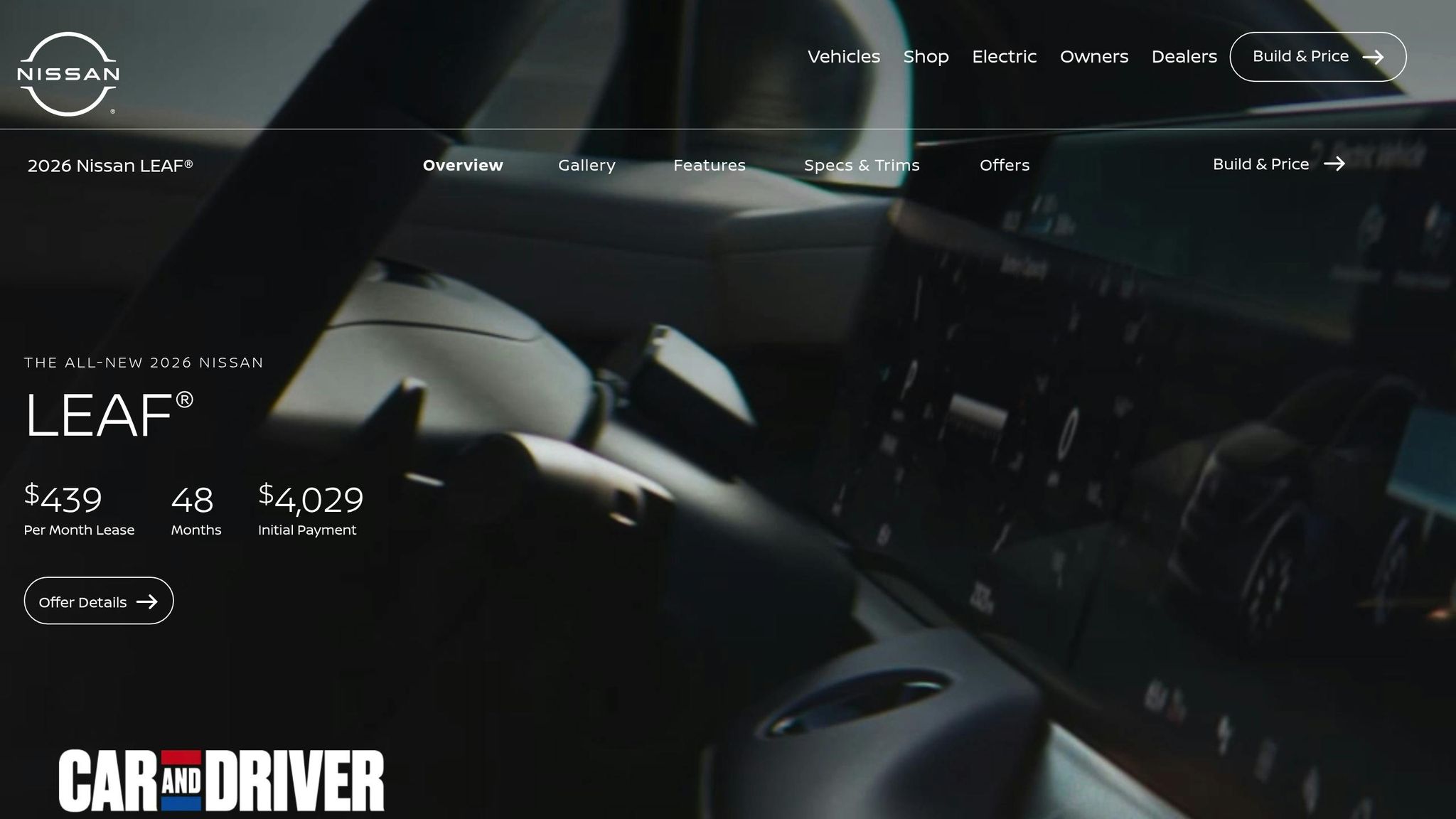
The Nissan Leaf Second Generation stands out as a practical and budget-friendly option for those exploring electric vehicles in Rwanda. For buyers looking to embrace electric mobility without breaking the bank, this model strikes a great balance between affordability and useful features, making it ideal for both city driving and moderate highway trips.
Actual Driving Range in Miles
The Nissan Leaf Second Generation delivers a driving range of 212 miles per charge. This range is well-suited for Kigali’s daily commutes and intercity journeys. The car’s regenerative braking system is particularly effective on Rwanda’s hilly terrain, as it recaptures energy during downhill drives to help extend its range.
Total Ownership Costs
With a price range of 15,000,000 to 25,000,000 RWF, the Leaf is among the most competitively priced electric vehicles in Rwanda. It comes with a battery warranty of 8 years or 100,000 miles, offering peace of mind to buyers. However, unlike some rivals, Nissan does not include complimentary maintenance packages with the purchase. Over five years, the Leaf’s operating costs are estimated to be about 70% lower than those of equivalent gasoline-powered vehicles.
Charging Infrastructure Compatibility in Rwanda
The Leaf is equipped with two charging ports: a J1772 port for Level 1 and Level 2 AC charging, and a NACS (Tesla-style) port for DC fast charging. This setup integrates seamlessly with Rwanda’s expanding charging network, which features public chargers in Kigali’s commercial hubs and DC fast chargers along major routes like the Kigali-Musanze and Kigali-Rusumo highways. At DC fast-charging stations, the Leaf’s battery can go from 10% to 80% in roughly 35 minutes. For home charging, installing a Level 2 charger costs between 300,000 and 800,000 RWF and takes about 3 to 8 hours to fully charge the battery. These options make charging convenient and align well with the Leaf’s efficiency and city-friendly design.
Performance on Kigali Streets and Rural Roads
In Kigali’s urban environment, the Leaf’s strong torque makes it easy to handle steep inclines. Its 5.9-inch ground clearance – slightly higher than the redesigned 2026 model’s 5.3 inches – helps it navigate uneven roads more effectively. However, while the Leaf performs well on city streets, it’s less suited for winding, rough rural roads where its handling feels less stable. For storage, the car offers 20 cubic feet of cargo space behind the rear seats, which expands to 55.5 cubic feet when the seats are folded down.
6. MG ZS EV

The MG ZS EV stands out as an affordable electric SUV that caters to Rwandan drivers looking for value without giving up essential features. Designed to handle Rwanda’s unique driving conditions, this SUV strikes a balance between range, cost, and performance. It also comes with a reassuring 7-year or 80,000-mile warranty, making it a solid choice for families and daily commuters. The Long Range model, featuring a 72.6 kWh battery, is particularly well-suited for the country’s roads.
Actual Driving Range in Miles
According to MG, the Long Range version of the ZS EV offers a WLTP range of 273 miles. However, real-world tests show a more practical range of 232–240 miles under typical conditions. For the Standard Range model, equipped with a 51 kWh battery, the official range is 198 miles, though drivers can expect around 170 miles in everyday use. The car also features a three-level regenerative braking system, which supports one-pedal driving – ideal for navigating Kigali’s hilly terrain. With 280 Nm of torque, the ZS EV accelerates from 0 to 62 mph in about 8.2–8.4 seconds, providing a smooth and responsive driving experience.
Total Ownership Costs
The MG ZS EV helps drivers save on maintenance, with servicing costs roughly 50% lower than traditional vehicles and scheduled every 12 months or 15,000 miles. Its energy efficiency – 3.5–3.6 miles per kWh – keeps electricity bills manageable. Charging the 72 kWh battery at home costs approximately $14.50 for a full charge, and the comprehensive warranty covers both the vehicle and the battery, offering additional peace of mind.
Charging Infrastructure Compatibility in Rwanda
This model includes a CCS-II port for DC rapid charging and a Type 2 connector for AC charging, making it compatible with Rwanda’s growing charging infrastructure. At Kigali’s DC fast chargers, the Long Range battery can go from 10% to 80% in about 42 minutes using a 100 kW charger. For home charging, a 7 kW wallbox can fully charge the battery in roughly 10.5 hours. The ZS EV also features V2L (Vehicle-to-Load) technology, allowing it to power external devices, and the iSMART app lets users pre-cool the cabin or schedule charging during off-peak hours.
Performance on Kigali Streets and Rural Roads
In Kigali’s urban environment, the ZS EV delivers a comfortable ride, thanks to its responsive steering and suspension that handles bumps well at lower speeds. However, its ground clearance can be a drawback on rural roads with deep potholes or tall speed bumps, and its front-wheel-drive system may struggle slightly on wet or loose surfaces. Inside, the SUV offers ample storage with a boot capacity of around 470–480 liters, while its 500 kg towing capacity is impressive for its class. Safety features include MG Pilot, which provides Active Emergency Braking, Lane Keep Assist, and Blind Spot Detection, adding an extra layer of security for drivers and passengers.
7. Volkswagen ID.4

The Volkswagen ID.4 is a mid-size electric SUV that combines solid construction, a roomy interior, and versatility, making it a great fit for Rwanda’s mix of urban streets and rural roads. With an 8-year/100,000-mile battery warranty (guaranteeing at least 70% capacity retention) and 2 years/20,000 miles of free scheduled maintenance, it offers peace of mind to drivers.
Actual Driving Range in Miles
The 2026 ID.4 Pro rear-wheel-drive model boasts an EPA-estimated range of 291 miles, while the all-wheel-drive version is rated at 263 miles. In real-world highway testing at 70 mph, the ID.4 managed about 253 miles under favorable conditions. For performance enthusiasts, the AWD model delivers 335 horsepower and accelerates from 0 to 60 mph in just 4.9 seconds, while the RWD version offers 282 horsepower and a 7.3-second sprint.
Total Ownership Costs
The starting price for the 2026 base model ID.4 is $45,095, with higher trims like the AWD Pro S Plus priced around $59,130. Over five years, operating costs are estimated to be about 70% lower than comparable gasoline-powered vehicles. For the Pro trim, the 5-year cost to own is approximately $66,666, which includes $1,935 for maintenance and $1,456 for repairs. Installing a home Level 2 charger in Rwanda typically costs between 300,000 and 800,000 RWF, adding another layer of convenience for owners. These factors make the ID.4 a smart long-term investment.
Charging Infrastructure Compatibility in Rwanda
The Volkswagen ID.4 is equipped with a CCS (Combined Charging System) port, supporting both AC and DC fast charging. This ensures compatibility with Rwanda’s growing charging network. At public DC fast-charging stations, the ID.4 can charge from 10% to 80% in about 28 to 30 minutes, with peak rates reaching up to 175 kW. For home setups, the vehicle supports both 110-volt and 240-volt connections, with a peak AC charging power of 11 kW. Its reliable and user-friendly charging system makes it a practical choice for drivers navigating Rwanda’s evolving EV landscape.
Performance on Kigali Streets and Rural Roads
Navigating Kigali’s streets is a breeze with the ID.4’s 31.5-foot turning diameter, making tight city maneuvers effortless. The suspension system smooths out road imperfections, ensuring a quiet and comfortable ride. However, with a ground clearance of 6.0 inches, drivers should be cautious on unpaved rural roads with deep potholes or rugged terrain. For Rwanda’s hilly areas, the AWD version is the better option, offering improved traction and power, though it may exhibit some body roll during spirited driving. On top of that, the ID.4 provides up to 2,700 pounds of towing capacity and generous cargo space, making it ideal for both daily commutes and weekend getaways.
8. Leapmotor T Electric Pickup or Small Van
The Leapmotor T03 is designed to cater to small businesses and urban commuters, offering an affordable price range of $11,000–$18,500 (15,000,000–25,000,000 RWF). It also benefits from government incentives like an 80% reduction in import duties and a complete VAT exemption, making it even more appealing.
Actual Driving Range in Miles
The T03 boasts a WLTP range of 265 km (165 miles), which can extend up to 395 km (245 miles) in urban settings, thanks to its optimized regenerative braking system. On a full charge, drivers can realistically expect around 300 km (186 miles) in daily use. Its electric motor generates 70 kW (93.8 hp) and 158 Nm of torque, powered by a 37.3 kWh battery pack. The vehicle can reach a top speed of approximately 130 km/h (81 mph).
Total Ownership Costs
Over five years, owning a Leapmotor T03 can cost 20–30% less than comparable gasoline vehicles, primarily due to lower maintenance and energy expenses. Installing a home Level 2 charger typically costs between $220 and $590 (300,000 to 800,000 RWF). Standard home charging takes 8 to 15 hours for a full charge, while DC fast charging can replenish 30%–80% of the battery in just 36 minutes.
The T03 also comes packed with features, including a 10.1-inch touchscreen, a panoramic sunroof, 6 airbags, and 10 Advanced Driver Assistance Systems (ADAS) capable of receiving Over-the-Air updates. These benefits, along with its compatibility with Rwanda’s growing charging infrastructure, make it a practical choice for drivers.
Charging Infrastructure Compatibility in Rwanda
The T03 is fully compatible with Rwanda’s CCS2 charging network, which currently includes around 35 car-specific charging stations in Kigali. For urban drivers, daily charging is straightforward, but rural trips might require more careful planning due to limited infrastructure. To address this, more solar-powered, off-grid charging stations are being established in remote areas.
Performance on Kigali Streets and Rural Roads
With a compact length of 3.62 meters (11.9 feet), the T03 is ideal for navigating Kigali’s narrow streets and heavy traffic. Its performance has been praised for handling inclines with ease, as noted by reviewers:
The T03’s motor delivered consistent power, conquering the inclines with ease and demonstrating its capability to handle… hilly terrain
- ICT Frame
Despite its small size, the interior offers plenty of room, with 950 mm of front headroom and 960 mm of rear headroom, ensuring a comfortable ride for passengers.
9. Compact Chinese City EVs (e.g., Wuling-style minis)
Compact Chinese EVs like the Wuling Hongguang Mini EV offer one of the most affordable electric vehicle options in Rwanda, with prices starting at around $10,000 (11,000,000 RWF). At this price, these vehicles match the cost of older, used gasoline cars, making them more accessible to local drivers. The 2026 Wuling Mini EV is a 2-door, 2-seat hatchback, measuring 10 feet in length, and powered by a 14 kWh Lithium Iron Phosphate battery. It delivers 27 hp and 63 ft-lbs of torque.
Actual Driving Range in Miles
Let’s take a closer look at the performance of these budget-friendly EVs. The 2026 Wuling Mini EV has an EPA-rated range of 110 miles (177 km), a top speed of 62 mph, and takes 18 seconds to accelerate from 0-60 mph. These specs make it a practical choice for daily urban commutes. For context, this range is sufficient for several days of typical driving in Kigali without needing a recharge. On the other hand, the Geely Geometry E offers a longer range of 199-248 miles (320-400 km), but it comes with a higher price tag of approximately $20,000 (22,000,000 RWF) – double the cost of the Wuling Mini.
Total Ownership Costs
Over a five-year period, Wuling Mini EV owners can save about 1.8 million RWF annually on fuel compared to a used Toyota RAV4. These savings effectively cover the vehicle’s purchase price of 11 million RWF. Additionally, Rwanda’s government incentives, such as exemptions from import duties, excise duties, and VAT, significantly reduce the upfront cost.
Charging Infrastructure Compatibility in Rwanda
The affordability of these compact EVs is complemented by Rwanda’s growing charging infrastructure. These vehicles are fully compatible with the country’s charging network, including ultra-fast charging hubs with capacities up to 240 kW. Most owners, however, meet 80% of their charging needs at home using standard AC chargers, which take 6-8 hours for a full charge. In Kigali, drivers have access to nearly 200 charging stations, with 35 specifically designed for cars. Pophia Muhoza, Managing Director of Kabisa, remarked:
We’re proud to welcome all EVs to the first Kabisa Supercharger and see it as an important step in our progress towards an ultra-fast, convenient network across the entire region
.
Performance on Kigali Streets and Rural Roads
The Wuling Mini EV’s compact size – measuring just 3.06 meters (10 feet) in length and 1.52 meters (5 feet) in width – makes it ideal for navigating Kigali’s busy streets and parking in tight urban spaces. Equipped with rear-wheel drive and basic ADAS features through the Lingmou system, the vehicle also supports Over-the-Air updates via Ling OS. While its design is perfect for city driving, it’s less suited for rough rural roads.
10. Kia EV6
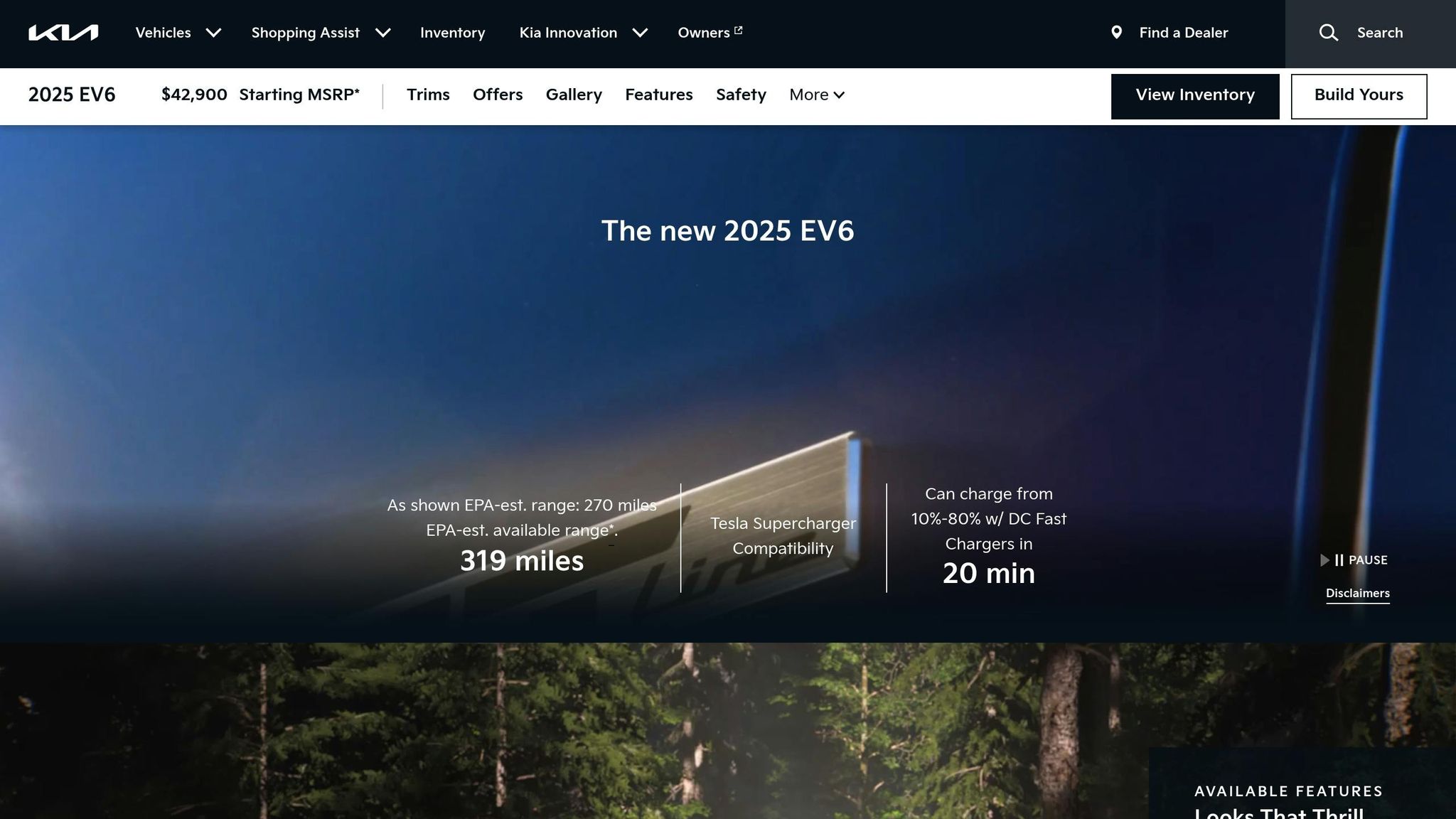
The Kia EV6 stands out as a premium crossover in Rwanda’s electric vehicle market, with prices starting at $42,900 (roughly 45,000,000 RWF)[19, 58]. Its standout features, extended range, and powerful performance make it an appealing option for those looking to invest in a high-end EV.
Driving Range Details
The 2025 Kia EV6 comes in several trims to suit different needs. The Light Long Range RWD trim offers an impressive 319 miles of range on its 84.0 kWh battery. Meanwhile, the Standard Range trim, equipped with a 63.0 kWh battery, delivers 237 miles. For those opting for all-wheel drive, the range varies between 270 and 295 miles, while the high-performance GT trim is rated at 231 miles. Charging is also fast and efficient – using a 350kW DC fast charger, the EV6 can go from 10% to 80% charge in just 18 to 20 minutes[59, 60].
Ownership Costs and Benefits
While the EV6 carries a premium price, buyers in Rwanda enjoy significant cost advantages, such as an 80% reduction in import duty and VAT exemption for electric vehicles. Depreciation for the 2024 models has been around 47% in the first two years, with resale values averaging $23,100, compared to the original MSRP of $43,975. It also comes with a 10-year/100,000-mile warranty for both the powertrain and battery. For home charging, installation costs in Rwanda range between 300,000 and 800,000 RWF. Combined with the growing charging infrastructure, these benefits make the EV6 a practical choice for Rwandan EV enthusiasts.
Charging Compatibility in Rwanda
The Kia EV6 is well-suited for Rwanda’s expanding charging network. Ultra-fast DC chargers are available in Kigali and along key highways like the Kigali-Musanze and Kigali-Rusumo routes, ensuring easy access. The EV6 supports both CCS and NACS charging standards through adapters, providing flexibility across different charging stations. For home charging, a Level 2 (240V/11kW) charger can fully recharge the battery in about 5 hours 40 minutes to 7 hours 20 minutes. Additionally, the EV6 features Vehicle-to-Load (V2L) capability, allowing the battery to power external devices during outages.
Performance on Rwandan Roads
The EV6 handles Kigali’s hilly terrain with ease. The GT trims, in particular, deliver up to 545 lb-ft of torque, making steep inclines a breeze[19, 59]. With a 6.1-inch ground clearance, the EV6 is ideal for urban streets, though it may require extra care on rougher rural roads. The all-wheel drive system enhances traction, and the GT trim’s Launch Mode delivers thrilling acceleration, going from 0 to 60 mph in just 3.4 seconds.
Comparison Table
Here’s a consolidated look at the performance and cost factors of Rwanda’s top 10 EVs. This table highlights key metrics such as purchase price, range, body type, optimal use, advantages, and limitations, making it easier to evaluate and choose the right electric vehicle for your needs.
| Vehicle | Purchase Price (USD) | Actual Range (Miles) | Body Type | Best Use Case in Rwanda | Main Advantages | Main Limitations |
|---|---|---|---|---|---|---|
| Tesla Model Y Long Range | $38,630+ | 310–330 | Mid-size SUV | Long-distance & provincial travel | High performance and advanced tech features | Premium pricing and limited local service options |
| BYD Atto 3 | $19,000–$34,500 | 260–300 | Compact SUV | Family daily commute | Local dealer support (CFAO) and an 8-year warranty | Mid-to-high price range |
| Leapmotor T03 | $11,500–$19,000 | 150–190 | City Car | Kigali urban commuting | Budget-friendly, easy to park, and low running costs | Limited space and range for highway use |
| Hyundai Kona Electric | ~$35,000 | 260 | Subcompact SUV | City and suburban driving | Efficient design, compact size, and reliable performance | Smaller rear seat area |
| Nissan Leaf (Gen 2) | ~$26,000 | 259–303 | Hatchback | Budget-conscious commuting | Affordable entry point for new EV buyers | Outdated CHAdeMO charging standard |
| MG ZS EV | $19,000–$34,500 | 200–250 | Compact SUV | General family use | Great value for an SUV package | Slower DC fast charging compared to competitors |
| Volkswagen ID.4 | $19,000–$34,500 | 250–290 | Compact SUV | Urban and provincial travel mix | Durable build quality and improved tech | Complicated software interface |
| Leapmotor Van/Pickup | $11,500–$19,000 | 150–180 | Commercial | Business and fleet deliveries | Lowest operating costs for businesses | Basic interior design |
| Wuling-style Minis | $11,500–$19,000 | 100–150 | Micro-car | Short Kigali errands | Lowest overall cost of ownership | Unsuitable for highways or rural roads |
| Kia EV6 | ~$45,000 | 280–310 | Crossover SUV | Sporty driving and long-distance travel | Ultra-fast charging (18–20 minutes) and premium features | Highest purchase price in the lineup |
With strong government incentives available, overall costs can be reduced even further, making these options more accessible for a variety of budgets and needs.
Conclusion
By 2026, Rwanda’s electric vehicle market is set to cater to a wide range of budgets and travel needs. Whether you’re commuting through Kigali’s bustling streets or venturing out for weekend getaways, it’s smart to choose an EV based on your longest routine journeys, not just your daily drives. Keep in mind, real-world range often amounts to 60% to 75% of the manufacturer’s EPA ratings, especially on tough terrains.
The government’s generous incentives – such as an 80% reduction in import duties and a full VAT exemption for Battery Electric Vehicles – make EVs more affordable than ever. On top of that, maintenance costs are about 40-50% lower compared to traditional gas-powered vehicles. Plus, with Rwanda’s growing network of charging stations, including DC fast chargers in business hubs and along major highways, range anxiety is becoming less of a concern for drivers nationwide.
For those looking to save even more, the used EV market is worth exploring. Vehicles that are 2 to 4 years old can offer significant savings while still delivering nearly the same technology and range as their brand-new counterparts. Just be sure to check the battery’s health, as it’s a key factor in determining the vehicle’s long-term value and resale potential. And with over 50% of Rwanda’s electricity coming from renewable energy sources, switching to an EV not only saves money but also contributes to a cleaner environment.
As AUTO24.rw aptly puts it:
"Rwanda’s transition to electric mobility isn’t just about sustainability – it’s about practicality, efficiency, and long-term savings."
To find the right EV for you, focus on the details that matter most for your lifestyle. Test-drive potential options along your usual routes, simulate typical loads, and explore your charging options. These practical steps are far more important than flashy performance stats. Rwanda’s expanding EV market is ready to meet your transportation needs while staying within your budget.
FAQs
What incentives does the Rwandan government offer for buying electric vehicles?
The Rwandan government has introduced a range of incentives to make electric vehicles (EVs) more accessible and appealing. Since April 2021, buyers of fully electric cars, hybrids, and electric motorcycles benefit from waived import duties, VAT, and excise taxes. This translates to 0% import duty and no VAT on EV purchases and most of their components.
To push EV adoption even further, the government provides rent-free land for charging stations and offers preferential electricity rates for EV charging. Efforts to expand the public charging network are also in full swing. Moreover, the 2024/25 fiscal policy extended these tax exemptions, ensuring EVs and hybrids remain free from import duties and related taxes for the current tax year.
Businesses involved in e-mobility are also encouraged through a reduced corporate income tax rate of 15%, fostering growth in local EV services and infrastructure. These initiatives are designed to cut costs for consumers and accelerate Rwanda’s shift toward cleaner transportation options.
What is Rwanda’s charging infrastructure like for electric vehicles?
Rwanda has made impressive strides in developing a dependable charging network for electric vehicles (EVs). By the close of 2024, the country had established 24 public fast-charging stations and 49 battery-swap facilities across Kigali and other key towns. These facilities are strategically positioned along busy roads and in urban hubs, ensuring that most EV owners are within 18–20 miles (30 km) of a charging point. With fast chargers delivering up to 250 kW and convenient battery-swap options, even compact EVs with ranges of 200–260 miles (320–420 km) can operate without drivers worrying about running out of power.
Looking ahead, Rwanda is set to add 38 more charging stations by 2026, focusing on highways, tourist destinations, and rural areas. The government has introduced incentives like duty-free imports and tax breaks, alongside investments in renewable energy, to keep electricity costs affordable – around $0.20 per kWh. This expanding infrastructure supports a seamless charging experience for both private EVs and electric buses, driving the nation’s shift toward cleaner and more sustainable transportation.
What’s the best electric car for city driving in Kigali?
For navigating the hilly streets and compact urban areas of Kigali, the BYD Dolphin stands out as a top choice for electric cars. With a price tag of about 22 million RWF (roughly $20,000 USD), it offers an impressive range of approximately 265 miles (427 km) on a single charge. Its small hatchback design is perfect for maneuvering through tight city spaces, and the addition of 80 kW fast-charging means you can recharge quickly using Kigali’s growing EV infrastructure.
When compared to other options like the Citroën e-C3 (around 25 million RWF with a 200-mile range) or the Jeep Avenger EV (about 35 million RWF with a 250-mile range), the Dolphin provides the best value in terms of cost per mile of range. Its combination of affordability, practicality, and range makes it an excellent choice for eco-conscious drivers in Kigali who are also mindful of their budgets.
Related Blog Posts
- Top 5 Compact EVs for Rwanda in 2025
- Top 5 Electric Cars sold at AUTO24 Rwanda
- Electric vs Petrol cars in Rwanda
- Electric Cars in Rwanda: Models and Charging Points