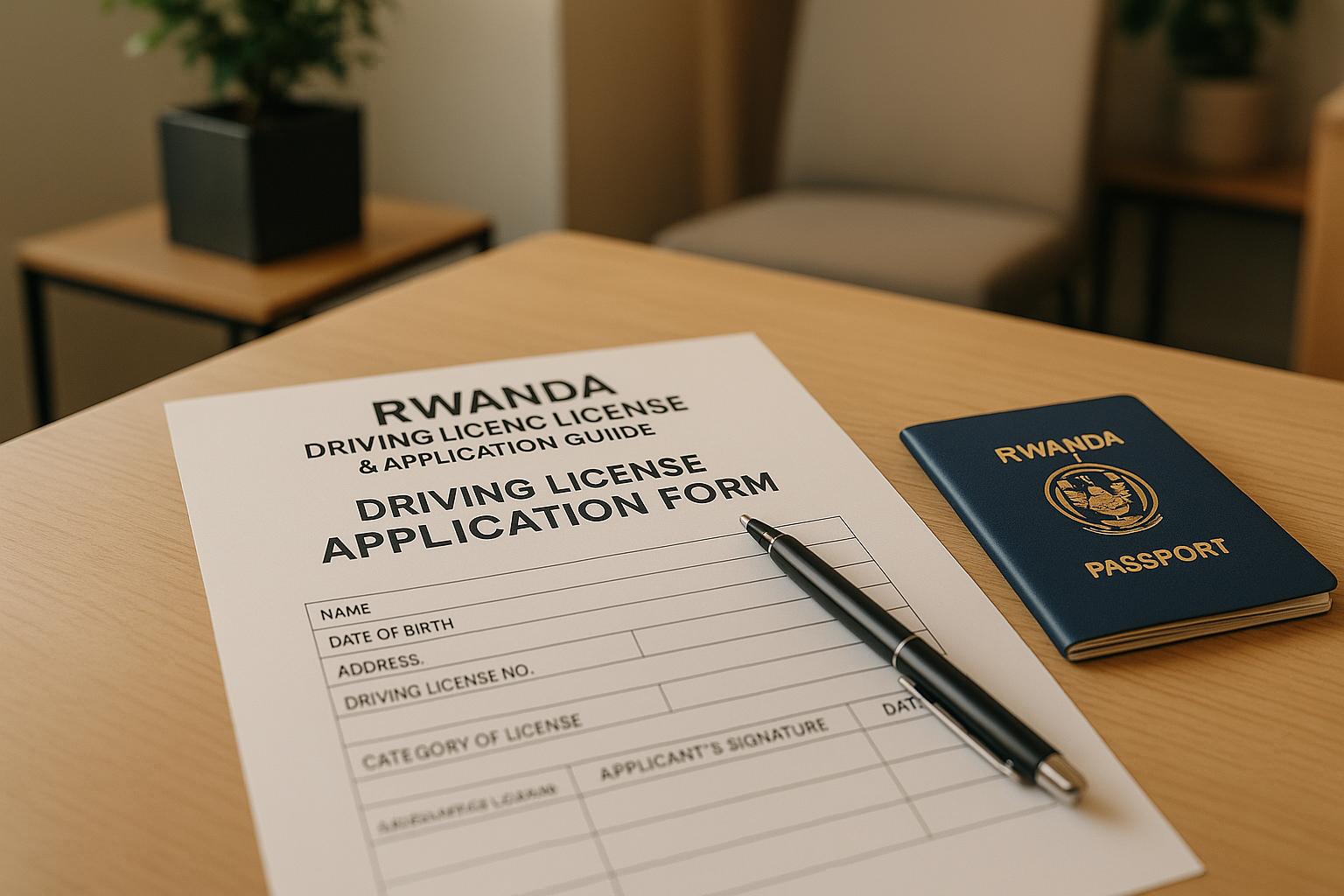
Navigating the process of obtaining a driving license in Rwanda is straightforward, thanks to the IremboGov platform. Here’s what you need to know:
- Eligibility: You must be at least 16 years old to apply for a Provisional Driving License (PDL) and 18 for a Definitive Driving License.
- Steps:
- Pass a theoretical test (minimum score: 60%).
- Apply for an e-Provisional Driving License (RWF 10,000 or ~$7.40).
- Complete driving school training.
- Pass the practical driving test.
- Apply for a full license (RWF 50,000 or ~$37).
- Foreign License Holders: Valid for 12 months; conversion requires theoretical and practical tests.
- License Categories: Ranges from motorcycles (Category A) to large vehicles (Category D1) and specialized machinery (Category F).
- Renewals & Costs: Renewals or duplicates cost RWF 5,000 (~$3.70).
The entire process is digital, efficient, and user-friendly. Ensure you meet the age and document requirements, prepare thoroughly for tests, and follow traffic rules once licensed.
Rwandan Driving License | Do Foreigners Need One? | Where to get it 🚗
Who Can Apply for a Rwandan Driving License
To qualify for a Rwandan driving license, your eligibility hinges on your age and the type of vehicle you intend to drive. Here’s a breakdown of the age requirements for different license categories.
Age Requirements by License Type
If you’re 16, you can start with a Provisional Driving License (PDL). This license allows you to practice driving under supervision after passing a knowledge test. For independent driving, you’ll need a Definitive Driving License, which you can apply for at 18.
For Category A (motorcycles), Category B (passenger vehicles with up to 8 seats and a maximum weight of 7,716 pounds), and Category F (special machinery), the minimum age is 18. The same age applies to specialized categories like A1 and B1, which are designed for drivers with physical disabilities.
If you’re aiming to operate larger vehicles, the age requirement increases. For Category C (trucks over 7,716 pounds), Category D (buses carrying 9 to 30 passengers), Category D1 (buses transporting more than 30 passengers), or Category E (vehicles with trailers), you need to be at least 21 years old.
Once you meet the age requirement for your desired category, you can proceed to gather the necessary documents and register through the IremboGov platform.
Required Documents and Prerequisites
Get your paperwork ready through the IremboGov platform to ensure a smooth application process.
Document Checklist
The documents you’ll need depend on the stage of your application. For the theoretical test registration, you must bring valid identification to the testing center. Rwandan citizens should use their national ID, while foreign residents should present a passport.
Once you pass the theoretical test, you can apply for an e-Provisional Driving License (e-PDL) with minimal paperwork. At this stage, you’ll need the registration code you received during your exam registration. Providing a mobile number or email can also help you track your application. Keep in mind, you must apply for your e-PDL within two years of passing the theoretical test; otherwise, you’ll need to retake the exam.
Next, follow the steps to obtain your learner’s permit and move forward with your driving journey.
Getting Your Learner’s Permit
To start, you’ll need a Provisional Driving License (PDL). This requires passing a theoretical driving test that focuses on the Rwandan road code. Applicants must be at least 16 years old to take the test. The test can be computer-based or written, and a passing score is at least 60% (or 12 out of 20 at some centers). If you don’t pass on your first try, you can retake the test after paying the fee again.
Make sure to arrive early on test day and bring your identification. Once you pass, you can immediately apply for your e-PDL through the IremboGov platform. You can do this online at www.irembo.gov.rw or by using the USSD code *909#.
The PDL limits you to supervised driving practice. It’s a necessary step for enrolling in driving school, registering for a full license, and taking the practical driving exam.
Additional Requirements for Foreign License Holders
Foreign nationals and non-resident Rwandans can use their valid foreign driving license for up to 12 months. After that, you’ll need to apply for a Rwandan driving license.
If you hold a foreign license, you may need to pass both theoretical and practical tests to convert it. Additionally, carrying an International Driving Permit (IDP) is highly recommended. The IDP acts as a translation of your national license and must be used alongside your original license. Some sources suggest the IDP isn’t mandatory for international visitors, but others indicate it’s required for self-driving. Many car rental companies also request an IDP. An IDP is valid for up to one year.
If you plan to convert your foreign license, start the process before your 12-month grace period ends. Whether you’re a local or foreign applicant, having the right documents is essential for moving through each stage of the licensing process.
How to Apply for a Driving License: Step-by-Step
Got all your documents ready? Here’s how you can secure your driving license, step by step.
Step 1: Register for the Provisional Driving License (PDL)
Start by passing the theoretical driving test, which costs RWF 5,000 (around $3.70). After that, head over to www.irembo.gov.rw to register for your e-Provisional Driving License (e-PDL) for RWF 10,000 (approximately $7.40). This provisional license is your ticket to practicing driving under supervision and is a must-have before you can join a driving school.
Step 2: Complete Driving School Training
Once you have your provisional license, enroll in a driving school approved by RURA (Rwanda Utilities Regulatory Authority). These schools meet strict standards for both instructors and vehicles. Training cars are specially designed for learning – they come equipped with dual pedals, are marked with the school’s name, and have a blue "L" displayed on the rear. During your training, you’ll master essential driving techniques and safety practices through supervised sessions with your instructor, preparing you for the practical test.
Step 3: Pass the Practical Driving Test
After finishing your driving school training, it’s time to book your practical driving test. This test evaluates your ability to handle a vehicle safely in everyday traffic. Make sure to bring a roadworthy vehicle that meets all safety requirements. Show off your safe driving skills during the test, and if you don’t pass on the first try, consider additional practice before attempting it again.
Step 4: Apply for Your Full Driving License
Once you’ve passed the practical test, you can apply for your full driving license online. Use your valid PDL and proof of training to complete the application on www.irembo.gov.rw. You’ll need to provide your personal details, upload the necessary documents, and pay the required fee. Once processed, you’ll receive a notification when your physical license card is ready for pickup. Double-check your new license to ensure all the details, including the vehicle categories you’re authorized to drive, are accurate. If you spot any errors, contact the issuing authority immediately.
Next up, let’s dive into the different license categories, their costs, and how to handle renewals.
sbb-itb-7bc66b5
License Types, Costs, and Renewal
Understanding license categories and associated fees is key when preparing your application.
License Categories and Vehicle Types
Rwanda offers nine distinct license categories tailored to various vehicle types. Driving a vehicle outside your licensed category is a serious traffic violation.
- Category A: For motorbikes and motorcycles, available to drivers aged 18 or older.
- Category A1: Specifically for individuals with certain physical disabilities, allowing them to operate specially designed motorbikes and tricycles, also starting at age 18.
For cars:
- Category B: Covers standard cars carrying up to eight passengers (excluding the driver) and weighing no more than 3,500 kg.
- Category B1: Designed for drivers with disabilities who require modified vehicles.
For heavier vehicles:
- Category C: For vehicles weighing over 3,500 kg and up to 10 tons; applicants must be at least 21.
- Category D: Allows operation of vehicles carrying more than eight and up to 30 passengers, including the driver.
- Category D1: For larger passenger vehicles holding over 30 passengers, excluding the driver. Both categories require a minimum age of 21.
Additional qualifications:
- Category E: An add-on for holders of B, C, or D licenses, enabling them to tow trailers up to 750 kg. Applicants must be 21 or older.
- Category F: Covers specialized machinery such as farming equipment, road construction vehicles, and loading or lifting machines, available from age 18.
Make sure to choose the right category for your needs before starting your online application.
Application Fees and License Validity
Here’s a breakdown of the costs:
- e-Provisional Driving License: RWF 10,000 (approximately $7.40).
- Definitive License Application: RWF 50,000 (around $37).
- Category Upgrade: Adding a new vehicle category costs RWF 10,000.
- Duplicate License: Whether provisional or definitive, the fee is RWF 5,000 (about $3.70).
- Renewals: Also RWF 5,000 for both provisional and definitive licenses.
How to Renew or Replace Your License
Renewing or replacing your license is simple using Rwanda’s online system. Visit www.irembo.gov.rw, log in, and select the service you need – whether renewal or a duplicate. Provide the required details and pay the RWF 5,000 fee.
For renewals, you’ll be notified when your updated license is ready. For duplicates, specify the reason for replacement and submit any necessary documents. It’s important to renew on time to avoid penalties for driving with an expired license.
With a clear understanding of license categories and fees, you’re all set to explore the driving rules and safety guidelines for navigating Rwanda’s roads.
Driving Rules and Safety Tips in Rwanda
Once you’ve secured your license, knowing Rwanda’s traffic laws and safety measures is key to driving safely and avoiding fines. Here’s what you need to know to navigate the roads confidently:
Traffic Laws and Road Signs
In Rwanda, drivers stick to the right side of the road. The speed limit for both urban and rural areas is capped at 80 km/h (49 mph).
Safety Requirements and Penalties
To avoid fines, it’s important to comply with safety regulations. For instance, refusing a sobriety test comes with a hefty penalty of RWF 150,000 (about $111). Driving without a valid license or International Driver’s Permit (IDP) can cost you RWF 50,000 (around $37), while incomplete documentation results in a RWF 10,000 fine (approximately $7.40).
What to Do During Police Stops
Police checkpoints are a routine part of road safety in Rwanda. If signaled to stop by an officer, pull over safely, lower your window, and remain calm. Keep your hands visible and cooperative during the interaction.
You are required to provide all requested documents, so always carry your driver’s license, vehicle registration, and, if applicable, your IDP. Handing over your IDP first can indicate that you’re a foreign driver, which may make communication smoother.
"If you are traveling in a foreign country and are stopped by a law enforcement officer, your domestic driver’s license and IDP should be presented to the officer." – InternationalDrivingPermit
Not having an IDP could lead authorities to treat your situation as driving without a valid license, which might result in fines or even the seizure of your vehicle.
Conclusion
Getting your Rwandan driving license can be a smooth process with the right preparation. Once you make the payment, your e-Provisional License is issued immediately, while the definitive license is processed in just one day and ready for pickup within 14 days . If you’re converting a foreign license, the definitive license is typically issued within 10 days after completing the necessary tests.
The online system makes the process more efficient, but it also means being organized is key. Double-check that you have all the required documents before applying, and keep your phone number and email up-to-date to receive updates about your application. Make sure to arrive early for your tests and prepare thoroughly to improve your chances of passing on the first try.
Once you have your license, remember to carry it with you at all times, along with your vehicle registration and, if applicable, your International Driving Permit. Familiarize yourself with Rwanda’s traffic laws to avoid fines or other issues. By following these steps and preparing carefully, you’ll be ready to drive confidently and legally on Rwandan roads.
FAQs
What documents do foreign nationals need to convert their driving license in Rwanda?
If you’re planning to convert your foreign driving license in Rwanda, here’s what you’ll need to do. Start by filling out the application form, then gather the following documents:
- A copy of your proof of identity, such as a National ID card or resident card
- A copy of your valid foreign driving license (if it’s not in English, include a notarized translation)
Ensure all your documents are up-to-date and error-free to prevent any delays in processing your application.
What’s the best way to prepare for the written and practical driving tests in Rwanda?
To get ready for the written test, dedicate time to studying Rwanda’s road code in detail. Pay close attention to traffic signs, regulations, and rules. If sample questions are available, use them to understand the test format and practice your knowledge.
For the practical test, focus on building confidence by driving in different conditions, like heavy traffic or on various road types. Sharpen key skills such as parking, using signals correctly, and strictly following traffic rules. With thorough preparation and a calm mindset, you’ll be well-equipped to pass both tests.
What happens if I fail my driving test in Rwanda?
If you don’t pass your driving test the first time, you’re eligible for one free re-test. But here’s the catch – if you fail again, you’ll have to restart the entire application process and pay the necessary fees all over again. To avoid that, take some time to focus on the areas where you had trouble and make sure you’re fully prepared before your next attempt.
Related Blog Posts
- How to register a used car in Rwanda
- Rwanda Vehicle Registration: Tax and Duty Breakdown
- Car ownership transfer in Rwanda: expert tips for a smooth process
- Rwanda Traffic Rules: Full Guide for New Drivers