Rwanda is pushing for cleaner transportation to meet its 2050 carbon neutrality goals. The government has introduced financial incentives to make electric mobility more accessible for individuals and businesses. Key initiatives include grants, loans, tax exemptions, and subsidies to reduce costs and encourage private sector involvement. These efforts aim to cut emissions, create jobs, and improve public health. Here’s a summary of the main programs:
- Rwanda Green Investment Facility (RGIF): Offers $42.79M in grants and loans for clean transport projects, prioritizing private sector-led initiatives.
- E-Moto Project: Provides €16.8M for electric motorcycles, including subsidies for low-income and female operators.
- Ireme Invest: Grants up to $43,500 and low-interest loans for smart mobility projects.
- Tax Incentives: VAT exemptions and duty waivers for electric vehicle imports.
- Charging Infrastructure Support: Rent-free land and reduced electricity tariffs for EV charging stations.
- Blended Finance: Combines public funds and private loans to expand e-mobility infrastructure.
These programs are designed to make green transport more affordable and accelerate the adoption of electric vehicles in Rwanda.
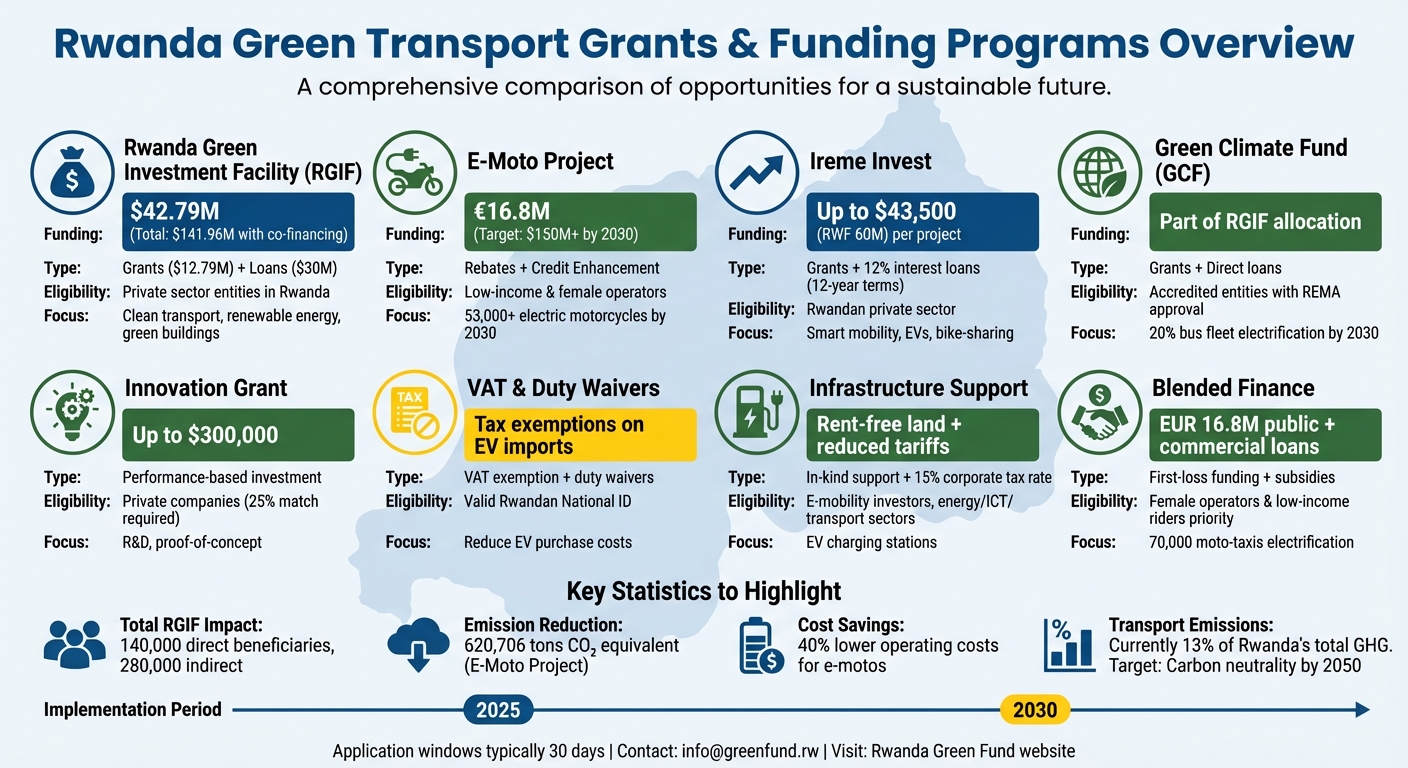
Rwanda Green Transport Grants Comparison: Funding Types, Amounts, and Eligibility
Rwandan government exempts Electric cars from Tax
1. Rwanda Green Investment Facility (RGIF) Clean Transportation Grants

The Rwanda Green Investment Facility (RGIF) is a significant funding source aimed at advancing clean transportation projects in Rwanda. Approved by the Green Climate Fund on October 25, 2023, and officially launched on October 31, 2025, this initiative brings $42.79 million in financing from the Green Climate Fund to support Rwanda’s green economy. With additional contributions from co-financing partners, the facility’s total value reaches an impressive $141.96 million.
Funding Amount and Types
RGIF offers two primary financing options to support projects:
- Grants: A total of $12.79 million in reimbursable grants is available to enhance project feasibility and reduce risks for private sector investors.
- Loans: An additional $30 million is allocated for project implementation through loans.
This two-tiered approach allows applicants to secure initial funding for developing their project concepts and then access further financial support for execution.
Focus Areas
Clean transportation is one of five key sectors eligible for RGIF funding. Other priority areas include renewable energy, climate-smart agriculture, water-efficient systems, and green buildings. The facility is specifically designed to support private sector initiatives that address market challenges and promote climate action. To qualify, projects must deliver measurable benefits in mitigating or adapting to climate change.
Eligibility Requirements
To be eligible for RGIF funding, your project must:
- Be implemented within Rwanda and align with the country’s Green Growth Climate Resilience Strategy.
- Be led by private sector entities, such as entrepreneurs or businesses, as the facility does not cater to government projects.
- Demonstrate a clear contribution to Rwanda’s low-carbon and climate-resilient economy goals.
The facility places a strong emphasis on projects with broad community impact, aiming to benefit 140,000 people directly and 280,000 indirectly. This makes initiatives with far-reaching social and environmental benefits particularly appealing.
Application Process
The application process for RGIF funding is time-sensitive and requires careful preparation. Public Calls for Proposals are issued by the Rwanda Green Fund (FONERWA), with a one-month submission window. During this time, applicants must submit a Project Profile Document (PPD) that meets specific criteria.
Applications are reviewed in multiple stages:
- Initial evaluation by a Fund Management Team.
- Assessment by a Technical Committee.
- Final decisions made by a Fund Managing Committee.
Given the tight timeline, staying updated through FONERWA’s website is crucial. Ensure your application highlights how the funding will reduce risks or improve the technical and financial feasibility of your clean transportation project. Proper planning and attention to detail can significantly improve your chances of securing this valuable support.
2. Rwanda Green Fund (RGF) E-Moto Project Financing
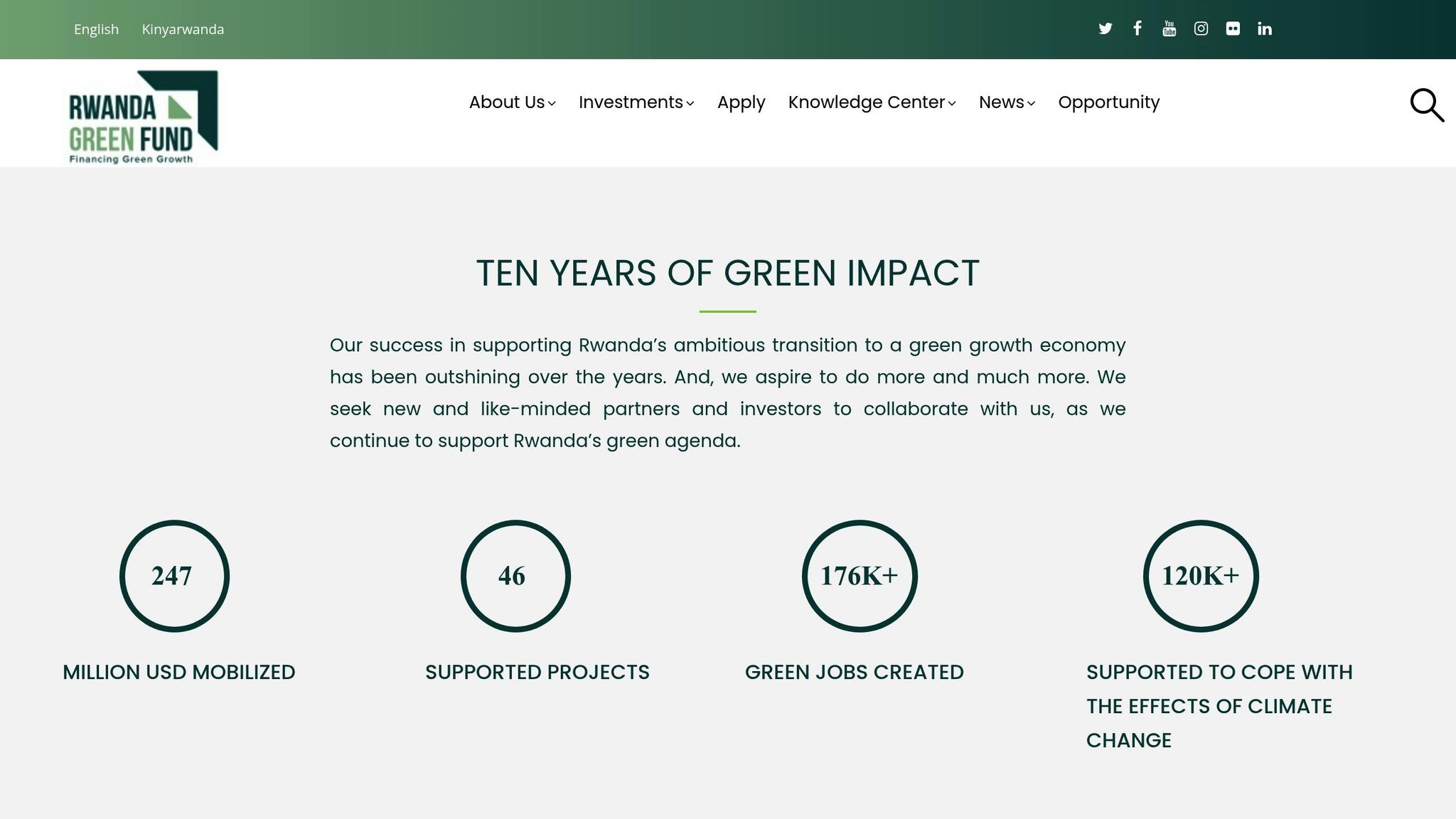
The Rwanda Green Fund’s E-Moto Project is set to invest €16.8 million to encourage the adoption of electric motorcycles across Rwanda. Between 2025 and 2030, the initiative aims to generate over $150 million in total financing and introduce more than 53,000 electric motorcycles to operators. Considering Rwanda’s taxi market, which includes about 70,000 motorcycles, this project addresses financial hurdles while promoting a shift toward electric mobility. It aligns with Rwanda’s broader efforts to advance sustainable urban transportation.
Funding Amount and Types
The project offers two key financial supports:
- E-Moto Rebate Scheme: Provides direct subsidies to lower the upfront costs for low-income and female operators.
- E-Moto Credit Enhancement Facility: Hosted by the Development Bank of Rwanda, this facility offers first-loss guarantees to encourage private lending from commercial banks and microfinance institutions.
These measures aim to make electric motorcycles more accessible while fostering private sector involvement.
Focus Areas
The project prioritizes three main areas:
- Electric Motorcycle Deployment: Expanding the availability of e-motos.
- Charging Infrastructure: Building the necessary network to support e-motos.
- Battery Waste Management: Ensuring proper disposal and recycling of used batteries.
Electric motorcycles are not only eco-friendly but also economical. They reduce operating costs by 40% compared to gasoline-powered bikes and have the potential to double operator incomes. Environmentally, the project is expected to cut greenhouse gas emissions by approximately 620,706 tons of CO₂ equivalent by the time it concludes. These efforts directly support Rwanda’s push for cleaner transportation and reduced emissions.
Eligibility Requirements
Funding is awarded through competitive public Calls for Proposals managed by FONERWA, following a structured evaluation process. The rebate scheme focuses on assisting low-income individuals and women, ensuring that underserved groups benefit from the green transition.
Application Process
Applications are accepted during a 30-day submission window. As of late 2025, the project is in its initial implementation phase, with full operations and fund disbursement planned for February 2026. Interested applicants should regularly check the Rwanda Green Fund website for Calls for Proposals and prepare comprehensive project concepts that highlight environmental benefits, especially carbon emission reductions.
3. Ireme Invest Low-Interest Loans and Grants
Ireme Invest operates with a dual funding model aimed at boosting Rwanda’s private sector involvement in green transport projects. First, the Project Preparation Facility, managed by the Rwanda Green Fund, provides grants to help projects progress from initial feasibility studies to becoming investment-ready. Second, the Credit Facility, run by the Development Bank of Rwanda, offers low-interest loans at a 12% rate, with repayment terms extending up to 12 years. Qualified businesses can receive grants of up to Rwf 60 million (approximately $43,500). This two-pronged approach builds on earlier efforts to simplify both project development and financing.
Focus Areas
The program emphasizes Smart Mobility solutions, such as electric vehicles, bike-sharing systems, and intelligent transport infrastructure. In October 2024, IZI Electric and Basigo successfully secured funding through this initiative to expand their operations, each targeting a fleet of 100 buses. At the time, IZI Electric operated 7 e-buses, while Basigo had 6 in service. The initiative is specifically designed to tackle transport emissions, which currently contribute 13% of Rwanda’s total greenhouse gas emissions.
Eligibility Requirements
To align with its funding goals, the program has specific eligibility criteria. Applicants must be based in Rwanda and demonstrate how their business aligns with the country’s climate objectives. Projects should support national climate strategies, including Rwanda’s National Strategy for Transformation (NST2) and the Paris Agreement. Additionally, the evaluation process gives significant weight to the technical and managerial expertise of the team behind the project.
Application Process Complexity
The application process follows a structured six-step framework, starting with account registration on the Ireme Invest online portal. All submissions must be completed online. After an initial eligibility screening, 30 businesses move forward for detailed appraisal, with 10 ultimately selected to receive grant funding. The final stage features a "Demo Day", where businesses can showcase their projects to attract further investment. Applicants are required to submit detailed documentation that clearly connects their business model to Rwanda’s climate goals. For assistance, you can reach out via email at [email protected] or [email protected].
4. Green Climate Fund (GCF) Through Development Bank of Rwanda (BRD)
The Green Climate Fund (GCF) channels international climate funding into Rwanda’s green transport sector through the Rwanda Green Investment Facility (RGIF). Approved in October 2023, RGIF officially kicks off its implementation on October 31, 2025. This initiative aims to eliminate market barriers that discourage private sector investment in climate-focused projects, reinforcing Rwanda’s mission to establish a low-carbon transport system. The African Development Bank (AfDB) serves as the accredited entity, while the Rwanda Environment Management Authority (REMA) acts as the National Designated Authority, collaborating with the Development Bank of Rwanda (BRD) to oversee fund management. Together, they set the stage for targeted financing strategies, outlined below.
Funding Amount/Type
RGIF operates through two key funding mechanisms: one provides grants and reimbursable grants to enhance project feasibility and make concepts financially viable, while the other offers direct loans for green projects that are ready to be executed. The initiative benefits from an additional $99,162,898 in co-financing, bringing the total project value to approximately $141,955,898. This co-financing not only expands the program’s reach but also attracts private sector contributions, bolstering the viability of supported projects.
Focus Areas
Clean transportation is a top priority for RGIF, alongside sectors like renewable energy and green buildings. The fund specifically backs projects that either mitigate climate change – such as reducing emissions through electric vehicle adoption – or adapt to its impacts, like developing resilient transport infrastructure. One of the program’s key goals is to electrify 20% of Rwanda’s bus fleet by 2030, aligning with the nation’s broader sustainability objectives.
Application Process Complexity
Although the institutional groundwork for RGIF was extensive – spanning 1,357 days from the initial concept note in February 2020 to board approval in October 2023 – the application process for individual developers is designed to address the hurdles that often deter private investment in Rwanda’s climate projects. The process encourages developers to start with grants for feasibility studies, which can pave the way for access to larger loans. To improve the chances of success, applicants are advised to consult with REMA or BRD to ensure their projects meet GCF’s specific criteria and cross-cutting requirements. This streamlined approach reflects Rwanda’s broader efforts to attract private sector involvement in green initiatives.
5. Ecofleet Solutions Electric Bus Subsidies
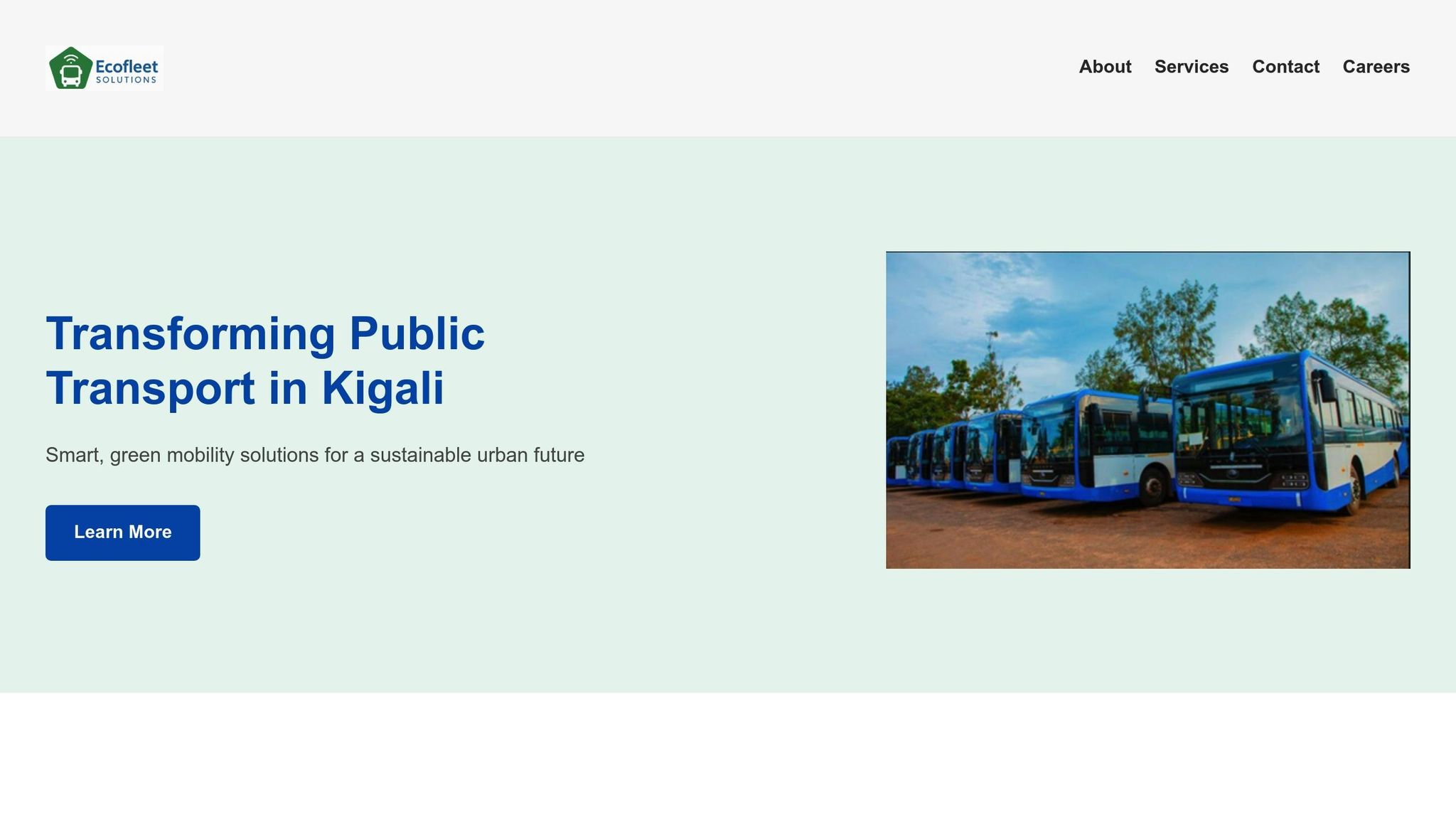
Ecofleet Solutions, a green mobility provider based in Kigali, plays a role in advancing e-mobility in Rwanda. While Ecofleet itself doesn’t run a subsidy program, electric bus operators and investors can take advantage of various government incentives designed to encourage the adoption of electric vehicles.
Eligibility Requirements
To qualify for these government incentives, electric bus operators must meet specific criteria. For instance, Rwanda offers a reduced corporate income tax rate of 15% to operators in the electric bus sector.
Funding Amount/Type
Subsidies for electric buses are accessible through the Rwanda Green Fund (FONERWA). These funds are distributed via public Calls for Proposals, which typically have a one-month submission period. In addition, private companies can apply for Innovation Grants – performance-based funding aimed at supporting green transport projects that demonstrate viability.
Focus Areas
The subsidy program doesn’t stop at electric buses. It also extends to electric motorcycles and charging station infrastructure. This comprehensive approach ensures that both the vehicles and the supporting infrastructure receive the financial support needed to make e-mobility a practical reality.
sbb-itb-7bc66b5
6. VAT Exemptions and Duty Waivers on EV Imports
Rwanda has rolled out tax incentives aimed at making electric vehicles (EVs) more affordable for both individuals and businesses. By offering VAT exemptions and reduced import duties, the government is actively lowering the financial barriers to EV adoption.
Eligibility Requirements
To take advantage of these tax benefits, applicants need a valid Rwandan National ID (or a child application number for minors) and an active email address to receive notifications and e-certificates. Applications are handled through the IremboGov platform, which streamlines government services for traffic-related matters. These incentives, alongside the financial grants mentioned earlier, directly cut down the cost of purchasing EVs.
Funding Amount/Type
Rather than providing direct cash grants, this initiative reduces the upfront costs associated with importing EVs. The resulting savings make it easier for individuals and businesses to transition to electric mobility, easing the financial strain of such a shift.
Focus Areas
These tax incentives align with Rwanda’s larger push toward green, sustainable transportation. They are a cornerstone of the country’s efforts to promote electric mobility as part of its environmental strategy. For those looking to explore EV options, AUTO24.rw offers a wide range of listings, featuring various brands and models available in Rwanda. This initiative underscores Rwanda’s dedication to making sustainable transport more accessible and affordable for everyone.
7. Industrial Tariffs and Rent-Free Land for EV Charging Stations
Rwanda’s government is taking proactive steps to tackle the challenges of building EV charging networks. By offering rent-free access to government-owned land and reduced industrial electricity tariffs, they aim to lower costs and encourage private sector involvement. These measures work hand-in-hand with earlier financial grants and subsidies, making it easier for businesses to invest in e-mobility infrastructure.
Eligibility Requirements
This program is open to e-mobility investors and companies operating in sectors like energy, ICT, and mass transportation. Rwanda’s e-mobility ecosystem already includes several active players, with the Rwanda Development Board (RDB) serving as the main contact point for businesses interested in participating in this initiative.
Funding Amount/Type
Instead of direct cash grants, the program focuses on infrastructure support. Eligible businesses gain access to rent-free land and reduced industrial electricity tariffs, which are notably lower than standard commercial rates. Additionally, investors can benefit from a reduced corporate income tax rate, further easing the financial burden of setting up EV charging stations.
"The incentives will also play a role to mobilize investment into the e-mobility sector which has fast emerged as a top sector on demand."
– Eng. Alfred Byiringiro, Director General for Transport
Application Process Complexity
To get started, businesses need to connect with the RDB, which manages these e-mobility initiatives. The process includes coordinating with the RDB and obtaining a "No Objection" letter from REMA by submitting a project concept note.
8. Blended Finance for E-Mobility Infrastructure
Rwanda is stepping up its efforts to expand e-mobility infrastructure by turning to blended finance. This approach mixes public funds with commercial loans, making it more appealing for private investors. By reducing risks for banks and easing access to capital for businesses and operators, Rwanda is creating a supportive environment for investments in electric vehicles and charging networks. This initiative works alongside the country’s existing grants and subsidies aimed at speeding up the transition to electric mobility.
Funding Amount and Type
In 2025, Rwanda launched the "Accelerating the Deployment of E-Motos in Rwanda" project, which combines EUR 16.8 million (approximately $18.2 million) of public funds with commercial lending. Set to run through 2030, the project employs three key financial tools: first-loss funding through the E-Moto Credit Enhancement Facility, direct subsidies via the E-Moto Rebate Scheme to reduce upfront costs, and technical assistance to bolster policy and infrastructure development. Together, these mechanisms lower risks and improve funding opportunities for e-mobility projects, aligning with Rwanda’s broader goals to cut emissions.
Focus Areas
The program zeroes in on electrifying moto-taxis, which are a cornerstone of Rwanda’s transport system. Moto-taxis account for half of the country’s vehicle fleet, with around 110,000 motorcycles in operation. Of these, an estimated 70,000 moto-taxis are expected to switch to electric models. The initiative also prioritizes expanding the charging infrastructure and ensures equitable access by focusing on female operators and low-income riders. Organizations like ICLEI Africa and GlobalDF provide technical guidance to smooth the transition. This targeted strategy simplifies the application process for stakeholders.
Application Process
The Rwanda Green Fund oversees a detailed, multi-step screening process for funding applications. A Fund Management Team and Technical Committee evaluate submissions, with final decisions made by a Managing Committee. Applicants should prepare their Project Profile Documents well in advance, as submission windows are limited to one month. Female operators and low-income riders interested in the E-Moto Rebate Scheme should confirm they meet the eligibility requirements to benefit from available subsidies.
Grant Comparison Table
Below is a quick-reference table summarizing the key features of various grants and facilities discussed earlier.
| Grant/Facility | Eligibility Criteria | Funding Type | Focus Areas | Application Requirements |
|---|---|---|---|---|
| RGF Standard Grant | Public institutions and NGOs | Grant | Environment and climate change projects | Submit Project Profile Documents (PPDs) within the one-month call |
| RGF Innovation Grant | Private sector companies | Performance-based investment (up to $300,000) | R&D, proof-of-concept, demonstration | 25% match funding required |
| RGF Credit Line | Private sector companies | Low-interest loan at 11.45% | Climate-resilient development | 30% match funding required; demonstrate implementation capacity |
| Ireme Invest Grants | Rwandan private sector | Grants (up to RWF 60 million, approx. $58,000) | Smart mobility, waste, clean energy, agri-business | Online portal submission; align with Rwanda’s climate goals |
| E-Moto Rebate Scheme | Low-income and female motorcycle taxi operators | Subsidy/Rebate | Lowering e-moto down payments | Managed through E-Moto Technical Hub at Rwanda Green Fund |
| E-Moto Credit Enhancement | Commercial banks | First-loss funding (part of EUR 16.8 million project) | Risk mitigation for e-moto lending | Participation in credit facility program |
| Green Climate Fund (GCF) | Accredited entities with REMA No Objection letter | Various (grants/loans) | Large-scale mitigation/adaptation, including transport | Project concept note and No Objection letter from Rwanda Environment Management Authority |
| E-Mobility Tax Incentives | Registered e-mobility, energy, or mass transport firms | 15% corporate tax rate; VAT/duty waivers | EV imports and local production | Registration through Rwanda Development Board (RDB) |
| Infrastructure Support | EV charging station providers | Rent-free land; industrial tariffs | Charging infrastructure | Coordination with Ministry of Infrastructure and RURA |
Note: Keep in mind that Innovation Grants require 25% match funding, while Credit Lines require 30%. Ensure that your Project Profile Documents are prepared well in advance.
Conclusion
Rwanda’s green transport grants offer a practical way to ease financial challenges while delivering measurable environmental gains. These programs address funding obstacles that often hinder green projects, making it easier for initiatives to move forward. Whether you’re a motorcycle taxi operator looking for an e-moto rebate or a business aiming to build charging stations, the mix of grants, concessional loans, and tax breaks paves a clear path for progress. As Teddy Mpinganzima Mugabo, CEO of Rwanda Green Fund, aptly puts it:
"Achieving Rwanda’s ambitious climate action goals requires significant financial resources and engagement from all stakeholders".
To improve your chances of approval, make sure your Project Profile Documents are ready and that your proposal aligns closely with Rwanda’s green growth goals. Staying updated by regularly checking the Rwanda Green Fund and Ireme Invest websites is also key.
The combination of strong financial support and clear environmental advantages makes green transport a smart and forward-thinking investment. These efforts are driving Rwanda’s move toward a more sustainable transportation future. Take action now and be part of this transformative shift.
FAQs
Who is eligible to apply for grants from the Rwanda Green Investment Facility?
The Rwanda Green Investment Facility offers grants to public institutions in Rwanda, including both central and local government bodies. To be eligible, projects must align with at least one of Rwanda’s Nationally Determined Contributions (NDC) priorities. These include areas like climate-smart agriculture, renewable energy, and sustainable transport. Additionally, the grant amount requested must range between RWF 1,000,000,000 and RWF 5,000,000,000.
This funding aims to support projects that advance Rwanda’s climate objectives while promoting sustainable growth.
How does the E-Moto Project support low-income and female operators in Rwanda?
The E-Moto Project is an initiative aimed at speeding up the use of electric motorcycles in Rwanda by offering financial assistance and encouraging the creation of environmentally-friendly jobs. While the program seeks to make sustainable transportation more accessible, there isn’t much clarity on whether specific subsidies are available for low-income individuals or female operators.
If future updates include detailed guidelines or eligibility criteria for these groups, it could shed light on how the project directly supports them. For now, the effort reflects a broader dedication to promoting inclusive and environmentally conscious mobility options in Rwanda.
What are the tax benefits for importing electric vehicles into Rwanda?
Rwanda provides generous tax breaks for importing electric vehicles (EVs). Right now, EV imports benefit from 0% import duty and are entirely exempt from VAT, excise, and withholding taxes. These perks are set to last until June 30, 2028.
For EVs priced over $60,000, customs duties are completely waived. On the other hand, models costing $60,000 or less face a 25% tariff. These measures are designed to encourage the shift toward cleaner, more sustainable transportation options nationwide.
Related Blog Posts
- Rwanda EV Import Duty Exemptions Explained
- Carbon Offsetting in Rwanda: How It Works
- Rwanda’s ICE Vehicles: Carbon Emissions Impact
- EV Policy Updates for 2025/2025 in Rwanda