Purchasing a used car in Rwanda can be tricky if you’re unfamiliar with the process. Here are the key steps to avoid costly mistakes:
- Verify Ownership & Documents: Ensure the seller’s ID matches the registration card (Yellow Card). Check for tax arrears, unpaid fines, and legal claims (caveats) that can block ownership transfer.
- Inspect the Vehicle: Examine the car’s condition, from the exterior and interior to the engine. Look for signs of accidents, rust, leaks, or mechanical issues. Always test drive the car.
- Understand Costs: Factor in taxes, registration fees, and potential repairs. Use Rwanda Revenue Authority’s (RRA) valuation tools to confirm the car’s market value.
- Ownership Transfer: Complete the transfer via the RRA e-Tax portal. Ensure all fees are paid, including the FRW 60,000 transfer fee, and secure a notarized sale contract.
- Payment: Use traceable methods like bank transfers or mobile money for security. Avoid paying cash upfront.
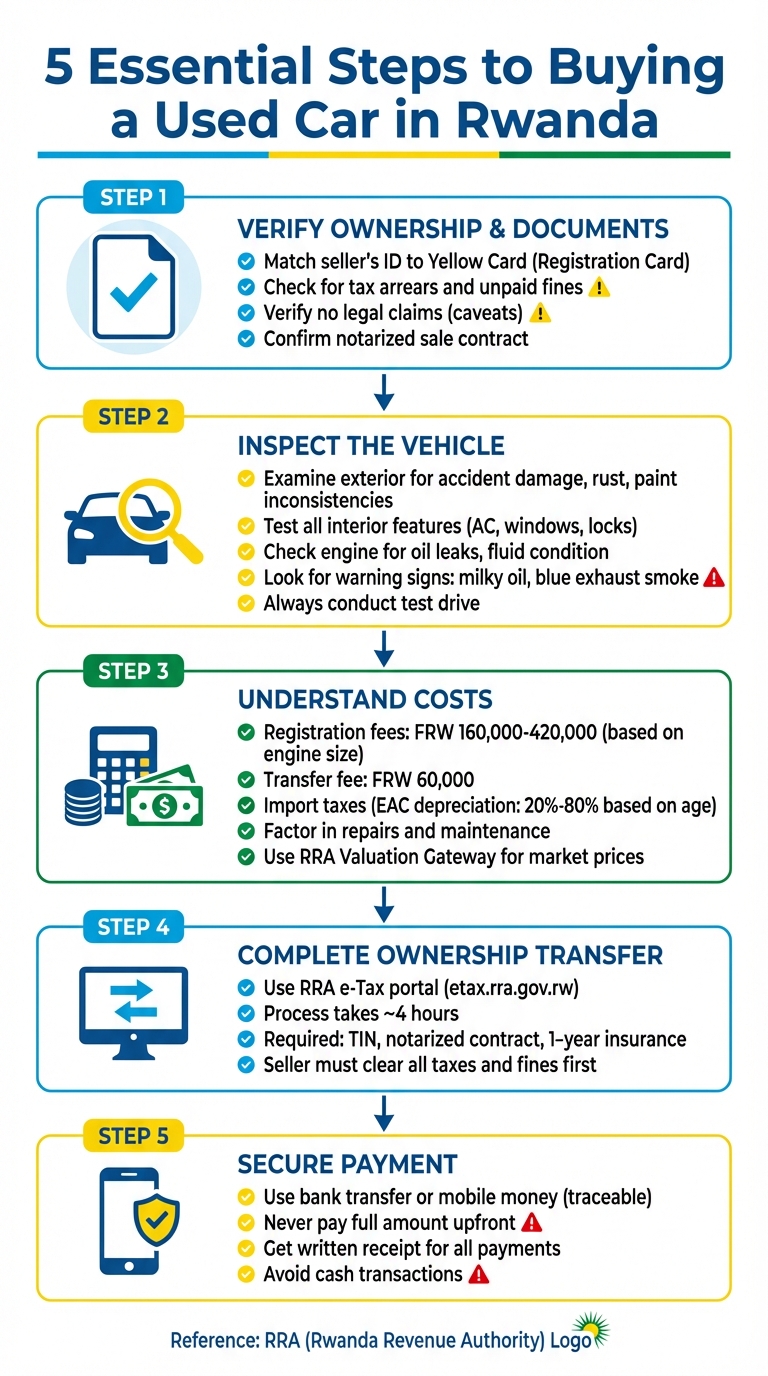
5-Step Guide to Buying a Used Car in Rwanda
Understanding Rwanda’s Used Car Market
Rwanda’s used car market operates through a variety of channels, each with its own pricing dynamics and legal considerations. Knowing where vehicles originate and what costs are involved can help you avoid unexpected expenses during the buying process. Here’s a closer look at the key aspects of this market.
Where Used Cars Come From in Rwanda
In Rwanda, used cars are sourced from several places, including private sales, government-run public auctions, and private auctions organized by court bailiffs, receivers, or large organizations like international NGOs. Many vehicles on the market are de-fleeted units from NGOs or international organizations, often identified by temporary plates such as IT, CD, UN, CMD, or RIT. If you’re purchasing one of these, be prepared for additional customs duties, which can significantly impact the final cost.
Other sources include inheritance and donations, but these transactions come with specific legal transfer requirements.
Understanding the origin of a vehicle is crucial, as it directly influences the depreciation and registration fees you’ll encounter. With this in mind, it’s important to consider the financial implications of Rwanda’s standardized vehicle cost system.
Import and Ownership Costs
Rwanda follows the East African Community (EAC) harmonized valuation system to calculate the taxable value of used vehicles. This system applies a depreciation schedule based on the car’s age. For example, vehicles used for 1–2 years are depreciated by 20%, while those used for 5–6 years see a 55% depreciation. The maximum depreciation rate is capped at 80% for vehicles older than 10 years.
In addition to the purchase price, buyers must pay a one-time registration fee, which varies by engine capacity. For instance:
- Vehicles with an engine capacity of 1,001–1,500cc incur a fee of 160,000 FRW.
- For engines between 3,001–4,500cc, the fee rises to 420,000 FRW.
You’ll also need to pay a fixed ownership transfer fee of 60,000 FRW. Before completing the transfer, ensure the seller has cleared any outstanding central, local, or customs taxes, as unpaid dues can block the transfer process.
Checking Current Market Prices
To ensure you’re paying a fair price, use the RRA Valuation Gateway, which provides official new vehicle prices. Apply the EAC depreciation rates to estimate the car’s current value based on its age. This can help you determine whether the seller’s asking price is reasonable.
For real-time market comparisons, check platforms like AutoMag.RW to see asking prices for similar models. Additionally, examine the vehicle’s Yellow Card (registration card) to verify important details like the year of manufacture and chassis number. These details are crucial for accurate valuation and price comparisons.
sbb-itb-7bc66b5
Checking Legal Ownership and Documents
Before diving into a vehicle’s condition, it’s essential to verify the legal ownership and documentation. Ensuring the seller has proper ownership is non-negotiable, especially with Rwanda’s automated ownership transfer system via the RRA’s E-Tax portal at etax.rra.gov.rw. If any documents are missing or appear suspicious, halt the transaction immediately.
Required Documents to Review
The Registration Card is your primary proof of ownership. The name on this card must exactly match the seller’s national ID or passport. Additionally, a notarized sale contract is required, detailing the date, location, vehicle value, and contact details for both parties. The seller must also provide a valid insurance certificate covering at least one year and a Technical Inspection Certificate (Control Technique) to confirm the vehicle is roadworthy.
It’s also crucial to ensure the seller’s RRA account has no outstanding tax arrears, as these can block the transfer process. For vehicles with temporary plates, check for proof of duty payment or tax exemption. Buyers must have their Taxpayer Identification Number (TIN) ready to complete the transfer.
Identifying Red Flags in Paperwork
Be cautious of tampered, scratched, or uneven chassis numbers – they’re major warning signs. If the seller claims to act on behalf of the owner but lacks a notarized Power of Attorney, make it a point to meet the registered owner.
Another critical area to check is for caveats – legal notices recorded with the RRA that can block a sale due to court orders, spousal claims, or unpaid loans. If the vehicle was used as collateral, the seller must provide a mortgage registration release from the Rwanda Development Board (RDB) before proceeding. For vehicles being reactivated after being declared "off-road", confirm the seller has the original suspension certificate and is covering costs for new plates and cards.
Be wary of deals that seem too good to be true, such as prices far below market value for popular models like the Toyota RAV4 or Suzuki Escudo. These often indicate fraud or hidden issues. Never hand over cash before verifying documents. Instead, use bank transfers or mobile money to ensure there’s a digital record of your transaction.
Document Checklist and Comparison Table
| Document to Review | What to Check | Red Flags |
|---|---|---|
| Registration Card (Yellow Card) | Matches seller’s ID and physical chassis number | Tampered numbers, mismatched names, or physical damage to the card |
| Sale Contract | Must be notarized; includes date, location, value, and signatures | Hand-written without notary stamp; missing seller/buyer TIN |
| RRA Tax Account | Seller must have zero tax liability | Seller refuses to show tax clearance or pushes for a quick sale |
| Customs Declaration | Required for IT, CD, UN, or CMD plates | Missing proof of duty payment when moving from exempt to non-exempt status |
| Insurance Certificate | Valid for one year; check historical info for commercial vehicles | Expired insurance or details that don’t match the registration card |
| Caveat Status | Check with RRA for any legal "caveats" or liens | Presence of a court order or legal notice blocking the transfer |
| Document Status | Observation | Recommended Action |
|---|---|---|
| Complete | Name on Yellow Card matches Seller’s ID; no tax arrears | Proceed with notarized contract and online transfer |
| Suspicious | Seller claims to be an agent but has no power of attorney | Insist on meeting the owner listed on the Yellow Card |
| Missing | Missing Customs duty proof for "IT" or "CD" plates | Do not pay until Customs duties are calculated and settled |
| Flagged | Vehicle has an active "caveat" or RDB mortgage | Stop the transaction until a legal release is provided |
Inspecting the Vehicle’s Condition
Once you’ve confirmed the legal documents are in order, it’s time to turn your attention to the vehicle itself. Paperwork can only tell part of the story, so a thorough inspection is essential to catch any hidden issues. Always inspect the car during daylight and on a dry day – rain and artificial lighting can mask defects like mismatched paint or body damage. If possible, bring along a trusted mechanic to spot mechanical problems that could cost you thousands down the road. Taking these precautions can help protect your investment and ensure the vehicle meets Rwanda’s safety and environmental standards.
Checking the Exterior and Body
Start by walking around the car and looking closely at its body. Uneven panels or gaps between doors and fenders could signal previous accident damage. Look for paint inconsistencies across panels; if you notice paint overspray on rubber seals around the hood or trunk, it’s a sign the car has been repainted. Press down on each corner of the car – if it bounces more than once, the shock absorbers may be worn out.
Inspect the tires for uneven wear patterns. "Cupped" tires, which have irregular wear marks, often point to problems with the shocks, brakes, or suspension. If you can, get underneath the car to check for split CV-joint boots leaking grease, fresh undercoating (which might be hiding structural repairs), or welding on the frame. Structural damage like frame welds or unibody kinks is a major safety concern and should be a deal-breaker.
Many vehicles imported into Rwanda come from Japanese auctions, so ask the seller for the original auction inspection sheet. Pay attention to "S" (rust) and "C" (corrosion) marks, which are followed by numbers 1–3 to indicate severity. A rating of S3, C3, or "Ana" (hole) suggests severe corrosion, which can be extremely expensive to repair.
Checking the Interior and Safety Features
Open all the doors and test everything inside the car. Make sure the seats, windows, sunroof, and door locks work smoothly. Turn on the air conditioning and heating to confirm they’re functioning properly. Pay attention to musty or moldy odors, especially in the trunk or spare tire compartment – these smells often indicate water leaks or flood damage.
"A musty, moldy, or mildewy smell could indicate water leaks… Some odors, such as mold and smoke, can be very hard to get rid of." – Jon Linkov, Deputy Auto Editor, Consumer Reports
Check the dashboard when you turn the ignition to the "on" position (without starting the engine). All the warning lights should briefly illuminate and then turn off. If lights like the check engine, ABS, or airbag warnings stay on, the car may have underlying issues that need professional attention.
Once you’re done with the interior, move on to inspecting the engine and other mechanical components.
Checking the Engine and Mechanical Parts
With the engine off, take a close look under the hood. Check for oil splatters, which could indicate leaks. Inspect the battery terminals for white or green corrosion, and squeeze the hoses and belts – they should feel firm and not show signs of cracking or softness. Pull out the dipstick and examine the oil; gritty oil suggests wear, while milky or foamy oil is a serious warning sign of a cracked engine block or blown head gasket.
Look at the transmission fluid, usually checked with a red dipstick. It should be pinkish and smell like oil. A burnt smell or visible metal particles could mean major transmission problems. Check the coolant in the overflow reservoir – it should be clean and brightly colored (green or orange). If you see oil floating in the coolant, it’s a sign of a leaky gasket or cracked cylinder head.
Start the engine and listen carefully. Knocking or rattling noises can indicate serious issues. While the engine idles, remove the oil filler cap – excessive fumes coming out suggest worn piston rings. Walk to the back of the car and inspect the tailpipe. A black, greasy residue inside means the engine is burning oil, while a dry, dark gray smudge is normal. Watch the exhaust smoke: blue smoke means the engine is burning oil, thick white smoke signals coolant leaks, and black smoke points to engine or fuel system problems.
How to Conduct a Test Drive
Never finalize a purchase without a proper test drive. Choose a route that includes a mix of smooth roads, bumpy streets, and a stretch where you can safely reach highway speeds. Listen for rattles or clunks when driving over rough patches – these noises often indicate suspension problems. The steering wheel should remain stable and centered; if it pulls to one side or vibrates during braking, the alignment may be off or the rotors could be warped.
Test the transmission by shifting through all gears. Shifts should feel smooth, with no knocking or hesitation. When stopped, press the brake pedal – it should feel firm, not spongy. Accelerate quickly to check the engine’s responsiveness and ensure no warning lights appear on the dashboard while driving.
"A mechanic helps detect hidden issues that may not be visible to an untrained eye, preventing costly mistakes." – AutoMag.rw
Consider paying for a professional pre-purchase inspection, which typically costs $100–$150. For safety, arrange to meet in busy, public areas like Remera or Nyabugogo in Kigali.
Refer to the table below to distinguish between minor issues that can be negotiated and major deal-breakers.
Minor Issues vs. Deal-Breakers Table
| Issue Category | Minor Issues (Negotiable) | Deal-Breakers (Avoid Purchase) |
|---|---|---|
| Engine | Dirty engine bay, old battery | Milky oil (head gasket failure), knocking sounds, heavy fumes from oil cap |
| Fluids | Low washer fluid, slightly old oil | Burnt transmission fluid, oil in radiator coolant |
| Exhaust | Surface rust on muffler | Blue or thick white smoke, heavy greasy residue in tailpipe |
| Body/Frame | Small scratches or stone chips | Uneven panels (accident damage), welding on frame, corrosion holes (Grade C3 or "Ana") |
| Mechanical | Worn wiper blades, minor belt squeak | Leaking CV joints, spongy brakes, vibrating steering wheel, split CV-joint boots |
| Interior | Worn seat fabric, minor stains | Musty smell (flood damage), non-functional airbags, stuck seat belts |
Calculating Total Cost and Environmental Impact
Once you’ve reviewed the legal documents and inspected the vehicle, it’s time to evaluate the total cost and its environmental impact. When buying a used car in Rwanda, it’s not just the sticker price you need to think about – there are additional expenses like taxes, registration fees, fuel, maintenance, and repairs. Rwanda’s tax policies are designed to discourage older, high-emission vehicles, with factors like age and engine size playing a big role in determining costs. A car that seems affordable upfront might come with extra fees that increase the total expense.
Estimating Total Ownership Costs
One of the first things to calculate is the import tax. Rwanda uses the EAC depreciation schedule, which determines a car’s taxable value by applying an age-based depreciation rate to its original price. This means the older the car, the lower its taxable value, but engine size also matters. Smaller engines (under 1,500cc) are taxed at a lower 5% excise duty, while larger engines (over 2,500cc) face a 15% excise duty. For instance, a Toyota Prado with a large engine will incur much higher taxes compared to a compact Toyota Vitz.
"The policy seeks to discourage importation of used cars and help cut on carbon emissions." – Raphael Tugirumuremyi, Commissioner for Customs, Rwanda Revenue Authority
Maintenance is another expense to plan for. Many used cars require upfront repairs – think new tires, engine servicing, brake replacements, or interior fixes – which can add hundreds of dollars to your initial costs. To avoid surprises, check the car’s service history and consult a mechanic to estimate future maintenance needs based on its mileage and condition. Models like the Toyota Corolla or Nissan X-Trail are popular in Rwanda, and their readily available spare parts help keep repair costs manageable over time.
Factoring in these costs ensures your purchase is financially sound and legally compliant.
Fuel Efficiency and Environmental Considerations
Fuel costs can quickly add up, especially since Rwanda increased fuel prices on November 8, 2025. The country’s hilly terrain and Kigali’s stop-and-go traffic make fuel efficiency a key consideration. Hybrid vehicles or fuel-efficient cars with technologies like regenerative braking can save you money in the long run. Driving habits also matter – speeding or rapid braking can lower fuel economy by 10%–40% in city conditions.
Look for features that improve fuel efficiency. For instance, Mazda’s SkyActiv engines enhance combustion, Honda’s Integrated Motor Assist combines electric and gasoline power, and Toyota’s Hybrid Synergy Drive is known for delivering impressive mileage in models like the Prius. A 2012 Toyota Prius, for example, emits just 89 g/km of CO₂, far less than older gasoline cars. However, with only 41% of vehicles in Rwanda passing local emission standards, confirm the car has cleared its mandatory Rwanda National Police emission inspection.
Good maintenance can also boost fuel efficiency. Using the right motor oil grade can improve mileage by 1%–2%, and properly inflated tires can increase it by up to 3%. During the test drive, check if features like eco-driving mode or variable valve timing are working. Keep in mind that real-world fuel efficiency often falls 15%–30% below the factory specifications, especially when driving on highways or steep roads.
To better understand how different vehicles stack up, here’s a comparison of fuel economy and emissions:
Comparison Table: Gas Cars vs. Eco-Friendly Options
| Vehicle Model | Engine/Technology | Est. Fuel Economy | CO₂ Emissions | Typical Price Range (USD) | Maintenance Notes |
|---|---|---|---|---|---|
| Suzuki Alto | 0.66L–1.0L Petrol | 24–26 km/l | <100 g/km | $3,000–$5,000 | Low parts cost; simple mechanics |
| Toyota Vitz | 1.0L–1.3L Petrol | 18–22 km/l | <110 g/km | $3,000–$6,000 | Popular in Rwanda; parts are easy to find |
| Mazda Demio | 1.3L SkyActiv | Up to 24 km/l | ~105 g/km | $6,000–$8,000 | Advanced fuel-saving technology |
| Honda Fit Hybrid | 1.5L IMA Hybrid | 25–27 km/l | <100 g/km | Under $6,000 | Lower fuel costs; potential battery upkeep |
| Toyota Prius | 1.8L Hybrid | Up to 26 km/l | 89 g/km | Under $8,000 | Great for city driving; reliable |
| Nissan Elgrand | 2.5L V6 Petrol | 9–11 km/l | Higher | $8,000+ | High fuel/tax costs; higher excise duty |
Hybrids like the Honda Fit Hybrid and Toyota Prius are becoming popular in Rwanda, especially with rising fuel prices and the growing network of EV charging stations from Kigali to Rubavu. While hybrids may cost more upfront, they can lead to substantial fuel savings over time, particularly for city driving. Just remember to account for potential battery replacement costs in older models and ensure local mechanics are equipped to handle hybrid systems.
Completing Payment, Ownership Transfer, and Final Checks
You’ve done the legwork – inspected the car, reviewed the paperwork, and crunched the numbers. Now it’s time to seal the deal. This final stage involves handling payment securely, ensuring the legal transfer of ownership, and completing a few last checks to make sure everything is in order.
Safe Payment Methods
Never hand over the full amount upfront. Stick to traceable payment options like bank transfers or mobile money, which provide a clear record of the transaction. A small deposit might be acceptable, but only after verifying the documents and getting a professional inspection. Always insist on a written receipt or formal agreement for every payment, detailing the amount, date, and signatures of both parties.
Before proceeding, confirm the seller has settled any outstanding taxes and traffic fines. These must be cleared to avoid complications during the transfer process.
Transferring Ownership and Registration
After payment is secured, the next priority is transferring ownership. As of October 16, 2023, all vehicle ownership transfers in Rwanda are handled online through the RRA e-Tax portal at etax.rra.gov.rw. The seller initiates the process, which typically takes about 4 hours. The fees are FRW 60,000 (roughly $44) for cars and FRW 30,000 (around $22) for motorcycles.
Make sure to have a notarized sale contract that includes the date, location, price, and contact details for both parties. As the buyer, you’ll need a Tax Identification Number (TIN). If you don’t already have one, you can obtain it from the RRA Motor Vehicle Unit at Dubai Port/Masaka. Additionally, securing a one-year insurance certificate is mandatory to complete the transfer. Once the transfer is approved, return the old number plates and the registration card (Yellow Card) to receive the new ones.
Important Tip: Don’t transfer ownership immediately after booking a technical inspection appointment. The system operates based on the vehicle’s license plate, and transferring ownership could require re-booking and paying again. If the vehicle’s inspection certificate (vignette) is still valid, keep a copy of the previous Yellow Card to justify the existing inspection.
Final Checklist and Responsibilities Table
Before signing off on the deal, use this checklist to ensure all tasks are completed and responsibilities are clear:
| Task | Responsible Party | Required Document/Action |
|---|---|---|
| Provide Original Log Book (Yellow Card) | Seller | Present original registration document |
| Clear Tax Arrears | Seller | Settle any outstanding tax obligations |
| Clear Traffic Fines | Seller | Pay all unpaid police fines |
| Draft & Notarize Sale Contract | Both | Include price, date, and signatures; must be notarized |
| Provide TIN & ID Copies | Buyer | Valid TIN and National ID or Passport |
| Pay Transfer Fees | Buyer | FRW 60,000 via the RRA system |
| Initiate Online Transfer | Seller | Submit transfer request via RRA e-Tax portal |
| Secure 1-Year Insurance | Buyer | Required for ownership transfer completion |
If you’re purchasing a vehicle with special plates like "IT", "CD", or "UN", be prepared to pay any due customs duties unless you hold the same diplomatic or tax-exempt status. For commercial vehicles such as taxis, historical insurance records may also be required during the transfer process.
Conclusion
Buying a used car in Rwanda requires careful preparation and attention to detail. From researching the market to thoroughly inspecting the vehicle, each step helps protect you from costly mistakes and potential scams. Always double-check that the seller’s ID matches the Yellow Card and confirm that all tax arrears have been cleared before moving forward.
Once all the paperwork is in order, proceed with a secure payment method and transfer the vehicle legally. The RRA e-Tax portal (etax.rra.gov.rw) streamlines the transfer process, but make sure you have all the required documents ready: a notarized sale contract, your TIN, and proof of at least one year of insurance coverage. Keep in mind the fixed transfer fee of FRW 60,000 (about $44). To ensure a safe and traceable transaction, opt for bank transfers or mobile money.
"The safest way to avoid scams is to understand the market before engaging with a seller." – AutoMag.rw
Be cautious with deals that seem too good to be true, such as prices far below market value or sellers pressuring you for quick payment. Always take the car for a test drive and have a trusted mechanic assess its condition to avoid unpleasant surprises.
For ongoing advice and updates, AutoMag.RW is a valuable resource. Visit their platform for inspection guides, safety tips, and expert assistance through their WhatsApp channel. With their support, you can make confident, informed decisions throughout your car-buying journey.
FAQs
What documents do you need to transfer car ownership in Rwanda?
To transfer car ownership in Rwanda, make sure you gather the following documents: a signed sale agreement, copies of ID for both the buyer and seller, and the buyer’s Tax Identification Number (TIN). You’ll also need the vehicle’s registration certificate (Yellow Card), proof of transfer fee payment, and a valid one-year vehicle insurance policy.
It’s important to review all documents carefully to ensure they are accurate and complete. This helps prevent any unnecessary delays in the transfer process.
How can I make sure a used car is legally owned and registered before buying it?
To ensure a used car is legally sound, start by examining the official registration documents (commonly known as the Yellow Card) and the ownership certificate to verify that the seller is the legitimate owner. Cross-check the Vehicle Identification Number (VIN) on the paperwork against the one on the car itself for consistency. Check with the Rwanda Revenue Authority to confirm there are no unpaid taxes, traffic fines, or other financial obligations tied to the vehicle. It’s also essential to obtain a notarized sale agreement signed by both the buyer and seller, along with valid identification from both parties. Lastly, make sure the car is completely free of liens or outstanding fees to avoid any legal headaches down the road.
What costs should I consider before buying a used car in Rwanda?
When purchasing a used car in Rwanda, the initial price tag is just one part of the equation. You’ll also need to budget for additional costs like taxes and duties, the ownership transfer fee, a one-year insurance policy, and the annual vehicle inspection mandated by the Rwanda National Police. These extra expenses typically add about 10–15% to the car’s price, depending on its value.
Then there are the ongoing costs to consider. Used cars in Rwanda generally range from 5,000,000–20,000,000 RWF (approximately $5,000–$20,000). However, older vehicles often come with higher maintenance needs, thanks to aging components and inconsistent service histories. Fuel costs are another factor, which will depend on the car’s fuel efficiency. If you’re leaning toward a hybrid or electric car, you’ll likely save on charging costs compared to traditional fuel-powered vehicles. Lastly, depreciation is a key consideration – used cars can lose anywhere from 20–70% of their value over time. By factoring in these recurring expenses alongside the purchase price, you’ll have a much clearer understanding of the total cost of ownership.
Related Blog Posts
- Where to buy a certified used car in Rwanda
- How to register a used car in Rwanda
- How to avoid scams buying a car in Rwanda
- Used Cars in Rwanda: Market Prices and Buying Tips