In 2026, fuel-efficient cars are essential in Rwanda, where gasoline costs 1,778.54 RWF per liter (about $1.35). Choosing the right car can reduce fuel expenses by up to 50%, especially for Kigali’s traffic and the country’s hilly terrain. This list highlights the top 10 cars that balance fuel savings, performance, and practicality for Rwanda’s roads.
Highlights:
- Toyota Prius Hybrid: Most efficient at 4L/100km (~58.8 MPG), ideal for city use.
- Toyota Corolla Hybrid: Versatile hybrid with 4.5L/100km (~52.3 MPG).
- Toyota RAV4 Hybrid: SUV with 5L/100km (~47 MPG), suitable for mixed terrain.
- Kia Sportage Hybrid: Mid-sized SUV offering 5.3L/100km (~44.4 MPG).
- Toyota Yaris Hybrid: Compact with 4.2L/100km (~56 MPG), great for city driving.
- Toyota Corolla (Petrol): Non-hybrid option at 7L/100km (~33.6 MPG).
- Nissan Note/March: Affordable compact cars with 6.5L/100km (~36.2 MPG).
- Hyundai Santa Fe Hybrid: Spacious SUV at 6L/100km (~39.2 MPG).
- BYD Atto 3 (EV): Electric SUV with ~15 kWh/100km, cutting fuel costs completely.
- Leapmotor T03 (EV): Compact EV with ~12 kWh/100km, perfect for urban commuting.
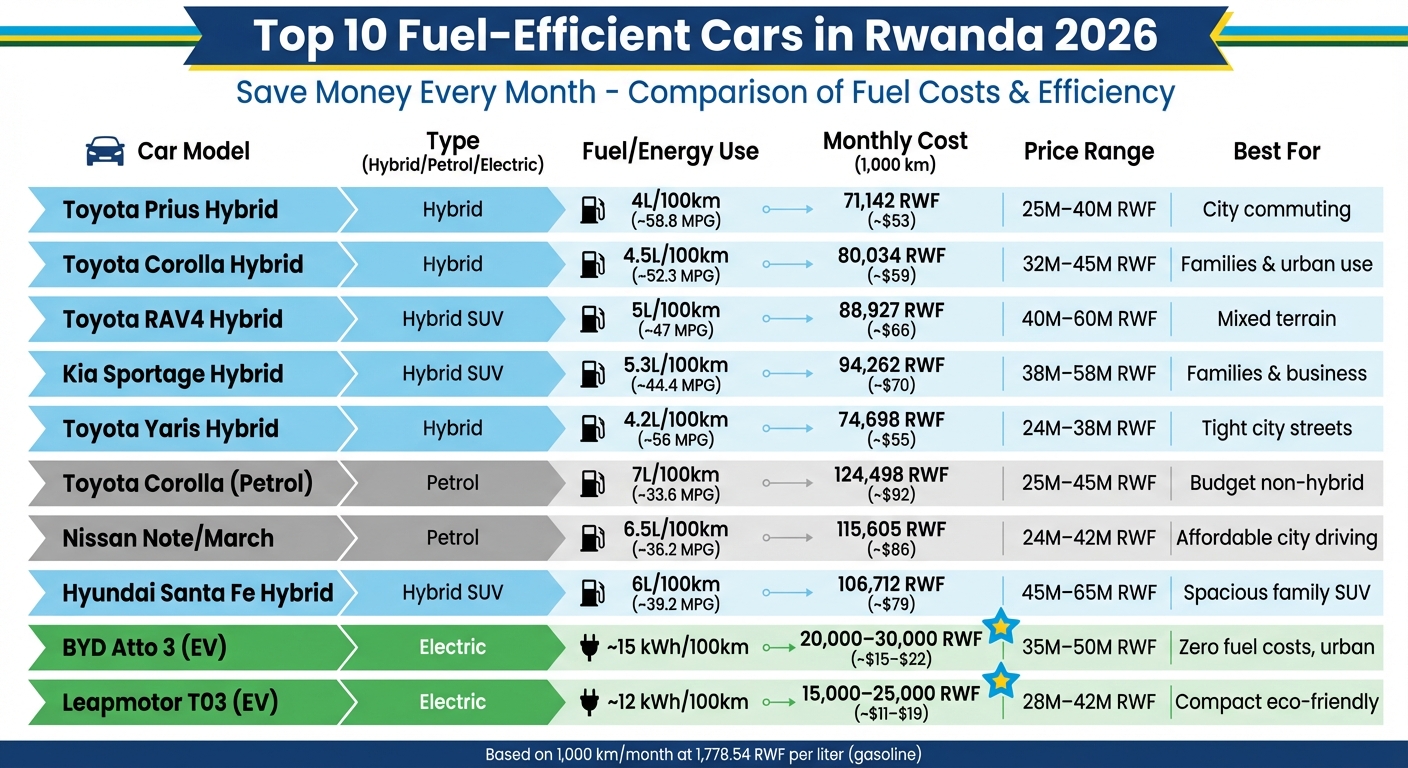
Quick Comparison Table
| Car Model | Type | Fuel/Energy Use | Monthly Cost (1,000 km) | Price Range (RWF) | Best For |
|---|---|---|---|---|---|
| Toyota Prius Hybrid | Hybrid | 4L/100km (~58.8 MPG) | 71,142 RWF (~$53) | 25M–40M | City commuting |
| Toyota Corolla Hybrid | Hybrid | 4.5L/100km (~52.3 MPG) | 80,034 RWF (~$59) | 32M–45M | Families & urban use |
| Toyota RAV4 Hybrid | Hybrid | 5L/100km (~47 MPG) | 88,927 RWF (~$66) | 40M–60M | Mixed terrain |
| Kia Sportage Hybrid | Hybrid | 5.3L/100km (~44.4 MPG) | 94,262 RWF (~$70) | 38M–58M | Families & business |
| Toyota Yaris Hybrid | Hybrid | 4.2L/100km (~56 MPG) | 74,698 RWF (~$55) | 24M–38M | Tight city streets |
| Toyota Corolla (Petrol) | Petrol | 7L/100km (~33.6 MPG) | 124,498 RWF (~$92) | 25M–45M | Budget non-hybrid option |
| Nissan Note/March | Petrol | 6.5L/100km (~36.2 MPG) | 115,605 RWF (~$86) | 24M–42M | Affordable city driving |
| Hyundai Santa Fe Hybrid | Hybrid | 6L/100km (~39.2 MPG) | 106,712 RWF (~$79) | 45M–65M | Spacious family SUV |
| BYD Atto 3 (EV) | Electric (EV) | ~15 kWh/100km | 20,000–30,000 RWF (~$15–$22) | 35M–50M | Zero fuel costs, urban use |
| Leapmotor T03 (EV) | Electric (EV) | ~12 kWh/100km | 15,000–25,000 RWF (~$11–$19) | 28M–42M | Compact eco-friendly option |
For city drivers, hybrids like the Prius and Yaris minimize costs, while EVs like the Leapmotor T03 eliminate fuel expenses entirely. SUVs such as the RAV4 Hybrid or Hyundai Santa Fe Hybrid are better for rougher terrain. Choose based on your budget, driving habits, and road conditions.
Top 10 Fuel-Efficient Cars in Rwanda 2026: Cost & Efficiency Comparison
1. Toyota Corolla Hybrid
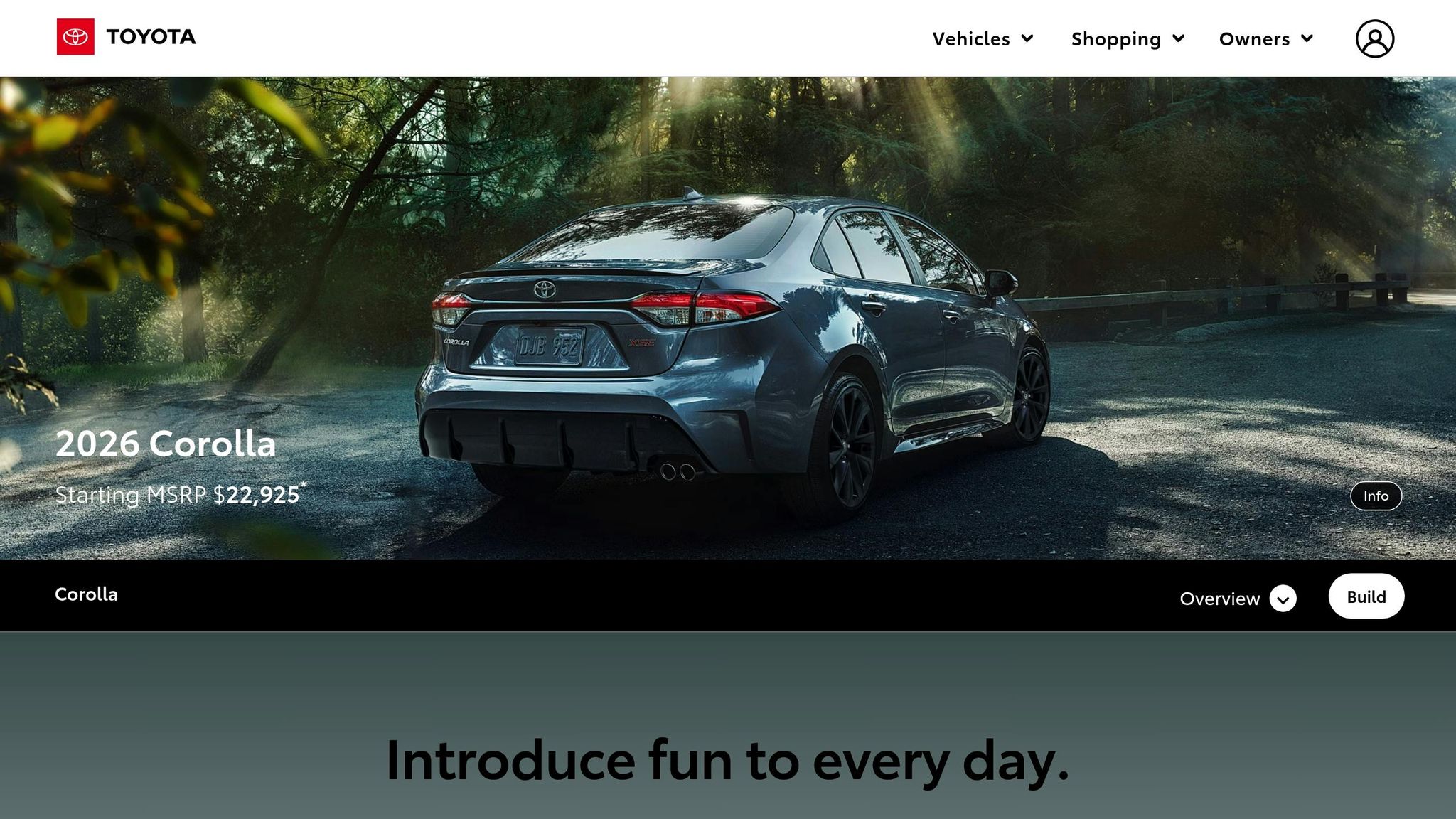
The Toyota Corolla Hybrid stands out as a top choice for fuel efficiency in Rwanda, especially in Kigali’s busy traffic. With an EPA-estimated 50 MPG combined (about 4.7 L/100 km), it offers excellent savings at the pump. The 2026 model goes even further, achieving 53 MPG in the city and 46 MPG on the highway – perfect for urban driving in Kigali. Below, we’ll break down its fuel consumption, costs, pricing, and overall suitability for local conditions.
Fuel Consumption (L/100 km and MPG)
The Corolla Hybrid is powered by a 1.8-liter engine paired with two electric motors, delivering a combined 138 horsepower. This setup achieves 4.4 L/100 km in city driving and 5.1 L/100 km on highways. Its "EV mode" allows short-distance driving on electric power alone, making it especially useful during heavy traffic, with zero fuel usage and near-silent operation. With a 43-liter fuel tank, the car can cover over 900 km on a single tank under mixed driving conditions.
Now, let’s explore what this means for your monthly fuel expenses.
Monthly Fuel Cost (RWF and USD)
With fuel prices in Rwanda currently at 1,778.54 RWF per liter, driving 1,000 km in a month would cost about 78,256 RWF ($61 USD). If you drive 1,500 km per month, the fuel expense rises to approximately 117,384 RWF ($91 USD).
Purchase Price Range (RWF and USD)
The starting price for the 2026 Corolla Hybrid is $24,775 USD for the base model, translating to around 32,400,000 RWF in Rwanda. While the initial cost is higher than non-hybrid alternatives, the long-term fuel savings can help offset the upfront investment.
Suitability for Rwandan Roads (Urban, Hilly, and Mixed Terrain)
With 138 horsepower and built on Toyota’s TNGA platform, the Corolla Hybrid handles Kigali’s hilly terrain and paved roads with ease. Its hybrid system, combined with the optional AWD trim, provides enough power for steep climbs and ensures agility in urban environments. The car’s 5.4-meter turning radius is ideal for navigating narrow city streets, and Toyota’s reputation for durability ensures affordable maintenance and easy access to spare parts throughout Rwanda.
2. Toyota Prius Hybrid
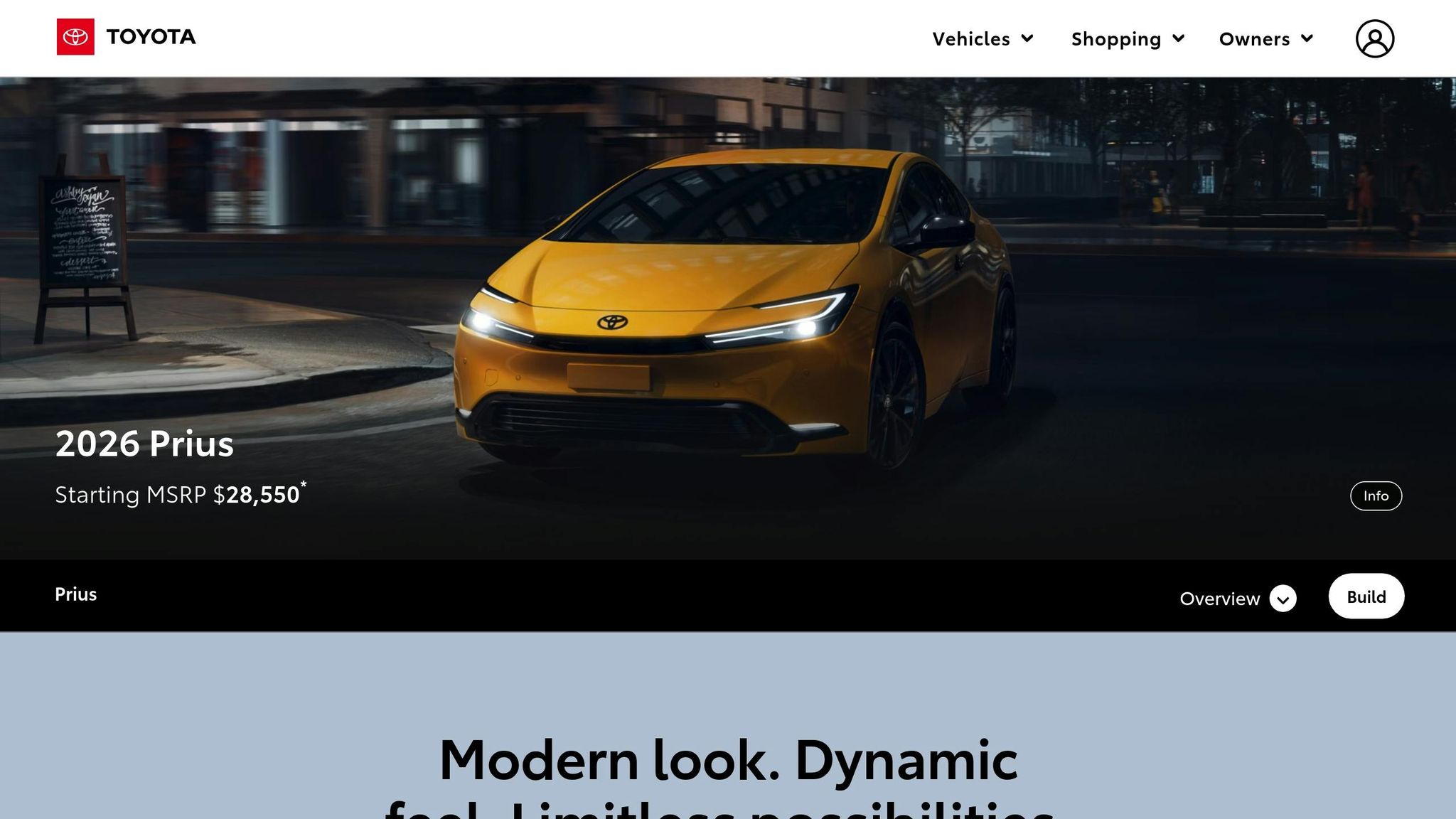
The Toyota Prius Hybrid is a standout choice for fuel efficiency in Rwanda. With a fuel consumption rate of about 4 L/100 km (equivalent to 57 MPG combined), it’s a great option for city commuters and rideshare drivers navigating Kigali’s streets. The 2026 Prius features a fifth-generation 2.0-liter hybrid system, delivering 196 horsepower in AWD and offering an EV mode for slow-moving, traffic-heavy situations.
Fuel Consumption (L/100 km and MPG)
The base LE FWD trim achieves an impressive 57 MPG (roughly 4.1 L/100 km). Meanwhile, the XLE and Limited trims with AWD provide slightly lower figures, around 52–54 MPG (approximately 4.4–4.5 L/100 km). The EV Mode allows the car to operate on battery power alone for short distances, making it especially useful in stop-and-go traffic. These fuel efficiency figures can significantly cut down on monthly fuel costs.
Monthly Fuel Cost (RWF and USD)
Given the current fuel price of 1,778.54 RWF per liter, driving 1,000 km a month would require about 40 liters of fuel, costing approximately 71,142 RWF (around $55 USD). For those covering 1,500 km monthly, fuel consumption rises to about 60 liters, translating to a cost of roughly 106,712 RWF (around $82 USD).
Purchase Price Range (RWF and USD)
The 2026 Prius starts at $28,550 USD for the base LE trim, which is about 39.4 million RWF. The XLE trim is priced at $31,995 USD (around 44.2 million RWF), while the Limited trim costs $35,565 USD (approximately 49.1 million RWF). For those considering used options, 2024 Prius models are available for $24,200 to $25,400 USD (roughly 33.4 to 35.1 million RWF). While the Prius may have a higher upfront cost compared to some other hybrids, its excellent fuel economy can help offset these expenses over time.
Suitability for Rwandan Roads (Urban, Hilly, and Mixed Terrain)
The Prius is best suited for paved urban roads, where its low center of gravity and available AWD enhance handling on hilly or winding routes. The Electronic On-Demand AWD system kicks in automatically to provide extra traction on steep or slippery surfaces. However, its lower ground clearance makes it less ideal for rough or unpaved rural roads, where hybrid SUVs might perform better.
3. Toyota RAV4 Hybrid
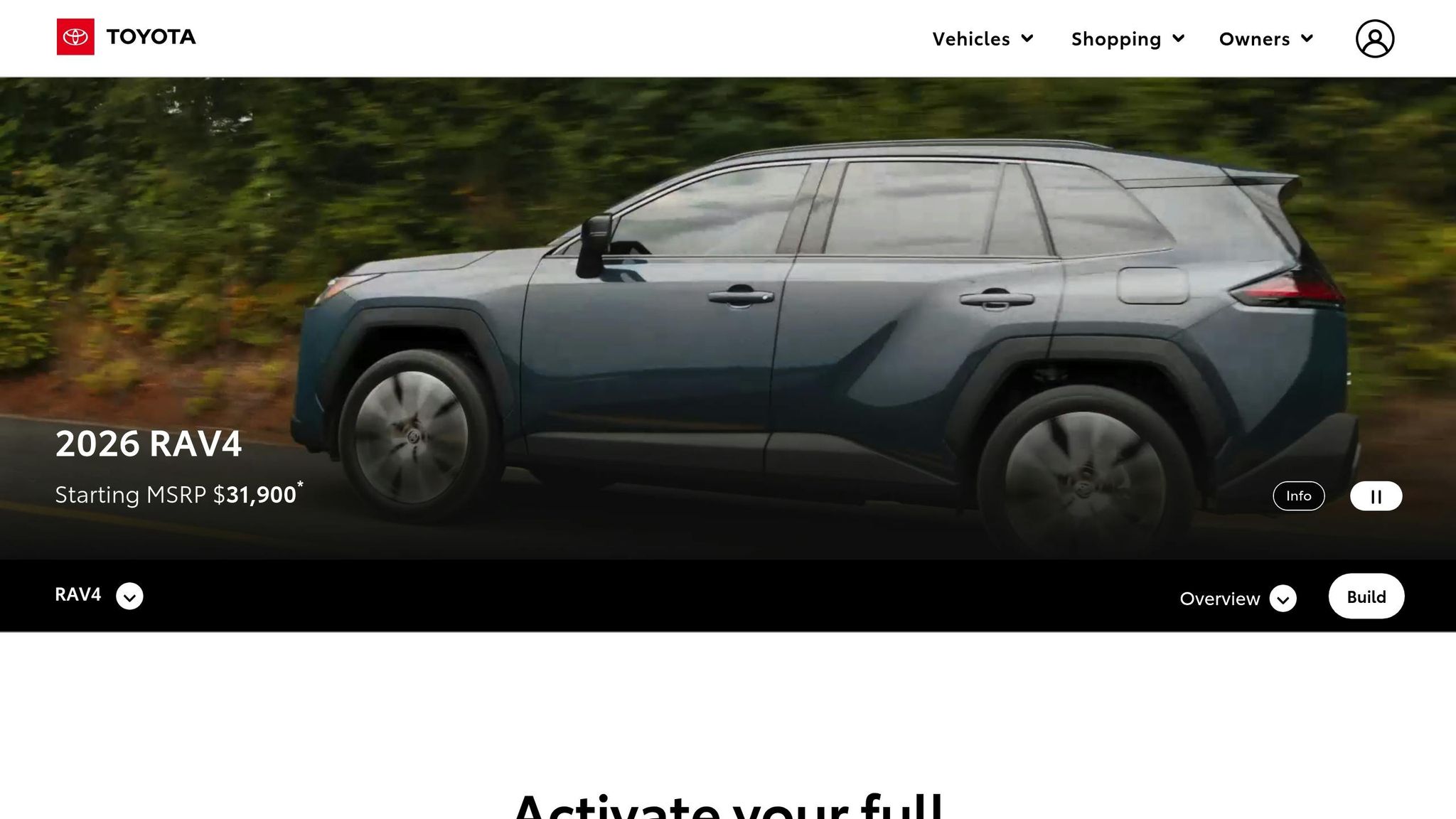
The Toyota RAV4 Hybrid continues Toyota’s legacy of blending fuel efficiency with SUV practicality, making it an excellent choice for Rwanda’s diverse terrain. Equipped with the 5th Generation Toyota Hybrid System (THS 5), it features a 2.5-liter 4-cylinder engine that delivers a combined 236 horsepower. Every trim level comes standard with Electronic On-Demand All-Wheel Drive (AWD), ensuring reliable performance across varying road conditions.
Fuel Consumption (L/100 km and MPG)
The 2026 RAV4 Hybrid is designed to be fuel-efficient, consuming between 5.5 and 6.2 liters per 100 kilometers. This translates to approximately 39 MPG (US) or 51 MPG (Imperial). The LE AWD trim stands out with the best city fuel efficiency at 5.1 L/100 km, while the Woodland Edition, equipped with off-road tires, uses slightly more fuel at 6.2 L/100 km. Features like regenerative braking and electric assist make it especially efficient in urban settings.
Purchase Price Range (RWF and USD)
Pricing for the RAV4 Hybrid varies depending on the trim:
- LE AWD: 42,834,900 RWF ($33,465)
- XLE AWD: 44,734,480 RWF ($34,950)
- Limited AWD: 53,282,590 RWF ($41,625)
For those considering a pre-owned option, used 2021 models start at 36,041,700 RWF.
Suitability for Rwandan Roads
With a ground clearance ranging from 206 to 216 mm (8.1–8.5 in), the RAV4 Hybrid handles both paved streets and gravel roads with ease. Its electronic AWD system ensures steady traction on hilly terrain and wet rural paths, while the hybrid engine excels in stop-and-go traffic. The vehicle also offers a spacious 580-liter trunk and comfortable seating for five, making it perfect for family trips or long journeys across Rwanda.
4. Kia Sportage (Including Hybrid Trims)
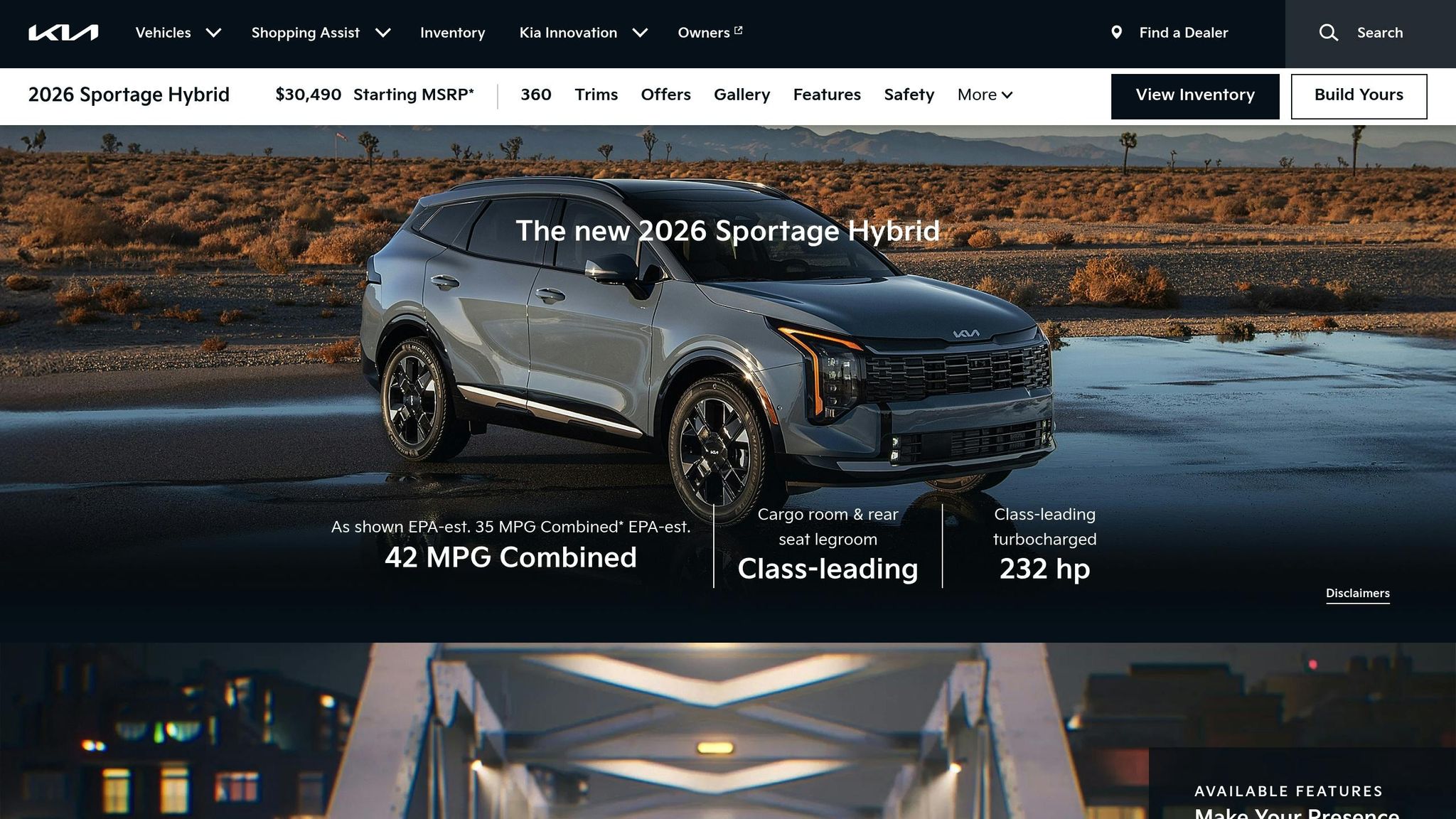
Building on Toyota’s success in offering efficient and versatile vehicles, the Kia Sportage provides another strong option for drivers navigating Rwanda’s diverse terrains. The Sportage lineup includes both gasoline and hybrid models, blending performance with fuel-saving technology. The 2026 Sportage Hybrid pairs a 1.6L turbocharged engine with an electric motor to produce 231 horsepower, while the non-hybrid LX trim comes equipped with a 2.5L inline-4 engine delivering 187 horsepower. For those seeking even more power and efficiency, the plug-in hybrid (PHEV) version offers 268 horsepower and an electric-only range of 34 miles.
Fuel Consumption (L/100 km and MPG)
When it comes to fuel efficiency, the 2026 Sportage Hybrid stands out with a combined fuel economy of 6.7 L/100 km (around 35.1 MPG). The non-hybrid 2024 Sportage LX, on the other hand, averages 8.4 L/100 km (28 MPG) combined. This means the hybrid model is about 20% more efficient than its gasoline-only counterpart. The PHEV variant takes things further, achieving 36 MPG on gasoline and an impressive 83 MPGe in electric mode, making it a cost-effective choice for fuel-conscious drivers.
Purchase Price Range (RWF and USD)
Pricing for the Kia Sportage varies depending on the model and trim level. The non-hybrid Sportage LX FWD starts at approximately 34,079,220 RWF (around $26,200 USD), while the LX Hybrid AWD is priced at about 35,588,820 RWF (roughly $27,350 USD). The EX Hybrid AWD comes in at 41,388,200 RWF (approximately $31,800 USD). For those interested in the plug-in hybrid option, the X Line Prestige PHEV is available for around 55,339,420 RWF (close to $42,550 USD).
Suitability for Rwandan Roads
The Kia Sportage is well-suited for Rwanda’s varied driving conditions, offering a blend of efficiency, performance, and practicality. Standard models feature a ground clearance of 7.1 inches, while the PHEV variant increases this to 8.3 inches, making it capable of handling uneven or rugged roads. Its 271 lb-ft of torque ensures strong, reliable acceleration, particularly useful for climbing steep hills. All-wheel drive, standard on the PHEV and optional on other hybrid trims, enhances traction on wet or unpaved surfaces. Navigating Kigali’s city streets is made easier with a 19.3-foot turning radius and a regenerative braking system, while safety features like Hill Start Assist and Downhill Brake Control provide added confidence on mountainous routes.
5. Toyota Yaris
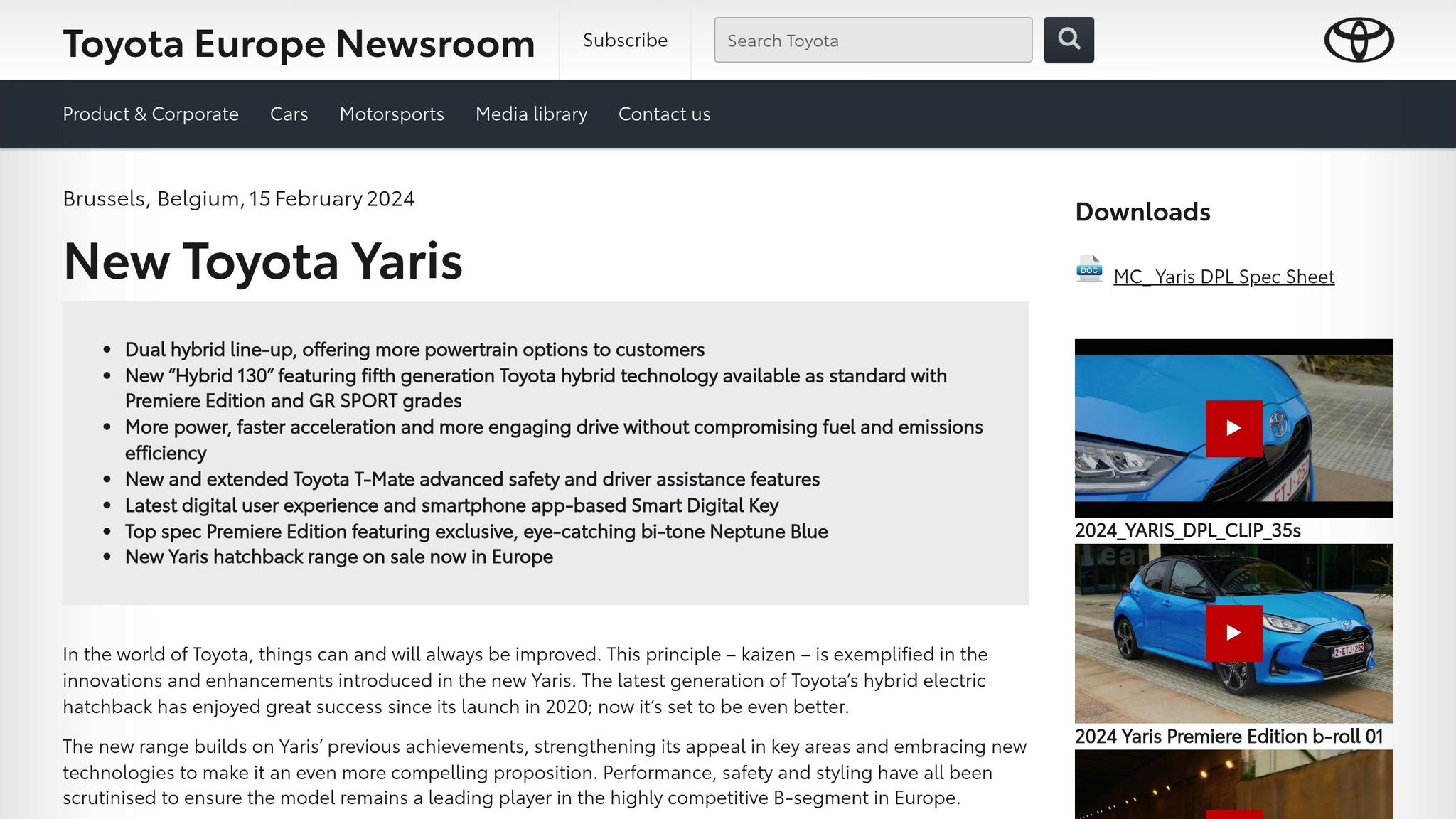
The Toyota Yaris stands out with its fuel-efficient design and compact build, making it ideal for urban environments. The 1.5L Hybrid model is officially rated at a combined fuel consumption of 3.0 L/100 km (approximately 78.4 MPG) under WLTP standards. However, real-world driving data from 2024 (spanning 123,478 miles) reports an average fuel efficiency of 46.5 MPG, which is notably lower than the official rating.
Fuel Consumption (L/100 km and MPG)
Fuel efficiency figures for the Yaris vary slightly across model years. The 2024 model averages 46.5 MPG, while the 2023 and 2022 models deliver 38.5 MPG and 39.9 MPG, respectively. The Yaris achieves this balance of performance and efficiency through its 1.5L engine (producing 100 horsepower), an electric motor, and a one-speed automatic transmission.
Monthly Fuel Cost (RWF and USD)
Gasoline prices in Rwanda, as of January 2026, average 1,778.54 RWF per liter ($1.37 USD). For a 2024 Yaris driven 1,000 km in a month, fuel costs would be approximately 89,994 RWF (around $69 USD). In comparison, the 2023 model, with slightly lower fuel efficiency, would cost about 108,668 RWF (around $83 USD) for the same distance. These figures highlight the Yaris as an economical choice for fuel-conscious drivers.
Purchase Price Range (RWF and USD)
The price of a new Toyota Yaris ranges between 24,000,000 and 42,000,000 RWF, with an average price of about 35,000,000 RWF ($26,900 USD), depending on the trim level and included features.
Suitability for Rwandan Roads
The Yaris is particularly well-suited for Rwanda’s urban settings. Its compact size, with a length of 3.945 meters and a curb weight of 1,055 kg, makes it easy to maneuver through Kigali’s busy streets. The car’s 9.0-meter turning circle ensures smooth navigation in tight spaces. Additionally, its Start & Stop technology improves efficiency during frequent stops, and the 36-liter fuel tank offers a solid range between refueling stops. Whether tackling city traffic or hilly terrain, the Yaris delivers practicality and reliability.
6. Toyota Corolla (Non-Hybrid)
The Toyota Corolla (Non-Hybrid) delivers dependable fuel efficiency without the added cost of hybrid technology. The 2026 model boasts an EPA-estimated 35 MPG combined (32 MPG city and 41 MPG highway), or roughly 6.7 L/100 km. While it’s less fuel-efficient than the hybrid version, the non-hybrid Corolla comes with a lower starting price and a reputation for reliability – qualities that resonate with Rwandan drivers.
Fuel Consumption (L/100 km and MPG)
The LE sedan, powered by a 2.0-liter engine, achieves an impressive 35 MPG combined. On the other hand, the sportier SE and XSE trims average slightly less at 34 MPG due to their performance-focused design. All trims are equipped with a CVT transmission, which enhances fuel efficiency – an advantage when navigating Rwanda’s hilly landscapes.
Monthly Fuel Cost (RWF and USD)
With fuel priced at 1,778.54 RWF per liter, driving 1,000 km per month would require about 67 liters, costing approximately 119,162 RWF ($92 USD). For those opting for the SE trim, which averages 6.9 L/100 km, monthly costs rise slightly to around 122,719 RWF ($94 USD).
Purchase Price Range (RWF and USD)
In Rwanda, a new Toyota Corolla Sedan 1.6 is priced at around 32,400,000 RWF (roughly $25,100 USD). Prices vary from 25,000,000 to 45,000,000 RWF depending on the trim and additional features. In the U.S., the base MSRP starts at $22,925, but import taxes and local market factors influence higher pricing in Rwanda. This balance of affordability and performance makes the Corolla a practical choice for the region.
Suitability for Rwandan Roads
The Corolla’s durability and low maintenance needs make it a standout option for Rwanda’s driving conditions. Its 169-horsepower engine handles Kigali’s steep hills with ease, while the TNGA platform ensures a smooth and stable ride on winding roads. Designed primarily for urban streets and highways, the sedan performs well on mixed surfaces with careful driving. For those frequently navigating rough or unpaved roads, the Corolla Cross variant offers better ground clearance at 161 mm, making it a more versatile alternative.
sbb-itb-7bc66b5
7. Nissan Note or Nissan March
The Nissan Note and Nissan March are compact, budget-friendly cars that deliver basic fuel efficiency without relying on hybrid technology. Their small size and easy maneuverability make them a perfect fit for Kigali’s bustling streets, especially for buyers looking to save on upfront costs.
Fuel Consumption (L/100 km and MPG)
Both models generally consume around 5.5 to 6.5 L/100 km (about 36 to 43 MPG) under mixed driving conditions. However, Rwanda’s hilly terrain and frequent stop-and-go traffic often push fuel consumption toward the higher end of this range. This directly affects how much you’ll spend on fuel each month.
Monthly Fuel Cost (RWF and USD)
With Rwanda’s current gasoline price at 1,778.54 RWF per liter, driving 1,000 km a month would require about 60 liters of fuel (assuming an average of 6 L/100 km). That translates to a monthly fuel cost of approximately 106,712 RWF ($82 USD). Keep in mind that city driving in Kigali – marked by constant braking and acceleration – can drive costs even higher compared to highway cruising.
Purchase Price Range (RWF and USD)
New models in this category typically cost between 24,000,000 and 42,000,000 RWF (around $18,500 to $32,500 USD). Many buyers opt for certified used imports from Japan, which often provide better value for money. If you’re considering a used car, it’s essential to have it inspected by a trusted local source to ensure it’s in good condition.
Suitability for Rwandan Roads
The Note and March shine in urban settings, where their compact size makes parking and navigating tight spaces a breeze. However, their lower ground clearance can be a drawback on Rwanda’s unpaved or rough roads, which are common outside Kigali’s well-maintained streets . For those who frequently travel on rural or uneven terrain, a vehicle with higher ground clearance might be a better choice to avoid undercarriage damage.
8. Hyundai Santa Fe Hybrid
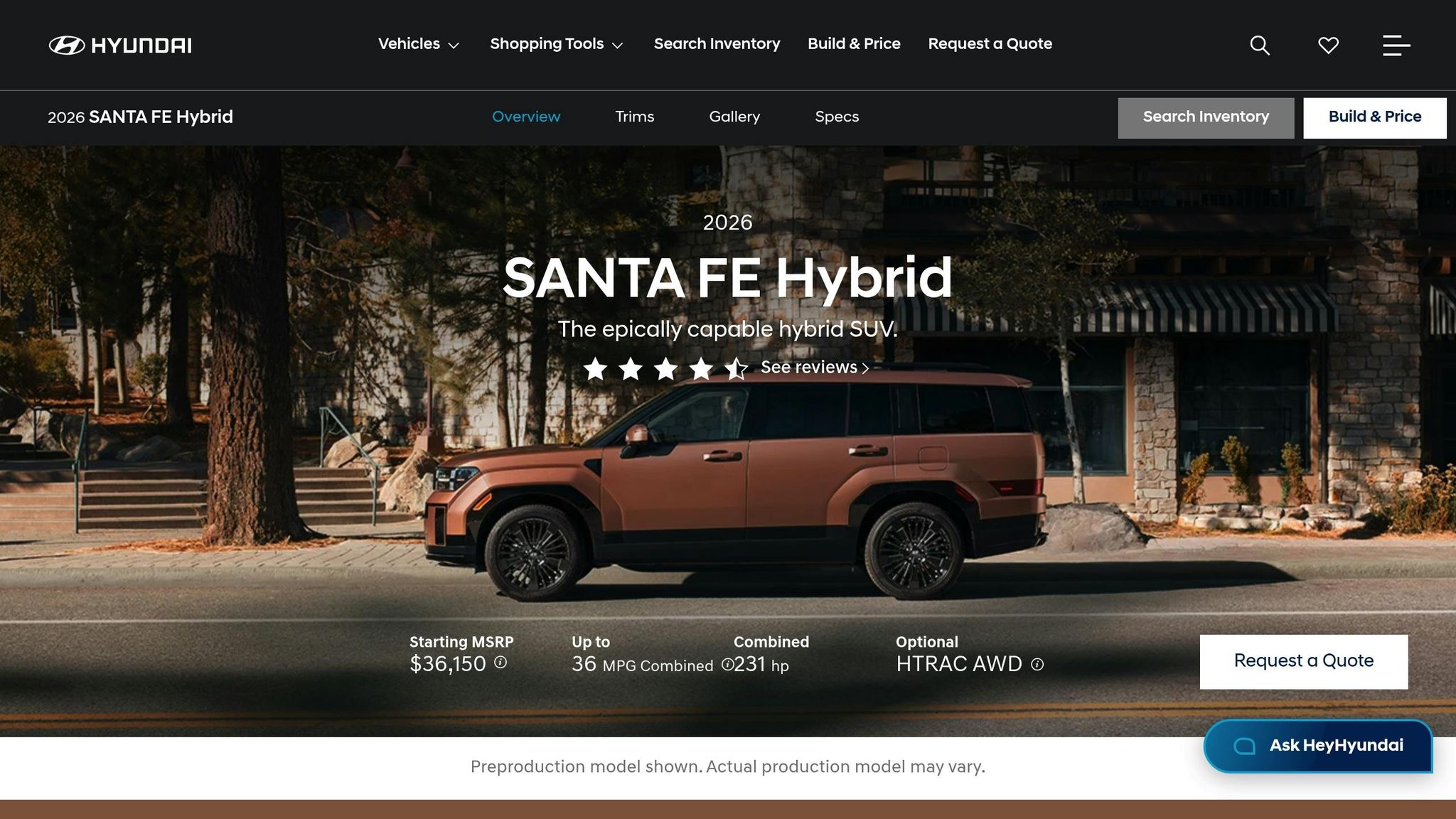
The Hyundai Santa Fe Hybrid brings together fuel efficiency, power, and versatility, making it a great fit for Rwanda’s diverse road conditions. With a 1.6L turbocharged engine delivering 231 horsepower and equipped with HTRAC All-Wheel Drive (AWD), it handles both city streets and rugged rural terrain with ease.
Fuel Consumption (L/100 km and MPG)
The 2026 Santa Fe Hybrid offers impressive fuel efficiency: 36 MPG combined (about 6.5 L/100 km) for front-wheel drive (FWD) models and 34 MPG (6.9 L/100 km) for AWD. In city driving, the FWD model achieves 37 MPG, making it a more economical choice. Compared to traditional gas-powered SUVs, these numbers translate to a 20% to 50% reduction in fuel usage. That means lower fuel costs month after month.
Monthly Fuel Cost (RWF and USD)
With gasoline priced at 1,778.54 RWF per liter, driving 1,000 km per month costs approximately 116,000 RWF for the FWD model and 123,000 RWF for the AWD version. These savings can add up significantly over time, especially for regular drivers.
Purchase Price Range (RWF and USD)
In Rwanda, the Santa Fe Hybrid starts at 43,149,400 RWF ($33,710 USD) for the Blue trim, while the SEL Premium version is priced at 48,256,880 RWF ($37,700 USD). Though the initial cost is higher than smaller cars, the combination of fuel savings, a spacious interior, and advanced safety features makes it a smart choice for families or anyone who frequently travels outside the city.
Suitability for Rwandan Roads
The Santa Fe Hybrid is built to handle hilly terrain and mixed road conditions. Features like the Blind-Spot View Monitor and Parking Distance Warning are especially useful for navigating Kigali’s busy streets. Meanwhile, its standard 18-inch alloy wheels strike a balance between comfort and durability, ensuring a smooth ride even on rougher roads.
9. BYD Atto 3 (EV Efficiency Benchmark)
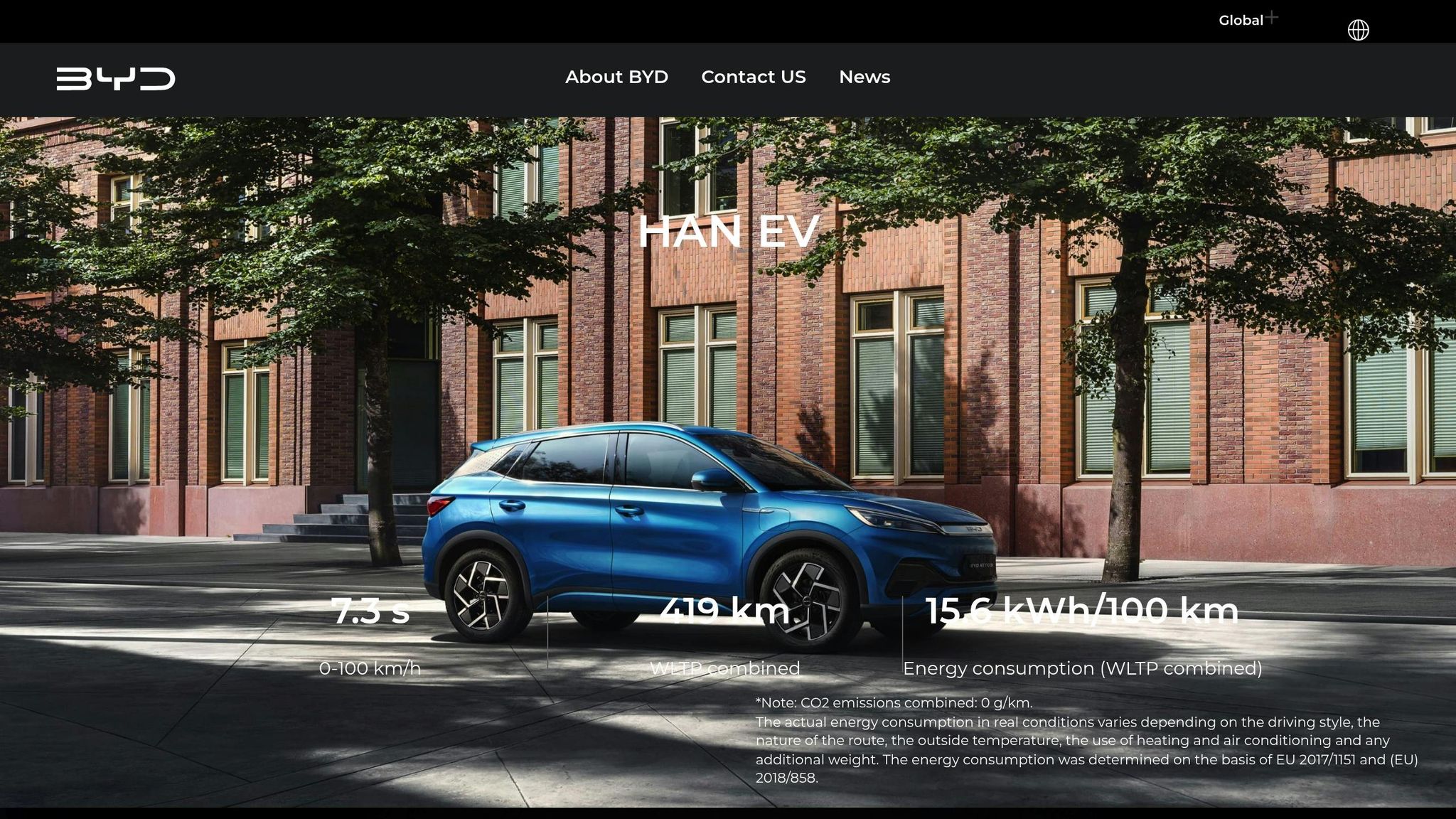
The BYD Atto 3 stands out as a symbol of the transition to fully electric mobility, leaving behind the need for traditional fuel entirely.
Known locally as the BYD Yuan Plus, this all-electric compact SUV is paving the way for fuel-free driving in Rwanda. By eliminating gasoline costs altogether, it offers drivers a chance to save significantly on monthly energy expenses. To ensure reliable support, BYD has established a network of authorized dealers across the country.
Energy Efficiency
Unlike gasoline-powered vehicles, the Atto 3 measures efficiency in kilowatt-hours per 100 kilometers. This shift highlights its focus on reducing both energy consumption and operating costs, making it a smart alternative to traditional fuel-driven cars.
Monthly Charging Costs
For drivers covering around 1,000 kilometers per month, charging the BYD Atto 3 is far more affordable compared to refueling a gasoline or hybrid SUV. With gasoline prices in Rwanda currently at 1,778.54 RWF per liter, the lower cost of electricity makes a noticeable difference. Local electricity rates ensure that charging this electric SUV is a budget-friendly option for most drivers.
Purchase Information
The BYD Atto 3 (Yuan Plus) is available through authorized dealerships in Rwanda. For the latest pricing, trim options, and availability, prospective buyers can reach out to local dealers or visit AutoMag.RW for detailed updates.
Built for Rwandan Roads
The BYD Atto 3 is designed to handle Rwanda’s diverse road conditions with ease. Its compact SUV design is perfect for navigating the busy streets of Kigali, while its steady torque and regenerative braking make it equally capable on the country’s hilly and varied terrains. Whether you’re in the city or exploring rural roads, the Atto 3 delivers reliable performance.
Just like our fuel-efficient models, the Atto 3 combines significant savings with the versatility needed to meet the demands of driving in Rwanda.
10. Leapmotor or Other Compact EVs Available via AUTO24.rw

Compact electric vehicles (EVs) are gaining traction in Rwanda as a practical alternative to traditional gasoline-powered cars. By cutting out fuel costs entirely, these EVs promise significant savings over time. Among the options available, the Leapmotor T03 stands out as a compact EV designed for city driving. AUTO24.rw, a local dealer, imports the Leapmotor lineup and also offers other compact EV choices, such as the BYD Dolphin and VW ID.3.
Monthly Energy Cost
Charging an EV at home is far cheaper than filling up a gas tank. With gasoline priced at 1,778.54 RWF per liter (about $1.35), the financial advantage of EVs becomes clear. In Rwanda, most EV owners handle 80–90% of their charging either at home or at work. Charging times vary: it takes 8–15 hours with a standard outlet or just 3–8 hours using a Level 2 charger. Installing a Level 2 charger typically costs between 300,000 and 800,000 RWF ($228 to $608).
"With rising fuel prices, switching to an EV reduces operating costs." – AUTO24.rw
Purchase Price Range and Tax Benefits
The Leapmotor T03, like other battery electric vehicles (BEVs), benefits from significant tax incentives in Rwanda. These include an 80% reduction in import duties and a full exemption from VAT, making these vehicles more affordable than they initially appear. These perks are more generous than those offered for hybrids or plug-in hybrids, adding to the appeal of compact EVs. Additionally, AUTO24.rw supports EV owners with access to an exclusive charging network.
Suitability for Rwandan Roads
Compact EVs like the Leapmotor T03 are well-suited for Kigali’s urban environment. Their small size and strong hill-climbing capabilities make navigating the city’s hilly terrain a breeze. Rwanda’s moderate climate also helps preserve battery performance and longevity. With over 50% of the nation’s electricity coming from renewable sources, these vehicles are a smart choice both economically and environmentally. For city-based drivers, the T03 and similar models easily meet Kigali’s typical daily commuting needs.
Comparison Table
Here’s a quick overview of powertrain types, fuel consumption, monthly costs (based on 1,000 km/month at 1,778.54 RWF per liter), purchase price ranges, and ideal use cases for the top 10 fuel-efficient cars in Rwanda for 2026.
The monthly cost estimates assume 1,000 km of driving each month at the current gasoline price of 1,778.54 RWF per liter (about $1.35). For electric vehicles (EVs), charging costs are significantly lower compared to gasoline. This table highlights the key metrics discussed earlier.
| Car Model | Powertrain Type | Consumption | MPG/MPGe | Monthly Cost | Purchase Price Range | Recommended Use Case |
|---|---|---|---|---|---|---|
| Toyota Prius | Hybrid | 4.0L/100km | ~58.8 | 71,142 RWF (~$53) | 25M–40M RWF | City commuting & rideshare drivers |
| Toyota Corolla Hybrid | Hybrid | 4.5L/100km | ~52.3 | 80,034 RWF (~$59) | 32M–45M RWF | Families & daily urban use |
| Toyota RAV4 Hybrid | Hybrid | 5.0L/100km | ~47.0 | 88,927 RWF (~$66) | 40M–60M RWF | Professionals & rougher terrain |
| Kia Sportage Hybrid | Hybrid | 5.3L/100km | ~44.4 | 94,262 RWF (~$70) | 38M–58M RWF | Business owners & families |
| Toyota Yaris | Hybrid | 4.2L/100km | ~56.0 | 74,698 RWF (~$55) | 24M–38M RWF | Tight city streets & short trips |
| Toyota Corolla (Petrol) | Petrol | 7.0L/100km | ~33.6 | 124,498 RWF (~$92) | 25M–45M RWF | Budget buyers seeking simplicity |
| Nissan Note/March | Petrol | 6.5L/100km | ~36.2 | 115,605 RWF (~$86) | 24M–42M RWF | Affordable city driving |
| Hyundai Santa Fe Hybrid | Hybrid | 6.0L/100km | ~39.2 | 106,712 RWF (~$79) | 45M–65M RWF | Luxury & tech-driven families |
| BYD Atto 3 | Electric (EV) | ~15 kWh/100km | ~100+ MPGe | 20,000–30,000 RWF (~$15–$22) | 35M–50M RWF | City use with charging access |
| Leapmotor T03 | Electric (EV) | ~12 kWh/100km | ~110+ MPGe | 15,000–25,000 RWF (~$11–$19) | 28M–42M RWF | Urban commuters & eco-conscious drivers |
For hybrids, the Toyota Prius and Toyota Yaris stand out with the lowest monthly costs. Meanwhile, EVs like the Leapmotor T03 offer even greater savings. For those needing more room and versatility, options such as the Toyota RAV4 Hybrid and Hyundai Santa Fe Hybrid combine efficiency with practicality.
Conclusion
The top 10 fuel-efficient vehicles for 2026 bring substantial savings tailored to Rwanda’s unique driving conditions. Choosing the right car depends on factors like your daily driving patterns, budget, and long-term goals. For those navigating Kigali’s hilly streets with the occasional venture onto unpaved roads, the Toyota RAV4 Hybrid is a solid choice, offering fuel efficiency of 5.0L/100km and enough ground clearance to handle local terrain. On the other hand, if your focus is strictly on city driving, the Toyota Prius stands out with exceptional fuel economy at 4L/100km. Meanwhile, compact EVs like the Leapmotor T03 provide excellent efficiency – perfect if you have consistent access to charging stations.
When considering a purchase, it’s essential to factor in total ownership costs alongside fuel efficiency. Rwanda’s tax incentives can help offset the higher upfront costs of hybrids and EVs, especially in light of rising fuel prices following the November 2025 adjustments. For EV buyers, installing a home charger typically costs between 300,000 and 800,000 RWF, an investment that pays off in the long run.
Access to reliable dealership support is equally important. Retailers such as AUTO24.rw offer certified used hybrids and EVs, guidance on navigating Rwanda’s tax incentives, and specialized maintenance services, including battery health checks and software updates designed for Rwanda’s climate. These services make owning a fuel-efficient vehicle a practical and worthwhile choice.
To explore these options further, visit your local Toyota, Kia, Hyundai, or Nissan dealerships to test drive these models and experience their efficiency firsthand. For a wider selection of fuel-efficient vehicles, check out AUTO24.rw, Rwanda’s leading platform for buying, selling, and trading cars. They were the first to bring brands like Tesla and Leapmotor to Rwanda. Whether you’re focused on immediate fuel savings or looking toward long-term sustainability, there’s a fuel-efficient vehicle that’s perfect for your needs – and Rwanda’s roads.
FAQs
What are the best hybrid cars for saving money on fuel in Rwandan cities?
If you’re aiming to cut down on fuel expenses while navigating city traffic in Rwanda, two standout hybrid options are the Toyota Prius and the Toyota Corolla Cross Hybrid.
The Toyota Prius, priced between RWF 25 million and 35 million (approximately $23,000–$32,000), is known for its impressive fuel efficiency, delivering around 50–54 MPG (about 4.5 L/100 km). Its compact design and low emissions make it a great fit for Kigali’s stop-and-go traffic. Plus, with its reliable service network, it’s a practical choice for urban drivers. On top of that, the Prius could save you up to $840 annually on fuel costs.
For families or those needing more space, the Toyota Corolla Cross Hybrid is an excellent alternative. It offers similar fuel efficiency at approximately 52 MPG (around 4.5 L/100 km) and is available for under RWF 35 million (about $32,000). Both the Prius and Corolla Cross Hybrid benefit from government tax incentives, making them wallet-friendly and eco-conscious options for city driving. Whether you prioritize fuel savings, reliability, or a bit of extra room, these hybrids are solid choices for Rwanda’s urban roads.
Are electric vehicles like the BYD Atto 3 more affordable to own than hybrids?
Electric vehicles (EVs), like the BYD Atto 3, tend to be cheaper to run each month compared to hybrids. Since EVs rely on electricity – which usually costs less than gasoline – and have fewer engine components, maintenance expenses are minimal. In Rwanda, drivers of fuel-efficient cars, including hybrids and EVs, can save up to $840 annually on fuel and maintenance. That’s roughly $70 a month in savings.
Hybrids, while still fuel-efficient, require some gasoline, which means their savings don’t quite match those of EVs. That said, EVs often come with a higher upfront price tag compared to hybrids. Fortunately, Rwanda’s tax exemptions and incentives help make EVs more accessible. For those planning to keep their vehicle long-term, the reduced monthly costs of owning an EV can make up for the initial investment over time.
What should I consider when deciding between a hybrid and an electric car in Rwanda?
When deciding between a hybrid and an electric vehicle (EV) in Rwanda, it’s important to start with the charging and fuel infrastructure. EVs are becoming more convenient for city driving, thanks to an expanding network of charging stations and battery-swap facilities. Hybrids, however, rely on fuel stations, which are still more widely available in rural areas where charging points might be harder to find.
Next, weigh the costs and potential savings. Hybrids generally cost less upfront, with prices starting at around $24,000, and they offer impressive range – often exceeding 600 miles on a full tank. EVs, with a starting price of about $21,000, come with lower operating costs due to cheaper electricity and reduced maintenance needs, though their initial purchase price can be higher depending on the model. Both vehicles can help drivers save up to $840 annually on fuel and maintenance compared to traditional gasoline-powered cars.
Finally, think about your driving habits and lifestyle needs. For short, urban commutes, EVs are ideal, providing quiet operation, lower running costs, and a more environmentally friendly option. On the other hand, hybrids are better suited for longer trips or areas where charging infrastructure is limited. Your ultimate decision should reflect your budget, typical driving routes, and personal priorities.
Related Blog Posts
- Electric vs Petrol cars in Rwanda
- Car Price Trends in Rwanda: Petrol vs Hybrid vs Electric
- Top 5 Most Fuel-Efficient Cars to Drive in Rwanda
- Top 10 fuel-efficient cars in Rwanda (2025 Edition)