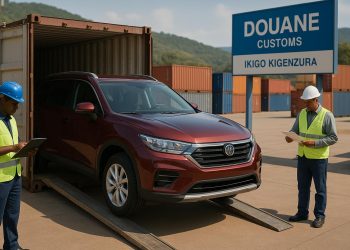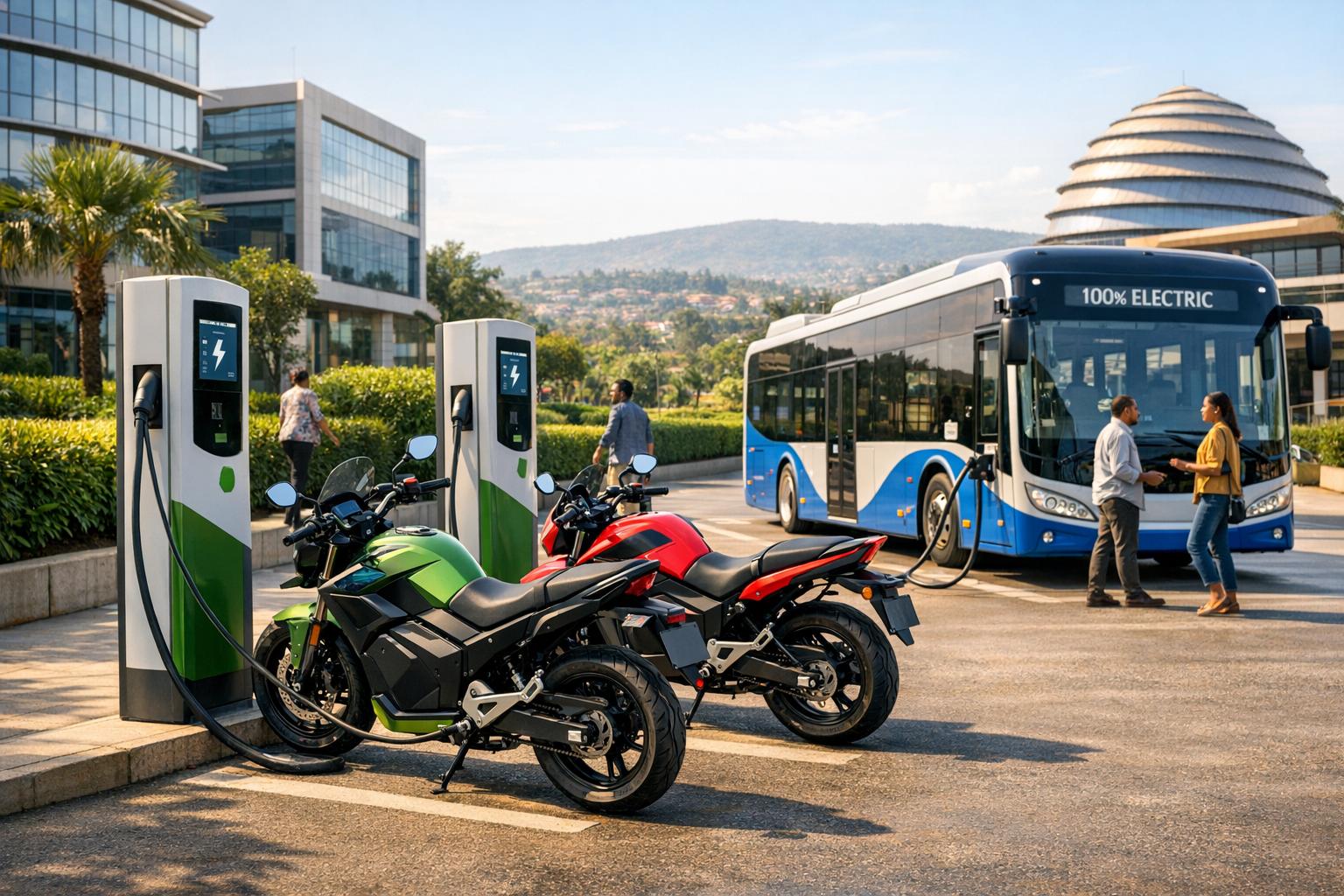
Rwanda is quickly transitioning to electric vehicles (EVs) to address air pollution, reduce fuel import costs, and modernize transportation. With road transport contributing 13% of greenhouse gas emissions and gas-powered motorcycles responsible for over 90% of particulate pollution, the shift to EVs is a strategic move. By 2030, Rwanda plans to electrify 20% of buses, 30% of motorcycles, and 8% of passenger cars. This transition is supported by government incentives, such as 0% import duties and VAT exemptions for EVs, and growing infrastructure like battery-swapping stations and charging facilities.
Key highlights:
- 4,800 electric motorcycles were operational by March 2024, mainly for taxis and deliveries.
- Fuel savings: E-bike users save $400–$750 annually compared to petrol bikes.
- Economic impact: Transitioning motorcycles to electric could save Rwanda $22 million yearly on fuel imports.
- Infrastructure growth: Kigali has 200 charging stations as of April 2025, with plans for further expansion.
- Public transport upgrades: Electric buses and a Bus Rapid Transit (BRT) system are being introduced to improve urban mobility.
Rwanda’s efforts show how small nations can lead in clean transportation, though challenges like grid capacity, high upfront costs, and skilled labor shortages remain.
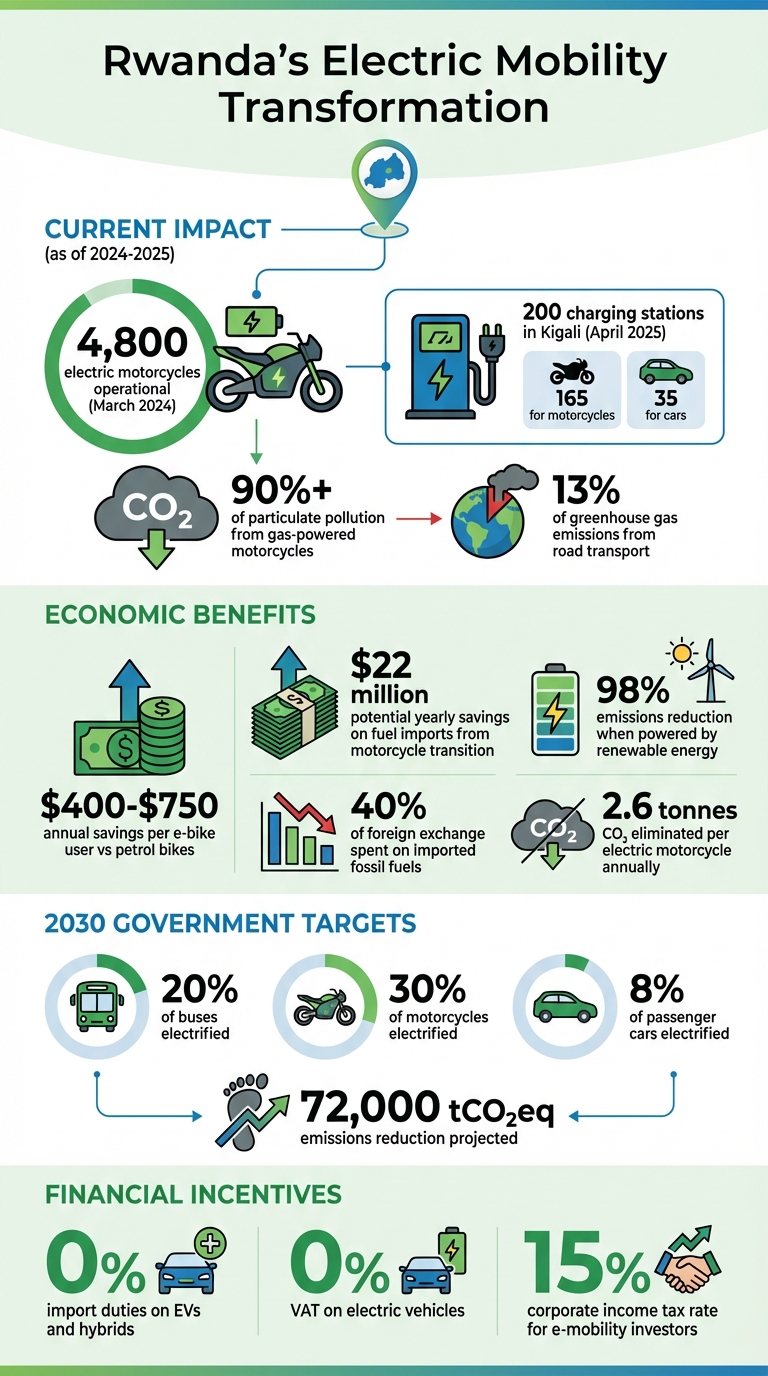
Rwanda’s Electric Vehicle Adoption: Key Statistics and 2030 Goals
Rwanda’s E-mobility revolution accelerates
Transportation Problems Rwanda Is Solving
Rwanda is tackling its transportation challenges head-on, addressing issues like rising emissions, high fuel costs, and urban congestion caused by outdated systems. Electric mobility is emerging as a practical solution to these pressing concerns, with targeted efforts focusing on environmental, economic, and urban mobility improvements.
Cutting Emissions and Meeting Climate Goals
Transportation accounts for 13% of Rwanda’s total greenhouse gas emissions, with gas-powered motorcycles being the biggest culprits. These motorcycles contribute over 90% of the country’s particulate matter air pollution, and in Kigali alone, taxi motorcycles are responsible for 32% of road traffic emissions. Switching to electric motorcycles makes a significant difference – each one eliminates about 2.6 tonnes of CO2 emissions annually. When powered by renewable energy, emissions drop by an impressive 98% compared to traditional gasoline models.
The Rwandan government has ambitious goals under its Nationally Determined Contribution (NDC) to combat climate change. By 2030, they aim to electrify 20% of buses, 30% of motorcycles, and 8% of cars. These efforts reflect Rwanda’s commitment to cleaner air and a healthier environment.
Lowering Costs of Imported Fuel
Rwanda spends 40% of its foreign exchange reserves on imported fossil fuels, leaving the economy vulnerable to price swings on the global market. Cutting down on fuel imports not only reduces this dependency but also frees up resources for other critical development needs. The financial benefits of electric vehicles (EVs) are hard to ignore. François Zirikana, an E-mobility Specialist at the City of Kigali, highlights the potential savings:
"Transitioning to electric motorcycles alone… would save the Rwandan economy US $22 million in fuel imports every year."
For individual operators, the savings are just as compelling. E-bike users save between $400 and $750 annually on fuel and maintenance compared to petrol bike operators. One hybrid vehicle owner in Kigali reported monthly costs dropping from $150 for petrol to just $40 for charging.
Fixing Traffic Congestion and Safety Problems
Kigali’s streets are bustling with nearly 100,000 motorcycles, about 26,000 of which serve as taxis. This reliance on motorcycle taxis contributes to traffic jams and raises safety concerns. Electric mobility is stepping in to ease these problems with smarter infrastructure and technology.
Battery-swapping stations now allow riders to replace drained batteries in under two minutes, keeping them on the move. At the same time, the government is rolling out the "Public Transport Generation 2" initiative, which uses technology to improve route planning and introduce scheduled services. Other measures, like car-free zones and bike-sharing programs, are also reshaping how people move around Kigali, making urban mobility safer and more efficient.
Government Policies Driving EV Growth
Rwanda is tackling transportation challenges head-on with policies designed to accelerate the adoption of electric mobility.
National Plans and Climate Policies
Rwanda’s commitment to electric vehicles is deeply rooted in its long-term national strategies. Vision 2050 and the Green Growth and Climate Resilience Strategy prioritize transportation as a key area for reducing emissions and building a low-carbon economy. Additionally, Rwanda’s Nationally Determined Contributions (NDC) under the Paris Agreement include specific EV adoption targets to be met by 2030. These plans are backed by policies that prioritize electric mobility through incentives and regulations aimed at reducing reliance on fossil fuels. Together, these measures create a supportive framework for scaling up electric vehicle use.
Tax Breaks and Financial Incentives
To make electric vehicles more accessible, Rwanda has introduced a range of financial incentives. For the 2024/2025 fiscal year, import duties on EVs, hybrids, and electric motorcycles have been set at 0%. Additionally, these vehicles are exempt from Value Added Tax (VAT), and spare parts, batteries, and charging equipment are free from excise duties and withholding tax.
Investors in the e-mobility sector also benefit from financial perks, including a reduced 15% corporate income tax rate and potential tax holidays. Eng. Alfred Byiringiro, Director General for Transport, highlighted the broader impact of these incentives:
"The incentives will also play a role to mobilize investment into the e-mobility sector which has fast emerged as a top sector on demand".
Charging station operators enjoy additional benefits, such as access to state-owned land rent-free and the lowest industrial electricity tariffs. They also receive discounts for off-peak charging between 11:00 PM and 8:00 AM.
Specific E-Mobility Programs
Rwanda is laying the groundwork for a thriving electric mobility ecosystem through infrastructure projects and strategic partnerships. In September 2025, the government launched Ecofleet Solutions, a state-owned enterprise tasked with electrifying Kigali’s public transport fleet. Dr. Jimmy Gasore, Minister of Infrastructure, reaffirmed the government’s dedication:
"The Government of Rwanda is committed to accelerating the transition to electric mobility as part of our climate and development agenda".
The Rwanda Urban Mobility Improvement (RUMI) project, funded by the World Bank, is another key initiative. With a $7.7 million investment, the project is upgrading the Nyabugogo multi-modal transit hub by installing 18 fast chargers and an 800-kW rooftop solar photovoltaic system with battery storage. This project showcases how decentralized energy solutions can support electric mobility.
In a separate initiative, the Rwanda Environment Management Authority (REMA) and the UNDP launched a program in February 2022 to retrofit 80 internal combustion engine motorcycles to electric. Local company Rwanda Electric Mobility has ambitious plans to retrofit 30,000 motorcycles over the next five years.
sbb-itb-7bc66b5
How Electric Vehicles Are Being Used in Rwanda
Rwanda’s proactive policies are driving the adoption of electric vehicles across various transportation sectors, showcasing a commitment to cleaner and more efficient mobility solutions.
Electric Motorcycles Leading the Change
Electric motorcycles are transforming Rwanda’s taxi industry. Since January 2025, the government has stopped registering new petrol-powered motorcycles for public transport in Kigali, mandating that all new taxi motorbikes be electric. Out of the country’s 110,000 motorcycles, approximately 70,000 are used as taxis, and these contribute to 32% of Rwanda’s road traffic emissions.
By March 2024, Rwanda had around 4,800 electric motorcycles in operation. Companies like Ampersand and Spiro are at the forefront of this shift. Ampersand, with 2,750 electric bikes, helps cut about 7,000 tons of carbon emissions annually. Meanwhile, Spiro, under CEO Kaushik Burman, has deployed over 17,000 bikes across Africa and continues to grow its production in Rwanda.
Riders can purchase motorcycles without batteries for about $1,168 and use battery-swapping stations to replace depleted batteries in under two minutes. This system not only saves time but also reduces annual operating costs by $400–$750. As venture capitalist Toffene Kama noted:
"The swapping process is like a two-minute thing… Sometimes it’s even faster than, for example, refueling [a gas-powered motorcycle] in an oil and gas station".
Moreover, charging costs are less than half the price of petrol for traveling the same distance. These innovations in two-wheel transportation are paving the way for broader advancements in Rwanda’s public transport system.
Electric Buses and Better Public Transport
Rwanda is also upgrading its public transportation with electric buses. Kigali now exclusively uses electric buses for all new public transport routes. The country’s broader goal is to have 20% of its bus fleet electrified by 2030, which is projected to cut emissions by 72,000 tCO₂eq within the same timeframe.
Plans include a Bus Rapid Transit (BRT) system featuring a 160-km (approximately 99 miles) network of dedicated lanes to ease congestion and improve service frequency. This integrated model highlights how electric mobility can align with urban development and environmental sustainability, setting the stage for a modern, efficient transportation system.
Building More Charging Stations
To support the growing number of electric vehicles, Rwanda is rapidly expanding its charging infrastructure. By April 2025, Kigali had about 200 charging stations – 165 for electric motorbikes and 35 for electric cars. Companies like Kabisa are expanding the charging network for four-wheel electric vehicles, while Ampersand continues to scale its battery-swapping stations for motorcycles.
Transit hubs now feature fast chargers powered by renewable energy. The government has also introduced incentives, such as rent-free land for charging station installations and capped electricity tariffs at reduced rates for these facilities. Additionally, smart charging technology is being deployed to shift demand to off-peak hours (11:00 PM to 8:00 AM), easing the strain on the power grid by up to 15%. This infrastructure growth is critical to supporting both electric motorcycles and buses, reinforcing Rwanda’s move toward integrated electric mobility.
What’s Next for Electric Vehicles in Rwanda
Rwanda as an Example for East Africa
Kigali’s compact and organized layout has made it a standout example for electric mobility in Africa. The country has taken a bold step by mandating that all new buses in its capital be electric and requiring all motorbike taxis in Kigali to transition to electric by January 2025. These forward-thinking policies, coupled with innovative battery-swapping systems and solar energy integration, position Rwanda as a leader in sustainable transportation.
As Sahr Kpundeh, World Bank Country Manager for Rwanda, explained:
"Electric mobility is not only about cleaner buses. It is about building the foundations of a modern economy powered by sustainable energy".
Rwanda’s approach – blending government incentives with the efforts of startups like Ampersand and Spiro – has created a roadmap for neighboring countries to follow. However, while Rwanda is setting the pace, significant challenges remain.
Remaining Obstacles to Address
Despite its progress, Rwanda faces hurdles in scaling electric mobility. Kigali’s electricity grid is already stretched thin, and projections indicate that peak demand could quadruple by 2030, further straining the system. The estimated $900 million needed for the country’s transition to electric mobility underscores the importance of innovative funding solutions, such as blended finance, green bonds, and expanded public-private partnerships.
Another challenge lies in infrastructure gaps outside Kigali, which make long-distance travel difficult for electric vehicle owners. Additionally, there is a shortage of skilled technicians capable of servicing electric vehicles. Paul Frobisher Mugambwa, an EV user in Kigali, highlighted this issue:
"If you buy an imported Chinese electric SUV, who is going to fix your car when it breaks down?".
High upfront costs also remain a barrier. Quality batteries can cost up to $1,000, limiting access for lower-income citizens. While these obstacles are significant, the advantages of electric mobility are driving continued progress.
Benefits of Electric Vehicles for Rwandans
Electric vehicles bring tangible benefits to Rwandans. For example, electric motorcycle riders save between $400 and $750 annually on fuel and maintenance, with charging costing less than half the price of petrol for the same distance. Battery-swapping stations further enhance convenience, allowing riders to replace depleted batteries in under two minutes, compared to the 6–8 hours needed for standard charging.
Beyond cost savings, electric vehicles are improving urban air quality and public health. Electric motorcycles powered by renewable energy produce 98% fewer emissions than their gasoline counterparts, addressing the 13% of Rwanda’s greenhouse gas emissions that come from road transport. These benefits extend beyond environmental impact, reducing fuel imports and creating jobs in the electric vehicle sector. Rwanda’s efforts show how electric mobility can drive both immediate and long-term benefits, paving the way for a cleaner and more sustainable future.
FAQs
What incentives are encouraging Rwanda to adopt electric vehicles so quickly?
Rwanda’s shift toward electric vehicles (EVs) has been remarkably swift, thanks to a mix of financial incentives and government-backed policies. These measures include tax exemptions on EVs, batteries, spare parts, and charging equipment, along with a zero-rated VAT. On top of that, electricity costs for EV charging are significantly subsidized, making it much cheaper to own and operate an electric vehicle.
But it’s not just about financial perks. Rwanda also provides non-financial incentives to encourage EV adoption. These include free land allocations for building charging stations, reserved parking spots marked with green license plates, access to dedicated bus lanes, and prioritizing EVs for government fleet purchases. Collectively, these initiatives are paving the way for more sustainable transportation and putting Rwanda at the forefront of electric mobility in the region.
How is Rwanda addressing challenges like limited grid capacity and a shortage of skilled workers to support electric mobility?
Rwanda is stepping up its efforts to address grid capacity issues by making significant investments in energy infrastructure. This includes building new solar and hydroelectric plants and upgrading transmission networks to handle increased demand. At the same time, local startups are coming up with creative solutions, such as solar-powered battery-swapping stations. These stations enable vehicles to charge using renewable energy, easing the load on the national grid.
To tackle the shortage of skilled labor, Rwanda is teaming up with global organizations to create training programs for electricians, technicians, and charging station operators. These initiatives, developed in partnership with local technical institutes, aim to equip workers with the skills needed to support the country’s expanding EV infrastructure. By combining advancements in energy systems with workforce training, Rwanda is setting the stage for a sustainable and scalable electric mobility future.
What are the economic benefits of Rwanda’s transition to electric mobility?
Rwanda’s move toward electric mobility is set to bring major economic advantages. By swapping out imported gasoline and diesel – currently making up around 40% of the country’s foreign exchange spending – for domestically generated electricity, Rwanda plans to cut fuel import expenses and ease pressure on its currency reserves. To support this shift, the government has introduced incentives like tax exemptions, reduced electricity rates, and rent-free land for charging stations, helping operators lower costs and make transportation both more affordable and profitable.
This transition is also sparking fresh investments and opening up job opportunities. Global automakers and local startups are pouring funds into electric vehicles, motorcycles, and charging infrastructure. These initiatives are boosting local manufacturing, service sectors, and related businesses, such as battery-swapping stations. All of this ties into Rwanda’s broader low-carbon growth strategy, making electric mobility a central part of its plans for economic development and climate action.
Related Blog Posts
- Rwanda’s ICE Vehicles: Carbon Emissions Impact
- Rwanda’s Plan for 20% Electric Buses by 2030
- Rwanda’s EV Road Projects: Progress and Impact
- EV Policy Updates for 2025/2025 in Rwanda