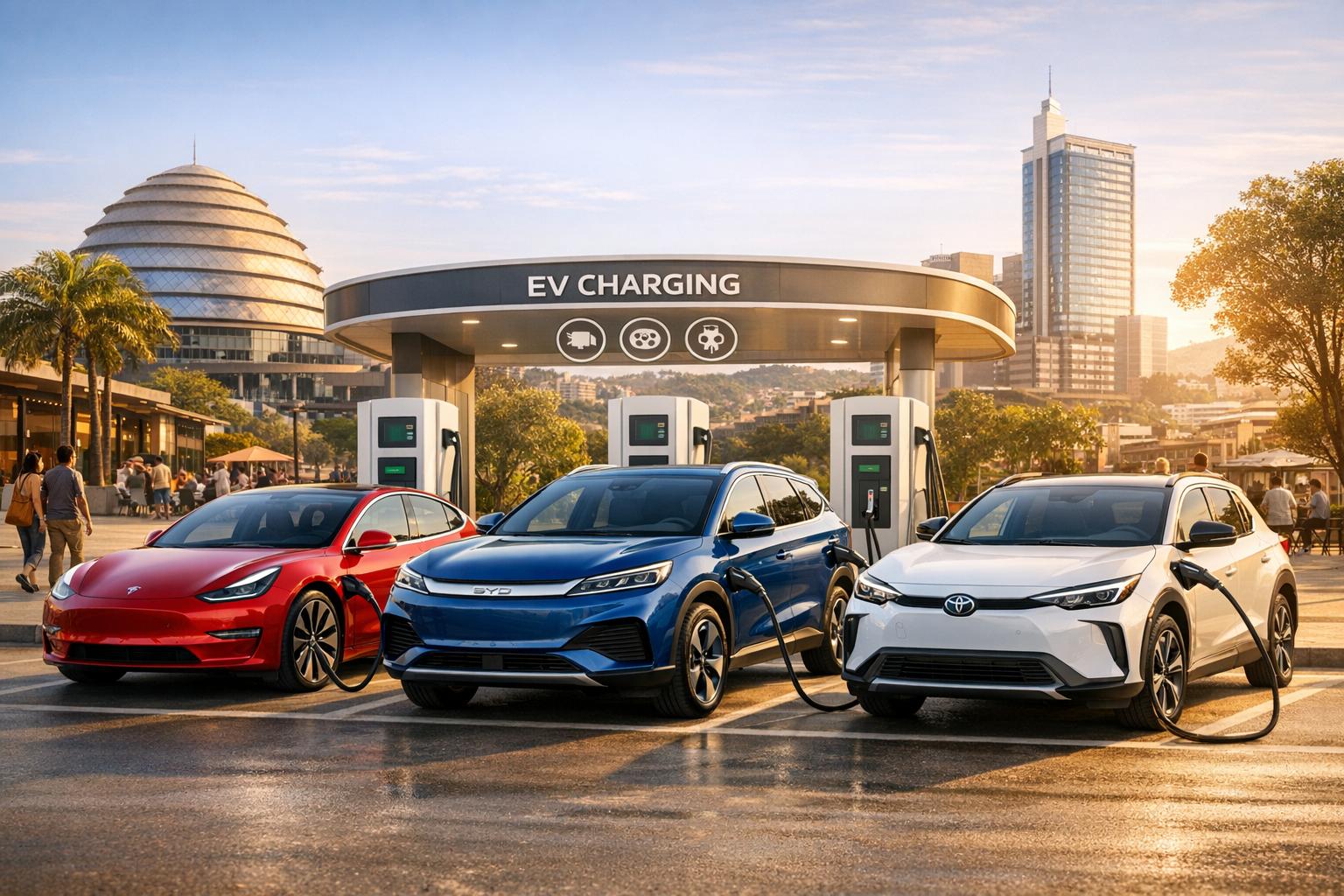
In Kigali, 2026, the electric vehicle (EV) market is transforming rapidly due to government policies that eliminate taxes on EVs and related equipment, subsidize electricity for charging, and provide rent-free land for charging stations. With a mandate to electrify 20% of Kigali’s bus fleet by 2030 and growing infrastructure like the Nyabugogo transit hub, major EV brands – BYD, Tesla, and Toyota – are competing to meet Kigali’s needs. Here’s a quick breakdown:
- BYD: Affordable EVs like the Dolphin-Mini ($11,800) and Atto 3 SUV (~$38,000) cater to budget-conscious buyers. BYD’s Blade Battery technology ensures long life and safety, while models like the Atto 3 are well-suited for Kigali’s hilly terrain.
- Tesla: Targets premium buyers with advanced features like Full Self-Driving and fast-charging Superchargers. Models like the Model Y offer great range (310 miles) and high ground clearance, ideal for urban and rural driving.
- Toyota: Offers both hybrids and EVs like the bZ4X ($34,900–$43,300). Hybrids address range anxiety, while the bZ4X provides strong performance and fast charging for drivers transitioning to fully electric options.
Key Takeaway: BYD leads in affordability and local support, Tesla excels in luxury and tech, and Toyota offers flexibility with hybrids and EVs. Your choice depends on budget, driving needs, and charging access.
Quick Comparison
| Factor | BYD | Tesla | Toyota |
|---|---|---|---|
| Price Range | $11,800–$38,000 | $45,000+ | $34,900–$43,300 |
| Charging Standard | CCS2 | CCS2 (EU models); adapters | CCS2 |
| Performance | Urban and rugged terrain | High-end, long range | Reliable, hybrid options |
| Emissions | Zero tailpipe emissions | Zero tailpipe emissions | BEVs: Zero; Hybrids: Lower |
Each brand offers unique advantages, but Kigali’s infrastructure and policies make EV ownership more accessible than ever. Choose based on your budget, driving habits, and long-term goals.
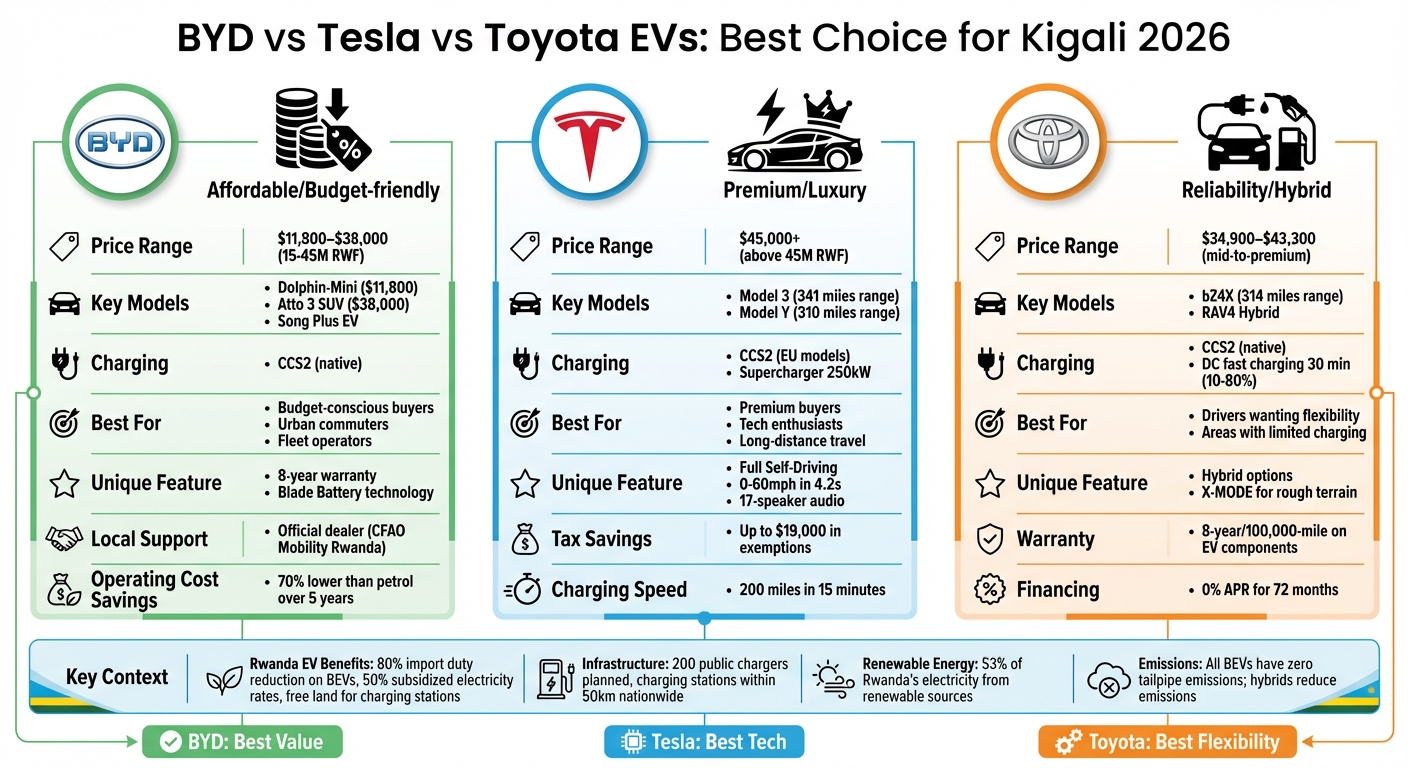
BYD vs Tesla vs Toyota EV Comparison for Kigali 2026
Why Buy a 2026 BYD Dolphin Surf Boost? From Tesla EV Owner
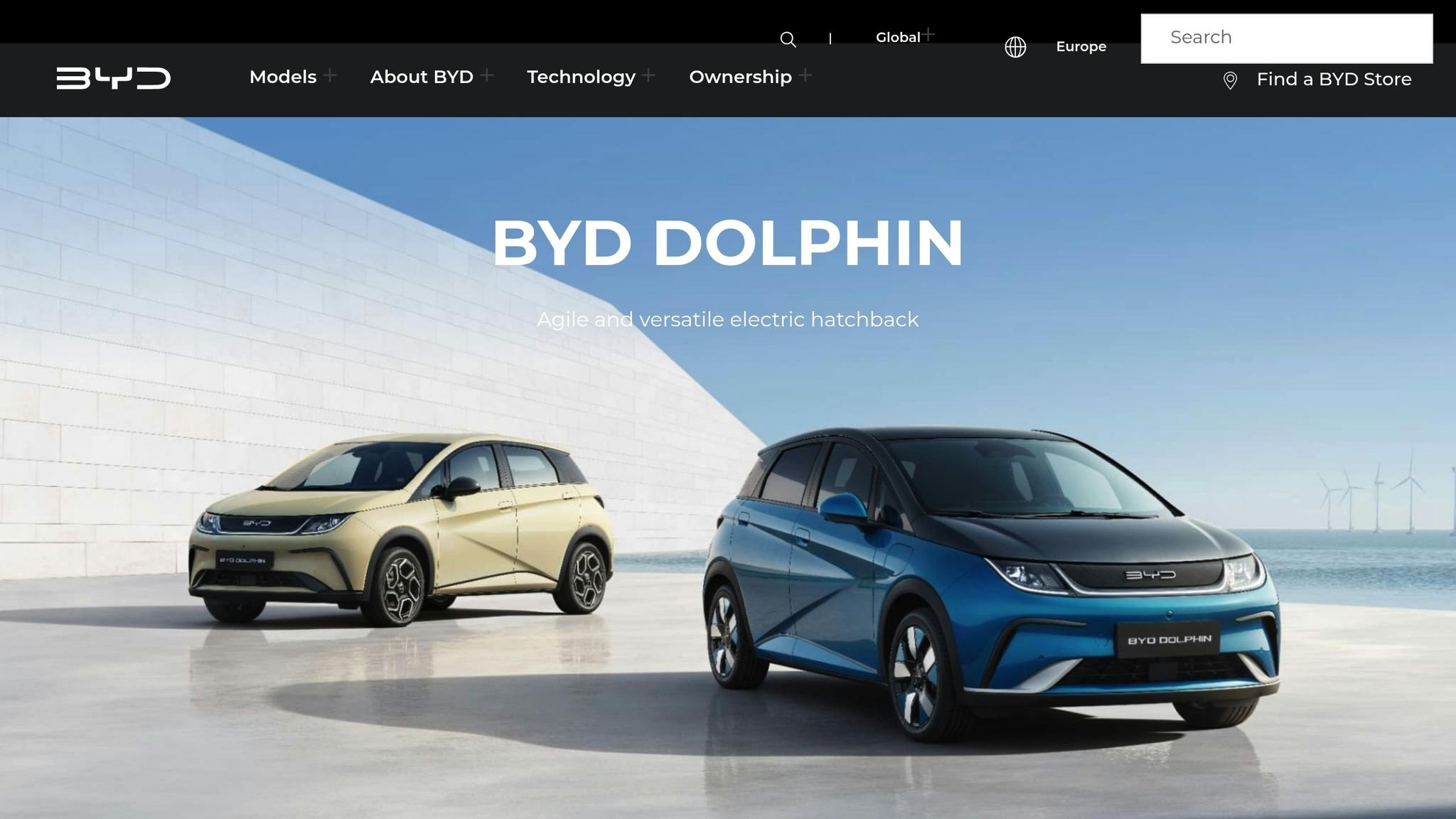
BYD EVs: Low-Cost Options for Kigali
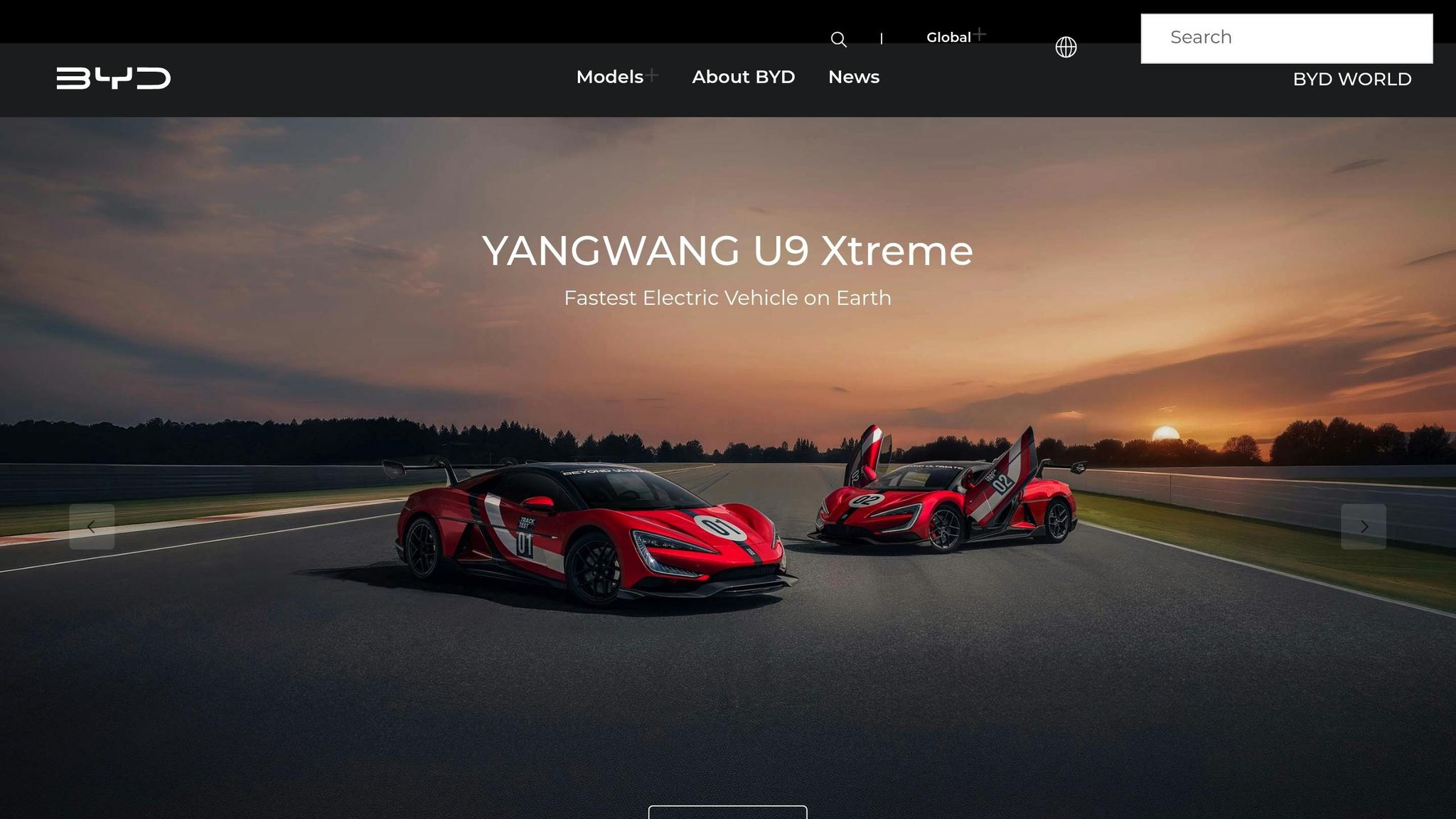
BYD has become the most accessible electric vehicle (EV) brand in Kigali, thanks to CFAO Mobility Rwanda, which launched in January 2024. CFAO offers a comprehensive e-mobility package that includes charging station installation, solar panels, energy storage devices, and maintenance services. This package aims to tackle concerns about reliable after-sales support.
BYD Models Available in Kigali
For those seeking an affordable entry point into EV ownership, the BYD Dolphin-Mini (also known as Seagull) is priced at approximately $11,800. On the other hand, the BYD Atto 3 SUV, available for Rwf 49.9 million (roughly $38,000), provides more interior space and comes with an impressive 8-year warranty, highlighting its long-term reliability. The Atto 3 was the first major model introduced by CFAO in Kigali, designed specifically to handle the challenges of the city’s terrain. As Srinivas Cheruvu, General Manager of CFAO Mobility in Rwanda, stated:
"We imagined this Kigali dealership as a welcoming place dedicated to discovering the BYD models, which combine modernity, comfort and costs savings".
Rounding out the lineup is the Song Plus EV, offering a driving range of up to 323 miles (520 km), making it ideal for longer trips outside the city. BYD’s SUV models, including the Atto 3 and Song Plus, feature elevated ground clearance to safeguard the battery pack on uneven roads.
These models are complemented by reliable charging solutions to ensure a seamless ownership experience.
Charging Station Compatibility
BYD vehicles in Kigali utilize the CCS2 charging standard, which aligns with Rwanda’s dual-standard infrastructure that also supports GB/T chargers. This compatibility allows owners to conveniently use existing public charging stations while benefiting from the planned expansion of the network. CFAO also partners with solar-powered home charging solutions, helping reduce electricity costs. Collaborations with local e-mobility companies like Ampersand further enhance maintenance and support services.
The integration of BYD’s vehicles with Kigali’s charging infrastructure ensures a smooth transition to EV ownership.
Battery Life and Road Performance
At the heart of BYD’s EVs is the Blade Battery, built with Cell-to-Pack (CTP) technology. This battery not only prioritizes safety but also boasts a lifespan of 8–15 years. In Kigali’s urban environment, compact models like the Dolphin are particularly efficient, leveraging regenerative braking on the city’s hilly roads to recapture energy. For journeys beyond the city limits, especially on rugged or unpaved provincial roads, models such as the Atto 3 and Tang – with their higher ground clearance – are better equipped.
Over five years, operating costs for BYD EVs are up to 70% lower compared to traditional fuel-powered vehicles, thanks in part to Rwanda’s subsidized electricity rates. Additionally, with over 50% of the country’s electricity coming from renewable sources, these vehicles contribute to environmental goals. Pierre Toulotte, BYD Brand Manager, emphasized this point:
"Rwanda is one of the most advanced countries in the continent in its willingness to reach carbon neutrality, to boost the sales of clean vehicles and to use clean electricity".
With these features, BYD EVs address the diverse demands of Kigali’s urban and rural driving conditions while promoting sustainability.
Tesla EVs: High-End Performance and Technology
While BYD focuses on affordability, Tesla is carving out its niche in Kigali’s premium market by delivering top-tier performance and advanced technology. Tesla appeals to middle and upper-income buyers who prioritize luxury and innovation. Despite competition from Chinese EV brands, Tesla maintains its position as a high-end, profitable choice in Rwanda’s growing EV market. Its emphasis on autonomous driving and premium features sets it apart from the pack.
Tesla Models for Kigali Drivers
For Kigali’s drivers in 2026, Tesla offers two key models: the Model 3 and the Model Y. The Model 3, refreshed with the "Highland" update, combines efficiency and performance. It boasts an impressive 131 MPGe, a quieter cabin, a range of up to 341 miles, and acceleration from 0 to 60 mph in just 4.2 seconds.
On the other hand, the Model Y is a better fit for Rwanda’s diverse road conditions. With its higher seating position and improved ground clearance, it tackles the challenges posed by uneven roads and high speed bumps – issues that had plagued earlier EV models like the e-Golf. Allan Kweli, Head of Operations at Volkswagen Mobility Solutions Rwanda, highlighted this when he said:
"The unevenness in road infrastructure and the height of speed-bumps turned out to be too challenging for the e-Golf, which has a relatively low ground clearance".
The Model Y’s SUV design not only addresses these issues but also offers a range of 310 miles and extra cargo space, making it a practical choice for families. Its popularity is evident; in 2025, the Model Y captured a commanding 39.5% share of the U.S. EV market, showcasing its widespread appeal. These features make it well-suited for Kigali’s mix of urban streets and rugged terrain.
Pricing and Tax Benefits
Although Tesla vehicles come with a premium price tag, buyers in Rwanda can take advantage of significant tax incentives. These include exemptions that can save buyers up to $19,000. Additionally, Tesla owners benefit from Rwanda’s subsidized electricity rates for EV charging, which are set at 50% of standard industrial rates. These financial perks make Tesla ownership more accessible for middle and upper-income buyers, helping to offset the initial investment over time.
Charging Network and Tech Features
Tesla’s Supercharger technology is a game-changer, offering charging speeds of up to 250 kW. This means drivers can add 200 miles of range in just 15 minutes. While Kigali’s public charging infrastructure is still developing, the government has a plan to ensure charging stations are located within 50 kilometers nationwide. Tesla owners can also use public stations with CCS2 compatibility.
The Rwandan government is actively working to fill infrastructure gaps. Srinivas Cheruvu, Managing Director of CFAO Mobility Rwanda, emphasized the urgency:
"People want to buy EVs, but they don’t have the confidence when they consider the limited charging stations available, and especially if they want to travel upcountry, it becomes even more difficult".
To address this, Rwanda offers incentives like free land for charging station development, tax exemptions on equipment, and a reduced 15% corporate tax rate for EV-related businesses. Tesla’s fast-charging capabilities and advanced technology help alleviate these concerns.
Beyond charging, Tesla vehicles come packed with cutting-edge features. The Full Self-Driving option, available for about $8,000 or via a $99/month subscription, adds a layer of luxury and convenience. Other highlights include a 17-speaker audio system and a floor-mounted battery design that enhances stability on Rwanda’s hilly roads. The 2026 models even include improved battery buffers, allowing short-distance travel when the range indicator hits zero – a thoughtful addition for drivers navigating Kigali’s terrain.
sbb-itb-7bc66b5
Toyota EVs: Proven Reliability and Hybrid Models
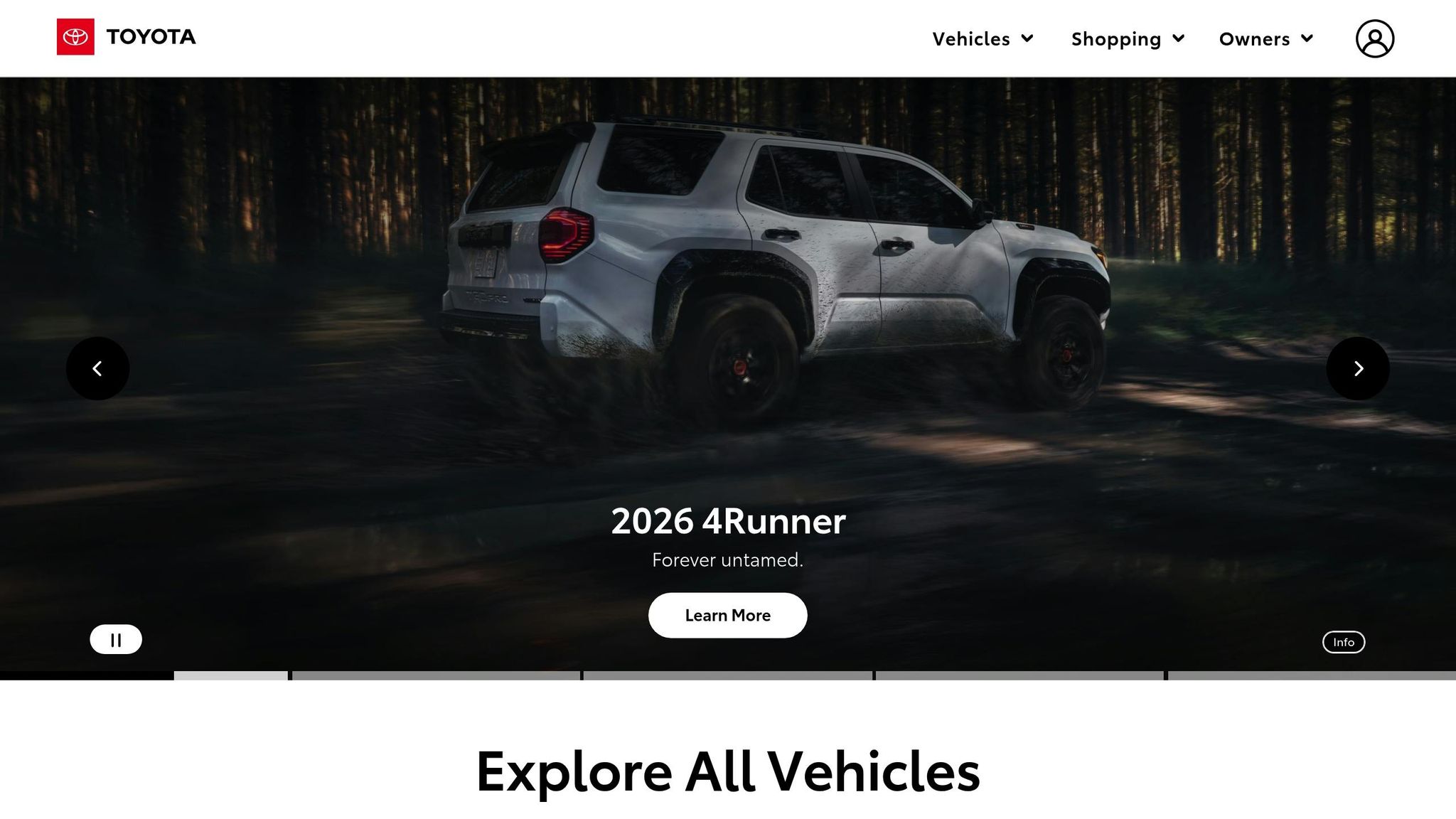
Toyota has built a reputation for reliability over decades, offering a mix of powertrain options to suit different needs. Instead of focusing solely on fully electric vehicles, the company provides a combination of hybrids and the all-electric bZ4X SUV, aligning with Kigali’s current charging infrastructure. This dual approach complements the city’s growing but still limited charging network.
Toyota Models for Rwanda
The 2026 Toyota bZ4X stands as Toyota’s flagship electric vehicle, built on the e-TNGA platform. It comes in two trims: the XLE, priced at $34,900, and the Limited, at $43,300. With an EPA-estimated range of up to 314 miles, the bZ4X supports DC fast charging, allowing it to recharge from 10% to 80% in roughly 30 minutes. Its X‑MODE system optimizes power and braking, making it well-suited for Kigali’s heavy rains and winding rural roads.
For those who frequently travel beyond Kigali, Toyota’s hybrid models, like the RAV4 Hybrid, offer a practical alternative. Joshua Nshuti of Greenleaf Motors explains the appeal:
"A hybrid vehicle eliminates the range anxiety as it can switch to gasoline, which is relevant as we are still far behind with charging infrastructure in Rwanda."
Hybrids recharge through regenerative braking, capturing energy during stop-and-go traffic or while navigating Kigali’s hilly terrain. One Kigali driver shared how switching to a plug-in hybrid reduced their monthly fuel expenses from $150 to $40 – a significant savings for daily commutes. These features make hybrids a versatile choice for balancing urban and rural driving needs.
Cost and Charging Options
Toyota’s approach to affordability and flexibility is evident in the bZ4X, which includes an 8-year or 100,000-mile warranty on EV components. Buyers can also take advantage of 0% APR financing for 72 months on new 2026 models. Additionally, Rwanda’s tax exemptions further lower the initial cost.
The bZ4X is equipped with the North American Charging System (NACS) port and comes with adapters for CCS1 and J1772 connections, ensuring compatibility with various public charging stations. This is especially useful as Rwanda’s EvPlugin network plans to install 200 public chargers nationwide, with 35 specifically allocated for cars. For home charging, a Level 2 (11-kW) setup can fully recharge the bZ4X in about seven hours overnight.
Emissions Reduction with Hybrids
While the bZ4X offers zero tailpipe emissions, Toyota’s hybrid models serve as a practical solution during the ongoing expansion of Rwanda’s charging network. Hybrids emit less than traditional gas vehicles and don’t rely on charging infrastructure, making them an excellent option for the current landscape. With Rwanda already generating 53% of its electricity from renewable sources, both hybrids and EVs contribute to a cleaner environment.
Michelle DeFreese from the Global Green Growth Institute highlights this dual benefit:
"The combination of transitioning to electric vehicles while investing heavily in renewable and clean energy resources is a powerful combination when it comes to reducing emissions."
Hybrids also require smaller batteries compared to full EVs, reducing the need for resource-intensive mining of materials like lithium and cobalt. For Kigali drivers weighing environmental concerns against practical realities, Toyota’s hybrid lineup offers an effective middle ground without the immediate need for an expansive charging network.
Side-by-Side Comparison
When Kigali drivers consider switching to an electric vehicle (EV), they often weigh factors like price, performance, and access to local support. Each brand – BYD, Tesla, and Toyota – brings its own strengths to the table, from pricing strategies to technology offerings and local service availability.
BYD leads in sales volume, offering a wide range of models from entry-level vehicles priced around 15–25 million RWF to premium options exceeding 45 million RWF. Tesla, on the other hand, focuses almost entirely on the high-end market, with prices typically starting above 45 million RWF. Meanwhile, Toyota offers a mid-to-premium pricing structure, with its bZ4X model ranging from $34,900 to $43,300. Toyota also provides hybrid options for those not ready to fully commit to an EV.
All three brands benefit from Rwanda’s 80% import duty reduction for Battery Electric Vehicles (BEVs). However, Toyota’s hybrid models only qualify for a reduced 30% duty. Additionally, operating costs for mid-range EVs in Rwanda are estimated to be 70% lower than those of petrol-powered cars over a five-year span. Below is a quick comparison of key factors across the three brands.
Comparison Table
| Factor | BYD | Tesla | Toyota |
|---|---|---|---|
| Price Range | Entry-level to premium (15–25 M RWF to above 45 M RWF) | Premium only (typically above 45 M RWF) | Mid-to-premium (bZ4X: $34,900–$43,300) |
| Charging Compatibility | Native CCS2 ports | European models: native CCS2; U.S. models need adapters | Native CCS2 |
| Model Variety & Performance | Wide range for urban and off-road use | Optimized for urban and highway performance | Reliable performance with strong local service |
| Emissions | Zero tailpipe emissions (BEVs) | Zero tailpipe emissions | Zero tailpipe emissions (BEVs); hybrids reduce emissions |
| Local Support | Official dealer network (via CFAO Mobility) | Available through third-party imports | Official distributor network in Rwanda |
Both BYD and Toyota models come equipped with native CCS2 ports, ensuring seamless compatibility with Rwanda’s charging infrastructure. Tesla’s compatibility varies based on the model’s origin – European-spec vehicles work natively with CCS2, while U.S. models require adapters.
Which EV Works Best for Kigali in 2026
Based on the comparisons above, here’s a closer look at the best EV options for Kigali drivers in 2026.
BYD emerges as the most practical choice for the majority of Kigali’s drivers. Offering a variety of models – from the budget-friendly Seagull to the versatile Tang PHEV – BYD is backed by strong local support through CFAO Mobility Rwanda. For city commuters, the BYD Dolphin stands out, designed to handle Kigali’s hilly terrain while benefiting from significant tax exemptions. For businesses and fleet operators, the BYD T3 provides a functional solution with commercial practicality and similar tax advantages.
Tesla caters to those seeking a premium experience, emphasizing cutting-edge technology and extended range. The Tesla Model Y, for instance, is a great fit for rural trips and long-distance travel, thanks to its excellent ground clearance and compatibility with Rwanda’s growing network of fast-charging stations. It’s an ideal choice for those who value high-end performance and advanced features.
Toyota’s hybrid models strike a balance for drivers who aren’t ready to go fully electric. These hybrids offer a practical solution in areas where charging infrastructure is still developing. They not only align with Rwanda’s sustainability initiatives but also accommodate the current pace of infrastructure growth.
For budget-conscious drivers, investing in home charging solutions can significantly cut costs while taking advantage of Kigali’s supportive policies on charging infrastructure and tax incentives. Rwanda’s moderate climate helps extend battery life, and with over half of the country’s electricity coming from renewable sources, switching to an EV offers real environmental benefits. These factors make EVs a smart choice for Kigali’s unique terrain and infrastructure needs.
For additional guidance on selecting the right EV, AutoMag.RW remains a valuable resource, offering multi-brand options and specialized support in Rwanda’s expanding electric vehicle market.
FAQs
Why are BYD electric vehicles a good fit for Kigali’s unique terrain?
BYD electric vehicles, like the BYD Dolphin, are a great match for Kigali’s unique landscape of hilly, narrow streets. Thanks to its compact design, the Dolphin handles urban navigation with ease. Plus, with a WLTP-rated range of about 265 miles, it’s built to perform reliably – even when tackling steep climbs. Need a quick recharge? The Dolphin’s 80 kW fast-charging capability lets you regain a usable charge in roughly 30 minutes. It’s also compatible with Kigali’s expanding network of battery-swap stations, adding an extra layer of convenience.
At a price point of around $20,000, the Dolphin combines affordability with durability and quality. Rwanda’s EV-friendly policies, including tax exemptions, make owning an electric vehicle even more cost-effective. With Kigali already boasting 24 public charging stations and 49 battery-swap facilities, BYD vehicles are a smart, economical solution for navigating the city’s varied terrain while contributing to its sustainability efforts.
How does Tesla’s pricing and technology influence its suitability for Kigali in 2026?
Tesla vehicles, with entry-level models starting at about $57,000, are positioned as high-end options. For many residents in Kigali, this price point – combined with steep import taxes and a lack of widespread charging stations – puts Tesla cars out of reach. These factors make them more appealing to wealthier buyers who can handle both the upfront cost and the ongoing expenses of ownership.
That said, Tesla’s technology is hard to ignore. With features like a range of up to 348 miles (roughly 560 km) on a single charge and ultra-fast 250 kW charging (available in models such as the Model Y), Tesla offers a compelling package for those who value performance, long-range capability, and state-of-the-art innovation. While these factors may not drive mass adoption in Kigali just yet, Tesla stands out as an attractive choice for the city’s affluent drivers looking for a premium electric vehicle experience.
Why are Toyota’s hybrid vehicles a smart choice for Kigali drivers?
Toyota’s hybrid vehicles offer an excellent choice for drivers in Kigali, blending the energy efficiency of an electric motor with the trusted dependability of a gasoline engine. One of their key advantages is eliminating the need for constant charging – a major plus in areas where charging stations are scarce, especially beyond the city center.
Take the Prius, for instance. It can cover more than 620 miles on a single tank, delivering impressive fuel efficiency while reducing CO₂ emissions. This can translate into savings of up to $840 annually on fuel and maintenance. On top of that, Toyota’s self-charging hybrid system is well-suited for Kigali’s hilly terrain and rural roads, ensuring reliable performance without the range concerns often associated with fully electric vehicles.
Related Blog Posts
- Popular Hybrid and Electric Cars in Rwanda
- Top 5 Compact EVs for Rwanda in 2025
- Top 5 Electric Cars sold at AUTO24 Rwanda
- Best Electric Vehicles for Kigali Drivers