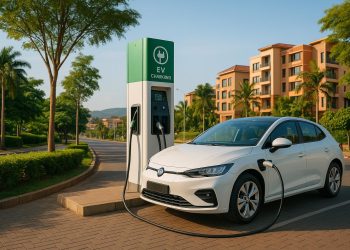
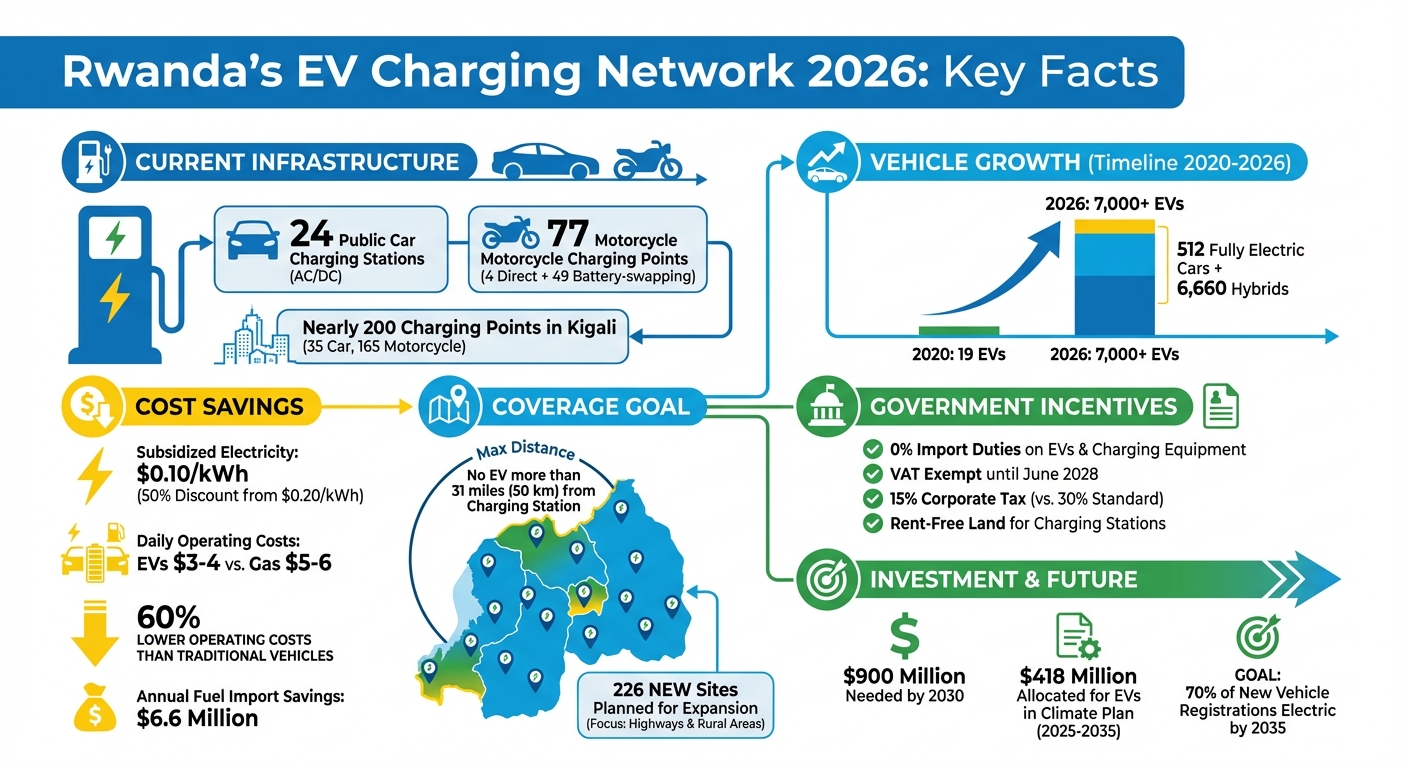
Rwanda has made impressive progress in electric mobility since 2020. With over 7,000 electric and hybrid vehicles now on the road, the country has expanded its charging infrastructure to meet growing demand. Kigali alone has nearly 200 charging points, including 35 for cars and 165 for motorcycles. The government’s master plan ensures no EV is more than 31 miles from a charging station, supporting urban and rural areas alike.
Key highlights:
- 24 public car charging stations (AC/DC) and 77 motorcycle charging points (battery-swapping and direct charging).
- Subsidized electricity for EV chargers at $0.10 per kWh, half the standard rate.
- Tax exemptions on EVs, batteries, and charging equipment until at least 2028.
- Rent-free land and reduced corporate tax rates for private investors.
- Aiming for 226 new charging sites, focusing on highways and rural areas.
This growth reflects Rwanda’s commitment to reducing emissions and modernizing transportation. Private companies like Ampersand and Kabisa are driving innovation, while government incentives lower costs for users and investors. With $900 million needed to expand infrastructure by 2030, Rwanda is on track to electrify its roads and reduce reliance on fuel imports.
Rwanda EV Charging Infrastructure Overview 2026: Stations, Costs & Growth
Rwanda’s E-mobility revolution accelerates
sbb-itb-7bc66b5
EV Charging Stations in Rwanda: 2026 Overview
Rwanda’s electric vehicle (EV) charging network has grown rapidly, though it’s still in the early stages compared to the overall adoption of EVs. As of early 2026, the country boasts 24 public charging stations for electric cars, offering both AC and DC charging options. For motorcycles, the infrastructure includes 4 direct charging stations and 49 battery-swapping facilities, providing a total of 77 public access points.
Different vehicles rely on specific charging methods. Electric cars primarily use plug-in stations, while motorcycles lean heavily on battery-swapping systems to keep riders on the move – especially important for those using motorcycles for work. The government has set an ambitious benchmark: no EV should be more than 31 miles (50 kilometers) away from a charging station. This goal is shaping the planning of both urban and rural charging networks to ensure wide-reaching accessibility.
"The goal is to ensure that no electric vehicle has to travel more than 50 kilometers without finding a station." – Jean Bosco Mugiraneza, Director General of Energy at MININFRA
A geospatial analysis conducted by the Ministry of Infrastructure has identified between 224 and 226 strategic locations for future charging stations. This approach moves away from scattered installations toward a coordinated strategy that considers traffic patterns, population density, and existing infrastructure like commercial buildings. The aim is to balance urban demand with rural connectivity.
Where Charging Stations Are Located
Currently, most of Rwanda’s charging infrastructure is concentrated in Kigali, particularly in busy urban areas such as shopping centers, office parks, and existing gas stations. Public transport hubs, like Nyabugogo Terminal, are also being prioritized for upgrades and new charging installations.
While focusing on urban areas makes economic sense, it creates challenges for long-distance travel. To address this, the government’s master plan includes extending the network along major highways, with charging stations spaced roughly 31 miles (50 kilometers) apart to reduce range anxiety. In rural areas like Nyamagabe, EVs are already being used for local logistics, such as transporting animal feed for agricultural purposes.
Types of Chargers Available
To meet the needs of a diverse vehicle fleet, Rwanda’s charging network includes a variety of technologies. The infrastructure is divided into three levels: Level 1-2 chargers (up to 50 kW) for standard public charging and Level 3 chargers for faster, high-power needs. The government has also endorsed dual international standards – Combined Charging System Type 2 (CCS2) and GB/T – to ensure compatibility with different vehicle brands entering the market. For electric buses, depot-based chargers with capacities between 120 kW and 160 kW facilitate overnight charging.
For motorcycles, battery-swapping remains the go-to solution. Riders can exchange depleted batteries for fully charged ones at any of the 49 combined stations, significantly reducing downtime.
In September 2025, the World Bank and the Government of Rwanda announced plans for the Nyabugogo multi-modal transit hub. This facility will include 18 chargers, an 800-kW rooftop solar photovoltaic system, and battery storage, with an estimated investment of $7.7 million. The project highlights how decentralized energy can support e-mobility. Meanwhile, the e-mobility company Kabisa, backed by the Rwanda Green Fund (Ireme Invest), has installed 35 car-specific charging stations in Kigali as of August 2025.
| Vehicle Type | Primary Charging Method | Charger Capacity/Type |
|---|---|---|
| Electric Cars | Public AC/DC Stations | Level 1–3 (up to 150+ kW) |
| E-Motorcycles | Battery Swapping & Direct Charging | Specialized swap stations |
| Electric Buses | Depot-based Fast Charging | 120–160 kW units |
Government Policies Supporting EV Infrastructure
Rwanda’s government has laid out a comprehensive policy framework to expand EV charging infrastructure. The Ministry of Infrastructure (MININFRA) introduced the National EV Infrastructure Master Plan, designed to guide investors toward high-demand areas while avoiding the construction of underused stations. This approach, rooted in data, minimizes financial risks for private companies by ensuring charging stations are strategically placed where they’re needed most.
In addition, the government launched Ecofleet Solutions, a state-run enterprise focused on modernizing public transport through sustainable mobility and infrastructure development. Dr. Jimmy Gasore, Rwanda’s Minister of Infrastructure, emphasized the country’s dedication to this transformation:
"The Government of Rwanda is committed to accelerating the transition to electric mobility as part of our climate and development agenda".
To bring this vision to life, Rwanda’s climate action plan (2025–2035) has earmarked $418 million specifically for EVs and a national charging network, as part of a broader $12 billion initiative aimed at cutting 14.86 million tonnes of carbon emissions. Updated building codes now require EV-ready infrastructure in new commercial and residential developments, ensuring that electric mobility is supported from the ground up. Together, these measures create a strong foundation for the growth of Rwanda’s EV market.
Tax Breaks and Financial Incentives
Rwanda has introduced a series of financial incentives to attract investment in EV charging infrastructure. Since July 1, 2025, all EVs and associated equipment, including charging stations and batteries, have been exempt from VAT, customs, excise, and withholding taxes. These exemptions, which extend until at least June 2028 for charging equipment, have reduced the total tax burden for EV-related imports by 48%. E-mobility investors also benefit from a 15% corporate income tax rate – a significant reduction from the standard 30% – and tax holidays lasting up to seven years.
Operational costs are further lowered through subsidized electricity rates. Charging stations pay $0.10 per kWh, half the standard commercial rate of $0.20 per kWh, with even lower rates available during off-peak hours. To simplify land acquisition, the government provides rent-free land for building charging stations.
Despite these incentives, the Rwanda Revenue Authority (RRA) reported a $10.1 million revenue shortfall in July 2025 due to tax exemptions – a calculated trade-off to drive the adoption of over 7,000 EVs and hybrids. Non-financial perks include "Green License Plates", which grant EV owners benefits like free parking and access to congestion zones.
| Incentive Type | Policy Detail |
|---|---|
| Electricity Tariff | $0.10/kWh for chargers vs. $0.20/kWh standard |
| Import Duties | 0% (Zero-rated) for EVs and charging equipment |
| VAT | Exempt for charging equipment until June 2028 |
| Corporate Tax | 15% preferential rate for e-mobility investors |
| Land Access | Rent-free government land for charging stations |
National Highway Charging Network Plan
A key element of Rwanda’s EV infrastructure strategy is the "50-Kilometer Rule", which ensures that no electric vehicle will need to travel more than 50 kilometers (31 miles) without access to a charging station. This policy is designed to ease range anxiety, especially for long-distance travel between urban and rural areas. As MININFRA explains:
"Rwanda’s Ministry of Infrastructure (MININFRA) wants to see that no car travels more than 50 kilometres without having a place to plug in".
The plan prioritizes expanding into rural areas by incorporating existing petrol stations and commercial buildings as sites for new charging points. This approach reduces infrastructure costs and accelerates deployment by leveraging locations with pre-existing electrical connections. Future highway charging stations will feature smart charging technology to encourage off-peak usage, potentially reducing grid strain by up to 15%.
To accommodate a variety of EV brands, the government plans to implement dual international charging standards – Combined Charging System Type 2 (CCS2) and GB/T. By 2035, the aim is for 70% of all new vehicle registrations to be electric, a significant leap from 15% in 2021. These initiatives are part of Rwanda’s broader effort to ensure a seamless and accessible charging network nationwide.
Private Companies Building Rwanda’s Charging Network
Major Private Companies in the EV Sector
Private companies are playing a key role in shaping Rwanda’s electric vehicle (EV) infrastructure, offering tailored solutions across different vehicle categories. Ampersand has taken the lead in the electric motorcycle market, creating a network of battery swapping stations that reduce downtime for riders. Similarly, Spiro provides electric motorcycles with battery swapping services to simplify operations for users.
In public transportation, BasiGo and IZI Electric are testing battery electric bus (BEB) models, supported by dedicated charging hubs. On the other hand, Kabisa is working to expand public car charging stations throughout Kigali, partnering with the Rwanda Green Fund (FONERWA) via its Ireme Invest initiative. Volkswagen Rwanda has also stepped into the EV market, introducing electric car models and collaborating with local partners to install public charging stations. Meanwhile, OX Delivers is focusing on electric trucks, specifically designed for rural logistics, along with charging setups to support freight operations in less accessible areas.
Investment Models and Business Opportunities
To accelerate EV adoption and infrastructure growth, private companies are turning to innovative business models and financing strategies. One approach gaining traction is the "battery-as-a-service" model. Companies like Ampersand and Spiro sell motorcycles without batteries and lease the batteries separately, addressing the high upfront cost of batteries, which can reach up to $1,000. This model makes EV ownership more accessible to a broader audience.
Public-private partnerships (PPPs) are also proving essential for scaling infrastructure projects. These partnerships allow private operators to develop solar-powered, decentralized charging hubs that operate independently of the national grid. This model is particularly effective in extending EV infrastructure to rural and underserved areas.
Government incentives further encourage private sector innovation. For example, operators benefit from a reduced corporate income tax rate of 15% (compared to the standard 30%), rent-free land for charging stations, and subsidized electricity priced at $0.10 per kWh. By combining these incentives with financing tools like blended finance mechanisms and green bonds, Rwanda is working toward mobilizing the estimated $900 million needed to achieve its 2030 electrification goals.
EV Market Growth and Adoption Trends
EV Ownership Numbers from 2020 to 2026
Rwanda’s electric vehicle (EV) market has seen impressive growth over the past six years. The number of EVs grew from just 19 in 2020 to over 7,000 by 2026. This total includes 512 fully electric cars and 6,660 hybrids.
This rapid shift was largely driven by government policies. For instance, in 2025, Kigali introduced a ban on registering new petrol motorcycles, prompting many riders to opt for electric alternatives. Since motorcycle taxis make up 80% of all motorcycles in Rwanda, they became a key focus for electrification efforts. On top of that, the government mandated that all buses in Kigali must be electric by December 2026. Economic factors also played a role, as EVs offer operating costs that are about 60% lower than those of traditional gas-powered vehicles. Subsidized electricity rates, set at $0.10 per kWh, further reduce costs. For example, daily energy expenses for electric motorcycles range between $3 and $4, compared to $5 to $6 for fuel-powered models.
This combination of policies and cost savings has laid the groundwork for the next phase of growth, including the expansion of charging infrastructure.
How Charging Stations Affect EV Sales
The growing network of charging stations has been vital in supporting Rwanda’s EV adoption. A well-developed charging infrastructure has eased concerns about range limitations, encouraging more people to consider EV ownership. Rwanda’s national plan ensures that no EV owner has to travel more than 50 kilometers to find a charging station. By placing these stations in high-traffic areas such as shopping malls, office complexes, and existing petrol stations, the country has made EVs a more practical option for everyday use.
Battery-swapping stations have also played a critical role, especially for electric motorcycles. These stations allow riders to quickly exchange depleted batteries for fully charged ones, making the switch to electric much more convenient. Together, these infrastructure improvements and financial incentives are propelling Rwanda toward a future dominated by electric mobility.
Planned Expansion of Charging Infrastructure
Rwanda’s charging network is set to grow significantly in the coming years. The Ministry of Infrastructure (MININFRA) has laid out a master plan aimed at meeting a national coverage benchmark. This plan is designed to ease concerns about vehicle range for drivers traveling beyond Kigali. It’s already guiding the selection of charging locations across the country.
Through geospatial analysis, the government has pinpointed 226 potential sites for new charging stations. These locations were chosen based on factors like high traffic volumes, proximity to existing petrol stations, and commercial viability. While Kigali currently boasts nearly 200 charging stations, the focus is shifting toward rural and upcountry areas to better accommodate long-distance travelers. Key urban centers and major highways are being prioritized to ensure infrastructure aligns with travel demands.
"The master plan includes identifying the necessary number of charging stations nationwide by focusing on high population density and traffic areas, as well as leveraging existing petrol stations and commercial buildings."
– Ministry of Infrastructure (MININFRA)
A move toward sustainable solutions is also evident, with solar-powered charging facilities like the one at the Nyabugogo multi-modal transit hub serving as models for future projects. These solar-integrated hubs aim to reduce reliance on the grid and are expected to be implemented at other key transit points. To support this vision, the government is rolling out targeted incentives to encourage both public and private investment.
Meeting Rwanda’s 2030 electrification goals will require an estimated $900 million, covering infrastructure for buses, motorcycles, and cars. To draw in private investors, the government is offering rent-free land for building charging stations and subsidized electricity rates at $0.10 per kWh. These measures, coupled with strategic site planning, are designed to ensure the network grows efficiently and sustainably.
Conclusion
Rwanda’s electric vehicle (EV) charging network has grown remarkably, evolving from nearly non-existent infrastructure in 2020 to a nationwide system projected to include nearly 200 stations in Kigali by 2026. The country’s leap from just 19 electric cars to over 7,000 EVs and hybrids highlights how thoughtful policies paired with private investment can drive widespread adoption. With 226 additional sites earmarked for future development, the network is expanding strategically to cover both urban centers and rural areas.
Key government incentives – such as rent-free land, subsidized electricity priced at $0.10 per kWh, and tax exemptions – have played a pivotal role in reducing costs. Private companies like Ampersand, BasiGo, and Spiro have stepped up to deploy EV infrastructure, cutting operating expenses by 60% compared to traditional vehicles. This shift alone is expected to save Rwanda $6.6 million annually on fuel imports through motorcycle electrification.
Beyond infrastructure, the transition to EVs is reshaping Rwanda’s economy. For example, farmers in districts like Nyamagabe are benefiting from lower transportation costs, with prices for goods like animal feed dropping by Rwf100 to Rwf200 per kilogram. These changes align with Rwanda’s ambitious 2030 goals, which include electrifying 20% of buses, 30% of motorcycles, and 8% of cars, while also reducing greenhouse gas emissions by 17% each year.
This growing network is more than a collection of charging stations – it’s transforming how Rwanda moves people and goods. By integrating smart charging solutions, solar-powered hubs, and expanding into rural areas, Rwanda is laying the groundwork for a modern, efficient, and forward-thinking transportation system. The country’s progress demonstrates how innovative infrastructure and policy can work hand-in-hand to build a resilient and sustainable future.
FAQs
What is Rwanda doing to make EV charging stations accessible in rural areas?
Rwanda is rolling out a nationwide plan to make electric vehicle (EV) charging more accessible, even in rural areas. The government has pinpointed over 226 potential charging locations and aims to ensure that no vehicle travels more than 31 miles (50 kilometers) without reaching a charging station. To make this happen, existing spaces like gas stations and commercial buildings will be adapted into charging hubs.
Private companies are being encouraged to set up fast chargers and battery-swap stations, including in remote regions. Rwanda’s e-mobility policy sweetens the deal for investors by offering incentives and pushing for solar-powered or hybrid charging setups in areas where electricity supply is unreliable. By blending government initiatives, private sector involvement, and cutting-edge technology, Rwanda is working toward a dependable charging network that promotes sustainable transportation across all communities.
What incentives does Rwanda offer to private investors in EV charging infrastructure?
Rwanda is rolling out enticing incentives to encourage private investment in electric vehicle (EV) charging infrastructure. One standout perk is a corporate income tax rate of just 15% for companies working on e-mobility projects – a significant drop from the standard rate. This reduced tax also extends to businesses in related fields, such as energy, IT, and public transportation, broadening the scope for participation.
These measures align with Rwanda’s Vision 2050 goals of achieving carbon neutrality. By cutting entry costs for investors, the government is aiming to fast-track the establishment of charging stations, expand the e-mobility market, and generate employment opportunities in the sustainable transportation sector.
What is battery swapping for electric motorcycles in Rwanda and how does it work?
Battery swapping offers a convenient solution for electric motorcycle riders, letting them trade a low battery for a fully charged one in just a few minutes. At designated stations, riders simply park their motorcycles, where either a staff member or an automated system handles the swap. The entire process usually wraps up in under 5 minutes, with payments made seamlessly through a mobile money app.
In Rwanda, many of these swap stations are powered by rooftop solar panels, which charge on-site batteries. This setup not only keeps the system off the main power grid but also makes it more affordable. The approach is particularly helpful for moto-taxi operators, allowing them to stay on the road without the downtime of traditional charging or the expense of setting up personal charging stations.
Related Blog Posts
- Rwanda EV Charging Gaps: Key Challenges
- Where to charge your electric vehicle in Rwanda: Kigali & beyond
- Rwanda’s EV Road Projects: Progress and Impact
- Rwanda EV Charging Network: Locations and Costs