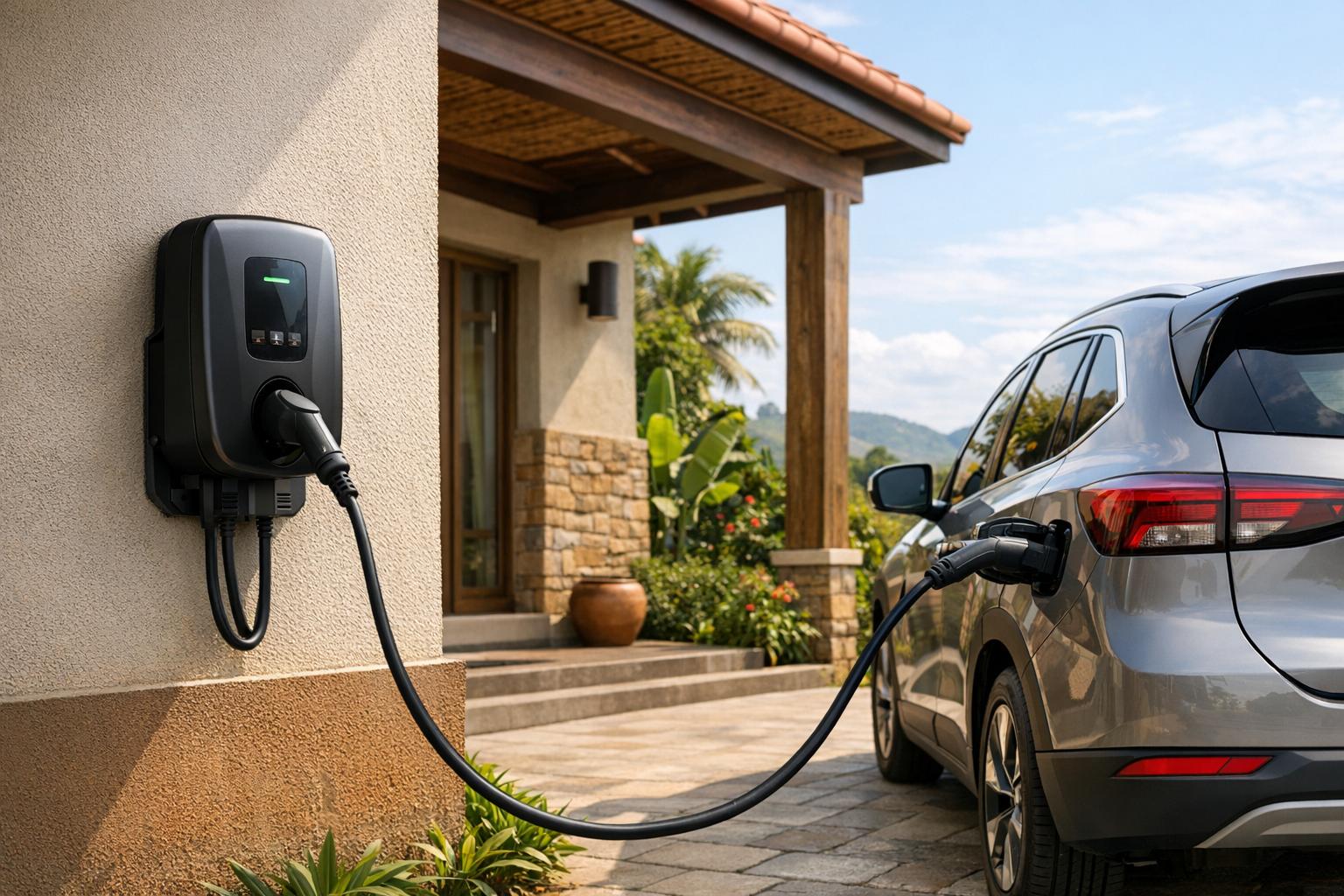
Installing a home EV charger in Rwanda in 2026 costs between $220 and $590 (300,000–800,000 RWF), depending on factors like the charger type and your home’s electrical setup. Level 1 chargers are cheaper and often included with EV purchases, while Level 2 chargers offer faster charging but require additional installation work and possibly electrical upgrades.
Key points to consider:
- Cost Breakdown: Equipment costs range from $0 to $2,500, and installation adds $269 to $769. Electrical upgrades for older homes may increase costs significantly.
- Government Incentives: Tax exemptions and subsidized electricity rates make installation more affordable.
- Installation Requirements: Use RURA-licensed electricians to ensure safety and compliance.
- Charger Options: Level 1 is slower but cheaper, while Level 2 provides faster charging and better efficiency.
Plan your setup based on your driving habits, home electrical capacity, and available incentives to minimize costs and ensure a smooth installation process.
Cost to Install an EV Charger at Home
Home EV Charger Costs in Rwanda: What to Expect in 2026
Installing a home EV charger in Rwanda typically costs between 300,000 and 800,000 RWF (about $220–$590 USD). This estimate includes both the equipment and labor for installation, though the final price may vary depending on your home’s electrical setup and the type of charger you choose. Key factors influencing costs include the charger level and whether electrical upgrades are needed.
The type of charger plays a major role in the overall expense. Level 1 chargers, which plug into standard outlets, require minimal installation work. In contrast, Level 2 chargers need a dedicated circuit, and your home may require upgrades like additional circuits or panel enhancements, adding to the total cost.
Government incentives help ease the financial burden. For instance, imported EV charging equipment is VAT-exempt until June 30, 2028, and electricity used for EV charging is billed at industrial rates. These incentives make the upfront costs more manageable for homeowners.
Some dealerships offer all-in-one EV solutions. For example, CFAO Mobility provides a 7-kilowatt charger installation along with a 3.3-kilowatt portable adapter for standard outlets. There are also bundled e-mobility packages that combine vehicles, charging stations, energy storage, and solar panels, offering a more budget-friendly and comprehensive approach.
When hiring an electrician, ensure they hold a valid RURA license. For standard residences (five bedrooms or fewer), a Class A professional is required. Licensing fees range from 30,000 to 100,000 RWF, and these are usually included in the installation quote. Verifying that your electrician is properly licensed ensures a safe and compliant installation.
Up next, we’ll break down the different types of chargers to help you choose the best option for your needs.
Types of Home EV Chargers
Choosing between a Level 1 or Level 2 charger depends largely on your driving habits in Rwanda. Let’s break down what each type offers and who they’re best suited for.
Level 1 chargers are the slower option, adding around 3 miles (4.8 km) of range per hour. These chargers are ideal for drivers who travel less than 40 miles (64 km) each day. Most electric vehicles (EVs) sold in Rwanda, such as BYD models, come with a 3.3-kilowatt portable adapter that plugs into any standard outlet.
On the other hand, Level 2 chargers provide faster charging and extra features. These chargers can fully recharge most EVs overnight and are more efficient, offering 90% energy efficiency compared to the 80% efficiency of Level 1 chargers. In Rwanda, a 7-kilowatt charger is the typical home installation, and CFAO Mobility includes one with EV purchases.
Srinivas Cheruvu, Managing Director of CFAO Mobility Rwanda, explains, "A 7-kilowatt charger completes a charge in about six to seven hours."
Level 2 chargers also support smart charging, allowing users to schedule charging during off-peak hours via mobile apps. This feature is especially valuable in Rwanda, where Kigali’s power lines hit 136% loading in 2024.
Tarek Keskes, an Energy Specialist at the World Bank, highlights the benefits of smart charging: "Shifting charging to off-peak hours or aligning it with solar generation can help ease the strain [on the grid]. Simulations show these strategies can reduce stress on the network by up to 15%."
For those commuting more than 40 miles daily, a Level 2 charger is the better choice. It ensures you avoid a "range deficit" by the week’s end and positions you to benefit from Rwanda’s upcoming time-of-use electricity tariffs. If your EV is parked outdoors, opt for a Level 2 charger with a NEMA 4 or 4X enclosure for added durability.
Cost Breakdown: Equipment and Installation
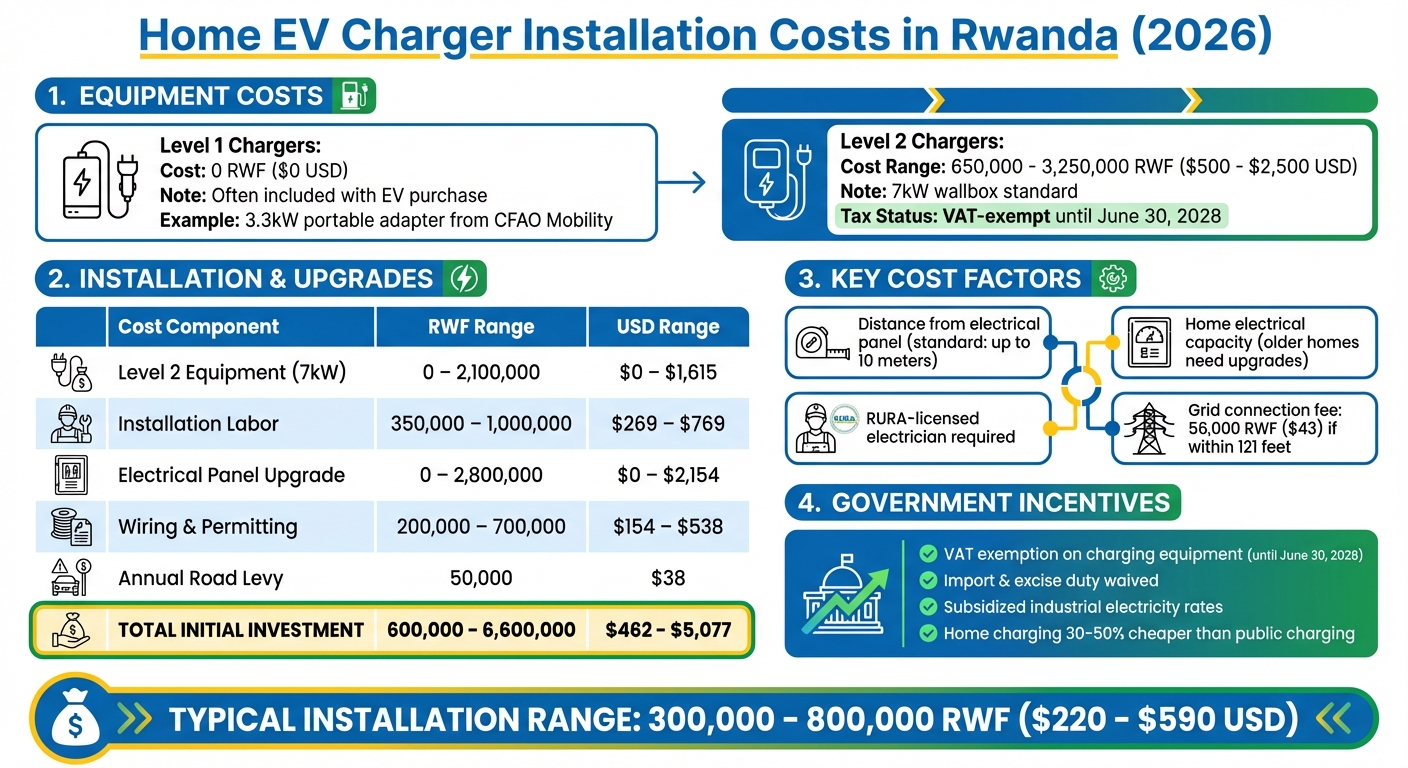
Home EV Charger Installation Costs in Rwanda 2026: Complete Cost Breakdown
Equipment Costs for Level 1 and Level 2 Chargers
In Rwanda, Level 1 chargers are often included with the purchase of an electric vehicle at no additional charge. For example, CFAO Mobility, the official distributor of BYD vehicles, provides a 3.3-kilowatt portable adapter with every EV sold.
For Level 2 chargers, prices range from 650,000 to 3,250,000 RWF (around $500 to $2,500). CFAO Mobility also includes a 7-kilowatt wallbox charger as part of their EV package. Additionally, tax exemptions from the Rwandan government on EV charging equipment help to lower these costs further.
Installation Costs and Local Service Providers
The cost of professional installation in Rwanda typically falls between 300,000 and 800,000 RWF, depending on the electrical capacity of your home. Local service providers like AUTO24.rw and CFAO Mobility offer complete installation services, covering everything from setup to after-sales support. CFAO Mobility, in particular, provides a full-service installation package to ensure a smooth and hassle-free process.
Installation costs can vary based on the distance between your home’s electrical panel and the charging point. Most standard installations cover up to 10 meters (approximately 32.8 feet) of cabling, while longer distances can increase the overall cost. For older homes, additional upgrades to the electrical panel and permitting requirements may further impact expenses.
Electrical Panel Upgrades and Permitting Fees
Older homes may require upgrades to their electrical panels to handle the demands of a 7-kilowatt Level 2 charger. These upgrades can push total costs above 3,900,000 RWF (approximately $3,000). All electrical work must be completed by electricians licensed by the Rwanda Utilities Regulatory Authority (RURA).
When hiring an electrician, it’s important to confirm they hold the appropriate license. Class A licenses are suitable for residential setups up to 230V, while Class B licenses are necessary for installations up to 400V, which are commonly used for faster Level 2 chargers. Licensing fees are typically included in installation quotes, with individual Class B licenses costing 100,000 RWF and company licenses priced at 300,000 RWF.
sbb-itb-7bc66b5
Government Incentives and Subsidies
Government incentives play a crucial role in making home EV chargers more affordable by reducing upfront costs. In Rwanda, tax incentives have been designed to ease the financial burden. For instance, all imported charging station equipment is exempt from Value Added Tax (VAT) until June 30, 2028. Additionally, import and excise duties are waived for charging hardware and accessories.
These measures are part of a larger government initiative aimed at accelerating EV adoption. Jean Bosco Mugiraneza, Director General of Energy at MININFRA, highlights:
"The master plan encompasses several strategic initiatives, such as infrastructure incentives including the provision of rent-free land, tax exemptions on equipment, and subsidised electricity rates (at the same cost as industry) to encourage private sector investment."
This approach not only encourages private investment but also helps reduce the costs associated with installing home chargers.
To maximize these benefits, users can take advantage of subsidized industrial electricity rates, which significantly lower ongoing charging expenses. The subsidy is automatically applied once your home charger is registered with the Rwanda Energy Group (REG). When purchasing, ensure your charger is classified as "imported fully electric vehicle charging station equipment" to qualify for these incentives.
For those requiring grid connections or electrical upgrades, the process is straightforward. Submit a Service Application Form to REG along with your ID and proof of land ownership. If the existing infrastructure is within 121 feet of your property, the standard low-voltage connection fee is 56,000 RWF (about $43).
Total Cost Estimates with Examples
Planning your total investment for an EV charging setup is crucial. The final expenses will vary based on whether the charger is included with your vehicle purchase, the electrical capacity of your home, and the complexity of the installation. Here’s a closer look at the estimated costs, building on earlier insights into installation and upgrade fees.
If you purchase an electric vehicle from CFAO Mobility, the cost of the charger is covered as part of the vehicle package. This includes a 7-kilowatt charger installation along with a 3.3-kilowatt portable adapter at no extra charge. However, you’ll still need to account for additional costs like electrical upgrades and an annual road levy, which is 50,000 RWF (about $38).
For those opting for standalone solutions, the costs can add up quickly. Buying a 7-kilowatt Level 2 charger separately typically costs between 700,000 and 2,100,000 RWF (approximately $538 to $1,615). Professional installation adds another 350,000 to 1,000,000 RWF ($269 to $769), depending on factors like the distance between your parking spot and your electrical panel. If your home has an older electrical system, you might need to upgrade your panel, which can cost anywhere from 700,000 to 2,800,000 RWF ($538 to $2,154). Additional expenses for wiring, conduits, and permitting fees range from 200,000 to 700,000 RWF ($154 to $538).
Cost Table: Full Breakdown
Below is a detailed breakdown of potential costs, including equipment, installation, and upgrades:
| Cost Component | Estimated Range (RWF) | Estimated Range (USD) |
|---|---|---|
| Level 2 Equipment (7kW) | 0 – 2,100,000 | $0 – $1,615 |
| Installation Labor | 350,000 – 1,000,000 | $269 – $769 |
| Electrical Panel Upgrade | 0 – 2,800,000 | $0 – $2,154 |
| Wiring & Permitting | 200,000 – 700,000 | $154 – $538 |
| Annual Road Levy | 50,000 | $38 |
| Total Initial Investment | 600,000 – 6,600,000 | $462 – $5,077 |
This table outlines the range of expenses you might face when setting up an EV charging solution in Rwanda. Whether your charger is included with your vehicle or purchased separately, it’s important to budget for potential electrical upgrades and installation fees to ensure a smooth setup process.
Conclusion
Installing a home EV charger in Rwanda by 2026 requires thoughtful planning, balancing costs, regulatory requirements, and available incentives. Government programs and improvements in local infrastructure play a key role in making this process more accessible. However, several factors will shape your overall expenses, including the type of charger you choose, the state of your home’s electrical system, and any necessary upgrades.
For standalone installations, costs typically fall between $700 and $2,500, though some bundled packages eliminate upfront installation fees altogether.
Start by evaluating your driving habits and confirming your home’s electrical capacity. Collaborate with qualified technicians licensed by RURA to ensure all work complies with regulations. Leveraging government-backed tax exemptions on EV equipment and taking advantage of subsidized electricity rates can significantly cut both initial and ongoing costs. This is especially important given that charging at home is generally 30–50% cheaper than public charging options.
Charging during off-peak hours can further lower electricity bills while reducing strain on the grid. This approach is crucial, particularly after Kigali’s power lines exceeded safe loading levels by 136% in 2024. To ensure long-term reliability, choose chargers that meet international standards like CCS2 or GB/T, aligning with Rwanda’s national e-mobility goals. By following these steps, you can achieve an efficient, cost-effective charging setup that complements the country’s growing electric vehicle ecosystem.
FAQs
What factors affect the cost of installing a home EV charger in Rwanda in 2026?
Several factors come into play when determining the cost of installing a home EV charger in Rwanda. One of the biggest considerations is the type of charger you select. A basic Level 1 charger, which connects to a standard outlet, is more affordable but charges at a much slower rate. On the other hand, a Level 2 charger, which requires a dedicated 240 V circuit, comes with a higher price tag. This is not just because of the unit itself but also due to potential electrical upgrades your home might need to support it.
Installation costs can vary widely based on the complexity of the work. If your setup requires extensive wiring, conduits, or panel upgrades, the costs will naturally increase. Additionally, the availability of skilled electricians in your area can influence pricing, as limited options may drive up labor costs. Beyond installation, electricity costs and grid reliability also play a role in long-term expenses. While Rwanda’s subsidized electricity rates make charging at home relatively affordable, frequent power outages might push you toward investing in backup solutions, which can significantly add to your initial costs.
Fortunately, government incentives can help offset these expenses. Rwanda offers tax exemptions on EV chargers, batteries, and related equipment, eliminating import taxes, excise duties, and VAT. Subsidized electricity rates for EV charging further ease the financial burden. However, it’s important to account for regulatory requirements, such as permits or compliance with safety standards. While these may add minor fees and paperwork, they are essential to ensure a safe and compliant installation.
How do government incentives help lower the cost of installing a home EV charger in Rwanda?
Government initiatives in Rwanda make installing a home EV charger much more affordable by tackling major expenses like equipment, installation, and electricity. For instance, tax exemptions on charging equipment remove import duties and VAT, potentially saving homeowners hundreds of dollars on the upfront cost. On top of that, subsidized electricity rates and rent-free land for any necessary site work further ease the financial burden.
Rwanda’s e-mobility policies also include customs and VAT waivers on all charging infrastructure until 2028, reducing the cost of home chargers by 15–20%. This means a Level 2 charger, which usually ranges from $1,200 to $4,000, becomes significantly more accessible. These combined efforts make setting up a home EV charger an economical and appealing option for Rwandan homeowners by 2026.
What factors should I consider when choosing between a Level 1 and Level 2 home EV charger?
Choosing between a Level 1 (120 V standard outlet) and Level 2 (240 V dedicated circuit) EV charger largely depends on how far you drive each day, how quickly you need to recharge, and your home’s electrical setup. If your daily driving is under 40 miles, a Level 1 charger, which adds about 3 miles of range per hour, might be enough to meet your needs. But if you regularly drive longer distances or rely on your EV frequently, a Level 2 charger – capable of adding 15–30 miles of range per hour – offers a more practical solution.
Think about how much downtime your vehicle has for charging. If you can leave your car plugged in overnight for 8–10 hours, a Level 1 charger could do the job. On the other hand, if you often need faster recharges, especially after longer trips, a Level 2 charger can save you a significant amount of time. Keep in mind, though, that installing a Level 2 charger usually requires professional help and may involve upgrading your home’s electrical panel, which adds to the initial cost. Despite this, the faster charging speed and future-proofing benefits make it a worthwhile investment for many EV owners.
Before making a decision, evaluate your home’s electrical capacity, consider the upfront and installation costs, and look into local incentives or subsidies that might help reduce expenses. Weighing these factors carefully will help you pick the charger that best fits your driving habits and lifestyle.
Related Blog Posts
- Electric car prices in Kigali in 2025: what can you afford?
- EV Charging vs. Fueling ICE Cars: Cost Analysis
- EV charging in Rwanda in 2026: where to charge + pricing + tips
- Used Electric Cars in Rwanda (2026): Best Deals + What to Avoid