Rwanda’s growing EV market brings both opportunities and challenges for vehicle maintenance. Here’s what you need to know:
- Battery Care: Batteries degrade over time, but keeping the charge between 20%-80% and avoiding full discharges can extend lifespan. Replacement costs vary: $5,000–$6,700 for a Nissan Leaf, up to $13,300 for a Tesla Model 3.
- Road Impact: Dusty, uneven roads accelerate wear on brakes, suspension, and filters. Regular inspections are key.
- Charging Challenges: Kigali’s grid strain can lead to slower charging times. Charging during off-peak hours helps reduce delays.
- Software Updates: Firmware updates improve performance and adapt to local terrain. Certified service centers ensure proper diagnostics.
- Durable Components: Electric motors, power electronics, and regenerative braking systems require minimal maintenance and last longer due to simpler designs.
Rwanda’s mild climate benefits EVs, reducing heat-related battery wear. With proper care, most batteries last 8–15 years. Local initiatives, tax exemptions, and growing expertise make EV maintenance more accessible. Regular maintenance and smart charging habits are crucial for long-term reliability.
EV Battery Replacement Costs and Maintenance Comparison in Rwanda 2026
Common EV Maintenance Problems in Rwanda
Battery Wear and Charging Problems
Battery wear is one of the top concerns for EV owners in Rwanda. While the country’s temperate climate spares batteries from extreme heat, practices like fully discharging (to 0%) or charging to 100% can still lead to premature wear.
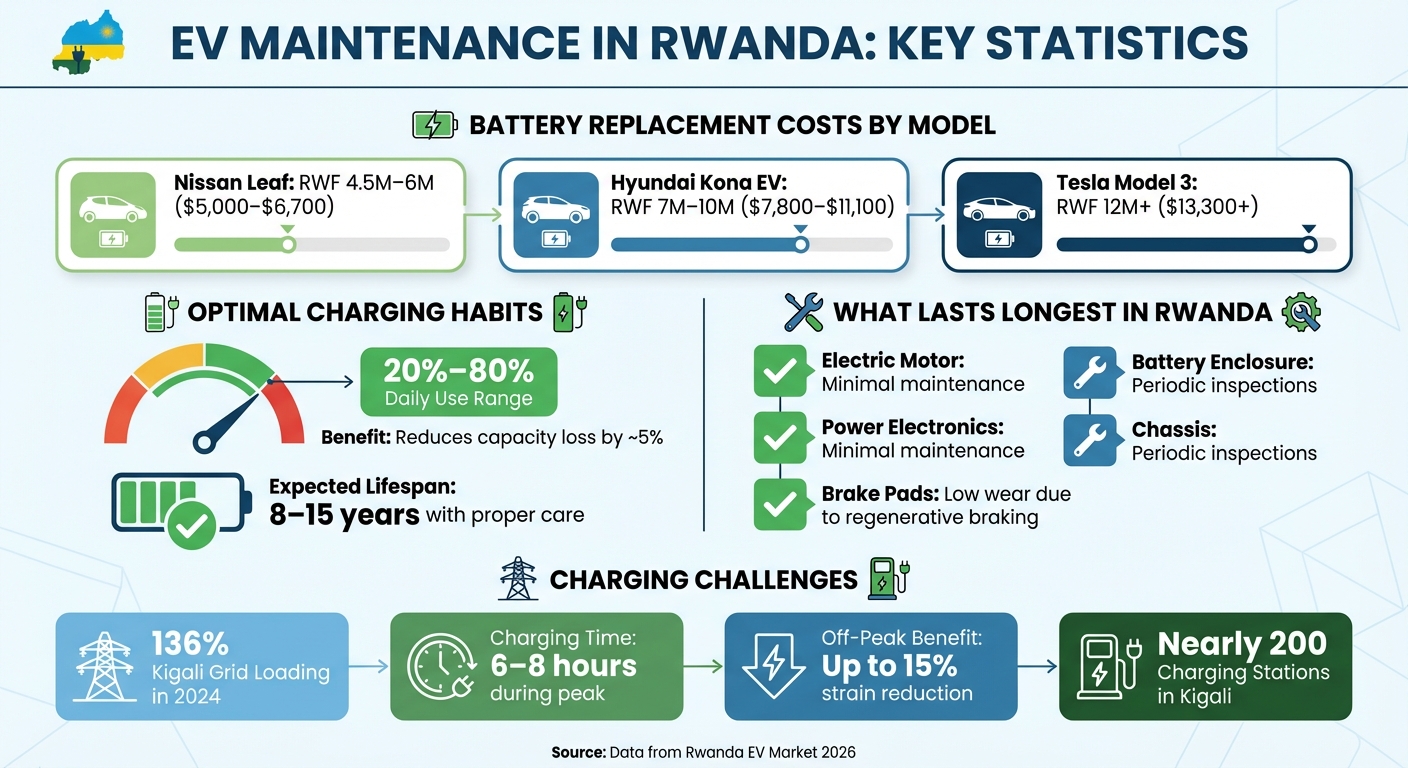
Another challenge is the strain on Rwanda’s power grid. For instance, Kigali experienced 136% line loading in 2024, which caused delays in charging times – stretching to 6–8 hours for electric motorcycle users.
To extend battery life, aim to keep the charge level between 20% and 80% for daily use. This simple habit can cut capacity loss by around 5%. Also, consider scheduling your charging during off-peak hours to ease grid pressure, potentially reducing strain by up to 15%. After driving, let your EV rest for 30–60 minutes to stabilize its thermal system, and save DC fast charging for long trips, as Level 2 home charging is gentler on the battery.
If you’re considering a second-hand EV – like a Nissan Leaf, Renault Zoe, or Hyundai Kona EV – always ask for a State of Health (SoH) report to gauge battery condition. Battery replacement costs can be steep: RWF 4.5M–6M ($5,000–$6,700) for a Nissan Leaf, RWF 7M–10M ($7,800–$11,100) for a Hyundai Kona EV, and over RWF 12M (about $13,300) for a Tesla Model 3.
As Francois Habimana, an EV fleet manager in Kigali, explains, "Replacing a battery is costly, but with proper care, most Rwandan EV drivers won’t need to think about it for at least a decade".
Beyond battery care, Rwanda’s unique road conditions bring additional challenges for EV maintenance.
How Dusty and Rough Roads Affect EV Parts
Rwanda’s unpaved and uneven roads, common in areas like Musanze and Huye, put extra stress on EV components. Suspension systems, brakes, and filters tend to wear out faster due to the mechanical strain from these rough terrains. Frequent regenerative braking in hilly regions adds to this wear and tear.
Dust is another culprit. Fine particles can clog cabin air filters, cooling systems, and even brake assemblies, leading to accelerated wear compared to what manufacturers typically expect for highway driving. Regular inspections and maintenance are key to keeping your EV running smoothly in these conditions.
These road-related challenges highlight the importance of adopting maintenance routines tailored to Rwanda’s driving environment.
Software and Diagnostic Issues
EVs aren’t just about hardware; their software and diagnostics can also pose challenges. In Rwanda, a shortage of technicians trained in high-voltage systems and advanced diagnostics remains a hurdle. Most general mechanics lack the expertise to handle the complexities of EVs.
François Zirikana, E-mobility Specialist for the City of Kigali, notes, "The government is working with local e-mobility operators to provide training to the youth".
Firmware updates are essential for optimizing battery performance and extending lifespan, especially in Rwanda’s hilly terrain where deep discharges are common. Without regular updates, your EV’s battery management system might struggle to adapt to local driving conditions.
To ensure proper care, rely on certified service centers equipped with the right diagnostic tools. Companies like Ampersand and Volkswagen Rwanda are actively developing local expertise in EV maintenance. For concerns about end-of-life batteries, SLS Energy offers diagnostic services and repurposes old EV batteries for stationary energy storage. Additionally, when buying used EVs, platforms like Auto24.rw now include battery health details in their listings, helping buyers make smarter decisions.
Inside KABISA: Rwanda’s EV Revolution | WIB Documentary
Durable EV Components: What Lasts Longest
Even in challenging environments, some EV components are built to go the distance. While regular maintenance is still crucial, certain parts of electric vehicles are designed with durability in mind, making them a reliable choice for Rwanda’s unique driving conditions.
Electric Motors and Power Electronics
Electric motors are built to last, thanks to their simpler design compared to traditional internal combustion engines. With fewer moving parts, these motors require little maintenance. Rwanda’s moderate climate also plays a role in extending the lifespan of power electronics, as it avoids the extreme heat that can cause damage in hotter regions. To further protect these components, they are enclosed in sealed housings that shield them from dust, moisture, and vibrations.
In areas like Musanze and Huye, where hilly terrain is common, regenerative braking offers an added advantage. It not only recovers energy but also reduces wear on brake pads, contributing to the motor’s longevity. For liquid-cooled systems, it’s essential to check coolant levels and hoses every six months. While regenerative braking reduces mechanical brake use, lubricating brake calipers annually – especially on dusty roads – can prevent issues like seizing. Regular firmware updates are also recommended to ensure optimal motor and battery performance.
This level of mechanical reliability supports the overall resilience of EVs, making them well-suited for Rwanda’s roads.
Chassis and Body Strength
The chassis design of EVs is another factor that enhances their durability, particularly on Rwanda’s rough and uneven roads. The heavy battery pack is strategically placed low in the vehicle, lowering the center of gravity. This improves stability and reduces the risk of rollovers, even on challenging terrain. Additionally, robust battery enclosures not only protect the battery from external damage but also reinforce the vehicle’s lower frame, adding an extra layer of strength during collisions and adverse weather conditions.
| Component | Maintenance Need | Why It Lasts in Rwanda |
|---|---|---|
| Electric Motor | Minimal | Fewer moving parts than conventional engines |
| Power Electronics | Minimal | Sealed protection and a moderate climate |
| Brake Pads | Low | Regenerative braking reduces wear |
| Battery Enclosure | Periodic inspections | Built to resist vibration and water exposure |
| Chassis | Periodic inspections | Low center of gravity enhances stability |
Most EV manufacturers back their vehicles with warranties of up to eight years or 100,000 miles (160,000 km), covering the battery and major electrical systems. This extended coverage underscores the durability of EV components, making them a dependable choice for Rwanda’s varied driving conditions.
sbb-itb-7bc66b5
Adjusting EV Maintenance for Rwanda’s Conditions
Dealing with Rwanda’s Climate and Altitude
Rwanda’s mild climate works in favor of EV batteries, as extreme heat – one of the main culprits behind battery degradation – is rarely an issue here. That said, the country’s hilly regions, like those in Musanze and Huye, pose their own set of challenges. While regenerative braking on downhill stretches helps conserve battery life, the constant strain of climbing steep inclines can wear down batteries faster.
To minimize the impact of Rwanda’s terrain on battery health, it’s recommended to keep the battery charge between 10% and 90% and prioritize Level 2 home charging over fast-charging stations. Parking in shaded or indoor areas can also help prevent heat buildup, even in Rwanda’s relatively mild temperatures. Staying on top of software updates is another must, as these updates often include improvements to battery management systems tailored for diverse driving conditions.
Given the demands of Rwanda’s unique geography, these practices are essential for maintaining your EV’s performance and ensuring long-term battery health.
Using Local Maintenance Resources
Proper EV maintenance in Rwanda goes beyond battery care – it requires tapping into the country’s growing network of local support services. Rwanda has made significant strides to accommodate EV needs. For instance, Kabisa has set up an EV-specific garage to handle specialized repairs. Additionally, the government has eliminated import duties, VAT, and excise taxes on EV spare parts, batteries, and charging equipment, making upkeep more affordable.
To address the technical skills gap, local TVET programs are training mechanics in EV-specific maintenance, and companies like Ampersand and Volkswagen Rwanda are teaming up with the government to provide hands-on technical training for young professionals. On top of that, Enviroserve Rwanda is working with EV companies to give degraded batteries – those at 80% capacity – a second life by repurposing them for stationary energy storage in mini-grids.
For those buying used EVs, platforms like AUTO24.rw offer added peace of mind with battery health reports and certified pre-owned listings that often include partial warranties. Regular inspections are also key: personal EVs must pass a technical safety inspection every year, while commercial EVs are checked every six months. If a vehicle fails inspection, repairs need to be completed and a re-inspection scheduled within 14 days, with a re-inspection fee set at 20% of the original cost.
Conclusion: What EV Owners in Rwanda Should Know
To keep your EV battery in good shape, aim to maintain its charge between 20% and 80% during daily use. Avoiding full charge cycles (0%–100%) can help reduce capacity loss by about 5% over time. With this kind of care, most EV batteries are built to last between 8 and 15 years, meaning you likely won’t face a replacement for at least a decade. This routine battery care pairs well with Rwanda’s temperate climate and a growing network of charging stations.
Rwanda’s mild weather is a natural ally for EV owners, as it minimizes heat-related battery wear. Plus, with nearly 200 charging stations in Kigali, owning an EV is becoming more convenient every day. Whenever possible, opt for Level 2 home charging instead of frequent fast charging. It’s easier on your battery and can also reduce strain on the power grid by up to 15%.
"Replacing a battery is costly, but with proper care, most Rwandan EV drivers won’t need to think about it for at least a decade." – Francois Habimana, EV fleet manager
To further extend your EV’s lifespan, take advantage of Rwanda’s growing EV support services. Certified technicians, government-backed tax incentives, and exemptions on import duties for EVs and their accessories make maintenance more accessible. Stay on top of software updates, use regenerative braking on Rwanda’s hilly terrain, and always ask for a State of Health report if you’re buying a used EV. Although Rwanda’s EV industry is still in its early stages, trained professionals and battery repurposing programs are already available. With these tips, Rwandan EV owners can confidently enjoy reliable and long-term performance from their vehicles.
FAQs
How can I extend the lifespan of my EV battery in Rwanda?
To get the most out of your EV battery in Rwanda, it’s all about smart charging practices and making the most of the local environment. For everyday use, aim to keep your battery charge between 20% and 80%. Save that full 100% charge for when you’re planning longer trips. Also, try to limit how often you use fast chargers – they generate heat, which can gradually reduce your battery’s capacity. A Level 2 home charger is a better option for slow, steady charging.
Rwanda’s moderate climate works in your favor, as extreme heat tends to wear batteries down faster. Still, it’s a good idea to park in shaded or covered spots to avoid unnecessary temperature spikes. And don’t overlook the benefits of the country’s hilly terrain – regenerative braking can help recover energy while easing the load on your battery. Regular upkeep, like checking for corrosion on battery terminals and monitoring voltage levels, is another simple way to keep things running smoothly. By pairing good charging habits with Rwanda’s natural advantages, you can keep your EV battery performing well for years, potentially even outlasting its warranty.
What are the main maintenance challenges for EVs in Rwanda?
Electric vehicles (EVs) in Rwanda come with a unique set of maintenance challenges, influenced by the local environment and infrastructure. One major concern is battery performance. Over time, frequent fast-charging can reduce battery efficiency, and Rwanda’s warm climate may contribute to overheating issues, further impacting longevity.
The country’s hilly and uneven terrain also takes a toll on EVs. Brake and drivetrain components often experience increased wear due to the extra strain from navigating steep slopes and rugged roads. On top of that, rough road conditions in certain areas can lead to faster wear and tear on suspension systems and tires, making regular inspections and replacements a necessity.
To keep your EV running smoothly on Rwanda’s roads, it’s crucial to stay on top of maintenance schedules and use the right tools for the job. Proactive care can go a long way in preserving your vehicle’s performance and durability.
Where can I get my EV serviced in Rwanda?
In Rwanda, several certified service centers cater specifically to electric vehicles (EVs). CFAO Mobility BYD in Kigali stands out for its dependable after-sales services. China Electric Vehicle Rwanda Ltd focuses on specialized EV maintenance, while GoKabisa, the largest EV dealer in East Africa, operates a dedicated service center. These facilities are equipped to meet the unique requirements of EV owners, helping to keep vehicles running smoothly.
Related Blog Posts
- How Rwanda’s Hills Affect EV Range
- Electric vs Petrol cars in Rwanda
- Rwanda’s EV Road Projects: Progress and Impact
- Electric Cars in Rwanda: Models and Charging Points