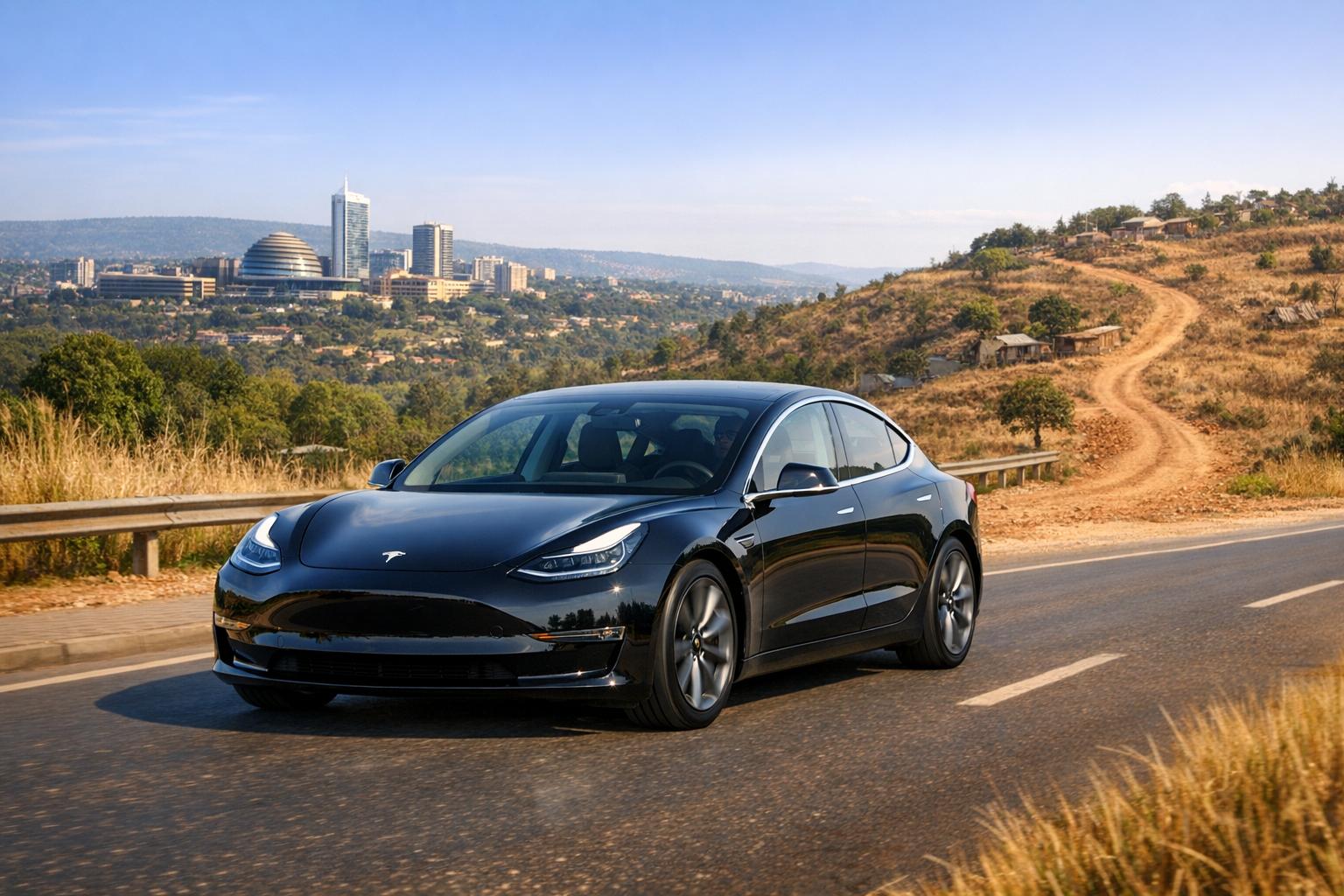
Owning a Tesla in Rwanda in 2026 presents both opportunities and challenges. While government incentives like zero import duties and subsidized electricity ($0.10/kWh) make EVs more affordable, Tesla‘s high price ($58,000 for the Model Y) and limited service options create hurdles. Kigali’s 200 charging stations (only 35 for cars) support urban Tesla owners, but rural drivers face range anxiety and maintenance difficulties. Competing brands like Volkswagen and Mitsubishi offer more affordable and terrain-friendly options, including hybrids that address Rwanda’s charging limitations.
Key Points:
- Cost: Tesla Model Y starts at $58,000; government incentives reduce overall costs by ~48%.
- Charging: Kigali has ~35 car-friendly charging stations; rural areas lack sufficient infrastructure.
- Maintenance: No Tesla service centers; AUTO24 Rwanda handles repairs but lacks trained technicians.
- Alternatives: Brands like Volkswagen and Mitsubishi offer more affordable and practical options, especially hybrids for rural areas.
For Kigali residents, Tesla ownership is feasible, but outside the city, alternatives may be more practical.
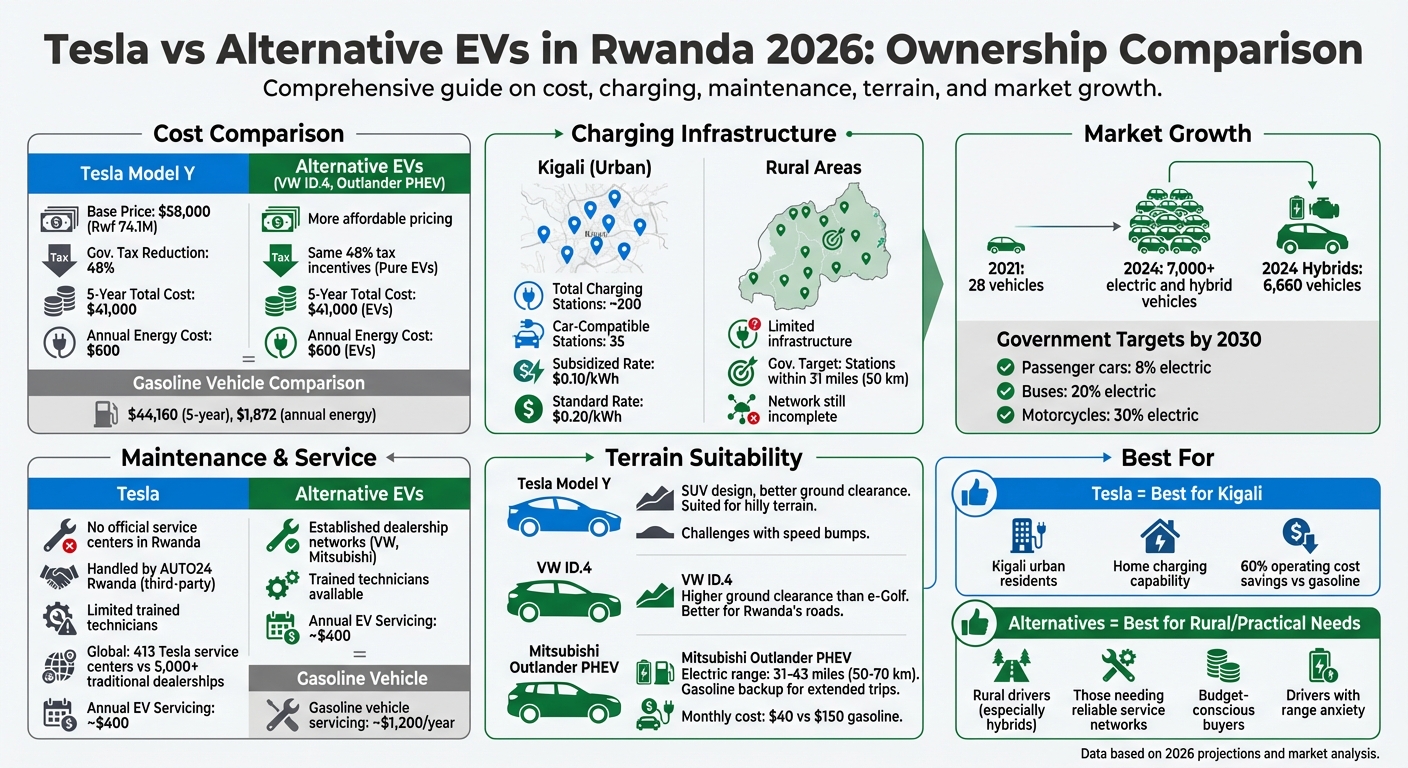
Tesla vs Alternative EVs in Rwanda 2026: Cost, Infrastructure and Practicality Comparison
1. Tesla Ownership in Rwanda
Charging Infrastructure
As of late 2025, Kigali boasts around 200 charging stations, but only about 35 are designed for cars, with most catering to electric motorcycles instead. Outside the city, Tesla owners face limited charging options, making home charging the primary solution for many. Electricity costs for EV charging are subsidized at $0.10 per kWh, and off-peak charging has helped reduce grid strain by about 15%. However, these charging limitations lead directly to another challenge: service and maintenance.
Maintenance and Service Support
Tesla does not have official service centers in Rwanda. Instead, AUTO24 Rwanda manages sales and support, having introduced the Tesla Model Y in March 2024. Ivan Ruzibiza, Country Manager of AUTO24 Rwanda, highlights the lower maintenance costs of EVs and the absence of regular refueling needs. Despite these advantages, Rwanda still lacks a sufficient number of skilled technicians to handle advanced EV repairs. This concern was echoed by Kigali accountant Paul Frobisher Mugambwa, who remarked:
"If you buy an imported Chinese electric SUV, who is going to fix your car when it breaks down?"
Globally, Tesla operates 413 service centers, a stark contrast to the 5,000+ traditional auto dealerships available worldwide. Prospective Tesla buyers in Rwanda are advised to visit AUTO24 at Joe House, Kigali, to understand warranty and repair terms. These service limitations add another layer of complexity and cost for Tesla owners.
Affordability
In Rwanda, the Tesla Model Y starts at $58,000 (approximately Rwf 74.1 million). While this price is high, government tax exemptions – including waivers on import duties, VAT, and excise duties – help reduce the total cost by about 48%. Over five years, operating an EV is estimated to cost $41,000, compared to $44,160 for a gasoline vehicle, thanks to savings on energy and maintenance. Still, Teslas remain a luxury item, especially in a country where nearly half the population lives on less than $2.15 per day. Additionally, Rwanda’s rugged roads and frequent high speed bumps pose challenges for low-clearance vehicles, as seen with the VW e-Golf’s earlier struggles. These factors make Tesla ownership a costly and, at times, impractical choice.
Government Policies
Despite these hurdles, Rwanda’s government is actively working to make EVs more viable. The country has set ambitious goals to electrify 8% of passenger cars, 20% of buses, and 30% of motorcycles by 2030. Alongside tax incentives, EV owners benefit from "Green License Plates", which come with perks like free parking and access to congestion zones. To further support EV adoption, new building codes now require EV-ready infrastructure in new constructions. Additionally, all new buses in Kigali must be electric, with Ecofleet Solutions assisting in this transition. Dr. Jimmy Gasore, Minister of Infrastructure, emphasized this commitment:
"The Government of Rwanda is committed to accelerating the transition to electric mobility as part of our climate and development agenda"
However, Kigali’s power grid is already under strain, with line loading reaching 136% in 2024 and peak demand expected to grow by 64% by 2030. Significant upgrades to the grid will be necessary to meet these demands.
Tesla Model Y Review : Features, Specs, and First Impressions
2. Other EV Options in Rwanda
Rwanda’s electric vehicle (EV) market offers several alternatives to Tesla, catering to the country’s specific needs and conditions. While Tesla’s premium pricing may limit its accessibility, options like the Volkswagen ID.4 and Mitsubishi Outlander PHEV provide more practical and adaptable solutions for local terrain and infrastructure.
Affordability
The Volkswagen ID.4, designed with higher ground clearance, addresses the challenges that plagued the e-Golf on Rwanda’s uneven roads and frequent speed bumps. For those worried about range, the Mitsubishi Outlander PHEV strikes a balance between electric efficiency and long-distance capability. This plug-in hybrid delivers an electric-only range of 31 to 43 miles (50 to 70 km) and includes a gasoline engine for extended trips. Joshua Nshuti from Greenleaf Motors highlights the appeal of hybrids in Rwanda:
"A hybrid vehicle eliminates the range anxiety as it can switch to gasoline, which is relevant as we are still far behind with charging infrastructure in Rwanda."
For Kigali residents, the Outlander PHEV offers a cost-effective solution, with monthly charging expenses of about $40 compared to $150 for gasoline. Additionally, electric motorcycles, such as those from Ampersand and Spiro, have gained significant traction. With over 7,000 electric and hybrid vehicles on the roads as of 2024, these e-motorcycles – priced around $500 – use battery-swapping systems to provide an affordable entry point into EV ownership. However, affordability alone isn’t enough; reliable aftersales service is equally important.
Maintenance and Service Support
Both Volkswagen and Mitsubishi have established dealership networks in Rwanda, but the limited availability of skilled EV technicians, especially for imported models, contributes to higher maintenance costs. Annual servicing for EVs averages around $400, compared to $1,200 for gasoline-powered vehicles. To address this gap, Kabisa, a local e-mobility company, is working to import more EV models and expand charging infrastructure. Meanwhile, electric motorcycles benefit from simpler maintenance, thanks to battery-swapping networks that reduce downtime and streamline repairs.
Charging Infrastructure
Rwanda’s charging network supports CCS2 and GB/T standards, but North American Tesla models require adapters to connect. Kigali currently hosts about 35 charging stations that accommodate all EV brands. Efforts to expand this infrastructure are being driven by partnerships between private companies like EvPlugin and government-backed initiatives such as the Rwanda Green Fund (Ireme Invest).
A standout example is the Nyabugogo transit hub, where 18 chargers powered by an 800-kW rooftop solar system serve as a central point for EV users. In public transportation, electric buses from BasiGo and IZI Electric are spearheading Kigali’s electrification push, aligning with government regulations that mandate all new buses to be electric. Sahr Kpundeh, World Bank Country Manager for Rwanda, emphasizes the broader impact of these efforts:
"Electric mobility is not only about cleaner buses. It is about building the foundations of a modern economy powered by sustainable energy."
With these advancements in charging infrastructure, Rwanda’s EV market is steadily evolving, offering practical solutions for a range of vehicles and users.
sbb-itb-7bc66b5
Pros and Cons
Deciding between a Tesla and other electric vehicles (EVs) in Rwanda requires a careful look at practical considerations. While government incentives apply to all EVs, the ownership experience can vary widely depending on the brand. Let’s break down the key differences between Tesla and other EV options in the Rwandan market.
Tesla does have some standout advantages. For starters, tax incentives help reduce operating costs by about 60% compared to gasoline vehicles. Additionally, the Tesla Model Y, with its SUV design, is better suited for Rwanda’s hilly terrain than lower-clearance sedans. But Tesla ownership isn’t without its hurdles. Without a dedicated Tesla service center in Rwanda, owners must rely on third-party importers like AUTO24. This also means a limited number of qualified technicians are available for repairs.
On the other hand, other EV brands like the Volkswagen ID.4 and BYD models come with established dealership networks, such as VW Mobility Solutions and CFAO Mobility. These dealerships provide trained technicians and dependable service support. Like Tesla, these vehicles benefit from tax incentives and enjoy subsidized charging rates of $0.10 per kilowatt-hour, compared to the standard $0.20/kWh. Their designs are also more tailored to Rwanda’s road conditions, making them practical for daily use. Allan Kweli from Volkswagen Mobility Solutions explains:
"The unevenness in road infrastructure and the height of speed-bumps turned out to be too challenging for the e-Golf, which has a relatively low ground clearance".
For drivers worried about range anxiety, plug-in hybrids like the Mitsubishi Outlander PHEV offer a unique solution. These vehicles can switch to gasoline when needed, a big plus given that only 35 out of Kigali’s nearly 200 charging stations are specifically designed for cars. As Joshua Nshuti from Greenleaf Motors points out:
"A hybrid vehicle eliminates the range anxiety as it can switch to gasoline, which is relevant as we are still far behind with charging infrastructure in Rwanda".
However, hybrids don’t qualify for the same full tax exemptions as pure EVs. Despite this, their popularity has soared, with adoption jumping from 28 vehicles in 2021 to 6,660 in 2024.
From a cost perspective, EVs offer long-term savings. Over five years, the total cost of owning an EV is about $41,000, compared to $44,160 for a gasoline vehicle. Annual energy costs for EVs are also significantly lower, dropping from $1,872 to $600. While these savings are appealing, challenges like limited maintenance support and sparse charging infrastructure outside Kigali remain important factors in deciding between a Tesla and other locally supported EV options.
Conclusion
Is owning a Tesla in Rwanda in 2026 a practical choice? That largely depends on how charging infrastructure, maintenance services, and terrain challenges stack up, especially when comparing urban and rural settings.
For drivers in Kigali, Tesla ownership seems promising. With subsidized electricity priced at just $0.10 per kWh and government incentives slashing taxes by 48%, the cost of owning and operating a Tesla in the city becomes much more manageable. These factors make Teslas a sensible option for urban commuting, where infrastructure and support are more accessible.
However, the picture changes outside Kigali. While the government plans to ensure charging stations are available within 31 miles (50 km) of any location, the network is still incomplete. Rural Tesla owners may face range anxiety, tough terrain filled with high speed bumps, and limited access to reliable maintenance. The absence of an official Tesla service center means repairs often fall to third-party importers like AUTO24 Rwanda, raising questions about the long-term feasibility of ownership in these areas.
FAQs
What challenges might you face owning a Tesla in rural Rwanda?
Owning a Tesla in rural Rwanda is not without its hurdles. One of the biggest issues is the limited charging infrastructure. Outside of Kigali, public chargers are few and far between. Even when you do find one, they tend to be slow, making long-distance travel both inconvenient and time-consuming.
Another challenge is the lack of maintenance and service support in rural areas. Most Tesla owners have to depend on technicians based in Kigali or import parts from abroad. This often leads to delays and higher costs, making repairs and regular upkeep more complicated.
On top of that, the rugged terrain in rural regions puts extra strain on Tesla vehicles. Unpaved roads and steep inclines can wear down electric drivetrains and reduce battery efficiency over time. These conditions make it harder for Teslas to perform optimally, adding another layer of difficulty for owners outside urban areas. Together, these factors paint a clear picture of the challenges tied to owning a Tesla in rural parts of Rwanda.
How do government incentives make owning a Tesla in Rwanda more affordable?
Rwanda’s government has introduced incentives that make owning a Tesla much more affordable by cutting down significant taxes. Since April 2021, electric vehicles, including Teslas, have been exempt from import duties and value-added tax (VAT). Typically, buyers of traditional cars face a 25% VAT and import levies of 20–30%, but these are waived for EVs. This means a Tesla, which might cost around $55,000 in other markets, can be purchased in Rwanda for nearly its base price – saving buyers thousands of dollars upfront.
On top of that, operating a Tesla in Rwanda is cheaper thanks to special electricity rates set at roughly $0.20 per kWh for EV charging. This is a fraction of the cost of gasoline, which averages about $4.92 per gallon. The government also promotes local e-mobility infrastructure, including service centers and spare parts, which helps lower maintenance expenses. These policies make Tesla ownership a more accessible and practical option for Rwanda’s high-income residents.
What maintenance options are available for Tesla owners in Rwanda?
Tesla owners in Rwanda have the support of AUTO24 Rwanda for after-sales service and warranty assistance. As the authorized dealer for Tesla’s Model Y in the country, AUTO24 handles everything from routine check-ups to warranty-covered repairs and general upkeep.
One of the perks of owning a Tesla is the reduced maintenance compared to traditional vehicles, thanks to fewer moving parts. AUTO24 highlights this advantage, making Tesla ownership even more appealing. While Rwanda doesn’t yet have dedicated Tesla service centers, AUTO24 bridges the gap by offering access to trained partner workshops and remote diagnostic services tailored to electric vehicles. This ensures Tesla owners get the specialized care their cars require.
Related Blog Posts
- AUTO24 and the Rise of Luxury EVs in Rwanda
- Popular Hybrid and Electric Cars in Rwanda
- Top 5 Compact EVs for Rwanda in 2025
- Tesla in Rwanda: Is It Possible and at What Cost?