Looking to buy a used electric car in Rwanda? Here’s what you need to know:
- Government incentives: Rwanda offers an 80% reduction in import duties and VAT exemptions on electric vehicles (EVs), making them more affordable.
- Factors to consider: Battery health, charging infrastructure, and proper documentation are critical when buying a used EV.
- Top models: Popular options include the Nissan Leaf (budget-friendly), Hyundai Kona Electric (family-friendly), and Tesla Model 3 (premium).
- Charging options: Rwanda’s charging network is expanding, especially in Kigali and along highways. Home charging (Level 2) is cost-effective and widely used.
- Costs: Used EVs range from $11,250 to $33,750. EVs save up to 70% on operating costs compared to gas cars, but battery replacements can cost $3,375–$9,000.
- Avoid scams: Always request a certified battery health report, verify documents, and inspect the vehicle thoroughly before purchase.
Quick tip: For a smoother experience, buy from trusted platforms like AutoMag.RW, which offer verified listings with battery health details and assist with paperwork.
Rwanda’s Used EV Market in 2026
Rwanda’s used electric vehicle (EV) market has grown rapidly, thanks to a combination of government incentives and economic shifts. Plug-in hybrids now benefit from a 50% reduction in import duties and partial VAT exemptions, making fully electric options even more appealing to buyers.
Recent hikes in fuel prices have further highlighted the cost-saving advantages of EVs over time. Additionally, with over half of Rwanda’s electricity coming from renewable sources, owning an EV aligns with the country’s clean energy ambitions while offering drivers a more sustainable charging option. These developments paint a clear picture of the forces shaping Rwanda’s EV market.
What’s Driving EV Growth in Rwanda
Rwanda’s EV growth isn’t just about tax incentives. The country’s mild climate helps preserve EV battery life, while its hilly terrain – particularly in areas like Musanze and Huye – enables regenerative braking during descents, boosting battery efficiency.
Infrastructure is also improving steadily. Public charging stations are no longer limited to Kigali; they’re now being installed along key highways and in major business hubs. DC fast chargers are making long-distance travel more convenient. Companies like Ampersand and Volkswagen Rwanda are leading the charge in building the EV ecosystem, while certified pre-owned platforms are offering partial battery warranties, easing concerns for second-hand buyers.
As Aline Kamanzi from a local EV advocacy group explains, "We’re just at the beginning of Rwanda’s electric journey. And battery tech is improving every year".
With better infrastructure and more favorable conditions, a wide variety of EV models are now available to meet the needs of Rwandan consumers.
Common EV Brands and Models Available
The used EV market in Rwanda offers something for everyone, from budget-friendly options to premium models. The Nissan Leaf remains a popular entry-level choice for city driving, offering a battery life of 8–10 years and an 8-year/100,000-mile warranty. Chinese brands are also gaining traction, with models like the BYD Dolphin, Leapmotor T03, and BYD Tang becoming more common alongside traditional options.
For those prioritizing range and longevity, the Hyundai Kona Electric offers a battery life of 10–15 years and an 8-year/100,000-mile warranty. Buyers looking for high-end options can consider the Tesla Model 3, which provides 12–15 years of battery life backed by an 8-year/120,000-mile warranty. Meanwhile, the Renault Zoe is an excellent choice for compact city driving, with a battery life of 8–12 years.
Diane Uwase, an EV sales expert based in Kigali, advises, "Always request a battery health report before purchasing a second-hand EV. Some models on certified platforms already display this info in the listings".
How to Inspect a Used EV
Inspecting a used electric vehicle (EV) requires a different approach than evaluating a traditional gasoline-powered car. While the battery is the centerpiece of your assessment, it’s also crucial to check charging compatibility and look for mechanical wear specific to EVs. Here’s a practical guide tailored to ensure you’re making an informed decision.
Battery Health and Range Testing
The battery’s condition is key to understanding an EV’s performance. The State of Health (SoH) percentage tells you how much capacity remains compared to when the battery was new. Many EVs provide this data via the dashboard or system settings, showing details like cell balancing and charging status. Be sure to ask the seller for a certified battery report.
When test-driving the vehicle, follow the "80% Rule." Request that the car not be charged beyond 80% beforehand. Drive until the battery is drained by 10–20%, then plug it into a fast charger to confirm the charging rate meets expectations. Record the dashboard readings – range, odometer, and state of charge – before and after your drive. Use these numbers to calculate the car’s real-world range by dividing the miles driven by the percentage of battery used.
"An EV battery doesn’t die overnight. It gradually loses capacity, just like your smartphone battery", says Jean-Claude N., an EV technician based in Kigali.
Don’t forget to test the regenerative braking system. This feature is particularly useful in hilly regions like Musanze or Huye, where it helps preserve battery life and extend range. Also, check the vehicle’s warranty status. Most manufacturers offer warranties covering 8 years or 100,000 miles, and these are often transferable to new owners.
Charging System Compatibility
Charging compatibility is another critical factor to evaluate. Ensure the vehicle’s charging port matches Rwanda’s infrastructure. Type 2 ports are commonly used for AC charging, while CCS ports are standard for DC fast charging. Some older models, like early Nissan Leafs, use CHAdeMO ports, which can pose challenges in an AC-dominant public charging network. Converting a CHAdeMO port or buying an adapter can cost over $2,000 (around 3.2 million RWF).
Physically test the charging system by plugging the car into a station. Confirm the locking mechanism works and that the vehicle communicates properly with the charger. Inspect the charging cables for damage, as replacements can cost at least $100 (about 160,000 RWF). Lastly, verify the vehicle’s ability to charge using both a standard outlet (8–15 hours) and a Level 2 home wallbox (3–8 hours).
Mechanical Condition Check
EVs are heavier than traditional cars, which can lead to faster wear on tires, brakes, and suspension – especially on Rwanda’s diverse road conditions. Check the tires for uneven wear and listen for unusual noises that might indicate suspension issues.
While test-driving, pay close attention to the brakes. Note how seamlessly the system transitions between regenerative and mechanical braking modes. To evaluate energy consumption, turn on the radio and air conditioning and observe how they affect the predicted driving range. If the EV supports vehicle-to-load (V2X) features, try charging a small device like a phone from the car’s ports.
Finally, make sure the car has a valid technical inspection certificate and check that the logbook matches the seller’s ID to avoid any paperwork problems.
Best Used EV Models for Rwanda in 2026
Used Electric Vehicle Comparison Guide for Rwanda 2026
Picking the right used electric vehicle (EV) depends on your driving habits and specific needs. In Rwanda, the climate and terrain work in favor of EV performance, making them an increasingly practical choice. Selecting a model that fits your environment also simplifies inspections, as discussed earlier. Below, we break down some great options for city driving, family use, and commercial needs.
Compact EVs for City Driving
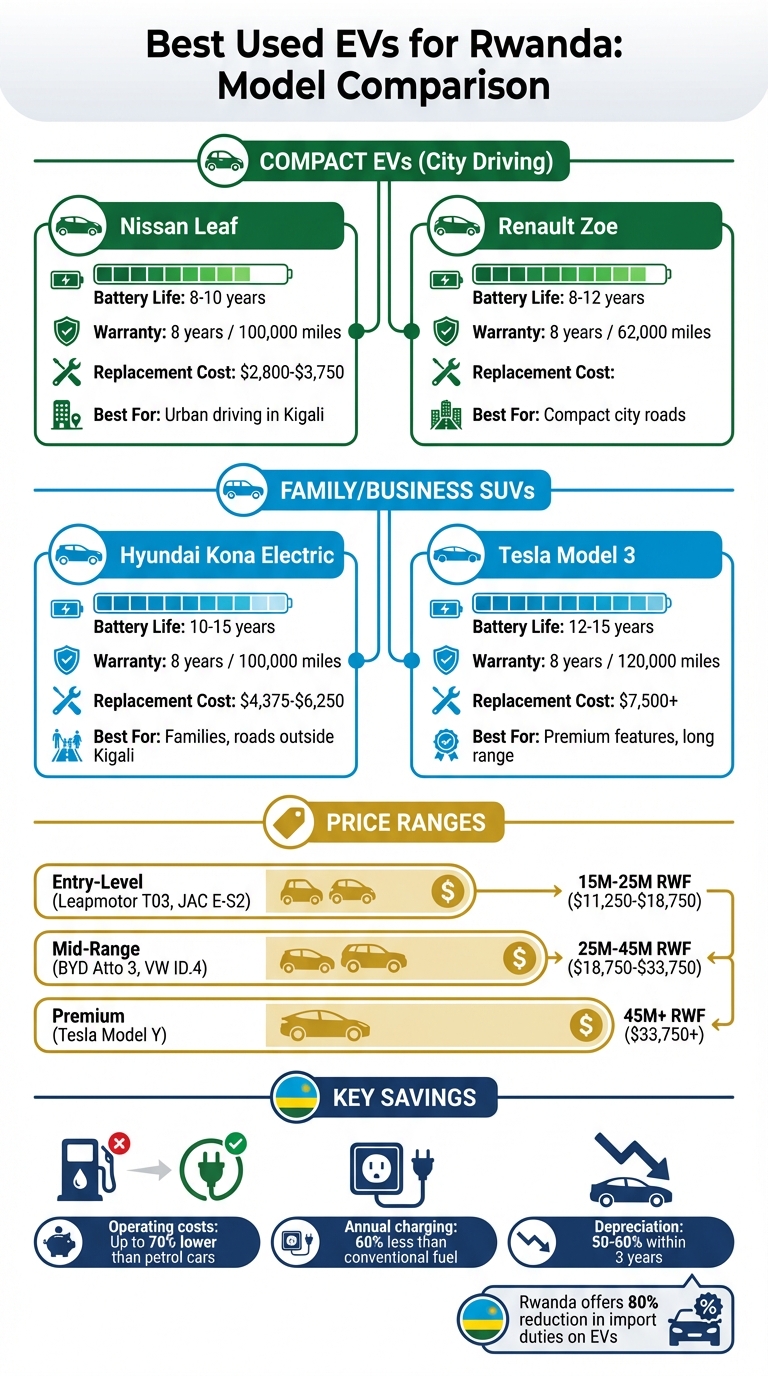
The Nissan Leaf continues to be a popular choice in Kigali. It’s affordable, easy to maintain, and perfectly sized for navigating urban streets. Its battery typically lasts 8–10 years, with a standard warranty covering 8 years or 100,000 miles. If a replacement is ever needed, the cost ranges from $2,800 to $3,750, which is manageable given the Leaf’s reliability and longevity.
Another excellent option is the Renault Zoe, which offers a slightly longer battery lifespan of 8–12 years. Its warranty covers 8 years or 62,000 miles. Thanks to its compact design, it’s a great fit for Rwanda’s city roads. Both models are budget-friendly and well-suited for Kigali’s urban environment.
SUVs and Larger EVs for Families or Business
For families, the Hyundai Kona Electric is a solid choice. With a battery life of 10–15 years and an 8-year/100,000-mile warranty, it provides peace of mind. Its higher ground clearance makes it suitable for navigating roads outside Kigali. Battery replacements, typically needed only after a decade, cost between $4,375 and $6,250.
If you’re looking for something more advanced, the Tesla Model 3 is becoming a viable option as imports increase. It boasts a battery lifespan of 12–15 years and a warranty covering 8 years or 120,000 miles. While it offers cutting-edge features and performance, battery replacement costs can exceed $7,500, making it a pricier choice. Still, for those who prioritize technology and range, it’s worth considering.
Electric Vehicles for Commercial Use
The used market for commercial EVs in Rwanda is still developing, but companies like Volkswagen Rwanda and Ampersand are making strides in expanding the country’s e-mobility infrastructure. For small business owners, durability and access to reliable service networks are key factors. Certified pre-owned options with remaining warranty coverage can also help save on future repair costs.
"Replacing a battery is costly, but with proper care, most Rwandan EV drivers won’t need to think about it for at least a decade", says Francois Habimana, an EV fleet manager in Kigali.
These models provide a strong starting point for evaluating costs, financing, and ownership details, which are explored in the next section.
Pricing, Financing, and Ownership Costs
Used EV Price Ranges
In Rwanda, the price of used electric vehicles (EVs) can vary significantly depending on factors like battery health, the car’s age, and its remaining range. Entry-level models such as the Leapmotor T03 and JAC E-S2 generally fall between 15,000,000 RWF and 25,000,000 RWF ($11,250–$18,750). Mid-range options, including the BYD Atto 3 and Volkswagen ID.4, range from 25,000,000 RWF to 45,000,000 RWF ($18,750–$33,750). On the higher end, premium models like the Tesla Model Y start at 45,000,000 RWF ($33,750) and can go up from there.
It’s worth noting that EVs tend to depreciate between 50% and 60% within three years. The condition of the battery is a key factor in determining a vehicle’s resale value.
"Rwanda has put in place policies to encourage the shift to e-mobility with exemptions on import taxes, excise duty, and a zero VAT for all e-vehicles", says Fidele Abimana, Permanent Secretary at the Ministry of Infrastructure.
These price ranges set the stage for exploring financing options and the broader financial benefits of EV ownership.
Financing and Payment Plans
To make EVs more accessible, financing options have become more flexible for buyers of used models. Certified pre-owned vehicles with partial battery warranties are helping to lower financial risks for consumers. Many dealerships now offer payment plans, although high interest rates can still drive up the total cost of financing.
When buying a used EV, it’s essential to check the battery’s condition. Requesting a recent State of Health (SoH) report is key to ensuring the price reflects the vehicle’s actual value. Additionally, comparing interest rates across banks can help reduce financing costs.
Total Ownership Costs
Switching to an EV can lead to substantial savings over time. For mid-range EVs, operating costs can be up to 70% lower than those of petrol-powered cars over a five-year period. Additionally, annual charging expenses are about 60% less than the cost of conventional fuel. Since most EV owners in Rwanda charge their vehicles at home or work – about 80–90% of the time – installing a Level 2 home charging station, which costs between 300,000 and 800,000 RWF ($225–$600), is a smart investment.
EVs also require less maintenance compared to traditional vehicles. There are no oil changes, and regenerative braking reduces the need for frequent brake replacements. However, insurance premiums for EVs can be up to 33% higher, primarily due to risks associated with battery replacement. On the environmental front, Rwanda’s electricity grid, which derives more than 50% of its energy from renewable sources, adds an eco-friendly advantage to owning an EV.
"Our plan is not only to sell a new car brand in Rwanda, but also to offer the customers an all-inclusive e-mobility package… including an adapted charging station", explains Pierre Toulotte, BYD Brand Manager.
For entry-level EVs, ownership costs over five years are 20–30% lower, while mid-range models can save up to 70% on operating expenses. Combined with Rwanda’s growing charging infrastructure in Kigali and along major highways, these savings make EVs an increasingly attractive choice for drivers looking to reduce costs and embrace greener transportation.
sbb-itb-7bc66b5
What to Avoid When Buying Used EVs
When buying a used EV in Rwanda, it’s not just about checking the battery and mechanics. There are a few other common traps you’ll want to avoid to make sure your purchase is worth the investment.
Misleading Battery Condition Claims
Some sellers might overstate the condition of an EV’s battery to justify a higher price tag. To avoid falling for this, always ask for a formal State of Health (SoH) report. Why? Because replacing a worn-out battery can set you back anywhere from 4,500,000 RWF to 12,000,000 RWF ($3,375–$9,000), depending on the model.
Take the time to document the dashboard readings both before and after your test drive to get a clearer picture of the battery’s performance. You can also test the vehicle on a DC fast charger – if the charging speed up to 80% is unusually slow, it might indicate deeper battery issues.
"Always request a battery health report before purchasing a second-hand EV", says Diane Uwase, an EV sales expert based in Kigali.
Insufficient Charging Options
Battery health is just one piece of the puzzle. You also need to make sure that charging options suit your daily needs. While Rwanda’s charging network is growing, most public stations are still concentrated in Kigali and along major highways. If you plan to charge at home, confirm that Level 2 charging is an option. If home charging isn’t feasible, locate the nearest public charging stations and ensure they’re convenient for your routine.
It’s also worth asking about the car’s charging history. Frequent use of fast chargers can wear down the battery over time, so this is an important detail to know.
Hidden Damage or Documentation Issues
A car might look great on the surface, but that doesn’t mean there aren’t hidden problems lurking underneath. Fraudulent documentation and concealed damage are common risks in the used EV market. Some scammers might even pressure you to skip essential checks, which could leave you with legal headaches or undisclosed accident damage.
Always cross-check the vehicle’s logbook (ownership card) to ensure the seller’s details match their national ID or passport. Verify that the car is properly registered with the Rwanda Revenue Authority (RRA) and ask for the official technical inspection certificate. Also, check for any unpaid fines or legal issues tied to the vehicle before sealing the deal.
"The safest way to avoid scams is to understand the market before engaging with a seller", advises Jean Baptiste Habumugisha.
To dig deeper, hire a trusted mechanic to inspect the car for hidden accident damage, suspension problems, or electronic issues. During your test drive, pay attention to the onboard diagnostics for any alerts or warning lights. Avoid paying in cash – opt for bank transfers or mobile money instead – and always meet sellers in public, well-trafficked areas for added safety.
Charging Infrastructure and Daily EV Use
Once you’ve chosen an EV, understanding Rwanda’s charging infrastructure is key to making it part of your daily routine. While the network is still growing, careful planning can make EV ownership in Rwanda smooth and practical.
Public Charging Stations in Rwanda
Rwanda’s public charging network is expanding rapidly, with most stations currently located in Kigali. These can be found at shopping malls, office buildings, and gas stations. The government is also transforming key transit hubs into charging centers. For instance, as of October 2025, the Nyabugogo transit hub includes 18 chargers, an 800-kW rooftop solar array, and battery storage to support Kigali’s electric bus fleet. This $7.7 million investment highlights how decentralized energy sources can support e-mobility.
Outside Kigali, the government is working to install charging stations along major highways connecting cities like Musanze and Huye, making longer trips more manageable. Most public chargers in Rwanda are fast-charging units with power outputs between 120 kW and 160 kW, compatible with CCS2 and GB/T standards. To handle increasing demand, authorities are encouraging smart charging practices, such as charging during off-peak hours, which can ease grid pressure by up to 15%. Despite these developments, many EV owners still prefer the convenience and affordability of home charging.
Installing Home Charging
For most EV owners in Rwanda, home charging is the go-to option. You can choose between using a standard outlet, which takes 8–15 hours for a full charge, or installing a Level 2 wallbox, which cuts charging time down to 3–8 hours.
Installing a Level 2 charger at home typically costs between 300,000 RWF and 800,000 RWF ($225–$600), depending on the setup. To make this more affordable, Rwanda has waived Value Added Tax (VAT) on charging equipment until June 30, 2028. Some local dealerships even assist with home charging installations and may offer perks like access to exclusive charging networks. Additionally, solar-powered home charging solutions are gaining popularity, letting owners cut electricity costs further.
"Use Level 2 home charging whenever possible. It’s gentler on the battery and more cost-effective", suggests Jean-Baptiste Habumugisha from AutoMag Rwanda.
Planning Trips Around Charging Needs
For most drivers in Kigali, EVs easily handle daily commutes. Charging overnight at home and keeping your battery level between 20% and 80–90% helps maintain battery health – charging to 100% daily is only necessary for extended trips. For longer journeys to places like Musanze or Huye, you can maximize efficiency with regenerative braking, which recaptures energy on downhill stretches.
Combining home and public charging options ensures smooth travel beyond city commutes. When planning trips, map out charging hubs along your route. In Kigali, key locations include the Central Business District (CBD), Remera, Kimironko, Nyanza, and Kabuga. For highway travel, look for fast chargers at gas stations or popular rest stops. If you drive a used EV, regularly check your battery’s State of Health (SoH) to adjust your plans as the range decreases over time. Parking in shaded or indoor areas can also help prevent battery overheating.
How to Choose the Right Used EV
Matching Your EV to Your Lifestyle and Budget
After checking the battery and overall condition, focus on how the EV fits your daily routine and finances. Start by figuring out your typical daily mileage. If you’re mostly commuting around Kigali, the range of most used EVs will likely cover your needs. However, for longer drives – like trips to Musanze or Huye – ensure the EV’s range is sufficient. Keep in mind that an older battery might only deliver 220 km when it originally offered 300 km. To avoid surprises, always ask for a State of Health (SoH) report to understand the battery’s current capacity.
To prolong battery life, aim to charge it daily between 20% and 80–90%. Reserve full 100% charges for longer trips. Replacing a battery can be expensive, with costs ranging from RWF 4.5M–6M ($3,375–$4,500) for a Nissan Leaf and RWF 7M–10M ($5,250–$7,500) for a Hyundai Kona EV. With proper care, most EV batteries can last 8 to 15 years, and Rwanda’s moderate climate is an added bonus for extending their lifespan.
Once you’ve considered your driving needs, the next step is finding a reliable seller.
Buying from Trusted Dealers
Choosing a reputable dealer or platform is key to a smooth purchase. Platforms like AutoMag.RW offer verified listings and certified pre-owned EVs, often with remaining warranty coverage. Many listings also include battery health details, saving you time and helping you avoid potential scams.
If you’re buying from a private seller, meet in well-populated public spaces like fuel stations or malls in areas such as Remera or Nyabugogo. Always bring a trusted mechanic to inspect the battery and electronics thoroughly.
Be cautious of red flags: unusually low prices, sellers pressuring you to close the deal quickly, or anyone unwilling to provide a complete vehicle history. Verify the logbook (ownership card) against the seller’s ID, and check that the technical inspection certificate and insurance documents are up to date. For payments, use mobile money or bank transfers to maintain a digital record instead of paying in cash.
Once you’ve identified a trustworthy seller, you’re ready to move forward with the purchase.
Completing Your Purchase
Before finalizing the deal, take the car for a test drive. Pay close attention to its performance and how well the regenerative braking system works. If everything checks out, complete all necessary paperwork before making any payments. You’ll need the logbook, a valid roadworthiness certificate, proof of insurance, and a written sales agreement.
Vehicle registration is handled by the Rwanda Revenue Authority (RRA), which can be done online or at one of their branches. After the registration is approved, you’ll receive unique license plates and an official Registration Card.
"An EV battery doesn’t die overnight. It gradually loses capacity, just like your smartphone battery." – Jean-Claude N., Kigali-based EV technician
Working with trusted dealers like AutoMag.RW can make the process much easier. They assist with the necessary paperwork and provide verified vehicle histories, ensuring a smoother registration process. Once everything is finalized, you’ll be ready to hit the road with confidence, knowing your used EV is properly registered and ready for Rwanda’s streets.
Conclusion
When it comes to buying a pre-owned electric vehicle (EV), a few key factors can make all the difference. Pay close attention to the battery’s condition, the local driving environment, and the seller’s reliability. The State of Health (SoH) percentage is a critical indicator – always ask for a comprehensive battery health report before making a decision. To extend the life of most EV batteries (typically 8 to 15 years), aim to keep the charge level between 20% and 80–90%.
If you live in areas with hilly terrain, like Musanze, take advantage of regenerative braking to support battery longevity. On top of that, fully electric vehicles come with a financial perk: they’re exempt from mandatory motor vehicle emission inspections, which could save you between 34,940 RWF and 51,578 RWF every year.
Before finalizing your purchase, double-check all vehicle documents and have a trusted mechanic inspect both the mechanical and electronic systems. For added safety, meet the seller in public spaces and opt for traceable digital payment methods.
For a smoother experience, consider using AutoMag.RW’s verified listings. They offer certified pre-owned EVs with detailed battery health reports, plus they assist with paperwork and registration through the Rwanda Revenue Authority. These steps will help you make an informed and secure purchase.
FAQs
What should I look out for when buying a used electric car in Rwanda?
When you’re in the market for a used electric car in Rwanda, it’s important to look beyond just the sticker price. Start by assessing the total cost of ownership. While the initial price might range between RWF 5,000,000 and RWF 20,000,000, don’t overlook additional expenses like import duties, taxes, and registration fees, which can significantly bump up the final cost. Also, consider depreciation and check whether the car still has a manufacturer warranty, as this could help save on future maintenance costs.
Next, take a close look at the car’s technical condition. Pay special attention to the battery – its age, capacity, and current range are crucial. Most EV batteries are built to last 8–15 years or around 100,000 miles, but factors like frequent fast charging or driving on rough terrain can shorten their lifespan. Look for signs of wear on the battery, review the vehicle’s service history, and verify the mileage. Also, ensure that all ownership and import documents are genuine and in order.
Lastly, consider the car’s practicality in your daily life. Think about the availability of charging stations in your area and your own charging habits. Regular slow charging is easier on the battery and helps maintain its health, unlike constant fast charging. By carefully weighing the costs, technical condition, and practical aspects, you’ll be better equipped to make a smart and reliable choice when investing in a used electric vehicle in Rwanda.
How easy is it to charge a used electric car in Rwanda?
Rwanda has made impressive strides in building its charging infrastructure, providing a hassle-free experience for used electric vehicle (EV) owners. With strong government backing and tax incentives, public charging stations have become easily accessible across Kigali and along major travel routes. Whether you’re at a mall, a hotel, or a fast-charging hub, you’ll find plenty of options to keep your EV powered up – no need for a private home charger.
On top of that, over half of Rwanda’s electricity comes from renewable energy sources. This means charging your EV isn’t just budget-friendly – it’s environmentally conscious too. Plus, Rwanda’s mild climate works in your favor, as the moderate temperatures help preserve battery life and maximize range. All these factors combine to make owning and maintaining a used EV in Rwanda convenient, affordable, and eco-friendly.
What should I watch out for when buying a used electric car in Rwanda?
When buying a used electric vehicle (EV) in Rwanda, there are some critical steps to take to avoid unnecessary headaches or expenses. Start by carefully verifying all the paperwork. Ensure the registration, import records, and Vehicle Identification Number (VIN) align with the seller’s claims. This step is crucial to confirm the car’s history and avoid any fraudulent deals.
The battery’s health should be your next focus since it’s the priciest part of an EV. Request a recent battery capacity or state-of-health report to check its condition. A worn-out battery can drastically reduce the vehicle’s range and result in costly replacements. Additionally, confirm that the car’s charging port is compatible with Rwanda’s charging standards, which generally include Type-2 connectors and 230V AC power.
Lastly, always prioritize safety and transparency when making payments. Use secure payment methods like bank transfers or certified checks, and arrange to meet the seller in a safe, public location – places like banks or government offices are ideal. By paying attention to these details, you’ll be better equipped to find a dependable EV that meets your needs.
Related Blog Posts
- Electric vs Petrol cars in Rwanda
- Buying a used electric car in Rwanda: guide for first-time buyers
- Electric Cars in Rwanda: 2025 Guide for New Buyers
- Electric Cars in Rwanda: Models and Charging Points