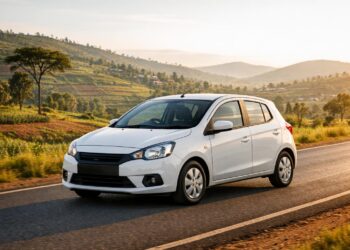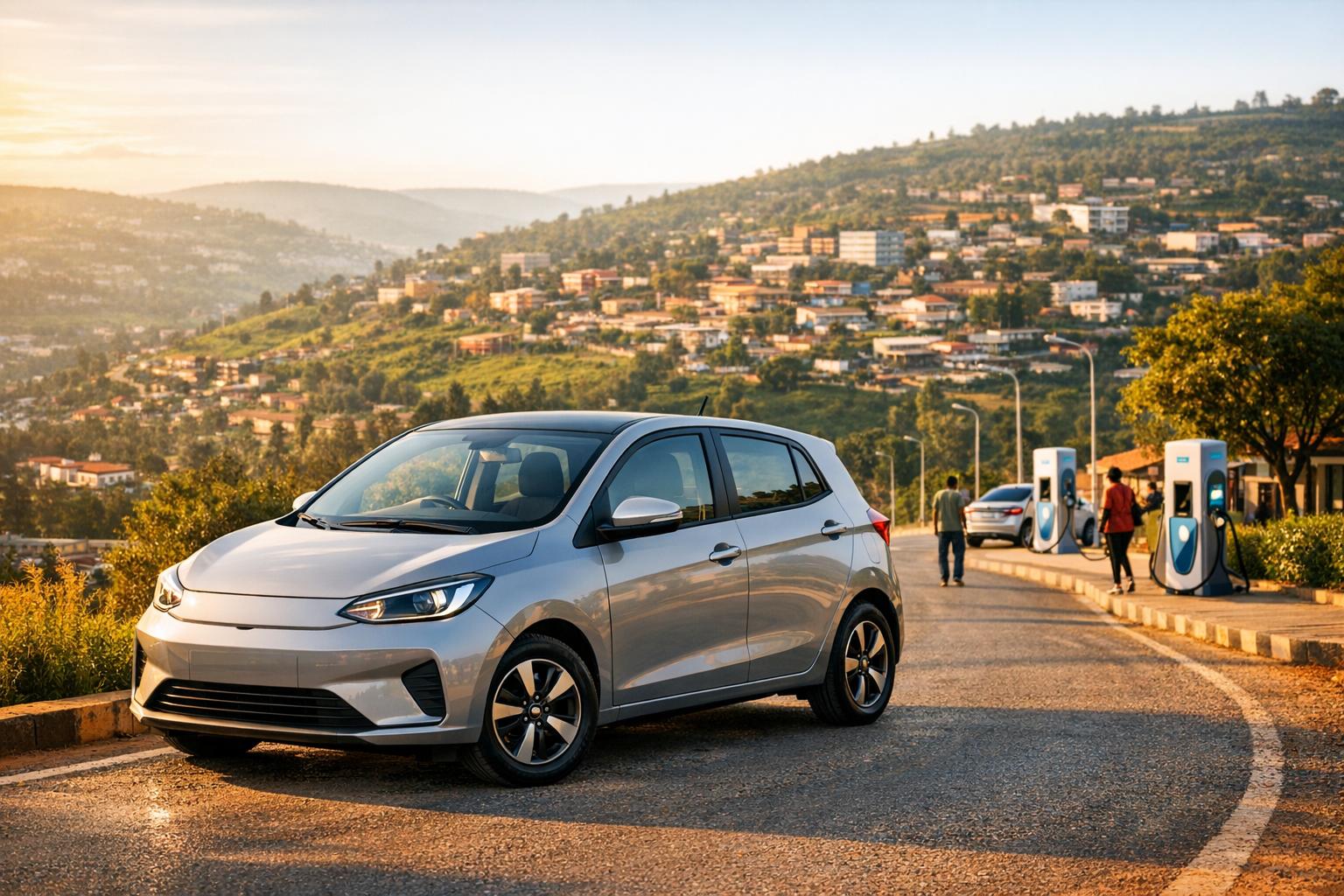
Looking for an affordable electric vehicle in Rwanda? Here’s the good news: EVs are now more accessible than ever, thanks to price drops in batteries, tax incentives, and growing infrastructure. Below are seven EVs under $20,000 that fit perfectly with Rwanda’s urban and hilly roads:
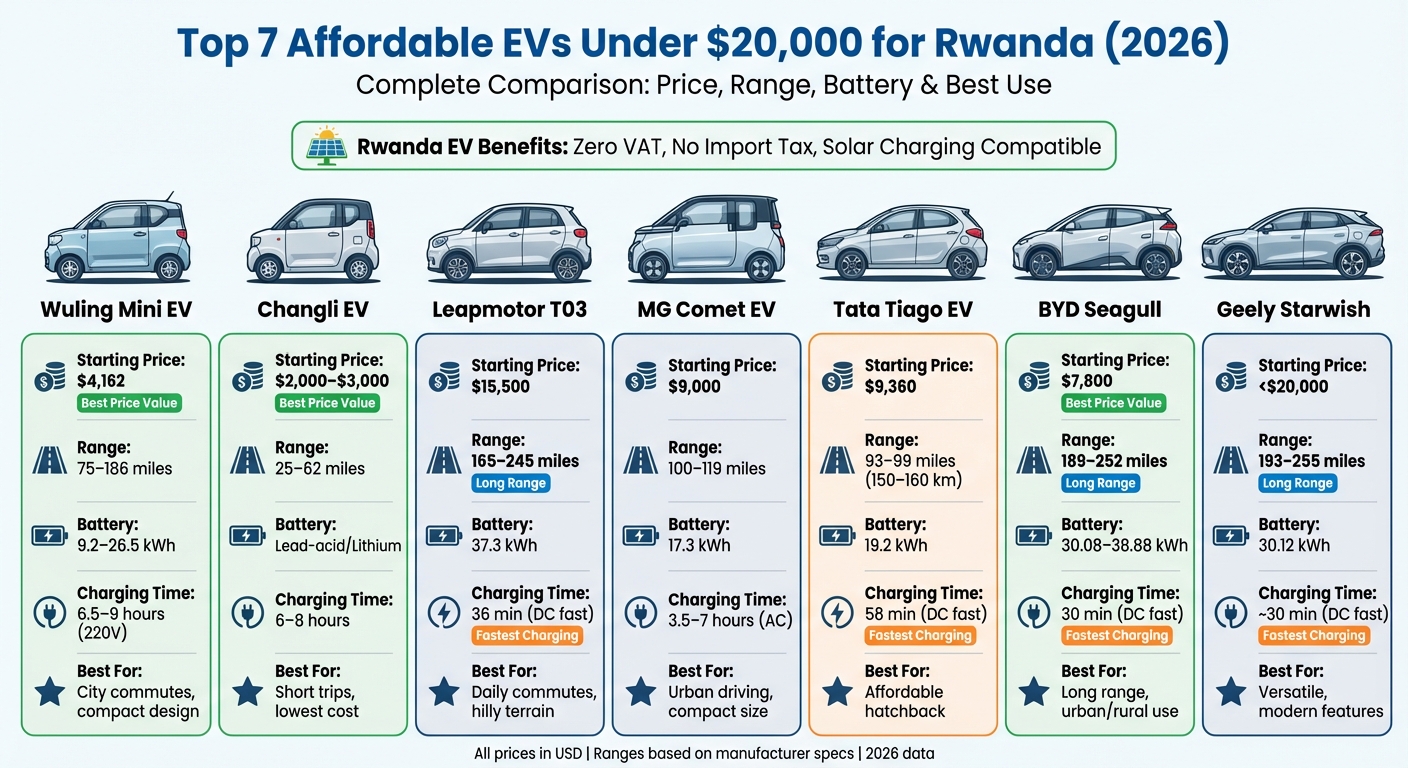
- Wuling Mini EV: Compact city car with a price starting at $4,162 and a range up to 186 miles.
- Changli EV: Budget-friendly, ideal for short city trips with a range of 25–62 miles.
- Leapmotor T03: Priced around $15,500, offering up to 245 miles of range and strong hill-climbing power.
- MG Comet EV: Starting at $9,000, this compact EV delivers 100–119 miles of range.
- Tata Tiago EV: Affordable at $9,360, with a range of 150–160 km and hill-friendly features.
- BYD Seagull: Popular globally, priced at $7,800, with up to 252 miles of range.
- Geely Starwish: Starting under $20,000, offering up to 255 miles of range and modern features.
Rwanda’s zero VAT and import tax exemptions make these EVs even more affordable. With low running costs, easy maintenance, and compatibility with solar charging, these options are perfect for eco-conscious drivers.
Quick Comparison
| Model | Starting Price | Range | Battery Size | Charging Time | Best For |
|---|---|---|---|---|---|
| Wuling Mini EV | $4,162 | 75–186 miles | 9.2–26.5 kWh | 6.5–9 hours (220V) | City commutes, compact design |
| Changli EV | ~$2,000–$3,000 | 25–62 miles | Lead-acid/Lithium | 6–8 hours | Short trips, low cost |
| Leapmotor T03 | ~$15,500 | 165–245 miles | 37.3 kWh | 36 min (DC fast) | Daily commutes, hilly terrain |
| MG Comet EV | ~$9,000 | 100–119 miles | 17.3 kWh | 3.5–7 hours (AC) | Urban driving, compact size |
| Tata Tiago EV | ~$9,360 | 150–160 km | 19.2 kWh | 58 min (DC fast) | Affordable hatchback |
| BYD Seagull | ~$7,800 | 189–252 miles | 30.08–38.88 kWh | 30 min (DC fast) | Long range, urban/rural use |
| Geely Starwish | <$20,000 | 193–255 miles | 30.12 kWh | ~30 min (DC fast) | Versatile, modern features |
These EVs are reshaping Rwanda’s transportation landscape while aligning with its clean energy goals.
7 Affordable EVs Under $20,000 in Rwanda: Price, Range & Features Comparison
1. Wuling Mini EV
Affordable Pricing Below $20,000
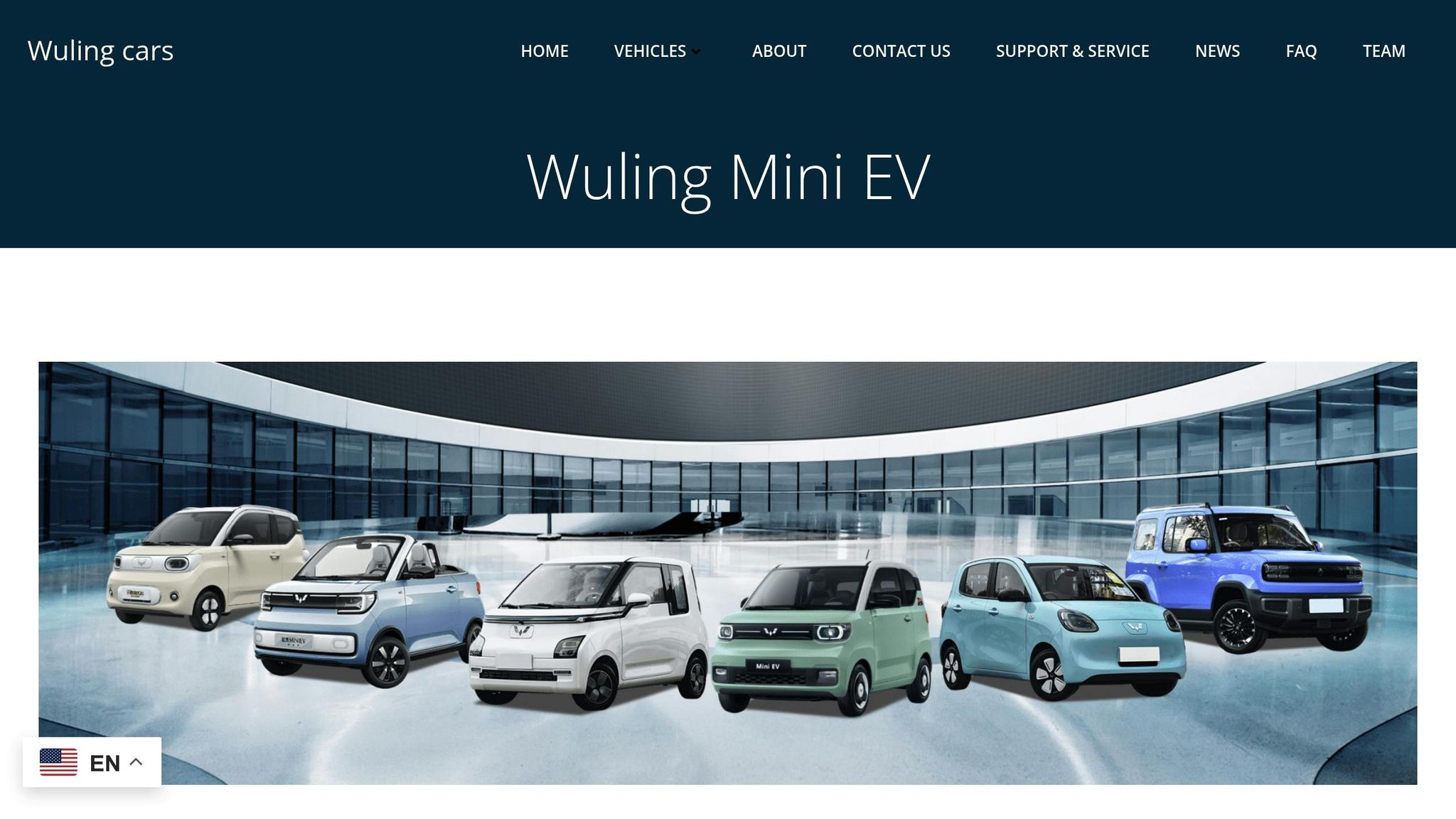
The Wuling Mini EV stands out as one of the most budget-friendly electric vehicles available. It debuted with a base price of around $4,162, and even the top-tier model was priced at about $5,607. The premium Macaron edition comes in at approximately $6,645. Although battery costs have caused prices to rise by about $1,000, the Mini EV remains well below the $20,000 mark. Impressively, the manufacturer earns minimal profits – reportedly less than $14 per unit. For buyers in Rwanda, the Mini EV is even more accessible thanks to the country’s zero VAT and import tax exemptions for electric vehicles. Beyond its competitive price, this EV delivers practical performance features that suit Rwanda’s unique terrain.
Battery Options and Driving Range
The Mini EV comes with battery capacities ranging from 9.2 kWh to 26.5 kWh, offering driving ranges between 75 miles (120 km) and 186 miles (300 km) under the NEDC standard. With an energy consumption rate of about 8.1 kWh per 62 miles (100 km), it’s ideal for city commutes and navigating both urban and hilly areas in Rwanda. Depending on the model, the vehicle delivers peak power outputs from 20 kW (27 hp) in the base version to 30 kW (40 hp) in the GameBoy and 2022 editions, alongside torque figures of 63 lb-ft (85 Nm) to 81 lb-ft (110 Nm). The top speed is 62 mph (100 km/h). Thanks to its rear-wheel-drive setup and the instant torque of its electric motor, the Mini EV handles Rwanda’s steep inclines with ease. Additionally, its "Sport" mode enhances acceleration and increases regenerative braking, which proves especially useful on downhill stretches.
Designed for Rwanda’s Infrastructure
The Mini EV’s compatibility with Rwanda’s growing charging infrastructure adds to its appeal. It charges using a standard 220V outlet, taking between 6.5 and 9 hours for a full charge depending on the battery size. This makes it perfect for home charging, especially when paired with Rwanda’s expanding solar energy solutions. Companies like CFAO Mobility Rwanda now offer "all-inclusive e-mobility packages", which include solar panel setups for generating electricity. With its small battery size and low energy consumption, the Mini EV is particularly well-suited for solar charging systems. Its compact design makes it ideal for navigating Kigali’s busy streets, though its 12-inch wheels require care when driving on rougher secondary roads.
Maintenance and Local Support
Built with standard consumer parts, the Mini EV is designed for straightforward repairs. Local support is bolstered by CFAO Mobility Rwanda’s dedicated EV ecosystem, which ensures efficient maintenance and after-sales services. Addressing concerns about service availability, Fidele Abimana, Permanent Secretary of the Ministry of Infrastructure, highlighted the importance of partnerships like those between CFAO and BYD:
The new CFAO and BYD partnership will also address the concern Rwandans have raised over the fear of having after sales services for e-vehicles (repair and maintenance)
. Later models of the Mini EV include safety enhancements such as driver-side airbags, reversing cameras, and low-speed pedestrian warning systems as standard features. With over 1.1 million units sold globally as of February 2023, the Mini EV has proven its reliability across a variety of markets.
2. Changli EV
Affordable Option for First-Time Buyers
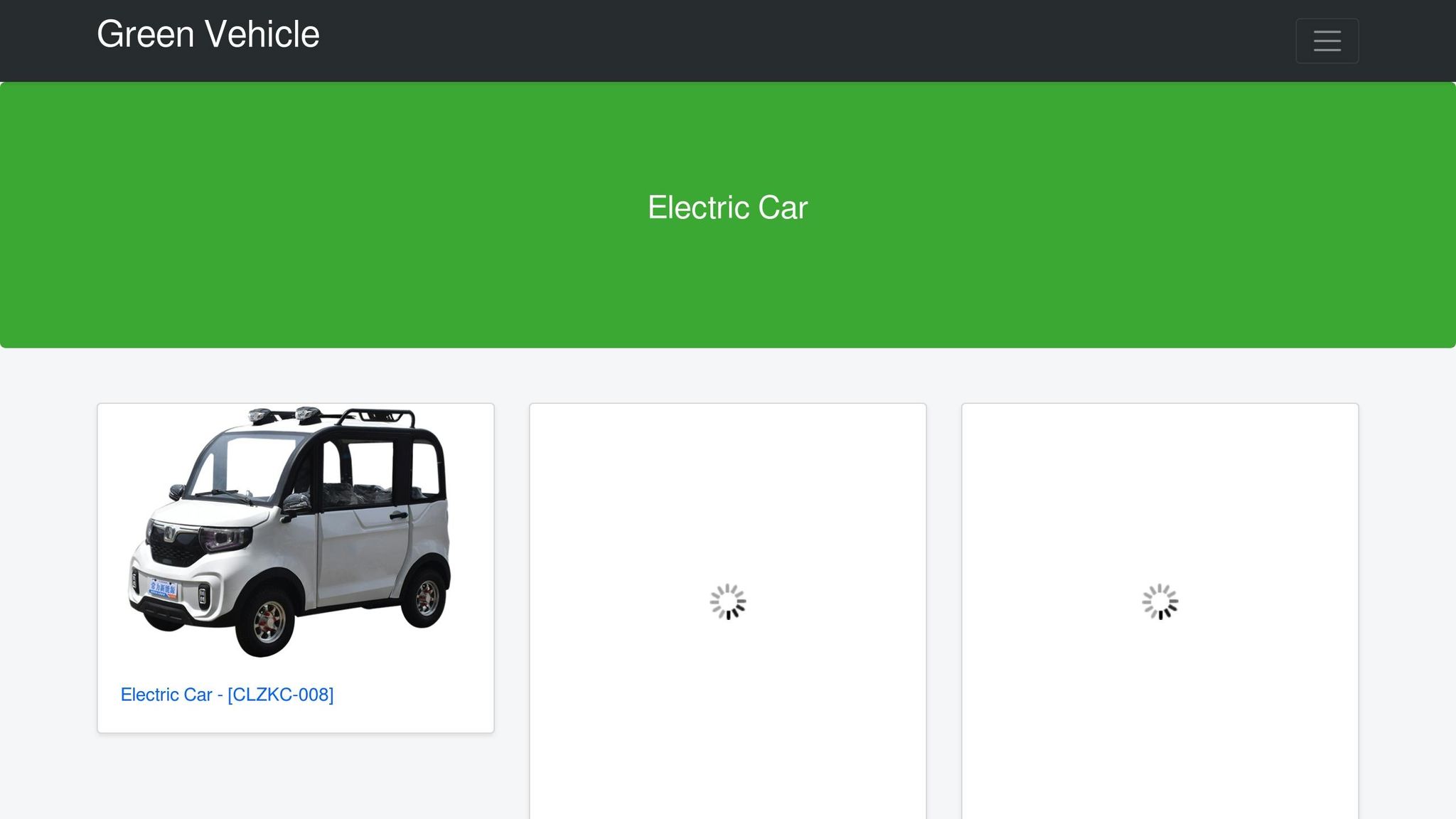
The Changli EV stands out as a budget-friendly choice for drivers in Rwanda. Its affordability comes from a no-frills interior that focuses on the essentials. Instead of multiple screens and features, it relies on a single 10.0-inch display that handles both gauges and infotainment functions. This streamlined approach helps keep costs down but also means fewer features and a more basic driving experience.
Best for Short City Trips
The Changli EV’s appeal lies in its price, but its range is tailored more for city use. With a driving range of 25–62 miles (40–100 km) per charge, it’s ideal for daily commutes around Kigali. However, it’s not the best choice for longer, rural trips. Most models are equipped with 60V or 72V lead-acid batteries, though there’s an option to upgrade to lithium-ion batteries. These upgrades not only extend the battery’s lifespan but also make the vehicle lighter.
3. Leapmotor T03
Affordable Entry Point Under $20,000
The Leapmotor T03 stands out as an accessible option for those in Rwanda seeking an eco-friendly vehicle without breaking the bank. With a starting price of approximately £14,192 (around $15,500), the T03 becomes even more appealing after incentives like an 80% import duty reduction and full VAT exemption, which significantly lower its cost. Thanks to a partnership with Stellantis, buyers can also rely on a well-established local network for parts and servicing. This makes the T03 a practical and affordable choice for environmentally conscious drivers.
Battery and Range Built for Daily Commutes
The T03 is powered by a 37.3 kWh Lithium Iron Phosphate battery, offering an official WLTP range of 165 miles (265 km). For city driving, its range can stretch up to 245 miles (395 km), making it perfect for daily commutes. Charging is convenient too – DC rapid charging at 48 kW can boost the battery from 30% to 80% in just 36 minutes. For home charging, a Level 2 charger can replenish the battery in 3 to 8 hours, with installation costs ranging between 300,000 and 800,000 RWF.
Built for Rwanda’s Hilly Terrain
Navigating Rwanda’s challenging landscapes is no problem for the T03. Its 95 hp motor delivers ample power, complemented by 158 Nm of torque, ensuring reliable hill-climbing performance. Features like Hill Start Assistance, Auto Hold, and a Traction Control System enhance driving confidence on steep roads. The car’s 160 mm ground clearance helps it handle varying road conditions, while its regenerative braking system recaptures energy during downhill drives.
"The 95hp motor is much peppier than the one in the Dacia Spring… and gives great performance away from traffic lights." – Tom Wiltshire, Deputy Web Reviews Editor, Carwow
The T03 also integrates seamlessly with solar charging options, adding to its versatility.
Solar Charging and Simplified Maintenance
Designed to align with Rwanda’s renewable energy goals, the T03 is fully compatible with the country’s expanding home solar charging infrastructure. With over 50% of Rwanda’s electricity coming from renewable sources, charging becomes not just affordable but environmentally responsible. Maintenance is straightforward, thanks to the Stellantis partnership, which ensures local service support. Plus, Over-the-Air (OTA) updates allow for remote software improvements, reducing the need for frequent dealership visits. Be sure to confirm local warranty options for added peace of mind.
4. MG Comet EV
Compact and Budget-Friendly Under $20,000
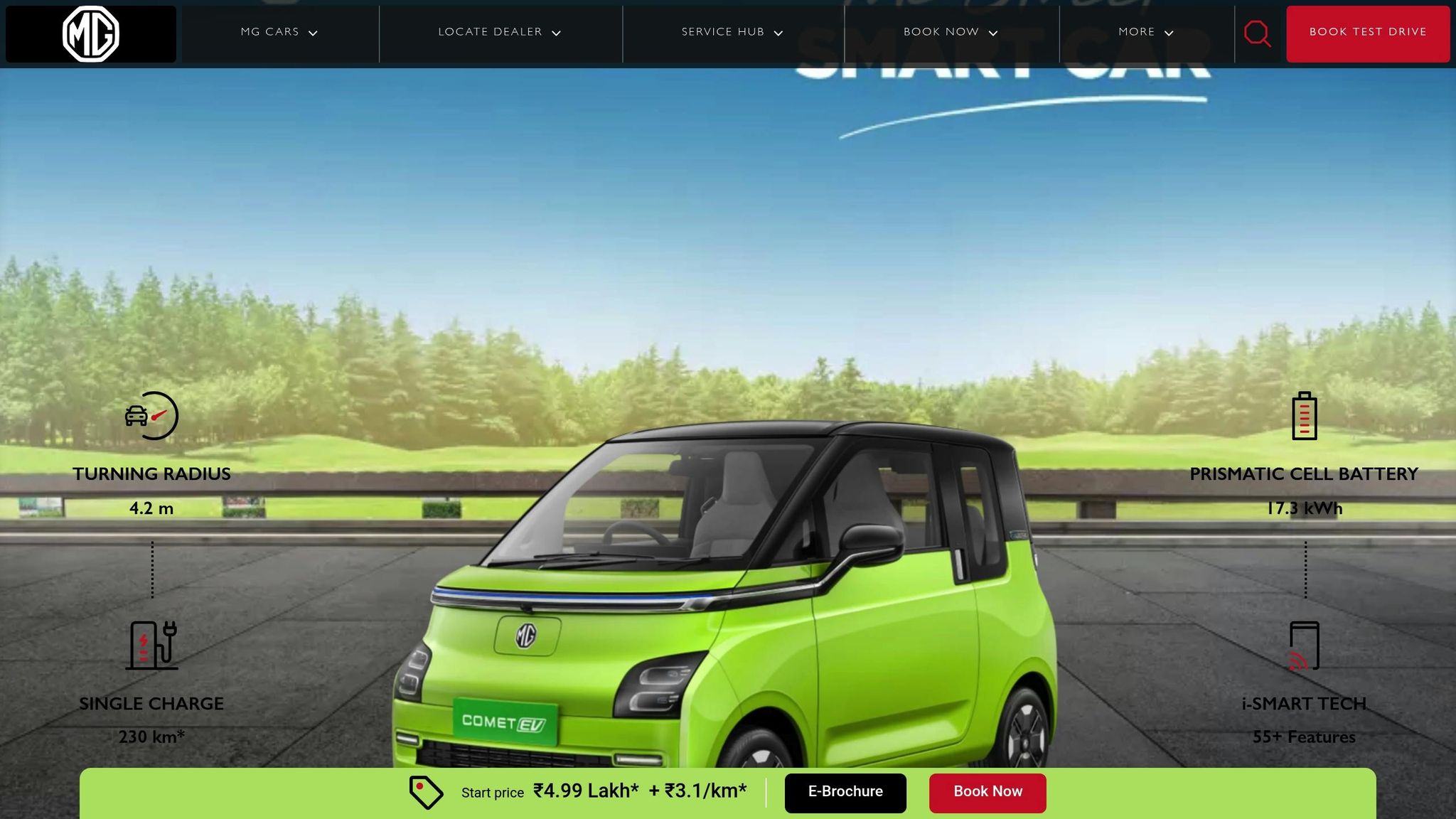
The MG Comet EV is a smart choice for budget-conscious buyers, with prices starting at just $9,000 for the base Executive model and going up to $12,000 for the Blackstorm variant. Thanks to Rwanda’s attractive EV incentives – like an 80% reduction in import duties and full VAT exemption – this compact electric car becomes even more affordable. Measuring 2,974 mm (about 9.8 feet) in length, it’s perfect for navigating Kigali’s bustling streets and squeezing into tight parking spaces. Plus, its 4.2-meter (around 13.8 feet) turning radius adds to its city-friendly appeal. In some regions, a Battery-as-a-Service subscription option can lower the upfront cost by approximately $2,200. All in all, it’s an affordable and practical option for everyday urban use.
Practical Range for City Driving
Equipped with a 17.3 kWh Lithium-ion battery that meets IP67 standards for water and dust resistance, the MG Comet EV offers a claimed range of 230 km (143 miles). In real-world conditions, you can expect a range between 160 and 191 km (100–119 miles) – ideal for daily commutes. Its 41 bhp motor generates 110 Nm of instant torque, making it a reliable performer for city driving. Charging is convenient, taking about 7 hours with a standard 3.3 kW AC charger or roughly 3.5 hours with a 7.4 kW fast AC charger, although it doesn’t support DC fast charging.
Built for Rwanda’s Hills and Roads
The Comet EV’s design and features make it well-suited for Rwanda’s terrain. Its 110 Nm of torque, combined with a hill-hold assist feature, ensures smooth acceleration and prevents rollback on steep inclines. With 165 mm of ground clearance and three driving modes – Eco, Normal, and Sport – it adapts easily to different conditions. Sport mode delivers maximum torque for tackling hills, while Eco mode helps conserve battery life on flat city roads.
"The braking is gradual and predictable, with enough feel at the pedal and the hill hold is a boon when one stops on a slope." – CarWale Expert Review
Low Maintenance and Local Support
The MG Comet EV keeps running costs impressively low at just $0.012 per kilometer – less than 10% of what a gasoline hatchback would cost. It comes with a 3-year/100,000 km warranty and an 8-year/120,000 km battery warranty. With over half of Rwanda’s electricity generated from renewable sources, home charging is both cost-effective and environmentally friendly. Local service networks provide easy access to parts and maintenance, and the simple electric drivetrain means fewer repairs compared to gas-powered vehicles. This combination of low upkeep and eco-friendly operation makes the Comet EV an excellent choice for sustainable driving in Rwanda.
5. Tata Tiago EV (Base Model)
A Budget-Friendly Electric Hatchback at $9,360
The Tata Tiago EV base model (XE MR) is priced around $9,360, making it one of the most affordable electric hatchbacks available. With an operating cost of roughly $0.01 per kilometer, it offers exceptional value. It also boasts a 4-star Global NCAP safety rating and an IP67-certified battery and motor for added durability. Despite its low price, the Tiago EV doesn’t skimp on performance.
Impressive Range and Charging Capabilities
Equipped with a 19.2 kWh lithium-ion battery, the Tiago EV delivers a real-world range of 150–160 km. Its 45 kW (61 hp) motor and 110 Nm of torque enable it to accelerate from 0 to 60 km/h in just 6.2 seconds. Charging options are flexible: a 3.3 kW AC charger takes about 6.9 hours for a full charge, while a DC fast charger can replenish the battery from 10% to 80% in just 58 minutes. Plus, the powertrain is covered by an 8-year or 160,000 km warranty, ensuring peace of mind for buyers.
Designed for Rwanda’s Terrain and Solar Compatibility
Tailored for Rwanda’s hilly landscapes, the Tiago EV includes Hill Hold, Hill Descent, and a 4-level Smart Regenerative Braking system. For steep climbs, Sport mode provides extra power, while City mode optimizes energy use in urban settings. Its compact size – measuring 3,769 mm in length with a 5.1 m turning radius – makes it ideal for navigating crowded streets. The car is also compatible with standard 3.3 kW AC wall boxes and 15A plug points, making it easy to integrate with residential solar power systems.
Minimal Maintenance and Local Support
The Tiago EV’s simple drivetrain reduces maintenance demands significantly. With a ground clearance of 165 mm (6.5 inches), it handles both paved roads and moderately uneven terrain with ease. The motor and battery’s IP67 rating further enhances durability, while local service networks are equipped to manage routine upkeep. These features position the Tata Tiago EV as a practical and reliable choice for Rwanda’s move toward sustainable transportation.
sbb-itb-7bc66b5
6. BYD Seagull
An Affordable EV with Global Popularity
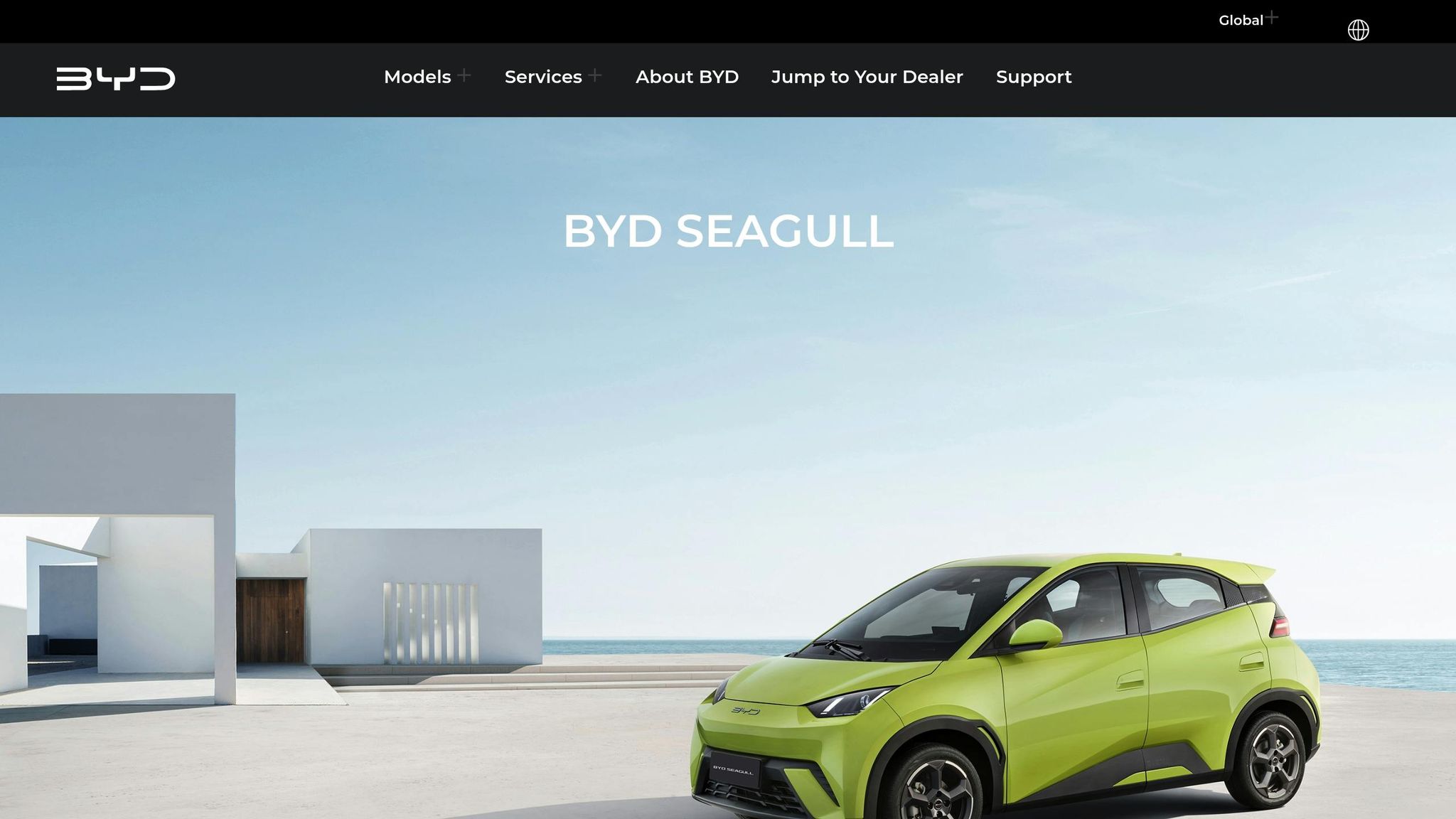
The BYD Seagull is set to hit Rwanda’s market in 2026 with a starting price of about $7,800, thanks to a 20% reduction in battery costs in 2024. Despite its low price, the Seagull has proven to be a massive success globally. BYD sold over 1 million units within just 25 months of its April 2023 launch. By November 2024, it became the best-selling car in China, even surpassing gas-powered vehicles. In Rwanda, BYD has partnered with CFAO Mobility, which opened the first BYD dealership in Kigali in January 2024, ensuring local availability and service.
Battery Options to Fit Different Lifestyles
The Seagull offers two battery choices to cater to diverse driving needs. Drivers can opt for a 30.08 kWh battery with a range of 305 km (189 mi) or a 38.88 kWh battery that extends the range to 405 km (252 mi). Both variants use BYD’s advanced "Blade Battery" technology, which earned a five-star Euro NCAP safety rating in 2025. Powered by a 55 kW motor delivering 135 Nm of torque, the Seagull accelerates from 0 to 50 km/h (31 mph) in just 4.9 seconds, making it ideal for Kigali’s urban traffic. Charging is convenient too – DC fast charging takes the battery from 30% to 80% in just 30 minutes, while the AC system integrates seamlessly with home solar setups.
Designed for Rwanda’s Terrain and Energy Needs
Built with Rwanda’s unique landscape in mind, the Seagull is equipped with features like a Hill Start Control System and instant torque to handle hilly roads with ease. Its compact size (3,780 mm in length) and a 4.95-meter turning radius make it perfect for navigating crowded city streets. CFAO Mobility offers an all-in-one e-mobility package that includes the car, tailored charging stations, and optional solar panels. The Seagull also comes with a VTOL (Vehicle-to-Load) feature, allowing it to function as a mobile power source – an excellent option for areas with developing infrastructure.
"Our plan is not only to sell a new car brand in Rwanda, but also to offer the customers an all-inclusive e-mobility package. That is why, we will offer top of the class vehicles and an adapted charging station, energy storage devices as well as solar panels."
- Pierre Toulotte, BYD Brand Manager
This thoughtful design, paired with local service and support, ensures a smooth ownership experience.
Easy Maintenance and Local Support
CFAO Mobility Rwanda provides comprehensive after-sales support, including maintenance, assistance, and access to genuine parts. The Seagull comes with a 6-year/150,000 km vehicle warranty and an 8-year battery warranty. Its lightweight build (weighing between 1,160 kg and 1,240 kg) and regenerative braking system with a one-pedal driving mode enhance efficiency while minimizing brake wear. Additionally, government incentives in Rwanda – like zero VAT and exemptions from import and excise duties on electric vehicles – make the Seagull an even more appealing option.
7. Geely Starwish (Entry Variant)
China’s Best-Selling Car Now Priced Under $20,000
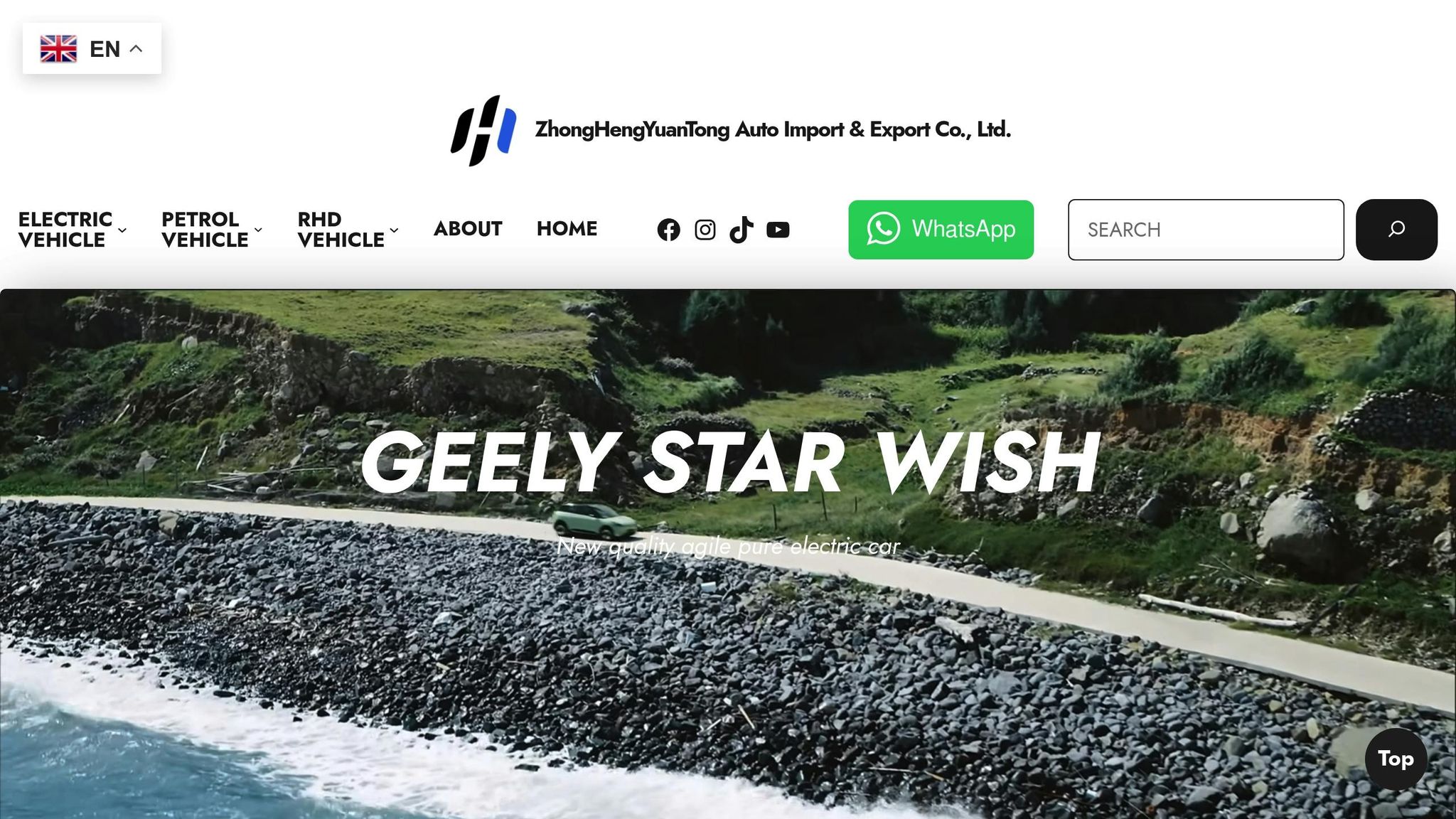
The Geely Starwish (also known as Xingyuan/EX2) made its way to Rwanda in 2026 with a price tag of under $20,000. In China, its pre-sale prices started at approximately RMB 78,800, and in Indonesia, it was priced around IDR 233 million. Thanks to local tax incentives, the Starwish remains highly competitive in international markets. In 2025, it achieved the title of China’s best-selling car across all categories, with an impressive 465,775 units sold. This milestone highlights the growing global demand for affordable electric vehicles (EVs).
Solid Range with Smart Battery Technology
The entry-level Starwish is powered by a 30.12 kWh lithium iron phosphate (LFP) battery supplied by CATL, delivering a range of 310 km (193 miles) under the CLTC standard. Its rear-wheel-drive setup features a rear motor producing 58 kW (78 hp) and a top speed of 125 km/h (78 mph), making it versatile for both urban commutes and highway trips. Geely’s "11-in-1 electric drive system" combines the motor, electronic controls, and reducers into a single, energy-efficient unit. For those seeking extended range, a higher-capacity model is available, offering up to 410 km (255 miles) and an upgraded motor with 85 kW (114 hp). The vehicle’s thoughtful design also aligns well with Rwanda’s renewable energy goals.
Built for Rwanda’s Roads and Solar Infrastructure
The Starwish’s rear-wheel-drive layout and bundled solar charging packages are tailored for Rwanda’s unique needs. Its instant torque makes it adept at handling the country’s hilly terrain, while the solar integration addresses concerns about grid reliability and helps reduce long-term operational costs. These features make it an appealing choice for drivers in developing regions, where renewable energy solutions are becoming increasingly important.
Modern Features and Local Service Support
In addition to its performance and energy-efficient features, the Starwish includes a range of modern amenities. It comes equipped with six airbags, L2 intelligent driving assistance, and a 14.6-inch Flyme Auto infotainment system. To address concerns about EV maintenance, local dealerships are setting up dedicated service centers to provide repairs, technical support, and access to genuine spare parts. With Rwanda aiming to cut greenhouse gas emissions by 38% by 2030, the Starwish offers an accessible step toward cleaner transportation.
How These EVs Fit Rwanda’s Needs in 2026
Rwanda is gearing up for a greener future, and these seven affordable electric vehicles (EVs) are designed to meet the country’s growing transportation demands. With a focus on energy efficiency, compact designs suited for urban areas, and compatibility with Rwanda’s expanding solar infrastructure, these EVs align perfectly with the nation’s clean energy goals.
What makes this transition even smoother are the supportive government policies in place. Rwanda has removed import taxes, excise duties, and VAT on all electric vehicles until at least June 30, 2028. Meanwhile, traditional internal combustion engine vehicles face a 15% road maintenance levy on fuel, along with annual road fees ranging from FRW 50,000 to FRW 150,000. These incentives make EVs a much more attractive and cost-effective option for Rwandans.
Charging and maintenance, often seen as hurdles to EV adoption, are being addressed head-on. Distributors like CFAO Mobility are offering bundled solutions that include charging stations, energy storage devices, and solar panels. This approach ensures that EV owners have reliable charging infrastructure and maintenance support, making the switch to electric vehicles more convenient.
On top of economic and practical benefits, these EVs play a critical role in Rwanda’s environmental goals. The country aims to cut greenhouse gas emissions by 38% by 2030. Considering that over 300,000 vehicles are registered in Rwanda – and 80% of those tested in 2022 were found to emit high levels of greenhouse gases – this shift to electric mobility is not just a choice but a necessity. Furthermore, reducing air pollution is vital, as ambient air pollution contributed to over 2,200 deaths in 2012, highlighting the urgent need for cleaner transportation options.
Local dealerships are also stepping up to ensure a seamless ownership experience. They’ve established service centers to provide professional maintenance and quick access to parts. Many new models come with warranties lasting up to eight years, and integrated solar solutions align with the country’s solar energy initiatives. With prices under $20,000, these EVs are paving the way for affordable, sustainable transportation in Rwanda.
Conclusion
These seven electric vehicles (EVs) prove that cleaner transportation doesn’t have to come with a hefty price tag. With options under $20,000, Rwandan buyers now have access to affordable, eco-friendly alternatives that make sustainable mobility a practical choice. The long-term financial benefits are hard to ignore – EVs cut out the need for oil changes, reduce brake wear thanks to regenerative braking, and are far cheaper to charge than fueling up with gas.
Opting for a lower-cost EV also means reaching the break-even point – where the savings on operating costs outweigh the initial purchase price – much sooner. As Antuan Goodwin, Senior Writer at CNET, puts it:
Choosing a cheaper EV can mean getting to the break-even point (where operating savings cancel out the price premium) sooner
.
These compact EVs are tailor-made for Rwanda’s urban landscape, offering easy maneuverability and effortless parking in bustling areas. Many models even come with modern conveniences like 10-inch infotainment screens, Apple CarPlay, and Android Auto. Combined with Rwanda’s supportive policies – such as removing import taxes and VAT on EVs – these vehicles represent a significant step toward accessible and environmentally friendly transportation.
Whether you’re cruising through Kigali’s busy streets or heading out for a weekend adventure, these affordable EVs provide a smart, sustainable, and practical solution. Electric mobility in Rwanda is no longer a distant goal – it’s here and ready to drive change.
FAQs
What are the advantages of owning an electric vehicle (EV) in Rwanda?
Owning an electric vehicle (EV) in Rwanda comes with several advantages. For starters, EVs produce little to no tailpipe emissions, which helps cut down on air pollution and aligns with Rwanda’s environmental goals. This makes them a greener option for getting around Kigali’s bustling streets or navigating the country’s rolling hills.
On top of that, EVs are more budget-friendly to operate. Electricity costs much less than gasoline, and because EVs have fewer moving parts, maintenance expenses are lower compared to traditional gas-powered cars. The Rwandan government has also stepped in with supportive measures, such as duty-free imports and an expanding network of public charging stations, making EV ownership even more accessible and practical.
Compact EVs like the BYD Dolphin and Dacia Spring are especially well-suited for Rwanda. Their smaller size is ideal for the country’s narrow roads, and their efficient batteries offer dependable daily range without constant recharging. Combining affordability, eco-friendliness, and convenience, EVs are an excellent choice for both city dwellers and rural drivers in Rwanda.
How do Rwanda’s tax incentives make electric vehicles more affordable for buyers?
Rwanda’s government has rolled out tax breaks that make owning an electric vehicle (EV) much more affordable. For starters, pure EVs are fully exempt from import duties, a cost that typically inflates the price of imported cars. On top of that, buyers don’t have to pay the usual 15% value-added tax (VAT), excise duties, or withholding taxes on EVs. These waivers are in place until June 30, 2028.
These tax benefits apply to EVs priced below a government-defined limit, ensuring they remain within reach for cost-conscious buyers. By cutting out these taxes, EV prices can drop by several thousand dollars, making them a viable alternative to traditional gas-powered cars. When paired with Rwanda’s growing network of charging stations, these incentives position EVs as a smart and economical option for drivers in 2026.
What are the best affordable EVs for Rwanda’s hilly roads?
Rwanda’s landscape, characterized by its rolling hills, demands electric vehicles (EVs) that can handle steep inclines and uneven terrain. If you’re looking for options under $20,000, here are two standout choices:
- Dayun Yuehu S5: This compact SUV, priced at approximately $14,200, boasts a higher ride height and durable suspension – perfect for navigating rugged, hilly roads with ease.
- BYD Dolphin: A budget-friendly hatchback priced below $15,000. With 140 mm of ground clearance and strong low-end torque, it’s well-suited for tackling inclines while maintaining efficiency.
Both models strike a great balance between affordability and performance, making them reliable, eco-conscious options for Rwanda’s demanding road conditions.
Related Blog Posts
- How Rwanda’s Hills Affect EV Range
- Top 5 Compact EVs for Rwanda in 2025
- Electric Cars in Rwanda: 2025 Guide for New Buyers
- Electric Cars in Rwanda: Models and Charging Points