Rwanda is rapidly advancing its electric vehicle (EV) infrastructure to support its Vision 2050 strategy of becoming a low-carbon economy. Here’s what you need to know:
- Coverage Goal: By 2030, no EV will be more than 31 miles (50 km) away from a charging station.
- Current Progress: As of February 2026, Rwanda has 24 public charging stations, a 240 kW ultrafast charger, 49 combined charging and battery-swapping stations, and 4 motorcycle chargers.
- EV Growth: EVs increased from 19 in 2020 to 512 in 2024, with hybrid registrations reaching 6,660 by 2024.
- Government Support: Policies include 0% VAT on EVs and charging equipment, $0.10/kWh subsidized electricity rates, and tax incentives for investors.
- Future Plans: 226 new charging sites identified, rural expansion underway, and integration of renewable energy into the grid.
Rwanda is steadily building a robust EV charging network, with clear milestones to ensure nationwide accessibility and support for its growing EV market.
Past Milestones in EV Charging Deployment
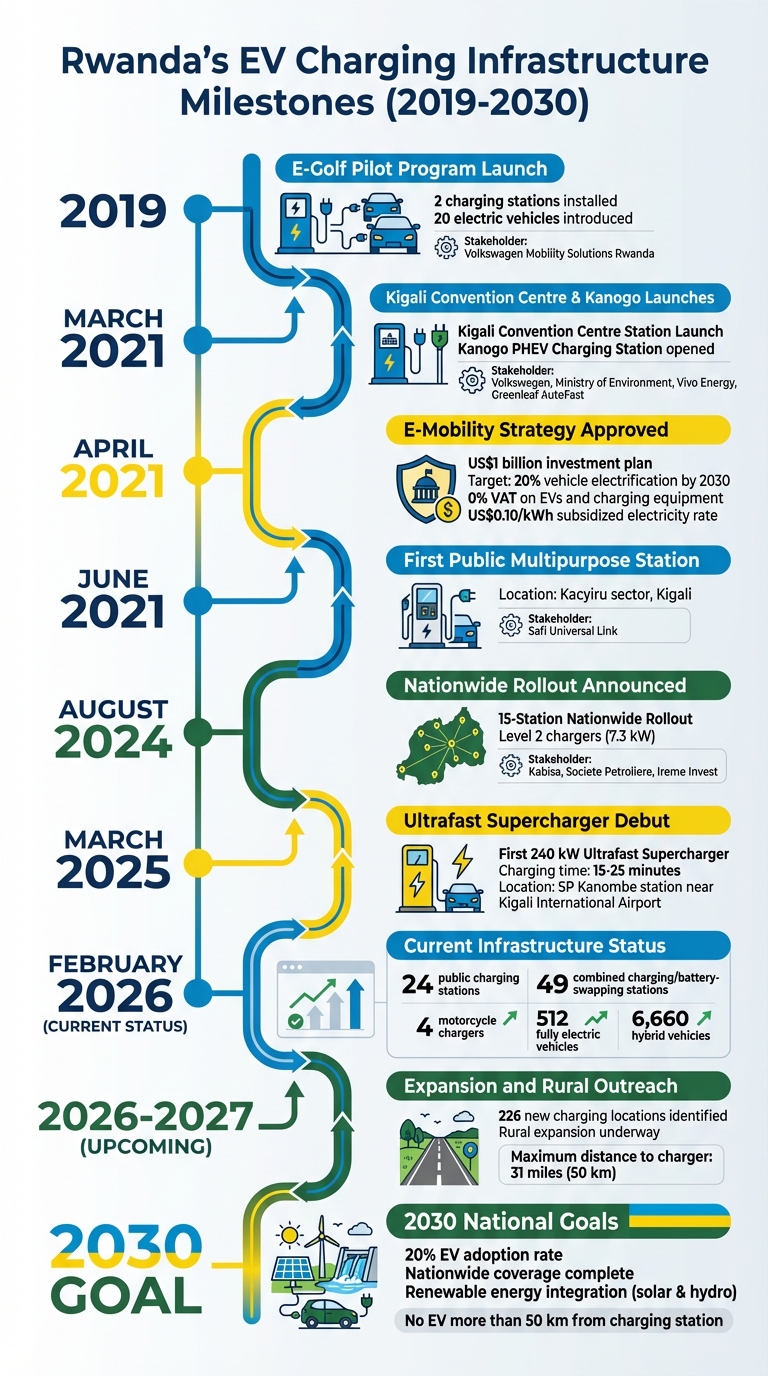
Rwanda EV Charging Infrastructure Timeline 2019-2030
First Charging Stations Launched
Rwanda’s journey into EV charging infrastructure began in 2019 when Volkswagen Mobility Solutions Rwanda introduced the e-Golf pilot program. This initiative included 20 electric vehicles and two charging stations in Kigali. By March 2021, the country had expanded its efforts with the launch of public charging stations at prominent locations. At the Kigali Convention Centre, Dr. Jean d’Arc Mujawamariya, Rwanda’s Minister of Environment, officially inaugurated one such station. Around the same time, Vivo Energy Rwanda, in partnership with Greenleaf AutoFast, unveiled a dedicated charging station for Plug-in Hybrid Electric Vehicles (PHEVs) at Kanogo.
A key milestone followed in June 2021 when Safi Universal Link, under the leadership of Jerry Ndayishimye, opened Rwanda’s first public multipurpose EV charging station in Kigali’s Kacyiru sector. This station served as a blueprint for integrating EV chargers at existing gas stations nationwide. Then in March 2025, Kabisa introduced the country’s first 240 kW ultrafast supercharger at the SP Kanombe station near Kigali International Airport. Unlike standard chargers (7.43 kW to 22 kW), this ultrafast charger could fully charge a vehicle in just 15 to 25 minutes.
Pophia Muhoza, Managing Director of Kabisa, stated, "We are excited to introduce Rwanda’s first ultrafast EV supercharger, accessible to all electric vehicles. This is just the beginning of our mission to build a convenient, high-speed charging ecosystem across East Africa".
These advancements were complemented by forward-thinking government policies.
Policy and Regulatory Framework Established
In April 2021, Rwanda laid the groundwork for its e-mobility future by approving a comprehensive E-Mobility Strategy. This plan outlined a path for a US$1 billion investment to electrify 20% of the country’s vehicles by 2030. The strategy included powerful incentives: a 0% VAT rate and exemptions from import duties on EVs, batteries, and charging equipment, which together reduced taxes by about 48%.
To make EV charging more affordable, the government introduced a subsidized electricity tariff of US$0.10/kWh, significantly lower than the standard rate of US$0.20/kWh. Additional measures included a 15% preferential corporate income tax for e-mobility investors, seven-year tax holidays for major manufacturers, and rent-free land allocations for charging bay development. Green License Plates were also introduced, offering perks like free parking and future access to congestion-free zones for EV owners.
Initial Partnerships and Investments
Private sector collaboration played a crucial role in scaling up Rwanda’s EV infrastructure. In August 2024, Kabisa and Societe Petroliere (SP) announced plans to install 15 additional Level 2 chargers (7.3 kW) across the country. This initiative was funded by Ireme Invest through the Rwanda Green Fund, following a successful three-station pilot that demonstrated the feasibility of integrating EV chargers at traditional fuel stations.
The Rwanda Green Fund (FONERWA), through its Ireme Invest facility, also financed EV charging infrastructure in Kigali. Meanwhile, companies like Ampersand expanded the ecosystem by introducing battery-swapping stations for electric motorcycles. This innovation reduced downtime for riders and boosted micro-mobility options.
| Milestone Date | Event / Infrastructure Type | Key Stakeholders |
|---|---|---|
| 2019 | Launch of e-Golf Pilot (2 stations) | Volkswagen Mobility Solutions |
| March 2021 | Kigali Convention Centre Station Launch | Volkswagen, Rwanda Ministry of Environment |
| March 2021 | Kanogo PHEV Charging Station | Vivo Energy, Greenleaf AutoFast |
| April 2021 | E-Mobility Strategy Approval | Government of Rwanda |
| June 2021 | First Public Multipurpose Station | Safi Universal Link |
| August 2024 | 15-Station Nationwide Rollout Announcement | Kabisa, Societe Petroliere, Ireme Invest |
| March 2025 | First 240 kW Ultrafast Supercharger | Kabisa, Societe Petroliere |
sbb-itb-7bc66b5
Current Status of EV Charging Infrastructure (February 2026)
Number and Types of Charging Stations
As of February 2026, Rwanda has established 24 public charging stations offering both AC and DC options, with capacities ranging from 7.43 kW to 22 kW. Additionally, a new 240 kW ultrafast supercharger has been introduced, capable of fully charging compatible vehicles in just 15–25 minutes. There are also 49 combined charging and battery-swapping stations specifically for motorcycles, along with 4 standalone motorcycle chargers.
Most of these charging stations are concentrated in Kigali, strategically located at shopping malls, office complexes, and petrol stations. A flagship site, the SP Kanombe station near Kigali International Airport and the Free Trade Zone, stands out as it houses the country’s first ultrafast charger, catering to both commercial and private vehicles. To ensure broader access, the government has earmarked additional locations for future charging sites. These developments highlight Rwanda’s efforts to balance infrastructure growth with the increasing demand for EVs.
Current EV Adoption Rates and Charging Demand
Rwanda’s EV adoption continues to grow steadily. The country’s fleet now includes 512 fully electric vehicles, while hybrid registrations have climbed to 6,660. However, fully electric vehicles make up only about 7% of the 7,172 low-emission cars imported between 2020 and 2024.
Although the current charging network meets today’s demand, the government is already planning for future needs. Beyond the numbers, EVs are proving their value across various sectors. For example, in rural areas like Nyamagabe District, EVs are helping reduce transportation costs for goods. Vicent Uwimana, Acting Director of Agriculture and Animal Resources in Nyamagabe District, shared how this shift is impacting the local economy:
"Electric cars are not only environmentally friendly but also cost-effective, leading to reduced prices for essential goods such as animal feeds".
This growing rural adoption shows that charging demand is beginning to extend beyond Kigali. It also underscores the importance of Rwanda’s nationwide expansion plans, which are key to achieving the country’s target of 20% EV adoption by 2030.
Upcoming Milestones and Deployment Goals (2026–2027)
New Charging Station Installations
The Rwandan Ministry of Infrastructure (MININFRA) has set an ambitious goal: ensuring that no electric vehicle (EV) is more than 31 miles (50 km) away from a charging station. A recent geospatial study identified 226 potential locations for new charging stations, prioritizing high-traffic zones, existing gas stations, and commercial centers. This approach aims to improve accessibility while encouraging private sector investment.
In Kigali, new policies mandate that all public buses introduced must be electric. To support this, grid upgrades are underway at key locations like Nyabugogo Terminal to accommodate high-capacity charging for electric buses. In September 2025, the government launched Ecofleet Solutions, a state-owned enterprise leading the charge in deploying electric buses and their infrastructure. Dr. Jimmy Gasore, Rwanda’s Minister of Infrastructure, outlined the broader vision:
"The Government of Rwanda is committed to accelerating the transition to electric mobility as part of our climate and development agenda".
These efforts are designed not only to expand EV coverage in urban areas but also to improve rural access, aligning with Rwanda’s master plan for nationwide EV accessibility.
Geographic Expansion to Rural Areas
While Kigali remains a focus, the next phase shifts attention to rural corridors. The government is working to ensure that rural highways and agricultural hubs are equipped with charging stations, making long-distance travel between cities more feasible. This effort aims to address range anxiety for drivers traveling beyond urban centers.
Partnerships and Funding Initiatives
To drive these infrastructure developments, the government has introduced several funding and partnership programs. For instance, VAT exemptions on imported EV charging equipment have been extended through June 30, 2028, making it more affordable to establish charging stations. Additionally, electricity used for EV charging is billed at an industrial rate, helping to lower operational costs for providers.
The Ministry of Infrastructure is also actively pursuing public-private partnerships with international organizations and private investors to fund fast-charging hubs and highway infrastructure. Sahr Kpundeh, the World Bank‘s Country Manager for Rwanda, highlighted the broader economic benefits of these initiatives:
"Electric mobility is not only about cleaner buses. It is about building the foundations of a modern economy powered by sustainable energy".
Long-Term Plans for EV Charging Deployment (2028–2030 and Beyond)
Rwanda is laying the groundwork for a future where electric vehicles (EVs) can operate seamlessly across the nation, with a comprehensive plan for EV charging infrastructure.
Nationwide Coverage Goals
Rwanda’s vision ensures that no EV will need to travel more than 31 miles (50 km) without access to a charging station. This initiative is part of a carefully designed master plan aimed at guiding investments and avoiding the pitfalls of outdated or underused infrastructure. Using geospatial analysis, the Ministry of Infrastructure (MININFRA) has pinpointed key locations for charging stations, focusing on high-traffic areas, existing petrol stations, and commercial buildings.
The plan aims to achieve nationwide coverage and a 20% EV adoption rate by 2030, with charging stations strategically placed along highways and in urban areas.
Advanced Charging Technologies
To make EV usage more convenient, Rwanda is focusing on DC-based fast-charging stations in cities and along major highways, significantly reducing charging times. For electric motorcycles, battery-swapping technology has become a game-changer, with operational swapping stations already in place as of August 2025. This system is particularly beneficial for riders who rely on motorcycles for daily commutes or commercial purposes.
For heavy commercial vehicles, the government is exploring interim solutions such as compressed natural gas (CNG) and biogas while advancements in battery technology continue.
These technological advancements are paired with a strong commitment to sustainable energy sources.
Renewable Energy Integration
Rwanda’s National Electrification Strategy emphasizes that the EV charging network will primarily rely on solar and hydroelectric power. This approach ensures that the environmental benefits of EVs extend beyond reducing tailpipe emissions. In February 2026, Vicent Uwimana, Acting Director of Agriculture and Animal Resources in Nyamagabe District, highlighted the importance of this renewable energy focus:
"The whole network uses renewable energy, highlighting the efficiency of the renewable-powered network."
To maintain grid stability as EV usage grows, the government plans to install rooftop solar panels and battery storage systems at major transit hubs like Nyabugogo Terminal. Smart charging systems will sync charging times with peak solar energy production, reducing grid stress by up to 15%. Tarek Keskes, a World Bank ESMAP Energy Specialist, underscored this approach:
"Our analysis shows that Rwanda can achieve its goals if smart charging, cost-reflective tariffs, and integrated planning are prioritized."
Conclusion
Rwanda’s progress in building an EV charging network highlights its dedication to sustainable transportation. The leap from just 19 electric vehicles in 2020 to 512 by 2024 reflects steady growth fueled by well-thought-out policies and strategic initiatives. Tax breaks and duty exemptions have laid a solid groundwork, encouraging both public and private sector involvement. These achievements set the tone for further advancements through 2030 and beyond.
The country’s master plan ensures EV accessibility across the nation. By prioritizing infrastructure, Rwanda is tackling range anxiety head-on, making it easier for more people to embrace electric vehicles.
Local communities are already seeing the benefits of this transition. For example, in Nyamagabe District, electric transport has helped lower costs for farmers and businesses, showcasing the economic advantages of EV adoption.
With a focus on renewable energy, Rwanda aims for 20% EV adoption by 2030, supported by a charging network powered by solar and hydro energy. This approach positions Rwanda as a leader in sustainable mobility across Africa.
The roadmap of milestones and targets highlights Rwanda’s well-coordinated strategy, combining policy, investment, and technology to drive the nationwide rollout of EV infrastructure.
FAQs
How will Rwanda achieve the 31-mile (50 km) charging coverage goal by 2030?
Rwanda aims to achieve a 31-mile (50 km) charging coverage target by 2030 with a well-thought-out master plan. This plan involves setting up EV charging stations at more than 226 strategic locations, including current gas stations and commercial properties. The goal is to ensure that no vehicle on the road travels more than 31 miles without access to a charging point, making EV infrastructure readily available across the country.
Which charger types will expand next (AC, DC fast, ultrafast, swapping)?
The next step for Rwanda’s EV infrastructure includes rolling out ultrafast chargers and battery-swapping facilities. Plans are underway to identify more than 226 potential locations across the country. These will be complemented by the introduction of ultrafast charging hubs, aiming to speed up the adoption of electric vehicles, especially for commercial use.
Can Rwanda’s power grid support more EVs and fast charging?
Rwanda is stepping up efforts to expand and upgrade its power grid, aiming to support the rising demand for electric vehicles (EVs) and fast charging stations. The initiative includes identifying over 226 potential charging locations across the country and bolstering energy infrastructure to provide a dependable electricity supply tailored to EV charging requirements.