Rwanda’s electric vehicle (EV) market is transforming multiple industries, driven by government policies like VAT exemptions on EVs and a ban on petrol-powered motorcycle taxis in Kigali. This shift is creating jobs, reducing emissions, and improving economic efficiency across sectors. Here’s how five industries are leveraging this growth:
- Energy: Expanding renewable-powered charging networks with subsidized electricity rates ($0.10/kWh) and smart grid upgrades to meet rising demand.
- Manufacturing: Local assembly plants for EVs and batteries are cutting imports and creating jobs in engineering and production.
- Transportation Services: Electric motorcycle taxis increase driver earnings by 45%, with reduced fuel and maintenance costs.
- Infrastructure Development: Investments in charging stations and grid upgrades ensure EV accessibility, with over 226 sites identified nationwide.
- Automotive Sales: Tax incentives and tailored financing are driving EV adoption, while dealerships expand offerings to include global EV brands.
Rwanda’s EV push is reshaping its economy while targeting a 53% reduction in greenhouse gas emissions by 2035.
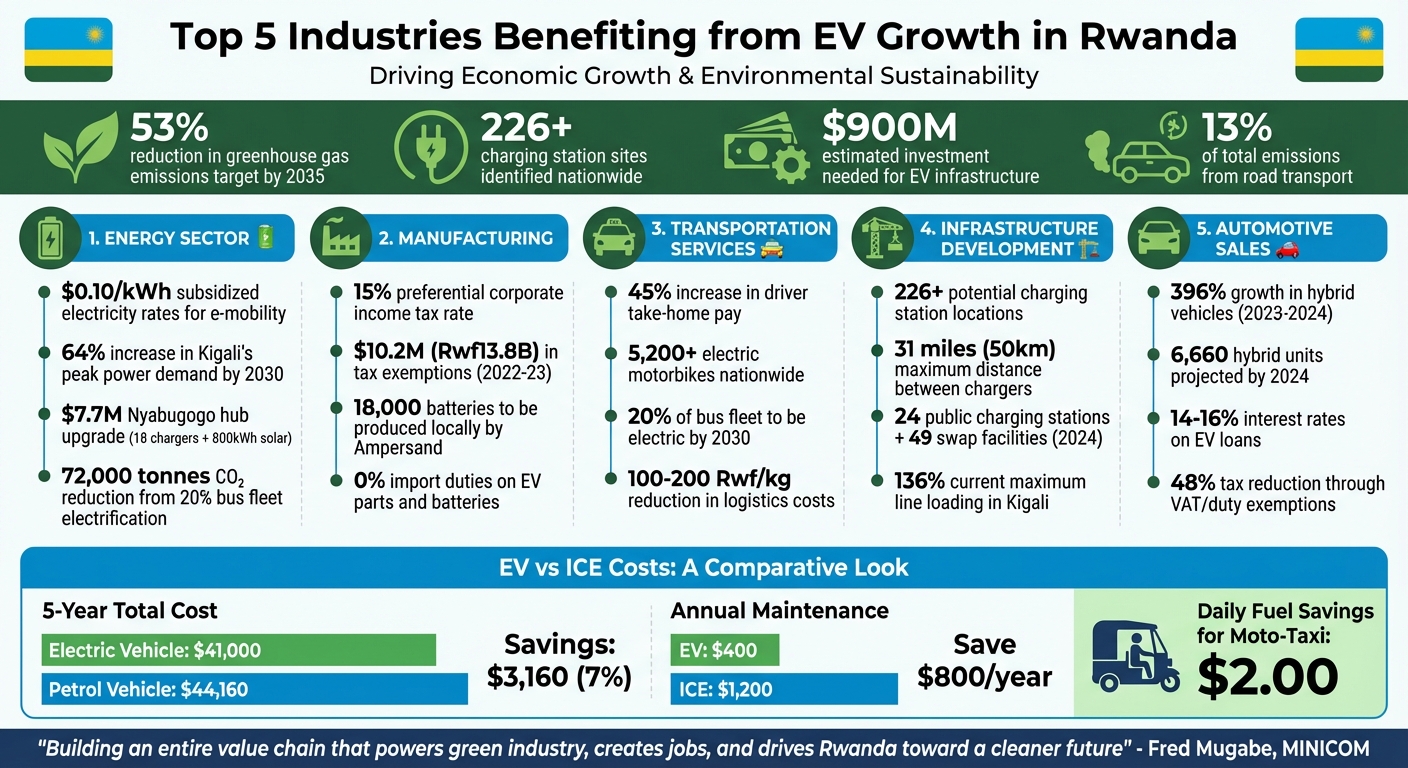
Rwanda EV Industry Impact: 5 Key Sectors Driving Economic Growth
Rwanda’s E-mobility revolution accelerates
sbb-itb-7bc66b5
1. Energy Sector
Rwanda’s energy sector is undergoing a transformation as electric vehicle (EV) adoption integrates renewable sources like solar and hydroelectric power into a growing charging network aimed at reducing emissions.
Economic Impact
E-mobility operators in Rwanda enjoy subsidized industrial electricity tariffs of about $0.10 per kilowatt-hour, making electric transportation more cost-competitive while creating new revenue opportunities for energy providers. However, infrastructure remains a key challenge. For instance, Kigali’s peak power demand is expected to rise by 64% by 2030. To address such challenges, Rwanda announced a $7.7 million project in September 2025 to upgrade the Nyabugogo multimodal transit hub. This facility will include 18 high-power chargers, an 800-kWh solar photovoltaic system, and 470 kWh of battery storage.
As Sahr Kpundeh, World Bank Country Manager for Rwanda, pointed out:
"Electric mobility is not only about cleaner buses. It is about building the foundations of a modern economy powered by sustainable energy."
These developments are not only reducing emissions but also creating new economic opportunities.
Environmental Benefits
Electrifying Rwanda’s transport sector is yielding measurable environmental improvements. Road transport contributes 13% of the country’s total emissions, with buses accounting for 40% of that figure. By transitioning 20% of the bus fleet to electric by 2030, Rwanda aims to eliminate 72,000 tonnes of carbon dioxide equivalents. Additionally, smart charging strategies that align vehicle charging with peak solar energy production could ease pressure on distribution networks by up to 15%.
Job Creation
The EV shift is opening doors for skilled jobs. In April 2025, Kabisa launched the "EV House" in Kigali, a facility that combines maintenance services with training programs. It features a telemechanic-enabled diagnostics bay and solar panels installed by Meshpower, providing hands-on training in renewable energy systems.
Battery production is another growing industry. By November 2025, Ampersand had set up 32 battery swap stations in Kigali and revealed plans to produce 18,000 batteries locally. Fred Mugabe, Industrial Development Policy Specialist at MINICOM, emphasized the broader vision:
"Our focus is to build an entire value chain that supports EV manufacturing, green jobs, and industrial growth."
These advancements are creating roles for energy engineers, solar technicians, and EV diagnostics experts, expanding career opportunities in specialized fields.
Industry Growth Potential
The energy sector’s long-term growth is bolstered by strategic investments and supportive policies. For example, the government offers a 15% preferential corporate income tax rate for investors in the e-mobility and energy sectors. Rwanda is also exploring vehicle-to-grid (V2G) technology, enabling EVs to function as distributed energy storage for the national grid. Furthermore, the government has pinpointed over 226 potential sites for charging stations and is actively upgrading the grid to support the increasing adoption of EVs.
2. Manufacturing Industry
Rwanda is making a bold move from importing finished electric vehicles (EVs) to producing them locally. Under its 2024–2034 Industrial Policy, the government has identified EVs as a key sector for growth, offering specific incentives to attract local manufacturers and assemblers.
Economic Impact
The rise in EV registrations has fueled local assembly efforts. Companies like Volkswagen Mobility Solutions Rwanda have set up flagship plants, reducing the country’s dependence on imports.
To encourage this shift, manufacturers and assemblers enjoy several financial benefits, including:
- A 15% corporate income tax rate
- Zero-rated VAT on EVs and parts
- 0% import duties on EV spare parts, batteries, and charging equipment
- Subsidized industrial electricity rates at approximately $0.10 per kilowatt-hour
- Rent-free government land for charging infrastructure
In the 2022–23 fiscal year alone, tax exemptions for EVs and hybrids accounted for an estimated Rwf13.8 billion ($10.2 million) in government support. Additionally, the Ireme Invest facility – a collaboration between the Rwanda Green Fund and the Development Bank of Rwanda – offers grants of up to Rwf144 million and recoverable grants of up to Rwf400 million to support e-mobility innovators. These initiatives showcase Rwanda’s dedication to advancing sustainable transportation.
This economic growth is not just about numbers – it’s also creating jobs and strengthening the local labor market.
Job Creation
The EV sector is driving demand for specialized technical and operational roles. For instance, Ampersand announced in November 2025 its plan to produce up to 18,000 batteries locally in Kigali to support its fleet of over 5,200 electric motorbikes. This effort is creating jobs for electrical engineers, assembly line workers, quality control experts, and logistics teams while bolstering Rwanda’s EV supply chain.
Volkswagen’s assembly plant plays a dual role by producing vehicles and serving as a hub for training workers in automotive manufacturing. Similarly, Spiro ramped up its local production capacity in late 2024 to meet Kigali’s government mandate requiring all new motorbike taxis to be electric by January 2025.
Industry Growth Potential
The EV industry in Rwanda is on a promising path, driven by ambitious policies and growing market demand. By 2030, the country aims to electrify 20% of its bus fleet, ensuring a steady need for local assembly and parts production. The mandatory switch to electric motorbike taxis in Kigali has also accelerated industrial scaling efforts. Beyond assembling vehicles, companies are diving into component production, especially lithium-ion batteries, to support the expanding fleet of electric motorcycles.
The Rwanda Green Fund has already backed more than 117 projects focused on job creation, social impact, and reducing carbon emissions. With road transport contributing 13% of Rwanda’s total emissions, the push for greener alternatives is not just an environmental necessity – it’s also a huge economic opportunity.
This industrial momentum is paving the way for further growth in Rwanda’s transportation services sector.
3. Transportation Services
Rwanda’s embrace of electric vehicles (EVs) is transforming its transportation landscape, impacting both urban and rural logistics. Starting in January 2025, the government will prohibit new petrol motorcycle registrations for commercial use in Kigali, allowing only electric motorcycle taxis for new operators. This bold policy has accelerated the shift in urban mobility, with companies like Ampersand and Spiro rapidly expanding battery-swapping networks to support a growing fleet of over 5,200 electric motorbikes nationwide. These efforts are redefining how people and goods move, setting a new standard for economic efficiency and environmental progress.
Economic Impact
The transition to electric transportation is delivering tangible savings for drivers and businesses alike. Electric motorcycle taxis, for instance, have increased drivers’ take-home pay by 45% while cutting operational costs. In Nyamagabe District, logistics expenses dropped by 100–200 Rwandan francs per kilogram, highlighting the financial advantages of EVs. Vincent Uwimana, Acting Director of Agriculture and Animal Resources in Nyamagabe District, remarked:
"Electric cars are not only environmentally friendly but also cost-effective, leading to reduced prices for essential goods such as animal feeds".
The public transit sector is also seeing major investments. Companies like BasiGo are testing electric buses in Kigali, aligning with the government’s goal to electrify 20% of the bus fleet by 2030. Plans for the $7.7 million upgrade of the Nyabugogo multi-modal transit hub include high-capacity chargers and solar power integration, ensuring the infrastructure can support electric fleets. Tarek Keskes, Energy Specialist at the World Bank, highlighted the benefits:
"The benefits for the daily commuter boarding a bus at Nyabugogo will be simple: cleaner air, quieter streets, and more reliable service".
Beyond financial gains, this shift is making a measurable impact on the environment.
Environmental Benefits
Rwanda’s move toward electric mobility is a critical step in meeting its climate goals. Road transport currently contributes 13% of the nation’s total emissions, with buses alone accounting for 40% of the transport sector’s emissions. The adoption of EVs in public and commercial transport is helping to reduce urban air pollution while cutting the sector’s carbon footprint. By integrating renewable energy sources like solar and hydroelectric power into charging infrastructure, Rwanda ensures that its electric mobility efforts remain environmentally responsible throughout the lifecycle.
Job Creation
The rise of electric transportation services is also opening up new job opportunities. Ampersand’s 32 battery swap stations in Kigali require staff for operations and management. Volkswagen’s "Move Rwanda" initiative, which introduced electric vehicles into its ride-hailing and car-sharing services, has created roles in fleet operations and digital management. Additionally, the government’s plan for over 4,100 battery-electric buses by 2050 will create a steady demand for technicians skilled in electric drivetrain maintenance and battery health management.
Industry Growth Potential
Rwanda’s transportation sector is poised for long-term growth. The mandatory switch to electric motorcycle taxis in Kigali has driven rapid expansion of battery-swapping infrastructure, with companies strategically placing stations to minimize downtime. The rise of shared electric mobility services is shifting the market away from private vehicle ownership toward more efficient transportation models. With charging stations planned at intervals of no more than 31 miles (50 kilometers) across the country, Rwanda is building a robust backbone for long-distance electric transport. This momentum supports further advancements in the nation’s EV market, paving the way for a more connected and sustainable future.
4. Infrastructure Development
Rwanda is making strides in upgrading its infrastructure to support the growing adoption of electric vehicles (EVs). The government has pinpointed over 226 potential locations for EV charging stations across the country, targeting high-traffic areas, existing gas stations, and commercial properties. This careful planning ensures that no EV will need to travel more than 31 miles (50 kilometers) without access to a charging station. By late 2024, Rwanda had already established 24 public charging stations for vehicles, 4 direct motorcycle chargers, and 49 facilities combining chargers with battery-swapping options.
Economic Impact
The infrastructure boom is not just about convenience – it’s fueling significant investments and cutting costs across industries. For instance, in November 2025, the government announced a $7.7 million project to transform the Nyabugogo multimodal transit hub into a green charging center. This ambitious plan includes installing 18 high-power chargers, an 800-kWh solar photovoltaic system, and 470 kWh of battery storage.
To meet its long-term EV goals, Rwanda estimates it will need up to $900 million for vehicle purchases and charging infrastructure. To attract investors, the government is offering rent-free land for charging stations and competitive industrial electricity rates of about $0.10 per kWh for e-mobility operators. Fred Mugabe, an Industrial Development Policy Specialist at MINICOM, highlighted the broader vision:
"Our goal is not just to adopt electric mobility; it’s to build an entire value chain that powers green industry, creates jobs, and drives Rwanda toward a cleaner, more resilient future".
These infrastructure investments align with advancements in energy and transportation, solidifying Rwanda’s transition to sustainable mobility.
Environmental Benefits
Expanding EV infrastructure plays a key role in Rwanda’s climate goals. Plans to electrify 20% of the bus fleet by 2030 are projected to cut 72,000 tonnes of carbon dioxide equivalents. By integrating solar power and battery storage into charging hubs, Rwanda aims to ensure EVs are powered by renewable energy instead of fossil fuels. This approach addresses a significant challenge, as road transport currently contributes 13% of the country’s total emissions.
Job Creation
The development of charging stations across urban and rural areas is expected to create a wide range of job opportunities. Ampersand, for example, has announced plans to locally produce up to 18,000 batteries, which will boost manufacturing employment. Additionally, the installation and maintenance of charging stations require skilled technicians for system setup and electrical upkeep. As the network expands to rural areas, roles for construction workers, solar panel installers, and energy storage engineers will grow, particularly in locations like Remera, Kimironko, Nyanza, and Kabuga.
Industry Growth Potential
As EV adoption accelerates, Rwanda’s infrastructure sector is set for sustained growth. However, the current electrical grid faces challenges – by 2024, maximum line loading in Kigali had reached 136%, surpassing safe limits even before full EV integration. This has prompted investments in grid modernization, including upgrades to power lines, transformers, and substations. Smart charging systems, designed to shift energy use to off-peak hours, are expected to ease grid stress by as much as 15%.
These upgrades, combined with public-private partnerships, government incentives, and increasing consumer interest, provide a strong foundation for infrastructure companies to scale operations nationwide.
5. Automotive Sales and Import
Rwanda’s automotive sales and import industry is undergoing a major shift, largely driven by the increasing adoption of electric vehicles (EVs). Recent statistics highlight a surge in EV purchases, with hybrid vehicle numbers projected to hit 6,660 units by 2024 – a staggering 396% growth from 2023 to 2024. This spike followed the introduction of a new government incentive package aimed at promoting EV adoption.
Economic Impact
To make EVs more affordable, the government has removed import duties and exempted fully electric vehicles from VAT. However, in late 2025, an 18% VAT was reintroduced for hybrid vehicles to further encourage zero-emission options.
In addition to tax incentives, major banks have stepped up with financing solutions tailored for EV buyers. Equity Bank, Bank of Kigali, and I&M Bank now offer credit products with interest rates ranging from 14% to 16%. In November 2025, Equity Bank’s Managing Director, Hannington Namara, announced a partnership to import over 1,000 electric vehicles, with the first batch of 30 already en route. He explained:
"We provide loans for purchasing EVs at interest rates between 14 and 16 percent as part of our commitment to environmental protection".
Traditional car dealerships are also adapting to this shift. CFAO Mobility has become the official distributor for BYD in Rwanda, while local dealers like KAS Auto are introducing brands such as Geely. AUTO24.rw has taken a leading role, becoming the first to bring Teslas, Leapmotor, and ROX electric vehicles to Rwanda, offering the broadest EV selection in the country.
Environmental Benefits
The move toward EVs is playing a significant role in advancing Rwanda’s climate goals. For instance, the adoption of electric motorcycles alone could save the country $22 million annually on fuel imports. Each electric motorcycle helps cut carbon dioxide emissions by about 2.6 metric tons per year. By 2030, Rwanda aims to have 20% of its buses, 30% of its motorcycles, and 8% of its cars running on electricity. Automotive importers are central to this effort, contributing to the larger goal of reducing greenhouse gas emissions by 53% by 2035.
Job Creation
The growing EV market is opening up new job opportunities across the automotive sector. Beyond traditional sales roles, there’s now a need for EV maintenance experts and battery swapping station operators. Ampersand, for example, plans to manufacture 18,000 batteries locally, creating jobs in manufacturing. CFAO Mobility is also looking into local assembly options, with Senior Sales Executive Augustin Nkotanyi stating:
"We’re exploring opportunities to support Rwanda’s industrialization goals, including potential local assembly aligned with government priorities and market readiness".
Industry Growth Potential
Government incentives are attracting both local and international players to the EV market. These include rent-free land for charging infrastructure and subsidized industrial electricity rates of about $0.10 per kilowatt-hour for e-mobility operators. These cost advantages are making EVs more appealing to consumers. For instance, electric motorcycle taxi riders have reported a 45% increase in take-home pay, amounting to roughly $840 in annual savings.
This momentum in EV adoption is not just reshaping Rwanda’s automotive landscape but also solidifying the sector as a key driver of the country’s green economy. The stage is now set for a closer look at how EVs compare to traditional internal combustion engine (ICE) vehicles in terms of costs and benefits.
EV vs. ICE Vehicle Cost Comparison
When it comes to comparing costs, EVs (electric vehicles) clearly show their value across fuel, maintenance, and ownership expenses.
Fuel savings are one of the most immediate benefits. Charging an electric motorcycle battery costs between $1.00 and $1.50 and provides a range of about 37 miles (60 km). In contrast, petrol motorcycles consume fuel at roughly $1.30 per liter, covering just 22 miles. For moto-taxi riders, this translates to about $2 in daily savings when switching to EVs.
Maintenance costs are another area where EVs shine. With fewer moving parts and no need for oil changes, annual maintenance for EVs averages $400, compared to about $1,200 for petrol vehicles. Over five years, this difference adds up, contributing to a total ownership cost of $41,000 for EVs, compared to $44,160 for petrol vehicles – a savings of approximately $3,160.
| Cost Category | Electric Vehicle | ICE Vehicle (Petrol) | Savings |
|---|---|---|---|
| 5-Year Cost | $41,000 | $44,160 | $3,160 (7%) |
| Annual Maintenance | $400 | $1,200 | $800 |
| Energy Cost (37 miles/60 km) | $1.00–$1.50 | ~$2.00+ | ~$0.50–$1.00 |
Beyond these savings, government incentives make EVs even more appealing. Rwanda offers a 48% tax reduction through import duty and VAT exemptions on EVs, helping to offset their higher upfront costs. For the country’s 46,000 moto-taxi riders, this shift could collectively save $6.6 million annually in fuel import costs. Additionally, entry-level electric motorcycles, like those from Spiro, are available for around $500, making them an affordable option for many.
These factors not only highlight the financial benefits of EVs but also support Rwanda’s broader push toward a greener economy.
Conclusion
Rwanda’s push toward electric vehicles (EVs) is doing more than cutting emissions – it’s reshaping the nation’s economy. From energy and manufacturing to transportation and infrastructure, every sector is seeing the ripple effects of this transition, creating new jobs and opening doors to innovative financing options.
The results are visible on both large and small scales. Since 2020, Rwanda has experienced notable economic growth and cost savings, all while progressing toward its ambitious goal of reducing greenhouse gas emissions by 53% by 2035. As Fred Mugabe, an Industrial Development Policy Specialist at MINICOM, explains:
"Our goal is not just to adopt electric mobility; it’s to build an entire value chain that powers green industry, creates jobs, and drives Rwanda toward a cleaner, more resilient future".
For drivers and businesses, the advantages are undeniable: reduced fuel and maintenance expenses paired with access to tailored financing. Meanwhile, the charging infrastructure is expanding at a rapid pace. Over 226 potential charging station sites have already been identified nationwide, ensuring that no vehicle is more than 31 miles (50 km) from a charger. A $7.7 million investment is also transforming the Nyabugogo transit hub into a solar-powered charging center, further supporting the shift to EVs.
FAQs
How will Rwanda’s power grid handle more EV charging?
Rwanda is gearing up its power grid to handle the rising demand for EV charging through careful planning and infrastructure upgrades. The government has mapped out a master plan aimed at ensuring charging stations are accessible across the country, identifying more than 226 potential locations to meet future needs. Key initiatives include boosting energy capacity, seamlessly integrating EV infrastructure into the grid, and encouraging EV adoption with incentives like duty-free imports and support for local charging station projects. These efforts aim to create a reliable and efficient energy system to support the shift to electric mobility.
Where can I charge or swap an EV battery outside Kigali?
EV battery swapping stations can now be found beyond Kigali, with Spiro Rwanda introducing an automated swap station as part of this initiative. The company has ambitious plans to roll out more stations nationwide, aiming to provide EV users with convenient access to battery swapping services across different areas.
What financing options make EVs cheaper upfront in Rwanda?
Rwanda has introduced a generous policy to encourage electric vehicle (EV) adoption. Until June 30, 2028, EVs are exempt from import duties, VAT, and excise taxes. This move drastically reduces the upfront costs, making EVs a more budget-friendly option for consumers.
Related Blog Posts
- Rwanda’s ICE Vehicles: Carbon Emissions Impact
- Is Rwanda Ready for Electric Vehicles?
- Rwanda’s EV Road Projects: Progress and Impact
- Why Rwanda Is Adopting Electric Mobility Fast