
Importing a vehicle into Rwanda can become costly if you miss deadlines, make documentation errors, or miscalculate taxes. The Rwanda Revenue Authority (RRA) imposes strict penalties, including fines of up to 60% of unpaid taxes, fixed penalties ranging from 50,000 Frw to 500,000 Frw, and monthly interest charges that can reach 1.5%.
Here are the key mistakes to avoid:
- Late Import Declaration Form (IDF) Submission: Fines increase from 20% (up to 30 days) to 60% (over 60 days).
- Missed Offloading Deadlines: Fines up to $5,000 for delays at ports.
- Tax Calculation Errors: Underreporting taxes can lead to fines of 10%-20% on the shortfall.
- Documentation Mistakes: Missing or incorrect forms can cost up to 5,000,000 Frw for large taxpayers.
- Delayed Ownership Transfers: Fines and interest accrue if not completed within 8 days.
To avoid penalties, submit forms on time, hire certified clearing agents, double-check documentation, and use the RRA’s online tools. Address errors immediately to minimize fines. Staying compliant saves money and simplifies the import process.
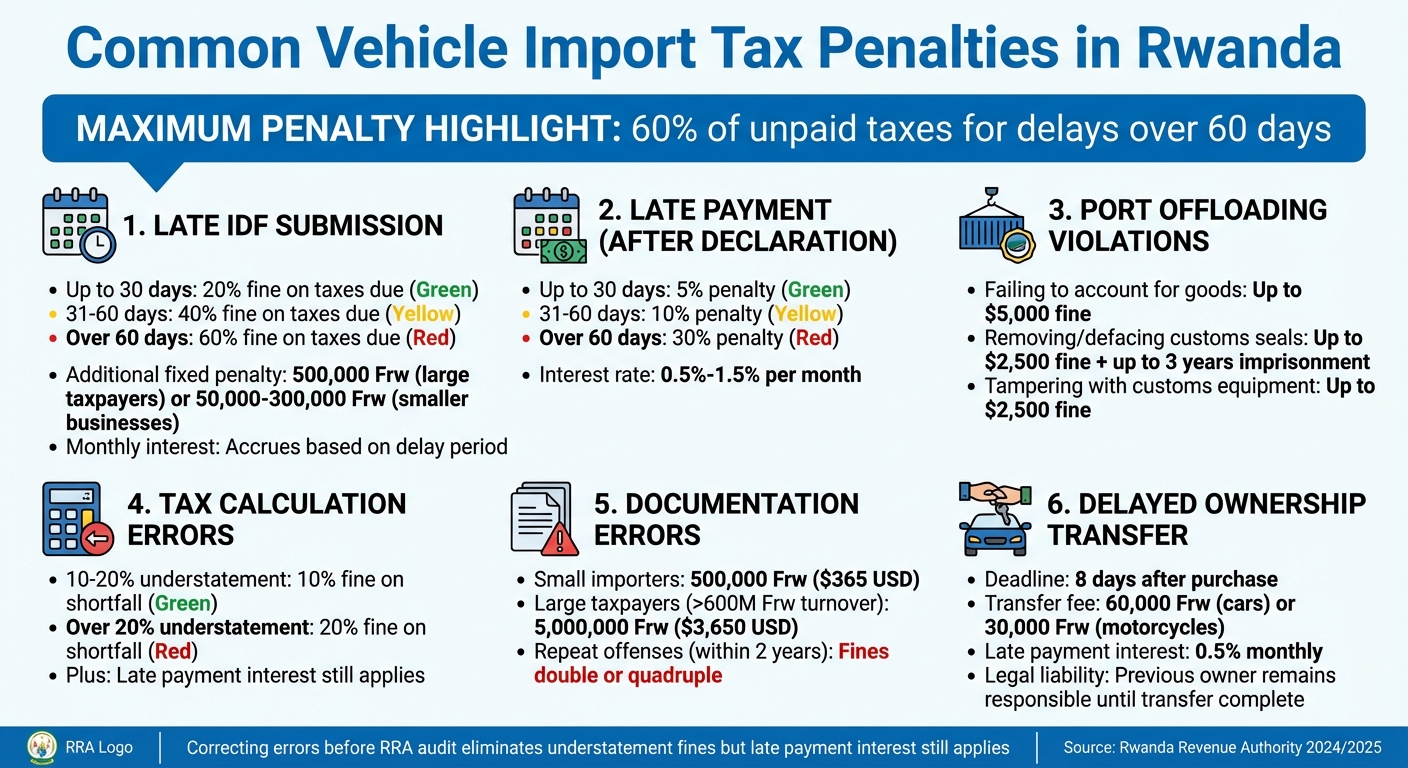
Rwanda Vehicle Import Penalties and Fines by Violation Type
Missing the Import Declaration Form (IDF) Deadline
Why the IDF Deadline Matters
The Import Declaration Form (IDF) is a crucial document for registering imported vehicles in Rwanda. Without it, you won’t be able to secure a customs release order, which means delays in clearing your vehicle through customs. This form includes key details like the Customs Procedure Code, HS Code, quantity, CIF value, and the vehicle’s origin.
Missing the IDF deadline can result in steep fines that increase over time. For delays of up to 30 days, you’ll face a 20% fine on the taxes due. A delay of 31–60 days increases the fine to 40%, and anything beyond 60 days triggers a 60% fine. Even if you declare on time but delay payment, penalties still apply – 5% for up to 30 days, 10% for 31–60 days, and 30% for delays over 60 days. On top of these fines, interest accrues monthly based on the delay period.
Large taxpayers face an additional fixed penalty of 500,000 Frw for missing the declaration deadline. Smaller businesses are fined between 50,000 Frw and 300,000 Frw, depending on their turnover. These penalties can add up, meaning you could be liable for a fixed fine, a percentage-based penalty, and interest all at once.
Clearly, adhering to the IDF submission deadlines is critical to avoid these financial setbacks. Here’s how you can ensure timely submission.
How to Submit Your IDF on Time
Submitting your IDF on time is key to avoiding penalties. Start by registering for your Tax Identification Number (TIN) well in advance – ideally before your vehicle arrives. Make sure the TIN matches the details on your National Identity Card or Passport exactly, as mismatched information can cause registration errors and further delays.
Use the Rwanda Trade Portal to file your IDF electronically before your cargo reaches the border. Filing early not only speeds up customs clearance but also allows you to calculate duties, tariffs, and taxes ahead of time. To streamline the process, prepare all necessary documents in advance, such as the supplier’s invoice, arrival notice, bill of lading, and T1 form.
Consider setting up a prepayment account linked to your TIN with the Rwanda Revenue Authority. By depositing funds in advance, you ensure that the correct amount of taxes and duties is automatically deducted when assessed, avoiding delays that could lead to penalties. If you anticipate missing a deadline, apply for an extension from the Commissioner General. Extensions, when approved, prevent penalties – provided you meet the new deadline.
Taking these steps can save you from unnecessary fines and keep the import process running smoothly.
sbb-itb-7bc66b5
Missing Vehicle Offloading Deadlines at Ports
Fines for Late Offloading
Once a vessel arrives at a Rwandan port – typically through Mombasa or Dar Es Salaam – strict offloading deadlines come into effect. According to the EAC Customs Management Act (EAC CMA 2024), vessel masters and agents are required to accurately report and account for all discharged goods to customs officers. Failing to comply can lead to serious consequences, including the forfeiture of goods and the detention of the vessel until all fines are settled.
Here’s a breakdown of potential penalties:
- Failing to account for discharged goods or deviating from the approved voyage: fines of up to $5,000.
- Removing or defacing customs seals: fines of up to $2,500 and imprisonment for up to three years.
- Tampering with customs equipment like buoys, chains, or ropes: fines of up to $2,500.
These penalties exist to uphold the customs process and ensure that all imported goods are properly managed.
How to Meet Offloading Deadlines
To avoid fines and delays, it’s crucial to plan ahead. Start by hiring a clearing agent approved by the Rwanda Revenue Authority before your vehicle arrives. These agents handle key responsibilities such as completing documentation, paying duties, and arranging inspections – steps that are vital for meeting offloading deadlines. Given that most vehicles destined for Rwanda pass through the Port of Mombasa in Kenya, working with an agent familiar with this route is especially important.
Make sure all your documents, like the original logbook or title deed, are valid and ready. Keep track of your vessel’s arrival schedule and coordinate with your clearing agent to avoid unnecessary delays. The Rwanda Trade Portal offers detailed guidelines for ports like Mombasa and Dar Es Salaam, including cargo handling procedures and clearance requirements. Lastly, never tamper with customs seals or equipment, as doing so can lead to severe legal and financial consequences. Staying compliant will save you time, money, and stress.
Import Tax Calculation Errors and EV Exemption Mistakes
Frequent Tax Payment Errors
Getting tax calculations wrong can hit your wallet hard. If you understate your tax liability by 10%–20%, you’ll face a 10% fine on the shortfall. Go beyond 20%, and the fine doubles to 20%. One common mistake is miscalculating the Cost, Insurance, and Freight (CIF) value, which is the basis for determining import duties. For the 2024/2025 fiscal year, the rules are clear: a 25% Common External Tariff applies only to the portion of a vehicle’s CIF value up to $60,000. Anything above that amount is exempt from this tariff.
Another costly oversight? Forgetting the 5% Withholding Tax on the CIF value. You can avoid this charge entirely if you have a valid Tax Clearance Certificate. Electric and hybrid vehicle owners have their own set of challenges. If the proper classification codes aren’t used during customs clearance, they could miss out on the 0% import duty they’re entitled to, leading to unnecessary overpayments. Getting these calculations right is especially important for those looking to benefit from EV and hybrid exemptions.
How to Calculate and Pay Taxes Correctly
Accurate calculations and proper documentation are your best defenses against fines and penalties. Start by confirming your vehicle’s eligibility for EV or hybrid exemptions directly with the Rwanda Revenue Authority (RRA). These incentives are reviewed annually, so staying updated is essential. As the RRA explains:
"The Government decided to extend incentives on Electric & Hybrid vehicles and Electric motorcycles to pay an import duty rate of zero. This intends to accelerate the transition to Electric Vehicles and reduce greenhouse gas emissions from vehicle transportation."
To ensure accuracy, work with certified clearing agents who can calculate your CIF value correctly and help you avoid penalties. Pay close attention to your vehicle’s specifications, as duty rates differ depending on factors like capacity and weight. For instance, buses with 50 or more seats and trucks weighing over 20 tons qualify for a 0% duty rate. On the other hand, smaller commercial vehicles face a 10% rate.
If you discover any errors in your tax calculations, correct them immediately to avoid understatement fines. Keep in mind, though, that late payment interest may still apply. Finally, maintaining organized filing and payment records is key. A valid Tax Clearance Certificate not only exempts you from the 5% Withholding Tax on future imports but also keeps your tax obligations in check.
Documentation Errors and Manifest Changes
When it comes to import taxes, getting your paperwork right is just as important as meeting deadlines and calculating taxes. Mistakes in documentation can lead to hefty penalties, so accuracy is non-negotiable.
Common Documentation Errors
Some of the most frequent errors include incomplete Import Declaration Forms (IDFs), incorrect Tax Identification Numbers (TINs), and missing exemption certificates. These slip-ups can result in steep fines from the Rwanda Revenue Authority (RRA). For instance, penalties range from 500,000 FRw (about $365 USD) for smaller importers to 5,000,000 FRw (around $3,650 USD) for larger taxpayers with annual turnovers exceeding 600 million FRw. Repeat the same mistake within two years, and those fines could double or even quadruple.
Undervaluing goods on a commercial invoice is another common and costly issue. If the declared value is understated by 10% to 20%, you’ll face a 10% fine on the difference. If the understatement exceeds 20%, the penalty increases to 20% of the difference.
How to Submit Accurate Documentation
The key to avoiding penalties is double-checking everything before submission. Rwanda’s Electronic Single Window (ReSW) simplifies this process by allowing you to upload and monitor all 12 required documents in one place. These include essential files like the Bill of Lading, Commercial Invoice, Packing List, and IDF. Make sure your manifest data aligns with your IDF and TIN to avoid discrepancies during the RRA’s review.
If you’re importing an electric or hybrid vehicle, obtain your Duties and Taxes Exemption Certificate before starting the clearance process. This step not only prevents overpayment but also avoids the hassle of making amendments after submission. Partnering with licensed clearing agents can further reduce the risk of errors – they’re well-versed in the Single Window system and its requirements.
If you spot an error, fix it immediately – preferably before the RRA notifies you. Correcting your declaration and paying any owed amount upfront can help you avoid understatement fines. While late payment interest – starting at 0.5% per month – will still apply, it’s far better than incurring additional penalties of 10% to 20%. Proper documentation ensures smoother customs clearance and complements accurate IDF and tax calculations.
Required Documents vs. Common Errors
| Required Documentation | Common Error/Mistake | Penalty Consequence |
|---|---|---|
| Import Declaration Form (IDF) | Missing or late submission | Fixed administrative fine ($36–$365 USD) |
| Tax Identification Number (TIN) | Incorrect or missing TIN | Incomplete information fine ($365–$3,650 USD) |
| Exemption Certificates | Missing certificates at time of filing | Overpayment or understatement fine (10–20%) |
| Commercial Invoice | Undervaluing goods | Understatement fine (10% or 20% of difference) |
| Manifest/Declaration | Providing misleading data | Fixed fine based on turnover (up to $3,650 USD) |
Delayed Vehicle Ownership Transfer After Import
Completing the ownership transfer on time is crucial to avoid fines, legal troubles, and ongoing tax obligations. Missing the deadline can lead to serious consequences, including financial penalties and liability for incidents involving the vehicle.
Penalties for Missing the Ownership Transfer Deadline
In Rwanda, the law mandates that vehicle ownership transfer – referred to as "mutation" – be completed within eight days of purchasing or receiving a vehicle. This process, like other import-related procedures, comes with strict deadlines. Failing to meet them can result in hefty fines and legal complications. Alarmingly, the previous owner remains legally responsible for any issues involving the vehicle until the transfer is finalized. ACP Boniface Rutikanga, Spokesperson for the Rwanda National Police, highlighted this issue:
"In many cases, the registered owner tells us they sold the vehicle long ago but never completed mutation, yet fines and legal responsibility continue to fall on them".
For imported vehicles with temporary plates (IT, CD, or UN), transferring ownership to a non-exempt buyer requires settling all outstanding customs duties before proceeding. Additionally, neglecting to deregister unused vehicles by returning plates and logbooks leads to ongoing tax accumulation. The transfer fees are 60,000 FRw (about $44 USD) for cars and 30,000 FRw (around $22 USD) for motorcycles. If the payment is late, a 0.5% monthly interest will be added.
As of January 2026, over 16,000 people in Rwanda had applied for ownership transfer services. However, around 10,000 of them – 62.5% – encountered challenges that required intervention by authorities. Jean Paulin Uwitonze, Assistant Commissioner for Taxpayer Services and Communication at RRA, explained the risks of delaying the process:
"Sellers are legally required to complete the mutation process within eight days of selling a vehicle. Failure to do so has led to widespread misuse of motor-vehicles for tax evasion, illegal businesses, smuggling, and other crimes".
These penalties make it clear that completing the transfer process promptly is essential, and the online system makes it easier to comply.
How to Complete the Ownership Transfer
Since October 16, 2023, all vehicle ownership transfers in Rwanda must be processed online via the RRA e-tax portal at etax.rra.gov.rw. Before initiating the transfer, ensure the seller’s account is clear of any tax debts, including central taxes, local taxes, customs duties, and motor vehicle taxes, as unresolved arrears will lead to cancellation of your request.
To proceed, you’ll need the following documents:
- A notarized sale contract
- Copies of ID for both the buyer and seller
- The vehicle’s registration card (Yellow Card)
- Your Tax Identification Number (TIN)
- A valid one-year insurance certificate
Once your online application is approved, you’ll need to physically hand over the previous number plates and registration card to receive new ones. For newly imported vehicles, ensure your TIN matches the identification used during customs declaration to avoid registration errors. If the seller is deceased or resides abroad, reach out to RRA or RNP for guidance on handling such cases.
A nationwide campaign launched on January 26, 2026, offered a grace period until February 28, 2026, allowing vehicle owners to resolve complex transfer issues without immediate penalties. Taking advantage of such opportunities can help you avoid unnecessary complications.
Conclusion
Navigating Rwanda’s import tax rules requires meeting strict deadlines, submitting proper documentation, and taking advantage of available incentives. Missing deadlines can lead to steep fines – up to 60% of the tax owed for delays beyond 60 days – while monthly late payment interest ranges from 0.5% to 1.5%. As discussed, steering clear of common mistakes is key to avoiding penalties and ensuring a hassle-free vehicle importation process.
Staying compliant doesn’t just help you avoid fines – it can also save you money. For instance, Rwanda offers a 0% import duty on items like electric and hybrid vehicles, capital machinery, and telecommunication equipment. On the other hand, imported cars with a Cost, Insurance, and Freight (CIF) value up to $60,000 are subject to a 25% Common External Tariff, with additional incentives available for higher-value vehicles. By combining these benefits with accurate and timely actions, you can simplify the entire import process.
If errors occur, addressing them quickly is crucial to minimizing penalties. Correcting a mistake and paying the tax before an audit notice eliminates understatement fines, though late payment interest will still apply. Payments are applied in a specific order: first to the principal tax, then to fines, and finally to interest. Taking these steps can help you stay on top of your obligations and avoid unnecessary costs.
FAQs
What should I do if I realize I filed the wrong import value or tax amount?
If you spot an error in your import value or tax amount, it’s crucial to address it right away to avoid potential penalties. You can do this by submitting an amended declaration or correction through the appropriate channels and informing the relevant customs or tax authorities. Ignoring the issue could lead to fines, penalties, or interest charges. Taking swift action not only ensures compliance but also helps resolve the matter more smoothly.
How can I confirm my vehicle qualifies for EV or hybrid import duty exemptions?
To determine if your vehicle qualifies for import duty exemptions in Rwanda, it must meet specific criteria. These include being an electric vehicle, a hybrid, or an electric motorcycle. Additionally, ensure the vehicle complies with all relevant regulations. These exemptions have been in place since April 2021.
Which documents are most likely to trigger penalties if they don’t match?
Discrepancies in declaration documents – such as the Commercial Invoice, Import Declaration Form (IDF), or certificates of origin – can cause serious headaches, including penalties. Mistakes like misclassification, undervaluation, or incorrect origin declarations often lead to import tax problems. Double-checking these documents for accuracy and consistency is key to steering clear of non-compliance penalties.
Related Blog Posts
- 5 Common Car Shipping Issues to Rwanda
- Car import duties in Rwanda: Updated costs and procedures for 2025
- Special EV Customs Rules: What Importers Need to Know
- Car Import Tax in Rwanda: Complete 2025 Guide