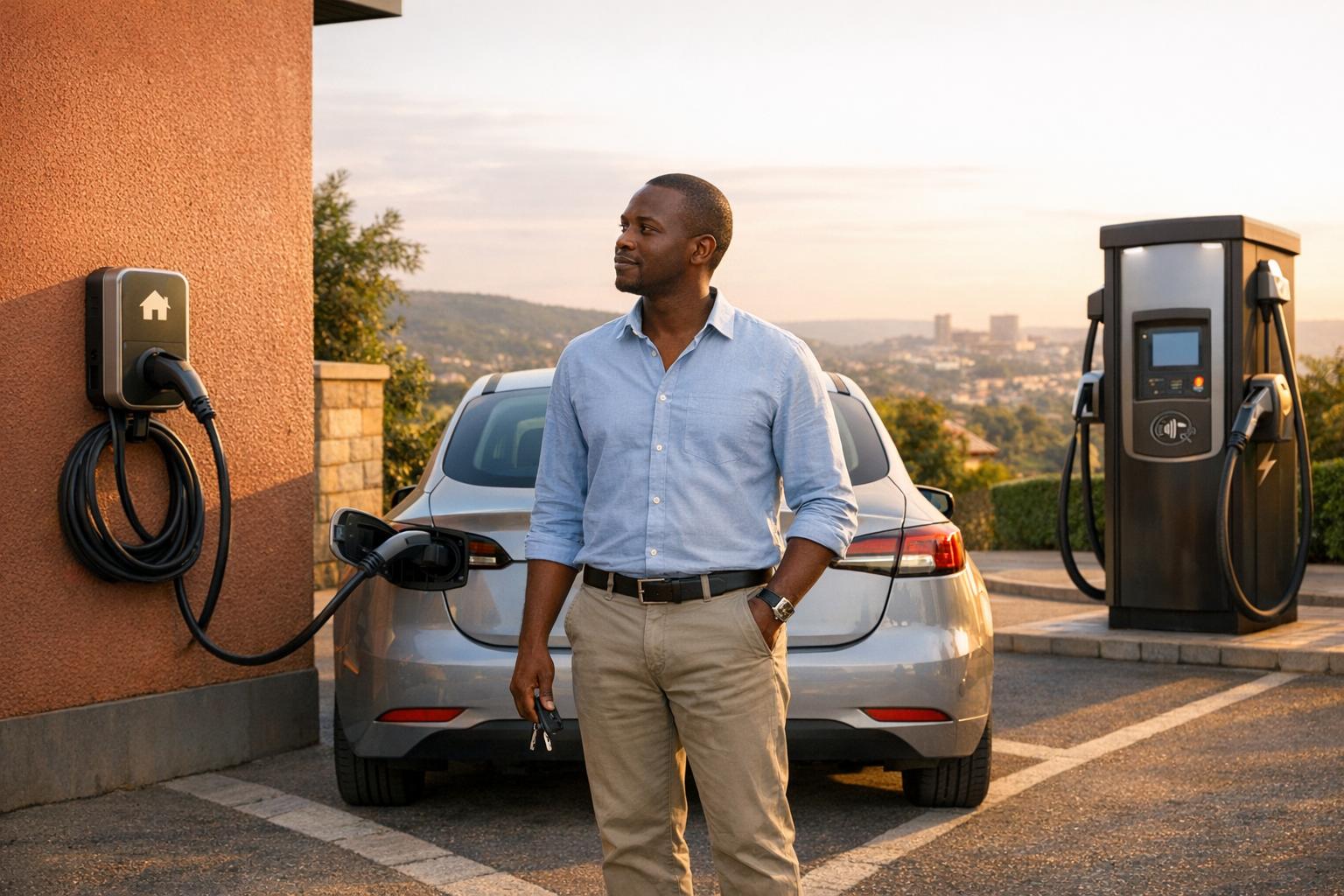
Charging an electric vehicle (EV) in Rwanda boils down to two main options: home charging and public charging. Here’s the quick breakdown:
- Home Charging: Cheaper by 30–50% compared to public charging, with electricity costs ranging from $0.10 to $0.118 per kWh (industrial rate). Initial setup costs for Level 2 chargers range from $220 to $590, with potential panel upgrades costing up to $3,000. Ideal for daily commuters with private parking.
- Public Charging: Convenient for long trips or those without home setups, but costs are 30–50% higher per kWh. Rwanda had only 24 public stations by 2024, mostly in Kigali, with plans to expand. Limited availability makes it less practical for regular use.
Quick Comparison
| Factor | Home Charging | Public Charging |
|---|---|---|
| Cost per kWh | $0.10–$0.118 (industrial rate) | 30–50% higher |
| Setup Costs | $220–$590 (plus upgrades if needed) | None |
| Convenience | High (overnight charging) | Limited (24 stations in 2024) |
| Best For | Daily commuting | Long-distance travel backup |
For most drivers, home charging offers the best savings and convenience, while public charging serves as a backup for specific situations.
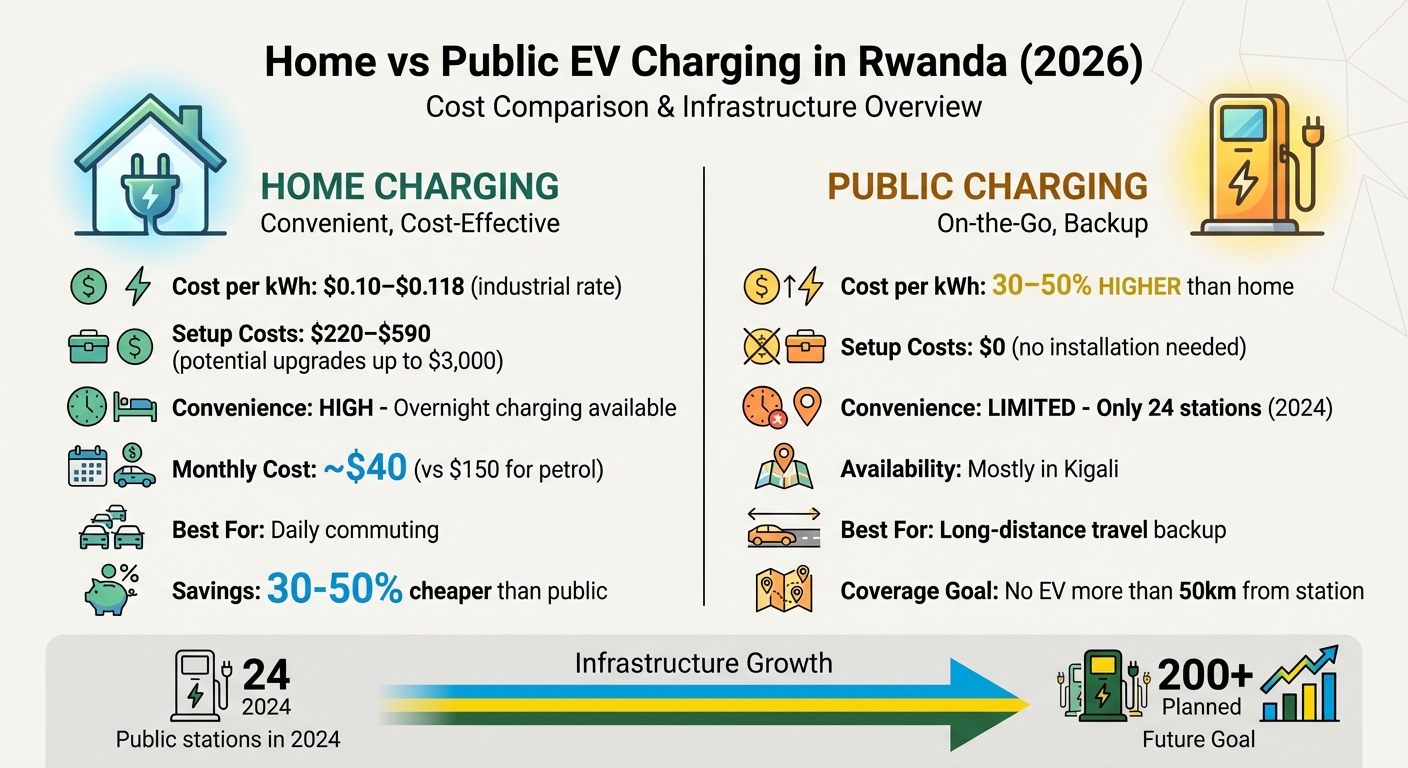
Home vs Public EV Charging Costs in Rwanda 2026
1. Home Charging
Cost per kWh
In Rwanda, home charging benefits from a subsidized industrial rate instead of the standard residential tariff. This subsidized rate ranges from $0.10 to $0.118 per kWh, significantly lower than the standard residential rate of $0.20 per kWh. This effectively cuts your charging costs in half, with even more savings during off-peak hours. This is particularly relevant as Kigali’s electrical grid hit 136% of its maximum load capacity in 2024.
Infrastructure Availability
Level 1 charging relies on a standard 220 V outlet with a portable adapter, providing around 4 to 5 km (2.5–3.1 miles) of range per hour. It works well for those driving less than 60 km (about 37 miles) daily. For those driving further, Level 2 charging is a better option. It uses a dedicated 7 kW wall charger, capable of fully charging most vehicles overnight – perfect for drivers covering more than 65 km (approximately 40 miles) per day.
Setting up a charging system at home involves some initial costs. Installation for a basic setup ranges between 300,000 and 800,000 RWF ($220 to $590), while the Level 2 charger itself can cost anywhere from 650,000 to 3,250,000 RWF, depending on the brand and features. Many dealerships, including CFAO Mobility, bundle 7 kW wall chargers and portable adapters with new EV purchases, which helps offset this cost. Additionally, VAT exemptions on charging equipment further lower the financial barrier.
Before installation, it’s essential to have a RURA-certified electrician evaluate your electrical panel’s capacity. For older homes, panel upgrades could cost between 700,000 and over 3,000,000 RWF. Keeping the distance between your electrical panel and parking space under 10 meters can also help reduce installation expenses.
Convenience
Home charging offers unmatched convenience, especially in Rwanda, where there are fewer than 30 public charging stations available for a population of 14 million. Simply plug in your vehicle overnight for a full charge. Smart chargers with mobile apps add even more ease, letting you schedule charging during off-peak hours to save on costs and reduce strain on the grid. For daily commuters, home charging ensures your EV is always ready without relying on the limited public charging network, which is mainly concentrated in Kigali. This convenience makes home charging a dependable solution compared to public charging alternatives.
sbb-itb-7bc66b5
Inside KABISA: Rwanda’s EV Revolution | WIB Documentary
2. Public Charging
While charging at home is often more cost-effective and convenient, using public charging stations comes with its own set of challenges and considerations.
Cost per kWh
Public charging in Rwanda is noticeably more expensive than home charging, costing 30% to 50% more per kilowatt-hour. These higher rates are largely due to the added infrastructure costs of maintaining public stations. For those who rely heavily on public charging, this price difference can add up quickly, making it a less budget-friendly choice for regular use.
Infrastructure Availability
Rwanda’s public charging network is still in its early stages, but it’s growing steadily. By late 2024, the country had 24 public charging stations, 4 direct chargers specifically for motorcycles, and 49 facilities offering both charging and battery-swapping options. Most of these stations are concentrated in Kigali, often located at shopping malls, office buildings, and petrol stations.
The government has a clear plan to expand this network. Their goal is to ensure that no electric vehicle driver needs to travel more than 50 kilometers (31 miles) to find a charging station. A geospatial analysis has already identified over 226 potential sites for future stations, focusing on areas with high traffic and dense populations. Efforts are also underway to install highway charging stations along major routes to popular destinations like Lake Kivu and Akagera National Park. However, until the network matures, public charging remains a secondary option for most drivers.
Convenience
With fewer than 30 stations available nationwide, public charging is best treated as a backup solution rather than a primary one. Drivers, especially those traveling outside Kigali, should plan carefully and check the real-time status of stations using tools like the PlugShare map. Some stations may occasionally be out of service due to maintenance. This limited availability highlights the importance of strategic trip planning, as public charging currently cannot match the reliability and ease of home charging.
Pros and Cons
When deciding between home and public charging, your choice will largely depend on your driving habits, budget, and whether your living situation allows for home charging. Both options come with their own advantages and drawbacks that impact both your finances and convenience.
Home charging offers excellent long-term savings, thanks to Rwanda’s favorable industrial electricity rate for EVs. Installation costs typically range from 300,000 to 800,000 RWF ($220 to $590), though more complex setups – like electrical panel upgrades – can exceed 3,000,000 RWF. On the bright side, monthly charging costs drop significantly to around $40, compared to the $150 many previously spent on petrol. However, home charging is only viable if you own a property with dedicated parking and the necessary electrical infrastructure.
Public charging, on the other hand, requires no upfront installation costs and provides faster charging speeds through DC fast chargers, making it a lifesaver for long trips. But there are trade-offs. Public charging stations come with added infrastructure fees and higher electricity rates – 30–50% more expensive than home charging. Limited availability is another challenge, with only 24 stations nationwide as of late 2024, mostly concentrated in Kigali. This leaves rural drivers with fewer options, despite government plans to ensure no EV is more than 31 miles (50 kilometers) from a charging station.
Here’s a quick breakdown of the key differences:
| Factor | Home Charging | Public Charging |
|---|---|---|
| Cost per kWh | Lower (industrial rate) | 30–50% higher |
| Setup Costs | 300,000–800,000 RWF | None |
| Convenience | High (overnight charging) | Limited (24 stations, mostly Kigali) |
| Long-term Savings | Highest | Lower due to premium rates |
| Best For | Daily commuting | Long-distance travel backup |
For regular drivers who own property, home charging is the most cost-effective solution, with savings that can offset the initial setup costs over time. Public charging, however, is an important backup for long trips or emergencies, adding flexibility for EV owners who may not have access to home charging.
Conclusion
Deciding between home and public charging in Rwanda depends largely on your living situation, driving habits, and whether you own property. For urban homeowners with private parking, home charging stands out as the most economical choice. It not only saves money over time compared to public stations but also lets you charge overnight, ensuring you wake up to a fully charged vehicle. While the upfront cost of installation might seem steep, the savings on energy costs – helped by Rwanda’s favorable industrial electricity rates – make it worthwhile in the long run.
In cities like Kigali, both home and public charging are viable options, with 24 public charging stations available. However, home charging during off-peak hours is recommended to ease pressure on the grid, which in 2024 reached 136% of its maximum load capacity.
For those in rural areas, the situation is more challenging. Public charging stations are still sparse outside Kigali, though efforts are underway to expand the network to 200 chargers across the country. The goal is to ensure no EV is more than 31 miles (50 kilometers) from a charging point. Until this is achieved, home charging is essential for rural EV owners, offering both convenience and cost savings. Investing in a reliable Level 2 home charger and a vehicle suited for rugged roads – like one with high ground clearance – can make navigating rural terrain much easier.
For apartment residents without access to dedicated parking or electrical setups, public charging is the only feasible option for now. While it’s pricier per kilowatt-hour, the growing network and VAT exemption on imported chargers (valid through June 30, 2028) suggest that public infrastructure will continue to expand and improve. Ultimately, the best charging approach depends on your individual circumstances and driving requirements.
FAQs
How much can I save per month by charging at home in Rwanda?
Charging your EV at home in Rwanda can help you save around $50 to $70 each month. This estimate is based on an electricity rate of roughly $0.176 per kWh and average household energy consumption. It’s a budget-friendly alternative when compared to using public charging stations.
How do I know if my home needs an electrical panel upgrade for Level 2 charging?
To find out if your home’s electrical panel can handle a Level 2 EV charger, start by checking its amperage rating and overall capacity. Level 2 chargers usually require a dedicated circuit rated between 40 and 50 amps. If your panel is already close to full capacity or doesn’t have room for a dedicated circuit, you might need an upgrade. It’s best to consult a licensed electrician who can evaluate your system and confirm whether it’s ready to safely support Level 2 charging.
What’s the best way to plan trips with Rwanda’s limited public chargers?
Planning trips with Rwanda’s limited public EV chargers requires a bit of strategy. Start by prioritizing charging at home – it’s often more cost-effective and reduces the need to rely heavily on public stations. To make the most of your journey, use EV charging maps to locate available public chargers and plan your stops accordingly.
It’s also smart to keep an eye on updates about new charging stations or infrastructure improvements. This can help you avoid the stress of running low on power, commonly known as range anxiety. For longer trips, ensure your EV is fully charged before you hit the road and map out charging stops in advance to stay ahead of any challenges.