There are few drives in Rwanda quite like the route toward the Virunga Massif. The road climbs steadily through mist-covered hills, tea plantations, and dense forest as altitude rises and the air grows noticeably cooler and thinner. It is one of the most spectacular journeys in East Africa — and one of the most demanding on your vehicle’s cooling system.
Drivers heading to Volcanoes National Park, Musanze, or the border regions near Gisenyi and Rubavu often focus on the road conditions ahead without giving a second thought to what is happening inside the engine bay. But high-altitude driving creates a unique combination of stresses on your radiator and cooling system that can turn a scenic trip into a roadside emergency if your car is not properly prepared.
In this guide, we explain exactly why altitude affects your engine’s cooling needs, how to maintain your radiator for high-altitude performance, and what to do if things go wrong on the road. Whether you drive this route regularly for work or make the occasional trip for gorilla trekking, this is essential reading.
For more vehicle tips, travel routes, and automotive news tailored to Rwandan roads and drivers, visit automag.rw — Rwanda’s go-to automotive resource.
Why High Altitude Is Hard on Your Cooling System
Most drivers understand that their engine produces heat and that the radiator is responsible for removing that heat. What fewer drivers appreciate is how profoundly altitude changes the physics of both processes.
Thinner Air, Less Cooling
At sea level, air is dense. As your vehicle moves forward, a thick column of air flows through the grille, across the radiator fins, and carries heat away efficiently. As you climb toward the Virunga region — where elevations frequently exceed 2,000 metres and can approach 4,500 metres near the volcanic peaks — the air becomes progressively less dense. With fewer air molecules per cubic metre, the same volume of airflow removes significantly less heat. Your radiator must work harder to achieve the same cooling effect.
The Engine Has to Work Harder Too
Thin air also contains less oxygen, which means your engine’s combustion process becomes less efficient. To compensate, especially on modern fuel-injected vehicles, the engine management system adjusts fuelling and ignition timing. The result is that the engine works harder — producing more heat — at exactly the altitude where the cooling system’s efficiency has dropped. It is a double disadvantage that catches many unprepared drivers out.
Steep Gradients Add to the Load
The routes near Virunga are not just high — they are steep. Extended uphill driving puts the engine under sustained load: the vehicle is heavy, momentum is not helping, and the engine churns continuously at higher throttle positions. This generates substantially more heat than flat highway driving. Combine sustained load with altitude-reduced cooling capacity, and you have a recipe for overheating in even a reasonably well-maintained car.
��️ Elevation Context: Musanze (formerly Ruhengeri) sits at approximately 1,850 metres above sea level. The Virunga volcanic peaks — including Mount Karisimbi, Rwanda’s highest point at 4,507 metres — rise dramatically above that. Even driving to the park gate at around 2,300–2,500 metres puts meaningful altitude-related stress on your cooling system.
Understanding Your Car’s Cooling System
Before diving into maintenance, it helps to understand how the system works. Your engine’s cooling system is a closed loop that circulates coolant — a mixture of water and antifreeze — through the engine to absorb heat, then through the radiator where that heat is released into the passing airflow, before circulating back into the engine to absorb more heat.
The key components are:
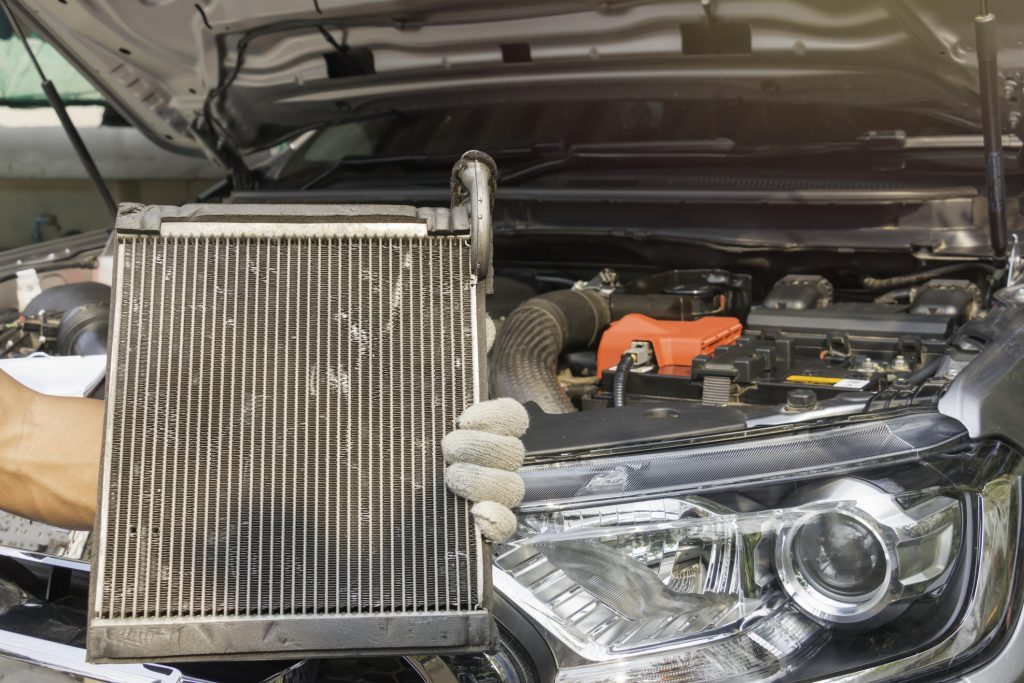
• Radiator: The large heat exchanger at the front of the engine bay. Air passes through its thin metal fins to cool the liquid inside.
• Coolant (antifreeze-water mix): The fluid that absorbs engine heat and carries it to the radiator. Proper coolant also raises the boiling point of the fluid above 100°C and lowers its freezing point below 0°C.
• Thermostat: A temperature-sensitive valve that regulates coolant flow. It stays closed when the engine is cold (for faster warm-up) and opens fully once operating temperature is reached.
• Water pump: Circulates coolant through the entire system. If it fails, coolant stops moving and the engine overheats rapidly.
• Cooling fan: Provides airflow through the radiator when the car is moving slowly or stationary. On modern cars this is usually electric; on older vehicles it may be driven directly by the engine via a belt.
• Expansion tank / overflow reservoir: Stores excess coolant as it expands when heated, and allows it to return when the system cools.
• Radiator cap: A pressure-regulating cap that raises the boiling point of the coolant by keeping the system pressurised. A faulty cap can cause the system to boil at lower temperatures.
Each of these components must be in good condition for the system to handle the demands of high-altitude mountain driving. A weakness in any single part can trigger a cascade that leads to overheating.
Pre-Trip Radiator Checks Before Heading to Virunga
The best time to discover a cooling system problem is in your driveway, not on a steep mountain pass. Before any high-altitude drive near Virunga or the Volcanoes National Park area, run through this checklist:
1. Check Coolant Level and Condition
With the engine cold, locate the coolant expansion tank — a translucent plastic reservoir usually labelled with a maximum and minimum level. The coolant should sit between these marks. If it is low, top up with the correct coolant for your vehicle (check the owner’s manual — not all coolants are compatible).
While you are there, look at the condition of the fluid. Fresh coolant is typically bright green, blue, orange, or pink depending on the type. If the coolant appears rusty, brown, oily, or milky, it needs to be replaced immediately. Rusty coolant has lost its anti-corrosion properties; milky coolant may indicate a blown head gasket, which is a serious engine problem.
2. Inspect the Radiator Exterior
Look at the radiator fins — the thin metal grid visible behind the front grille. Bent or clogged fins dramatically reduce the radiator’s ability to transfer heat. Leaves, insects, mud, and road debris accumulate over time. Gently straighten any bent fins with a flat tool and remove debris with compressed air or a soft brush. Never use a high-pressure water jet directly on the fins — the pressure easily damages them.
3. Check for Leaks
Inspect all radiator hoses — the thick rubber pipes connecting the radiator to the engine — for cracks, softness, bulging, or white residue (dried coolant). Check hose clamps for tightness. Look underneath the car and around the engine bay for any signs of coolant drips or puddles. Even a small leak that seems manageable in normal conditions can rapidly empty the system under the sustained load of mountain driving.
4. Test the Radiator Cap
A faulty radiator cap is a surprisingly common cause of overheating. The cap should hold a specific pressure — typically 0.9 to 1.3 bar, marked on the cap itself. A mechanic can test this with a simple pressure tester. Replace the cap if it fails the test or if it is more than four or five years old. A new cap costs very little; the overheating it prevents could save you far more.
5. Check the Thermostat
A stuck-closed thermostat prevents coolant from flowing to the radiator, causing rapid overheating. A stuck-open thermostat means the engine never reaches proper operating temperature, reducing efficiency. If your temperature gauge consistently reads abnormally low or high during normal driving, suspect the thermostat. Replacement is generally inexpensive and straightforward.
6. Inspect the Cooling Fan
Start the engine and let it idle until it reaches operating temperature. Watch whether the cooling fan engages — you should hear or see it spin once the engine is warm. On electric fans, check that the fan relay and temperature sensor are functioning. On belt-driven fans, inspect the belt for cracks, fraying, or incorrect tension. A non-functioning fan is manageable at highway speed (forward motion provides airflow) but catastrophic in slow, uphill traffic or at a standstill.
7. Check the Water Pump
Water pump failure is less easy to detect without tools, but warning signs include coolant leaking from near the pump (usually centre-front of the engine), a whining or grinding noise from the pump area, or a consistently overheating engine despite adequate coolant levels. If your car has a timing belt that also drives the water pump, and it is approaching the recommended replacement interval, replace both together — it is far cheaper than a second labour job.
�� Pro Tip: Have a full cooling system pressure test done by a mechanic before any serious mountain trip. This catches small leaks that are invisible during a visual inspection but become serious problems under the higher temperatures and pressures of high-altitude driving.
The Right Coolant Mix for High-Altitude Conditions
One of the most overlooked aspects of cooling system maintenance is getting the coolant mixture right. Pure water boils at 100°C at sea level — but even lower at altitude, because atmospheric pressure is reduced. This means a cooling system running on plain water (a common temporary fix in Rwanda) has even less thermal headroom at altitude than it does at sea level.
A proper antifreeze-water mixture solves this problem in two ways. First, it raises the boiling point of the coolant significantly — a 50/50 mix of quality antifreeze and water boosts the boiling point to around 129°C at sea level, and the pressurised system raises it further still. Second, it lowers the freezing point, which matters on cold overnight stops near the Virunga mountains where temperatures can drop sharply.
For high-altitude driving in Rwanda’s mountain regions, a 50/50 or even 60/40 antifreeze-to-water ratio is recommended. Use distilled or clean water rather than untreated tap water, which can contain minerals that accelerate corrosion and scale build-up inside the radiator.
⚠️ Important Warning: Never open the radiator cap or coolant reservoir when the engine is hot. The pressurised system can eject scalding coolant violently, causing serious burns. Always wait until the engine has fully cooled — at least 30 to 45 minutes after switching off — before opening the cooling system.
When to Flush and Replace Your Coolant
Coolant does not last forever. Over time, its chemical additives — corrosion inhibitors, pH buffers, and scale preventers — deplete. Old coolant becomes acidic, which begins to corrode metal components from the inside out. Radiators, water pumps, heater cores, and aluminium engine components are all vulnerable.
General coolant replacement intervals depend on the coolant type:
• Standard green coolant (IAT): Every 2 years or 40,000 km
• Long-life orange/pink coolant (OAT): Every 4–5 years or 80,000 km
• Extended-life coolant (HOAT): Every 5 years or 100,000 km
If you are unsure which coolant type is in your car, or if the coolant’s service history is unknown (common with used car purchases in Rwanda), the safest approach is to flush the system completely and start fresh with the correct type for your vehicle.
A coolant flush involves draining the old fluid, flushing the system with clean water to remove scale and debris, and refilling with fresh coolant at the correct mixture. A mechanic can do this for you, or it can be done at home by confident DIY enthusiasts following proper safety procedures.
What to Do While Driving in High-Altitude Conditions
Even with a well-maintained cooling system, mountain driving requires a more attentive driving style. Here is how to manage your vehicle on the climb toward Virunga:
• Watch the temperature gauge constantly: Do not let it drift into the red. If it climbs higher than normal, act before it reaches a critical level.
• Use lower gears on steep climbs: Keeping the engine in a lower gear reduces strain compared to lugging the engine in too high a gear. The engine spins more freely and generates less localised heat stress.
• Turn off the air conditioning on very steep sections: The AC compressor places significant additional load on the engine and generates extra heat. On a brutal climb, switch it off temporarily to give your cooling system a break.
• Avoid riding the brakes on descents: Use engine braking (lower gears) to control speed on the way down. Sustained brake use generates enormous heat and can affect your brake fluid, but the downhill portion also gives your engine — and cooling system — a valuable rest.
• If traffic makes you idle on a slope: Stationary idling in slow uphill traffic is particularly hard on the cooling system because there is no forward airflow through the radiator. The electric fan must carry all the load. Ensure your fan is functional before the trip.
• Carry extra coolant: Keep a bottle of premixed coolant and a bottle of clean water in the boot on any mountain trip. If you lose coolant from a minor leak, topping up lets you complete the journey safely and reach a garage.
What to Do If Your Car Overheats on the Road
Despite the best preparation, overheating can still happen. Knowing how to respond correctly can be the difference between a small inconvenience and a destroyed engine.
1. Act immediately when the gauge enters the red: Do not keep driving and hope it resolves itself. Find a safe place to pull over as quickly as possible.
2. Turn off the air conditioning: This reduces engine load instantly.
3. If safe to do so, turn the heater to maximum: This sounds counterintuitive, but the heater uses the engine’s coolant circuit and acts as a secondary heat exchanger. It can reduce engine temperature enough to get you safely off the road.
4. Pull over and switch off the engine: Do not let a badly overheating engine continue to run. Switch off, pop the bonnet, and step back.
5. Wait — do not open the cap: Let the engine cool for at least 30 to 45 minutes. Opening a hot pressurised system causes serious burns.
6. Inspect for visible leaks or damage: Once cool, look for burst hoses, loose clamps, or coolant pooled beneath the car.
7. Refill carefully if the level is low: Add coolant or clean water slowly to the expansion tank, not directly to the radiator cap unless necessary.
8. Restart and monitor closely: If the temperature stabilises, drive gently to the nearest garage. If it climbs again immediately, do not continue — call for roadside assistance.
�� Critical Warning: Driving a significantly overheating engine even a short distance risks warping the cylinder head, blowing the head gasket, or causing catastrophic engine failure. The repair bill for a blown head gasket or warped head can exceed RWF 500,000. A tow truck is far cheaper than engine surgery.
Choosing the Right Vehicle for Virunga Routes
Not all vehicles handle high-altitude mountain driving equally well. The combination of altitude, steep gradients, and sometimes rough road surfaces near the park boundaries favours vehicles with robust cooling systems, sufficient ground clearance, and strong low-range gearing.
Vehicles that have proven themselves popular and reliable on Rwanda’s mountain routes include the Toyota Land Cruiser, Mitsubishi Pajero, Toyota Hilux Surf (4Runner), Subaru Forester, and Toyota Prado. These vehicles combine capable 4WD systems with generally well-engineered cooling capacity. If you are considering purchasing a used car for regular mountain or off-road use in Rwanda, it pays to choose a model with a proven track record on this kind of terrain.
For a wide selection of reliable second-hand vehicles suited to Rwandan driving conditions — including 4WD and SUV options like the Toyota Land Cruiser, Mitsubishi Pajero, Nissan Patrol, and Subaru Forester — browse the listings on auto24.rw. Each vehicle comes with detailed specifications so you can choose a car that is genuinely suited to the drives you plan to make.
Electric Vehicles and High-Altitude Cooling: A Different Story
Electric vehicles manage thermal control very differently from combustion-engine cars. They have no engine coolant system in the traditional sense, but they do have sophisticated battery thermal management systems that regulate temperature during charging and driving. Interestingly, high-altitude driving can actually extend EV range on descents (regenerative braking) while reducing it on climbs — a trade-off that mirrors the experience of combustion drivers.
For drivers looking to explore sustainable mobility in Rwanda and beyond, EV24.africa offers import options for electric cars, expanding choices for eco-conscious drivers across Africa. As Rwanda’s road network continues to develop and charging infrastructure grows, EVs are becoming an increasingly practical option — even for scenic mountain routes near Virunga.
Recommended Cooling System Maintenance Schedule
Here is a simple schedule to keep your cooling system in top shape, particularly if you regularly drive high-altitude routes in Rwanda:
• Every month: Check coolant level in the expansion tank when the engine is cold. Top up if needed.
• Every 6 months or 10,000 km: Visually inspect all hoses, clamps, and the radiator exterior. Check for leaks or deterioration.
• Every 12 months or 20,000 km: Have a mechanic inspect the thermostat, water pump, radiator cap, and cooling fan operation. Pressure-test the system.
• Every 2–5 years (depending on coolant type): Flush and replace coolant completely with the correct type and mixture for your vehicle.
• Before any major mountain trip: Run through the full pre-trip checklist above. Do not skip this — conditions near Virunga are unforgiving for an under-prepared cooling system.
Quick Practical Tips: At a Glance
• Always carry a bottle of premixed coolant and a bottle of clean water in your boot on mountain trips
• Never use plain tap water as a long-term coolant solution — it lacks boiling point elevation and corrodes the system
• If your temperature gauge has been creeping higher than usual during normal driving, address it before a mountain trip, not after
• A cheap infrared thermometer lets you check radiator hose temperatures yourself — top and bottom hoses should both be warm when the engine is at operating temperature
• If you are towing a trailer or carrying heavy loads on mountain routes, your cooling system works significantly harder — consider a larger capacity aftermarket radiator if you do this regularly
• After a high-altitude trip, let the engine idle briefly before switching off — this helps the cooling fan clear residual heat from the engine bay
Frequently Asked Questions (FAQs)
Q: How do I know if my radiator is blocked or clogged?
A partially clogged radiator typically shows itself through the engine running warmer than usual, particularly in stop-and-go traffic or on climbs. The temperature gauge will creep higher than it normally does. A mechanic can do a flow test or inspect the radiator internally. Externally, you can check whether the top radiator hose is significantly hotter than the bottom — a large temperature difference across the radiator can indicate restricted flow. Chemical descaling or a professional radiator flush can sometimes restore flow; severely clogged radiators may need replacement.
Q: Can I use plain water instead of coolant for a mountain trip?
In a genuine emergency — if you are losing coolant and have nothing else — clean water is better than running the engine dry. But plain water should never be your planned approach for a mountain trip. It boils at a lower temperature than a proper coolant mix (especially at altitude where boiling point is already reduced), it contains minerals that build up inside the radiator, and it provides no corrosion protection for the metal components. Always use the correct antifreeze-water mixture.
Q: My car has never overheated on normal roads. Is a radiator check still necessary before Virunga?
Absolutely. A cooling system that copes perfectly with Kigali’s flat roads and moderate traffic may not have the headroom for a sustained 2,000-metre climb in thin air. Normal driving rarely pushes the cooling system to its limits. Mountain driving does. A small weakness — a slightly clogged radiator, a low coolant level, a marginally weak thermostat — that causes no problems normally can trigger overheating under mountain conditions. Pre-trip checks are not optional on these routes.
Q: How much does a cooling system service cost in Rwanda?
A basic coolant flush and refill at a reputable garage in Kigali typically costs between RWF 20,000 and RWF 50,000, depending on the vehicle and coolant type. A full cooling system inspection including pressure testing and thermostat check can add another RWF 10,000 to RWF 25,000 in labour. Replacement components — hoses, thermostat, radiator cap — range from RWF 3,000 to RWF 30,000 each. A water pump replacement is more expensive, typically RWF 40,000 to RWF 150,000 including parts and labour. Compare any of these costs to a head gasket replacement (RWF 500,000+) and the value of preventive maintenance becomes obvious.
Q: What is the temperature gauge reading I should be concerned about?
Every vehicle is different, but as a general rule the temperature gauge needle should sit somewhere in the middle of its range during normal operation — not at the bottom (engine too cold) and not approaching the upper quarter. If the needle climbs into the upper quarter during driving, especially on a flat road, address it before any mountain driving. If it enters the red zone, pull over immediately.
Q: Should I use the same coolant type that is already in my car, or can I switch types?
Mixing different coolant types is generally not recommended and can cause the chemical additives to react negatively, forming a gel-like substance that can block passages. If you are topping up, always use the same type as what is already in the system. If you want to switch coolant types entirely, do a complete flush first to remove the old coolant before refilling with the new type. When in doubt, ask a mechanic or refer to your owner’s manual.
Q: My heater stopped working. Could this be related to the cooling system?
Yes — a non-functioning heater is often a cooling system symptom. The cabin heater uses a small heat exchanger called a heater core, which is part of the coolant circuit. If the coolant level is low, the heater core may not receive enough fluid to produce heat. A stuck thermostat that never opens properly can also cause this. A blocked heater core is another possibility. Any of these conditions should be investigated before a mountain trip, as low coolant and thermostat problems directly affect overheating risk.
Q: How long should I let the engine cool before adding coolant after overheating?
At least 30 to 45 minutes after switching off the engine — longer if the overheating was severe. The radiator and surrounding components remain under pressure and at very high temperature long after the engine stops. Adding coolant too early risks the pressurised hot system ejecting scalding fluid when the cap is opened. Patience here is not just a virtue — it is a safety necessity.
Final Thoughts: Prepare the Car, Enjoy the Journey
The road to Virunga is one of Rwanda’s most rewarding drives. Green volcanic peaks, terraced hillsides, crater lakes, and the promise of mountain gorillas make it a journey worth preparing properly for. The last thing any driver wants is a boiling radiator on a remote mountain road with no mechanic for kilometres.
Radiator and cooling system maintenance is not complicated, and it does not have to be expensive. A modest investment in pre-trip checks, the right coolant mix, and an attentive driving style on the climbs is all it takes to protect your engine and ensure the journey goes as planned.
For more Rwanda-specific driving guides, vehicle reviews, and car care tips, head to automag.rw. And if a mountain route like this has you thinking it might be time to upgrade to a vehicle better suited to Rwanda’s varied terrain, explore the available 4WD and SUV listings on auto24.rw — you might find exactly what you need for the road ahead.