
Rwanda is shifting toward eco-friendly transportation in 2026, driven by strict emission standards and tax incentives. Importers are focusing on fuel-efficient and green vehicles due to these policies. The top car import sources for Rwanda are Japan, the UAE, and Europe, each offering unique advantages:
- Japan: Known for affordable, reliable second-hand cars, Japan is the most budget-friendly option. It also leads in hybrid and electric vehicle technology, aligning with Rwanda’s green goals.
- UAE: Offers modern, low-mileage vehicles, including luxury models. Proximity to East Africa ensures faster shipping and competitive costs.
- Europe: A hub for premium, eco-conscious vehicles. European imports benefit from Rwanda’s tax exemptions on electric and hybrid models.
Each market caters to different priorities like cost, durability, and emission compliance. Below is a quick comparison to help you decide.
Quick Comparison
| Criteria | Japan | UAE | Europe |
|---|---|---|---|
| Cost | Low (used cars) | Moderate (luxury focus) | High (premium brands) |
| Eco-Friendliness | High (hybrids/EVs) | Moderate | Very High |
| Shipping Time | 5–8 weeks | Faster (regional) | 4–6 weeks |
| Vehicle Quality | Reliable, second-hand | Modern, low mileage | Premium engineering |
Rwanda’s evolving market favors greener, newer models, making these regions ideal for car imports. The choice depends on your budget and preferences.
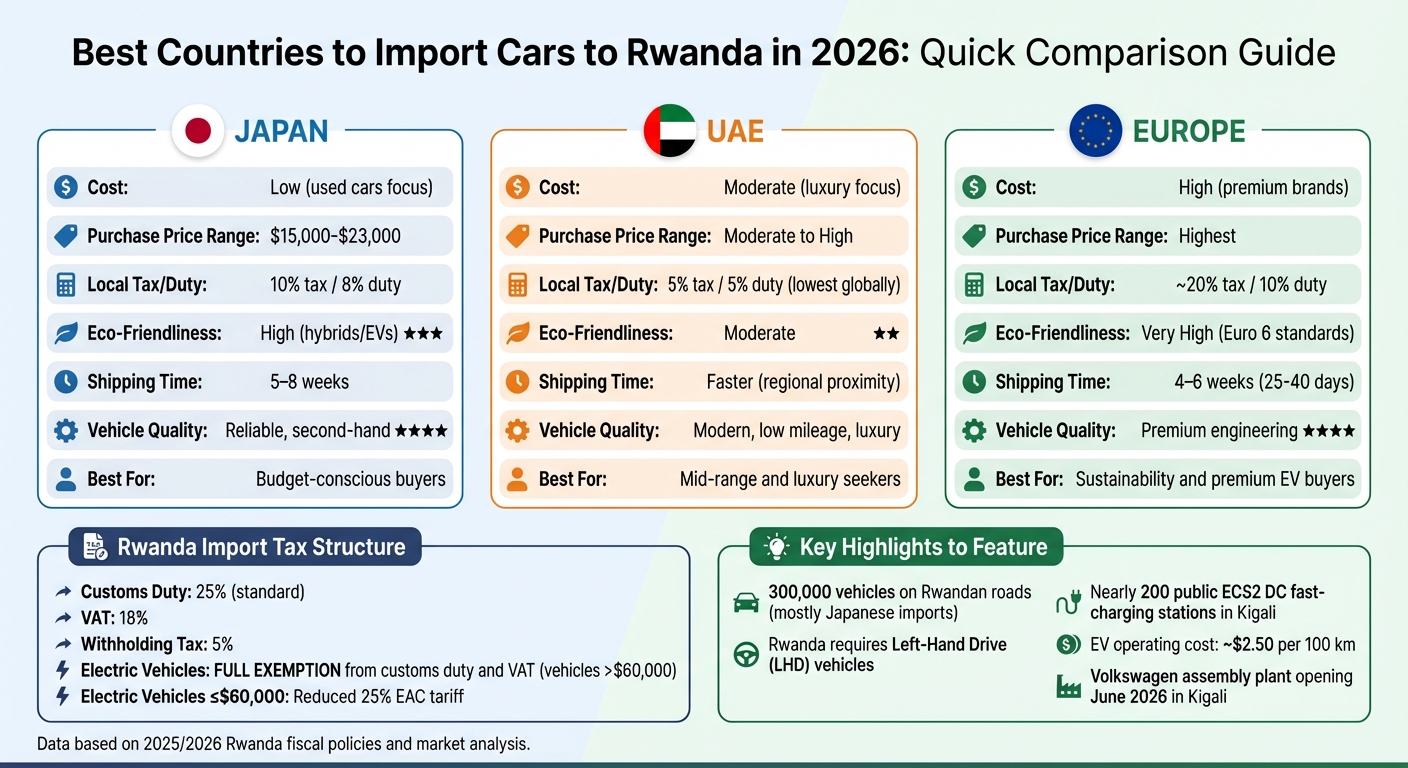
Japan vs UAE vs Europe Car Import Comparison for Rwanda 2026
1. Japan
Cost of Import
Japan stands out as an affordable option for importing vehicles to Rwanda. Thanks to Rwanda’s flexible import policies, there are no age restrictions on used vehicles. This means importers can choose older, budget-friendly models without sacrificing quality. Additionally, Japanese used cars are not subject to mandatory pre-shipment inspections, which helps lower initial expenses.
Regular Roll-on/Roll-off (RoRo) shipping services connect Japan to ports in Dar-es-Salaam and Mombasa, with transit times ranging from 24 to 34 days. Import taxes include a 25% customs duty, an 18% VAT, and a 5% withholding tax. For electric and hybrid vehicles, the 2025/2026 budget introduces significant tax benefits. Fully exempt from customs duties, electric vehicles priced at or below $60,000 are subject to a reduced East African Community (EAC) Common External Tariff of 25%, while those costing more than $60,000 receive complete tariff exemptions.
Rwanda’s vehicle registration fees are based on engine capacity. For example, cars with engines between 0–1,000cc incur a fee of RWF 75,000 (around $55), while those with 1,001–1,500cc engines are charged RWF 160,000 (approximately $118).
In addition to these cost benefits, Japanese vehicles are known for their quality and reliability.
Vehicle Quality and Durability
Japanese cars enjoy a strong reputation in Rwanda, with most of the 300,000 vehicles on Rwandan roads being second-hand imports from Japan. This reflects the trust Rwandans place in Japanese engineering and long-lasting performance. The lack of age limits on imports from Japan allows buyers to access a wide selection of well-maintained vehicles across various price ranges. However, importers should keep in mind that Rwanda requires Left-Hand Drive (LHD) vehicles for permanent registration. Right-Hand Drive (RHD) cars from Japan are allowed only for a temporary period of up to two weeks.
Eco-Friendliness and Emission Compliance
Japan is a leader in hybrid and electric vehicle technology, making it a key player in Rwanda’s push toward greener transportation. Many of these eco-friendly models qualify for substantial tax incentives, such as full customs duty exemptions for electric and hybrid vehicles. This aligns with Rwanda’s environmental goals and offers buyers a cost-effective way to adopt cleaner technologies.
Logistics and Import Process
The process of importing vehicles from Japan is relatively straightforward. Importers need to provide key documents, including the original title, registration certificate, bill of lading, commercial invoice, and international insurance policy. Monthly RoRo shipping schedules, often managed by carriers like Hyundai Glovis, ensure consistent service and reliable delivery times. Vehicles are shipped to established ports like Dar-es-Salaam or Mombasa, with dependable inland transport options to Kigali. This logistical efficiency helps importers plan costs and timelines with confidence.
sbb-itb-7bc66b5
2. UAE
Cost of Import
Vehicles imported from the UAE are subject to the non-EAC tax regime, which includes a 25% Common External Tariff (CET) and an 18% VAT. Additionally, engine size impacts excise taxes: vehicles with engines under 1,500cc incur a 5% tax, those between 1,500cc and 2,500cc face 10%, and engines over 2,500cc are taxed at 15%. Other mandatory charges include a 1.5% Infrastructure Development Levy, a 0.2% African Union Levy, and a 0.2% Quality Inspection Fee, all calculated based on the customs value. On top of these, an annual road maintenance fee of RWF 50,000 applies to standard cars and jeeps.
Vehicle Quality and Durability
The UAE is known for offering a selection of modern, well-maintained vehicles with low mileage. This is especially valuable in Rwanda, where urban congestion – particularly in Kigali during rush hours – demands reliable and durable vehicles. The availability of newer sedans and SUVs from the UAE aligns well with the needs of Rwandan drivers.
Eco-Friendliness and Emission Compliance
For those prioritizing environmentally friendly options, electric vehicles are an appealing choice. Rwanda exempts EVs from both the 18% VAT and the 25% customs duty, making them a budget-friendly option for eco-conscious buyers. This exemption applies universally, ensuring that electric vehicles imported from the UAE remain an attractive option for sustainable transportation. With the UAE covered, let’s now turn our attention to automotive options from Europe.
3. Europe
Cost of Import
European imports are subject to the standard non-EAC tax structure, which includes a 25% customs duty, 18% VAT, and 5% withholding tax. However, the 2025/2026 fiscal year introduced notable exemptions: hybrid and electric vehicles priced above $60,000 are fully exempt from customs duties, while those at or below $60,000 benefit from a reduced EAC Common External Tariff. Registration fees vary based on engine size, ranging from RWF 75,000 for vehicles under 1,000cc to RWF 560,000 for those exceeding 4,500cc.
Shipping vehicles from European ports to East African destinations like Dar es Salaam or Mombasa typically takes 25–40 days via RoRo (Roll-on/Roll-off) shipping. Standard quotes usually cover ocean freight only, with overland transit fees billed separately. Germany, Italy, France, Belgium, and the Netherlands are among the most popular source countries for European imports.
Vehicle Quality and Durability
European manufacturers, including Volkswagen, are well-regarded for their high-quality engineering, blending durability with modern features and long-term value. The Volkswagen T-Cross, for instance, offers excellent stability and smooth steering, making it ideal for urban driving in Kigali. It also outperforms comparable Japanese compact SUVs in terms of fuel efficiency in city conditions.
Volkswagen has further strengthened its presence in Rwanda by opening an assembly plant in Kigali in June 2018. This facility produces models like the Polo, Passat, Tiguan, Amarok, and Teramont, catering specifically to the local market. While European vehicles excel in urban environments, rugged models like the Toyota Land Cruiser remain a top choice for rural areas. Additionally, since Rwanda mandates left-hand drive vehicles for permanent registration, European markets (excluding the UK and Ireland) are particularly appealing.
European vehicles are also recognized for their advancements in eco-technology, making them a forward-thinking choice for buyers.
Eco-Friendliness and Emission Compliance
European manufacturers are playing a key role in Rwanda’s shift to electric mobility, aligning with the country’s Green Growth and Climate Resilient Strategy. In 2021, Volkswagen Rwanda introduced the nation’s first fully electric car as part of a pilot project with Siemens. To support this initiative, 15 charging stations were installed for an initial fleet of 20 electric vehicles.
European electric models are designed to meet strict international standards, ensuring they pass Rwanda’s mandatory emissions inspections. Replacing a traditional vehicle with an electric one can cut greenhouse gas emissions by half over its lifetime, as EVs are approximately 60% more energy-efficient than conventional cars.
As Ukwishaka David, Climate Change Data Officer at REMA, explained:
Electric vehicles will improve the air quality of Kigali, because they don’t emit pollutants such as volatile organic compounds, hydrocarbons, carbon monoxide, and various oxides of nitrogen.
By reducing dependence on petroleum and improving urban air quality, European imports are helping Rwanda address critical environmental challenges.
Logistics and Import Process
When importing a European vehicle, ensure the VIN and all original documentation are thoroughly verified. Plan for ocean freight costs to Dar es Salaam, along with any additional overland transit fees. Opting for hybrids, which qualify for full customs duty exemptions, can also help reduce overall costs.
G63 vs G580 in Rwanda: How to Save $150K in Taxes
Advantages and Disadvantages
Here’s a breakdown of the trade-offs for each import market, based on the detailed regional analysis.
Japan stands out as the most cost-effective option, with used vehicles priced between $15,000 and $23,000 in the East African market. This affordability is supported by a 10% consumption tax and 8% duty rate. However, importing older models can lead to higher age-based duties, which may offset some of the savings. Additionally, Japan’s focus on second-hand vehicles means fewer choices for those seeking newer, eco-friendly options.
The UAE offers a middle ground with competitive pricing and quicker logistics due to its proximity. With only 5% tax and 5% duty, it boasts some of the lowest rates globally. The UAE is particularly attractive for buyers looking for luxury and new vehicles, as it excels in re-exporting high-end models. That said, its inventory is heavily skewed toward premium brands, which might not appeal to all buyers.
Europe tends to have the highest purchase prices, largely due to premium manufacturers and steep local VAT rates – 19% in Germany and 20% in France. On the plus side, European imports are highly eco-conscious, adhering to strict Euro 6 emissions standards. This makes them eligible for Rwanda’s full customs duty exemptions on electric and hybrid vehicles. Moreover, the $20 million Volkswagen assembly plant set to open in Kigali in June 2026 will make locally assembled models like the Passat, Polo, and Teramont more accessible. As Thomas Schaefer, CEO of Volkswagen Group South Africa, remarked:
We are trying to break this thought-pattern that Africa is poor; they can’t afford (new) cars
.
Here’s a quick comparison of these markets:
| Criteria | Japan | UAE | Europe |
|---|---|---|---|
| Purchase Cost | Lowest (focus on used cars) | Moderate to High (luxury focus) | Highest (premium brands) |
| Local Tax/Duty | 10% tax / 8% duty | 5% tax / 5% duty | ~20% tax / 10% duty |
| Quality | High reliability, low mileage | Desert-spec luxury | Premium engineering |
| Eco-Friendliness | Moderate | Moderate | Very High (Euro 6 standards) |
| Shipping Time | 5–8 weeks | Faster (regional proximity) | Moderate |
In short, Japan is the go-to for affordability, the UAE is ideal for luxury and speed, and Europe delivers premium, eco-conscious technology that aligns with Rwanda’s environmental goals.
Conclusion
The analysis above highlights the unique advantages of importing vehicles from Japan, the UAE, and Europe, depending on your priorities and Rwanda’s growing automotive market.
Japan is a sensible choice for budget-conscious buyers. With no restrictions on the age of used car imports, buyers can access older, more affordable models. However, keep in mind that only Left-Hand Drive (LHD) vehicles are allowed, as Right-Hand Drive models are permitted temporarily.
The UAE stands out for mid-range and luxury car enthusiasts. Known as a global hub for high-end vehicles, the UAE offers a wide variety of options, along with efficient shipping to the region. This makes it a compelling choice for professionals and businesses seeking quality vehicles.
Europe is ideal for those prioritizing sustainability and premium electric vehicles. Buyers can benefit from full VAT exemptions and zero import duties on battery electric vehicles until June 30, 2028. Additionally, Kigali’s growing charging infrastructure – with nearly 200 public CCS2 DC fast-charging stations and low operating costs (around $2.50 per 100 km) – makes European electric models a practical and eco-friendly option. This aligns perfectly with Rwanda’s push for greener transportation solutions.
These insights reflect Rwanda’s diverse and forward-thinking approach to vehicle imports, catering to a range of budgets, preferences, and sustainability goals.
FAQs
Which country is best for my budget in 2026?
Japan stands out as the most affordable option for importing cars to Rwanda in 2026. With lower vehicle prices and import regulations that favor used cars, it’s an excellent choice for buyers looking to save money.
Can I import a right-hand-drive car into Rwanda?
Yes, you can bring a right-hand-drive car into Rwanda, but only for a limited period of two weeks. Be sure to follow all local regulations during this time.
What documents do I need to import and register a car in Rwanda?
To bring a car into Rwanda and get it registered, make sure you have these documents ready:
- Commercial or purchase invoice: Proof of the vehicle’s purchase.
- Passport copy: A valid copy of your passport for identification.
- Driver’s license: A valid driver’s license for operating the vehicle.
- Original bill of lading: This document details the shipment of the car.
- Certificate of ownership and registration: Proof that you legally own the vehicle.
Related Blog Posts
- Car Prices in Rwanda in 2025: What to Expect This Year
- Car import duties in Rwanda: Updated costs and procedures for 2025
- Your complete guide to importing a car into Rwanda in 2025
- How to Import a Car to Rwanda: Step-by-Step and Costs