
Importing a car to Rwanda in 2026 involves multiple taxes and fees that can significantly increase the total cost. Here’s what you need to know:
Key Points:
- Electric Vehicles (EVs): Exempt from VAT (until June 30, 2028) and customs duties if priced above $60,000. No excise duty or fuel-related levies apply.
- Hybrid Vehicles: Exempt from customs duty but subject to 18% VAT and excise duties based on age (5–15%). Fuel-related levies also apply.
- Gasoline/Diesel Vehicles: Face the highest costs, including 25% customs duty, 18% VAT, excise duties (5–15%), and a 15% fuel levy.
Additional Costs:
- Infrastructure Levy: 1.5% of CIF value
- African Union Levy: 0.2%
- Annual road maintenance fee: FRW 50,000 (~$57)
Example Costs (CIF Value):
- Toyota Harrier Hybrid ($45,000): Total ~$58,000–$62,000
- Toyota Camry Gasoline ($35,000): Total ~$52,000–$56,000
- Tesla EV ($75,000): Total ~$80,000–$81,500
Rwanda’s tax policies favor EVs with significant savings, while gasoline and diesel cars remain the most expensive to import. Timing matters, as VAT exemptions for EVs end in 2028.
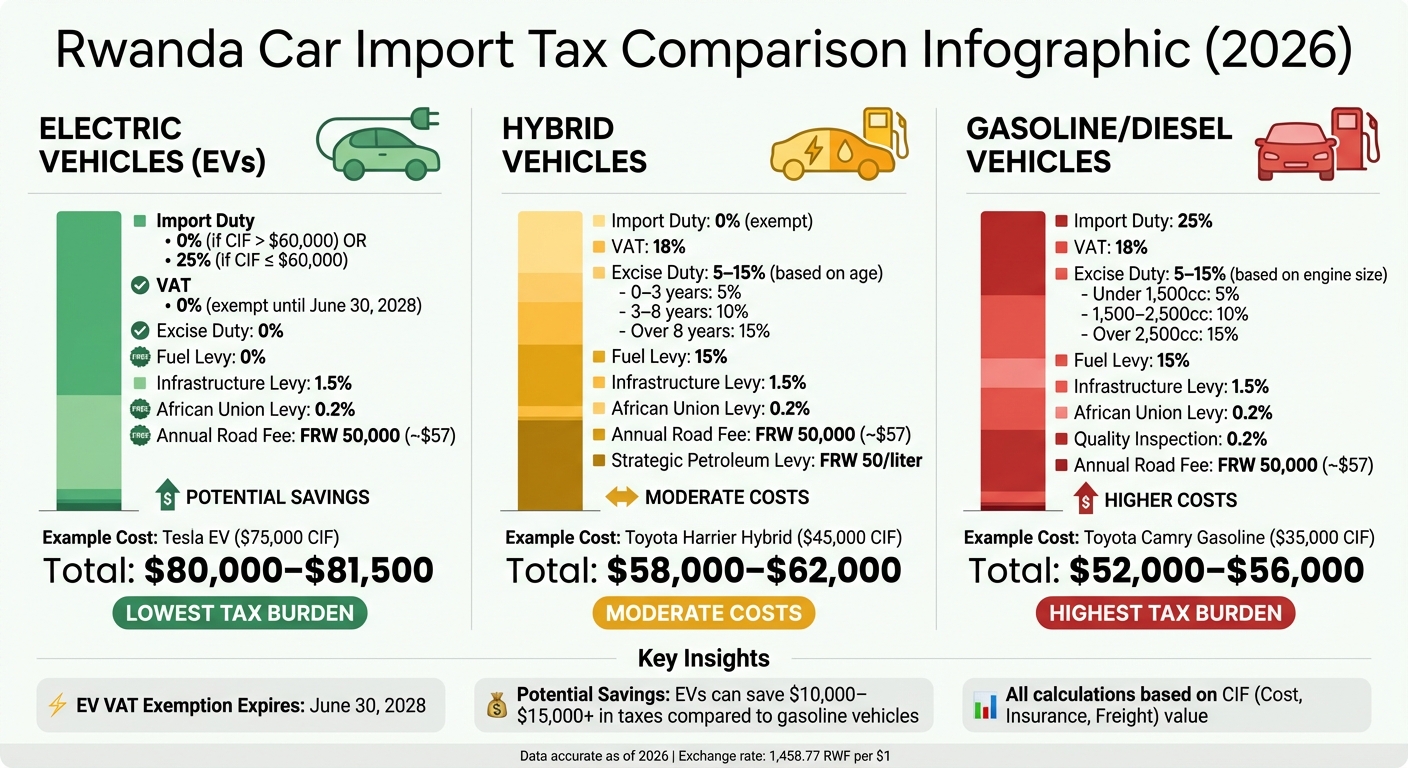
Rwanda Car Import Tax Comparison 2026: EV vs Hybrid vs Gasoline Costs
Rwanda’s 2026 Car Import Tax Structure
Main Tax Components
Rwanda’s car import tax system includes several key charges that impact the overall cost of bringing vehicles into the country. First, there’s the import duty, which aligns with the East African Community Common External Tariff and is generally set at 25% for finished passenger vehicles. Then comes the value-added tax (VAT), applied at the standard rate of 18%, although electric vehicles (EVs) are exempt from VAT until mid-2028. Additionally, excise duty is determined by factors such as engine capacity for traditional vehicles and vehicle age for hybrids, with rates falling between 5% and 15%.
Other charges are calculated based on the CIF (Cost, Insurance, and Freight) value of the vehicle. These include:
- Infrastructure Development Levy: 1.5%
- African Union Levy: 0.2%
- Quality Inspection Fee: 0.2%
- Environmental Levy: 0.2% (applied to goods packaged in plastic)
Most vehicles are also subject to an annual road maintenance levy, which varies by vehicle type. For instance, cars and jeeps pay FRW 50,000 (about $57), while trailers are charged FRW 150,000 (about $171). However, this fee is waived for government and diplomatic vehicles. Together, these components form the basis for calculating the total tax burden.
How Taxes Are Calculated
The tax calculation process begins with the CIF value, which serves as the foundation for all major taxes and levies. Here’s how it works:
- Import Duty: Applied directly to the CIF value. For example, a vehicle with a CIF value of $20,000 would incur a $5,000 import duty at the 25% rate.
- VAT and Excise Duty: These are calculated on the CIF value plus the import duty. This layering significantly increases the total tax amount.
- Additional Levies: Charges like the Infrastructure Development Levy, African Union Levy, Quality Inspection Fee, and Environmental Levy are calculated directly from the CIF value.
Understanding this structure is essential for grasping the overall cost implications of importing different types of vehicles into Rwanda. For instance, knowing how each tax and levy is applied can help predict the final expenses for a vehicle with a specific CIF value.
sbb-itb-7bc66b5
G63 vs G580 in Rwanda: How to Save $150K in Taxes
Import Duty Rates by Vehicle Type
When it comes to import taxes, the rates vary significantly depending on the type of vehicle.
Gasoline and Diesel Vehicles
Gasoline and diesel vehicles face the steepest taxes. Here’s the breakdown:
- Import Duty: 25%
- Excise Duty: Ranges from 5% to 15%, depending on engine size:
- Under 1,500cc: 5%
- 1,500–2,500cc: 10%
- Over 2,500cc: 15%
- Fuel Levy: 15% (based on CIF value)
- VAT: 18%
- Additional Levies:
- Infrastructure Development: 1.5%
- African Union: 0.2%
- Quality Inspection: 0.2%
These costs make gasoline and diesel vehicles the most expensive to import. On the other hand, electric vehicles enjoy a very different tax treatment.
Electric Vehicles and Tax Benefits
Electric vehicles (EVs) come with notable tax advantages. If the CIF value exceeds $60,000, EVs are completely exempt from customs duties. For those priced at or below $60,000, a 25% duty applies.
Other benefits include:
- VAT Exemption: EVs are free from the standard 18% VAT until June 30, 2028.
- No Excise Duty or Fuel Levy: EVs avoid these charges entirely.
- Annual Maintenance Fee: Passenger electric cars only pay a fixed road maintenance fee of FRW 50,000 (around $57) each year.
These exemptions make EVs a cost-efficient and eco-friendly option. Hybrid vehicles, however, fall somewhere in the middle.
Hybrid Vehicles
Hybrid vehicles combine aspects of both tax regimes. Here’s how they are taxed:
- Customs Duty: Exempt.
- VAT: 18%
- Excise Duty: Based on the vehicle’s age:
- 0–3 years: 5%
- 3–8 years: 10%
- Over 8 years: 15%
- Fuel-Based Road Maintenance Levy: 15%
- Strategic Petroleum Reserve Levy: FRW 50 per liter.
These mixed rates mean that while hybrids are less expensive to import than traditional gasoline or diesel vehicles, they are not as tax-friendly as EVs. Choosing the right vehicle requires careful consideration of these varying tax implications.
Additional Fees and Costs
When importing a vehicle into Rwanda, additional expenses beyond import duties play a significant role in determining the overall cost. These fees, combined with the taxes and levies already discussed, contribute to the total price tag.
VAT and Excise Duty
Value Added Tax (VAT) is set at 18% and is calculated based on the CIF value plus other duties. However, electric vehicles are exempt from VAT until July 2028. Hybrid vehicles, on the other hand, are subject to the full 18% VAT despite being exempt from import duties.
Excise duty depends on the type and age of the vehicle. Hybrid vehicles are taxed under a tiered excise duty system, while electric vehicles generally avoid this duty altogether.
Withholding Tax and RRA Fees
After calculating duties, administrative and processing fees also come into play. The Rwanda Revenue Authority (RRA) imposes fixed processing fees during the import process. These include charges for documentation and other administrative steps necessary for vehicle clearance. Importers should account for these additional costs in their budget.
Port Handling and Logistics Costs
Costs related to port handling and logistics can significantly impact the final price. At ports like Mombasa or Dar es Salaam, handling fees for offloading, storage, and documentation add to the expense. The CIF value, which includes shipping costs to these ports, serves as the basis for most tax calculations.
However, moving the vehicle inland from the port incurs separate charges. Starting in the 2025/2026 fiscal year, VAT will also apply to local transport of goods, further increasing these expenses. Depending on the vehicle’s size and the chosen shipping route, inland transport and port handling fees can add several hundred dollars to the total cost. Properly accounting for these logistics expenses is essential to get a clear picture of the overall import costs, complementing the taxes and duties outlined earlier.
2026 Policy Changes and EV Incentives
Government Incentives for EV Adoption
The 2026 policy updates in Rwanda are making it even easier for people to choose electric vehicles (EVs) over traditional fuel-powered options. Fully electric vehicles will continue to be exempt from Value Added Tax (VAT) until June 30, 2028. This tax break also extends to charging station equipment, making it cheaper to set up charging solutions at home or for businesses. On top of that, the customs duty system is structured to favor EV adoption. Electric vehicles priced above $60,000 are entirely customs duty-free, while those priced at or below $60,000 face a 25% customs duty. To further promote local manufacturing, electric vehicles assembled within Rwanda are exempt from excise duties. These measures clearly aim to make zero-emission vehicles more appealing than hybrids or traditional combustion engine vehicles.
How Policy Changes Affect Buyers
For buyers, these policy changes mean significant savings when importing electric vehicles compared to gasoline, diesel, or hybrid options. For instance, all car owners must pay a fixed annual road maintenance levy of FRW 50,000 (about $57). However, EV owners avoid the extra 15% road maintenance levy applied to the CIF value of imported petrol and diesel vehicles, as well as the FRW 50 per liter levy on the strategic petroleum reserve. High-end EVs priced above $60,000 enjoy both customs duty and VAT exemptions, unlike hybrids, which are subject to import duties, 18% VAT, and additional excise charges based on age. Even lower-priced EVs benefit from VAT exemptions and reduced customs duties, making them a more cost-effective choice when you factor in the total import costs.
Total Import Cost Examples
All cost calculations are based on the exchange rate of 1,458.77 RWF per $1 as of March 2026.
Toyota Harrier Hybrid
Bringing in a 2022 Toyota Harrier Hybrid, valued at $45,000 CIF and benefiting from full customs duty exemption, involves several charges: 18% VAT, a 1.5% infrastructure levy, a 5% withholding tax, and approximately 10% excise duty for a 4-year-old model. There’s also a fixed annual road levy of FRW 50,000 (about $34). Altogether, the total import costs fall between $58,000 and $62,000.
Now, let’s look at the costs for a standard gasoline sedan.
Standard Sedan Under $60,000 CIF Value
For a 2020 Toyota Camry with a CIF value of $35,000, the charges include 25% customs duty, excise duty ranging from 15% to 20% (based on its 2.5-liter engine), a 1.5% infrastructure levy, 18% VAT, and a 5% withholding tax. Additionally, there’s a fixed annual road levy of FRW 50,000 and a 15% road maintenance levy applied to the CIF value for petrol vehicles. The total landed cost is estimated at $52,000 to $56,000.
Finally, let’s examine the scenario for a high-end electric vehicle (EV).
Tesla EV Over $60,000 CIF Value
Importing a Tesla Model Y Long Range with a CIF value of $75,000 showcases the incentives offered for EVs. High-value EVs exceeding $60,000 receive full exemptions from customs duty and VAT. The remaining charges include a 0.2% environmental levy, a 5% withholding tax, combined additional levies of about 1.7%, and a fixed annual road levy of FRW 50,000 (around $34). Thanks to these benefits, the total import costs are approximately $80,000 to $81,500. Notably, EVs avoid the 15% road maintenance levy that applies to gasoline and diesel vehicles.
Key Takeaways for Car Buyers in Rwanda
Here’s a rundown of how taxes apply to different types of vehicles in Rwanda:
Electric vehicles offer the best tax advantages. EVs priced over $60,000 are completely exempt from customs duties and VAT until June 30, 2028. For EVs priced at $60,000 or less, a 25% tariff applies, but they avoid the fuel-related taxes that gasoline and diesel cars face.
Gasoline and diesel vehicles come with higher costs due to extra taxes. These vehicles not only face standard customs duties but also a 15% road maintenance levy on their CIF value and a strategic petroleum reserve levy of FRW 50 per liter. Hybrids, on the other hand, provide a more balanced cost structure.
Hybrid vehicles benefit from customs duty exemptions but are subject to 18% VAT and an excise duty based on age. Vehicles under three years old are charged 5%, while those older than eight years face a 15% excise duty. Newer hybrids are taxed less, with just 5% excise duty compared to 15% for older ones. Additionally, all non-exempt vehicles must pay an annual road maintenance fee of FRW 50,000 (around $34).
Timing matters for EV buyers. Importing an electric vehicle before June 30, 2028, secures the VAT exemption. For public transport operators, buses carrying 50 or more passengers qualify for full customs duty exemption, while those with 25–49 seats are taxed at 10%.
FAQs
What costs aren’t included in the CIF value?
The CIF value does not include taxes, duties, or additional charges such as VAT, excise duty, and other levies required by the Rwandan government. These costs are added upon importation and need to be calculated separately to understand the full cost of bringing a vehicle into the country.
How do I calculate the total tax from CIF step by step?
To figure out the total tax from CIF (Cost, Insurance, and Freight) in Rwanda for 2026, follow these steps:
- Determine the CIF value: This includes the vehicle’s price, insurance, and freight costs combined. It’s the baseline for tax calculations.
- Calculate the environmental levy: This is set at 0.2% of the CIF value.
- Include import duties and excise taxes: These rates vary based on the type of vehicle and its country of origin.
Add up these components to arrive at the total tax amount. Make sure to confirm the specific rates applicable to your vehicle type, as policies and classifications may change.
What happens to EV costs after June 30, 2028?
After June 30, 2028, electric vehicles (EVs) imported into Rwanda will no longer benefit from full customs duty exemptions. With these incentives set to expire, the cost of importing EVs is likely to increase.