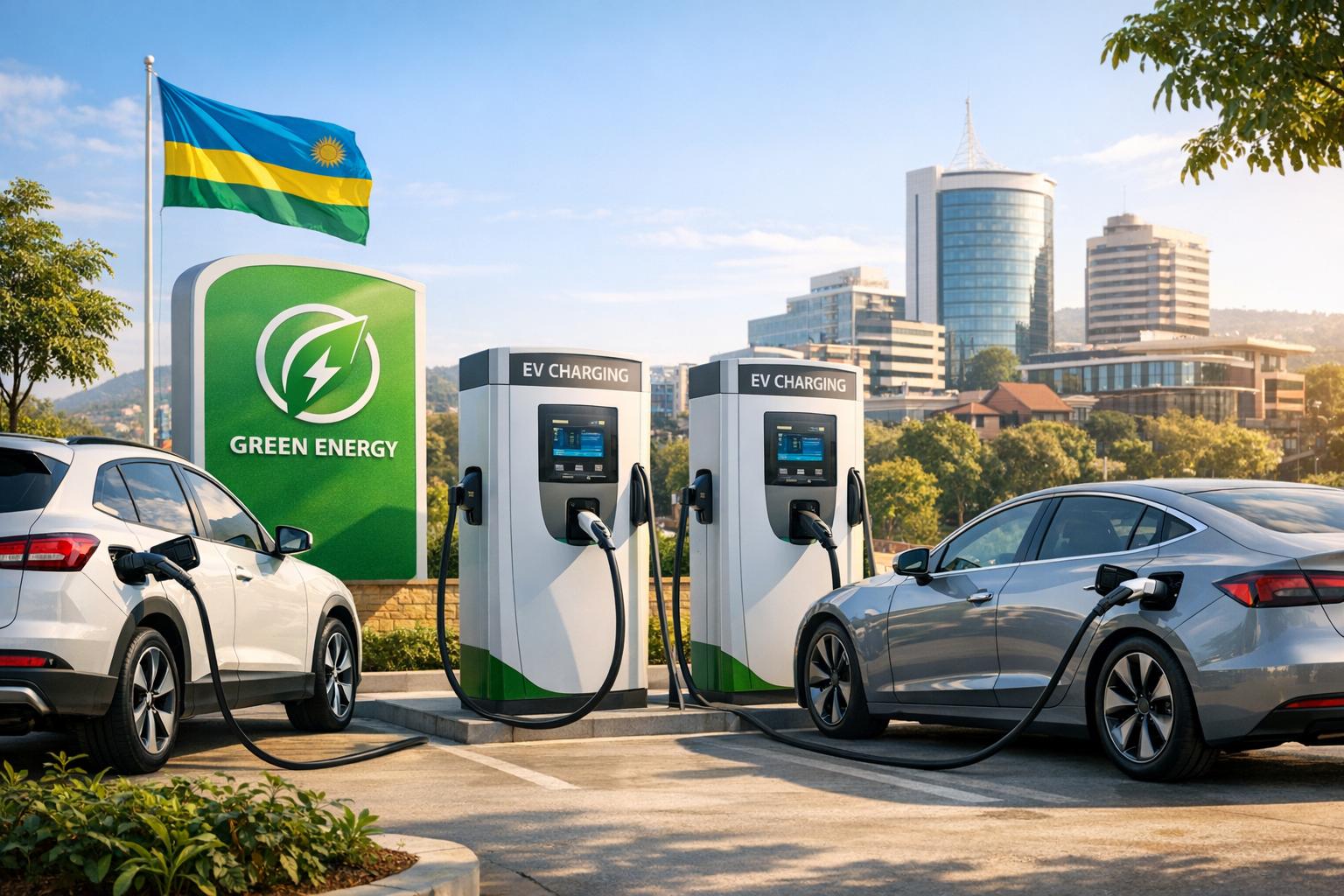
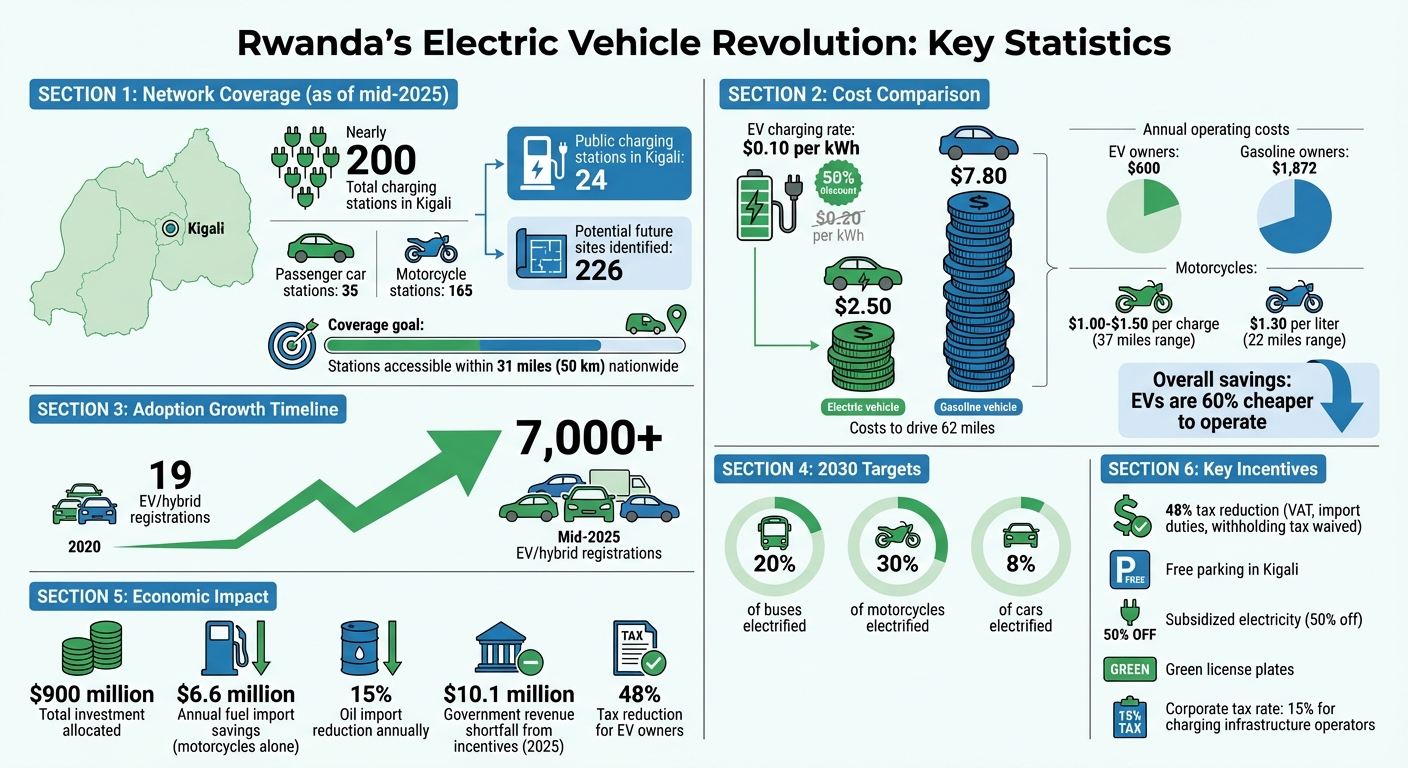
Rwanda is building one of East Africa’s most advanced EV charging networks, ensuring charging stations are accessible within 31 miles (50 kilometers) nationwide. By mid-2025, Kigali alone had nearly 200 stations, with 35 for passenger cars and 165 for motorcycles. The government has also identified 226 potential sites for future expansion.
Key highlights:
- Charging Costs: EV users pay $0.10 per kWh – half the standard residential rate – making it 60% cheaper to operate an EV compared to traditional vehicles.
- Adoption Growth: EV and hybrid registrations rose from 19 in 2020 to over 7,000 by mid-2025.
- Incentives: Tax exemptions, subsidized electricity rates, and free parking for EVs encourage adoption.
- Expansion Focus: Charging stations are prioritized in high-traffic areas, urban hubs, and major highways like Kigali to Lake Kivu and Kigali to Akagera National Park.
This initiative supports Rwanda’s goal to electrify 20% of buses, 30% of motorcycles, and 8% of cars by 2030. The network not only reduces fuel costs but also addresses range concerns, creating a more accessible EV ecosystem.
Rwanda EV Charging Network Statistics and Growth 2020-2030
EV Charging Station Locations in Rwanda
Charging Stations in Kigali
Kigali serves as the central hub for Rwanda’s electric vehicle (EV) infrastructure, with 24 public charging stations strategically located at shopping malls, office complexes, and petrol stations. Many of these stations also provide battery-swapping services, catering primarily to the city’s growing fleet of electric motorcycles operated by companies like Ampersand.
Efforts are underway to replicate this model beyond Kigali, gradually expanding the national EV charging network.
Charging Stations Outside Kigali
Outside Kigali, similar initiatives are bringing EV accessibility to more regions across Rwanda. A government-led geospatial analysis has pinpointed potential locations, such as petrol stations and commercial buildings, that can be repurposed for EV charging facilities. For example, the Nyamagabe District is part of this rural expansion, aimed at supporting agricultural logistics.
The government’s master plan focuses on areas with high population density, busy traffic zones, and major highways to ensure widespread coverage. Key travel routes, like the Kigali to Lake Kivu corridor in the Western Province (about 81 miles or 130 kilometers) and the Kigali to Akagera National Park route in the Eastern Province (around 84 miles or 135 kilometers), have been identified as priority areas for infrastructure development.
sbb-itb-7bc66b5
Rwanda’s E-mobility revolution accelerates
EV Charging Costs and Pricing
As Rwanda expands its network of charging stations, understanding the cost of EV charging is crucial for assessing the country’s push toward sustainable mobility.
Electricity Rates per kWh
In Rwanda, EV charging costs are subsidized to encourage adoption. During peak hours, electricity for EV charging is priced at $0.10 per kWh, which is half the standard rate of $0.20 per kWh. Off-peak rates are even lower, providing an additional incentive for users to charge their vehicles during these times.
To put this into perspective, driving an electric vehicle for 62 miles costs about $2.50, compared to $7.80 for a gasoline-powered car. Over the course of a year, EV owners spend approximately $600, while gasoline vehicle owners face costs of around $1,872. For electric motorcycle users, a single battery charge or swap costs between $1.00 and $1.50, covering about 37 miles (60 kilometers). In contrast, one liter of gasoline, priced at $1.30, only provides a range of 22 miles (35 kilometers).
In September 2025, the World Bank recommended that Rwanda adopt “cost-reflective, time-of-use tariffs” to better manage grid demand as EV usage grows.
Tarek Keskes, a World Bank ESMAP Energy Specialist, remarked: “Our analysis shows that Rwanda can achieve its goals if smart charging, cost-reflective tariffs, and integrated planning are prioritized”.
Fees and Discount Programs
Rwanda has also introduced a range of incentives to make EV ownership more affordable. The government reduces EV-related taxes by 48%, waiving VAT, import duties, and withholding taxes. EV owners benefit from green license plates, which come with perks like free parking in Kigali and exemption from congestion zone fees.
For companies operating charging infrastructure, the government provides rent-free land and offers a preferential corporate income tax rate of 15%, significantly lower than standard rates. Additionally, charging equipment, batteries, and spare parts are exempt from VAT and import duties. These measures aim to lower operational costs, which helps keep charging fees affordable for users. However, these initiatives have led to a $10.1 million revenue shortfall for the government as of 2025.
Expansion Plans for Rwanda’s Charging Network
Rwanda’s Ministry of Infrastructure (MININFRA) is working on a master plan to ensure electric vehicle (EV) charging stations are accessible within 31 miles (50 kilometers) across the country. Using geospatial analysis, the government has pinpointed over 226 potential sites for new charging stations to guide investors. While a nationwide rollout timeline has yet to be finalized, the framework lays the groundwork for strategic station placement and infrastructure upgrades.
Priority Locations for New Stations
The government’s expansion strategy prioritizes areas with high population density and heavy traffic. By focusing on locations like existing petrol stations, commercial buildings, and urban hubs, the plan aims to place chargers where demand is already present. Major highways will also be equipped with charging stations to support long-distance travel and reduce range anxiety. In Kigali, efforts are concentrated on busy areas, such as shopping malls, office complexes, and key transit terminals.
"The master plan includes identifying the necessary number of charging stations nationwide by focusing on high population density and traffic areas, as well as leveraging existing petrol stations and commercial buildings." – Ministry of Infrastructure (MININFRA)
Government Infrastructure Plan and Targets
Rwanda has set ambitious goals for its e-mobility transition, aiming to electrify 20% of its bus fleet, 30% of motorcycles, and 8% of cars by 2030. To support this shift, the government has allocated roughly $900 million for vehicle purchases and charging infrastructure. One key project includes upgrades to the Nyabugogo transit hub, where $7.7 million is being invested in 18 chargers, an 800-kW solar rooftop system, and battery storage.
These investments are part of a broader strategy to lower charging costs and optimize the electricity grid. Measures like encouraging off-peak charging could reduce grid load by 15%. In September 2025, the World Bank recommended adopting "cost-reflective, time-of-use tariffs" to better manage demand as EV adoption grows. Rwanda is also moving toward dual international charging standards – Combined Charging System Type 2 (CCS2) and GB/T – to accommodate a variety of EV models.
"The Government of Rwanda is committed to accelerating the transition to electric mobility as part of our climate and development agenda." – Dr. Jimmy Gasore, Minister of Infrastructure for Rwanda
Conclusion
Rwanda’s electric vehicle (EV) charging network represents a major step forward in reducing the country’s dependency on fossil fuels. With road transport contributing 13% of Rwanda’s greenhouse gas emissions and annual oil imports costing between $17 million and $20 million, this network offers a practical alternative to traditional petrol-powered vehicles. The shift to electric motorcycles alone is expected to save approximately $6.6 million annually in fuel imports, cutting oil imports by 15% each year.
Expanding this network requires targeted investments and collaboration between private investors and the government. About $900 million has been earmarked for EV purchases and charging infrastructure, supported by tax incentives and investment-friendly policies to encourage growth.
"Electric mobility is not only about cleaner buses. It is about building the foundations of a modern economy powered by sustainable energy."
- Sahr Kpundeh, World Bank Country Manager for Rwanda
Public adoption plays a vital role in ensuring the success of this initiative. Since 2020, registrations of electric and hybrid vehicles have risen significantly, reflecting growing consumer confidence. Policies like Kigali’s 2025 ban on new petrol motorcycle registrations and subsidized electricity rates of $0.10 per kWh – half the standard commercial rate – further incentivize this transition.
As Rwanda works toward its ambitious 2030 electrification goals, the charging network serves as a cornerstone of the country’s sustainable mobility strategy. By aiming to electrify 20% of buses, 30% of motorcycles, and 8% of cars by 2030, Rwanda is blending strategic planning, financial incentives, and public participation to drive both environmental progress and economic growth. This initiative not only addresses climate concerns but also lays the groundwork for a more sustainable and modern economy.
FAQs
What benefits does Rwanda offer to electric vehicle (EV) owners?
Rwanda’s government has rolled out a series of measures to promote the use of electric vehicles (EVs) and drive progress in sustainable transportation. Among these is a 15% corporate income tax rate, specifically for businesses operating in the e-mobility sector. This includes companies involved in EV charging services, importing electric vehicles, or developing technologies tied to the industry. The goal? To ease financial burdens for investors and EV users alike.
These actions align with Rwanda’s Vision 2050 ambitions to achieve carbon neutrality and its updated climate action targets. By encouraging private-sector investments and expanding the EV charging infrastructure, the country is paving the way for more accessible and practical EV adoption.
How is Rwanda preparing its electricity grid for the growing demand from EVs?
Rwanda is taking thoughtful steps to prepare its electricity grid for the rising demand driven by electric vehicles (EVs). The plan includes boosting power generation, upgrading transmission and distribution networks, and placing a strong emphasis on renewable energy projects. These efforts aim to ensure the grid remains both reliable and efficient as EV adoption grows.
To make this vision a reality, the government is actively encouraging private investment in grid improvements and renewable energy through clear policies and creative financing options. On top of that, strategies like smart charging systems, demand-side management, and energy storage solutions are being prioritized. These measures help balance the electricity load while keeping energy costs reasonable for consumers. By linking EV infrastructure development with grid enhancements, Rwanda is paving the way for a seamless shift to greener transportation.
Where are the key locations for new EV charging stations in Rwanda?
The Rwandan government is focusing on high-density urban areas and key traffic routes to roll out new EV charging stations. Their aim? To make sure no vehicle has to travel more than 31 miles (50 kilometers) to find a charging point.
Targeted locations include cities like Kigali, Rubavu, Musanze, and Huye, along with major highways such as the Kigali-Rubavu and Kigali-Musanze routes. Plans also involve upgrading gas stations and shopping centers with heavy vehicle traffic to accommodate EV chargers. This initiative aligns with Rwanda’s goal of creating a greener, more accessible transportation system.
Related Blog Posts
- Where to charge your electric vehicle in Rwanda: Kigali & beyond
- Rwanda’s EV Road Projects: Progress and Impact
- EV Charging vs. Fueling ICE Cars: Cost Analysis
- EV charging in Rwanda in 2026: where to charge + pricing + tips