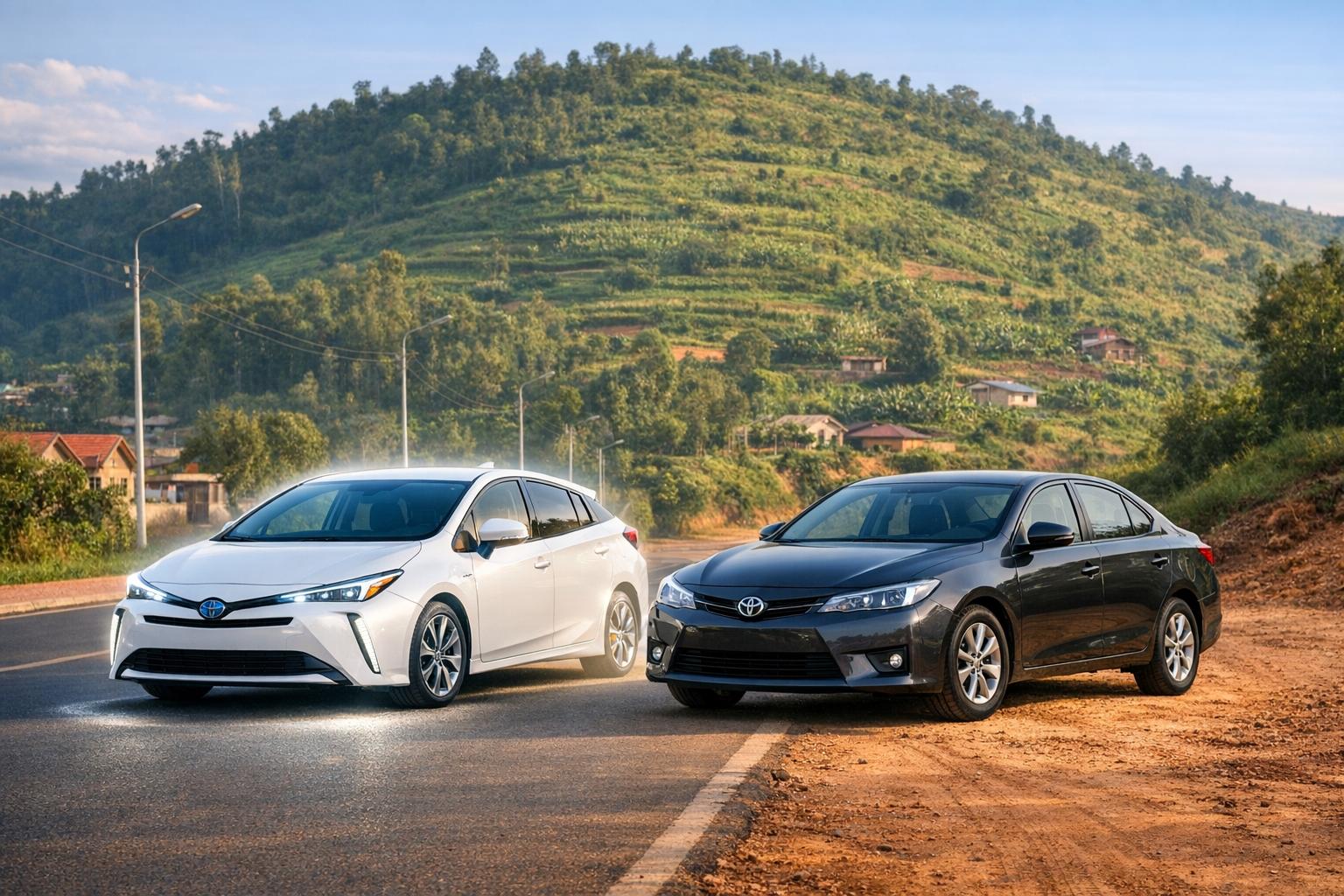
Choosing between hybrid and petrol vehicles in Rwanda boils down to recent tax changes, your driving habits, and long-term costs. Here’s what you need to know:
- Hybrids: Once tax-exempt, they now face an 18% VAT and age-based excise duties. They’re fuel-efficient in city traffic but lose value as batteries degrade, especially in models over 8 years old. Newer hybrids (less than 3 years old) remain a good choice for urban drivers.
- Petrol Cars: Cheaper upfront and easier to maintain, but higher fuel costs and taxes (25% import duty) make them less appealing for city use. They’re better suited for rural areas or buyers on tighter budgets.
Key Takeaway: If you drive in Kigali and can afford a newer model, a hybrid may save you money in fuel and maintenance. For rural areas or older vehicles, petrol cars are simpler and more reliable.
Quick Comparison
| Factor | Hybrid Vehicles | Petrol Vehicles |
|---|---|---|
| Upfront Cost | Higher | Lower |
| Fuel Efficiency | Better in city traffic | Lower overall |
| Taxes | 0% import duty, 18% VAT, excise tax | 25% import duty, 18% VAT |
| Maintenance | Lower for newer models | Higher but simpler |
| Best For | Urban drivers, short commutes | Rural areas, tight budgets |
Rwanda’s push for fully electric vehicles means hybrids are no longer the long-term solution they once were. If you’re planning for the future, consider a newer hybrid or explore electric options while they remain VAT-exempt until 2028.
Hybrid vs Petrol Cars in Rwanda: Complete Cost and Tax Comparison 2025
What Are Hybrid Vehicles?
Hybrid vehicles combine a traditional gasoline engine with an electric motor and a battery pack, using two power sources to improve energy efficiency. These systems automatically alternate between the electric motor and the gasoline engine depending on driving conditions – or combine both when extra power is needed.
How Hybrid Vehicles Work
Hybrid systems use a process called regenerative braking to recover energy that would otherwise be lost during braking. This energy is converted into electricity to recharge the battery. Jake Fisher, Senior Director of Consumer Reports‘ Auto Test Center, explains it well:
"Hybrids are so fuel-efficient because they utilize energy that would otherwise be wasted."
At lower speeds – usually up to 30 mph – the electric motor takes the lead, making hybrids ideal for stop-and-go traffic. When additional power is required, the gasoline engine activates. Standard hybrids (HEVs) recharge their batteries through a combination of the engine and regenerative braking, so they don’t need to be plugged in. On the other hand, plug-in hybrid electric vehicles (PHEVs) offer an all-electric driving range, typically between 20 to 40 miles, before switching to hybrid mode. This mix of capabilities makes hybrids particularly well-suited for urban environments like Rwanda’s bustling cities.
Benefits of Hybrids in Rwanda
In Kigali’s often-congested urban traffic, hybrids shine by delivering noticeable fuel savings and cutting emissions. Their electric motors reduce fuel consumption during low-speed driving, which is common in city conditions. Compared to similar gasoline-only vehicles, hybrids produce about 33% fewer emissions, aligning well with Rwanda’s environmental goals.
For Rwandan drivers navigating daily traffic jams, the fuel efficiency of hybrids offers a practical solution. They’re especially appealing to those not quite ready to commit to a fully electric vehicle. The dual-power system also provides versatility, handling both city commutes and longer highway trips with ease.
Drawbacks of Hybrids in Rwanda
However, hybrids face growing challenges in Rwanda. The reintroduction of an 18% value-added tax (VAT) on hybrid vehicles in 2025, along with age-based excise duties, has significantly reduced the cost advantage they once had. These policy shifts reflect the government’s push toward fully electric vehicles, making hybrids a less compelling long-term investment.
Another issue is battery degradation in older models. Between July 2021 and July 2024, 45% of imported hybrids in Rwanda were 10 to 14 years old. As Minister of State for National Treasury Godfrey Kabera pointed out:
"When these hybrid cars get very old, they only operate using the fuel-powered part. As a result, we are not fully achieving our goal of promoting e-mobility."
Older hybrids often lose much of their electric capability, functioning more like standard gasoline cars but with the added inefficiency of a worn-out battery.
| Vehicle Age | Excise Duty Rate | VAT Rate |
|---|---|---|
| 0–3 Years | 5% | 18% |
| 3–8 Years | 10% | 18% |
| Over 8 Years | 15% | 18% |
With hybrids no longer enjoying favorable tax treatment, potential buyers must carefully consider whether the fuel savings outweigh the higher upfront costs and long-term maintenance concerns.
What Are Petrol Vehicles?
Petrol vehicles run exclusively on gasoline-powered engines. Unlike hybrids, they don’t include electric motors or battery packs, relying solely on a conventional engine, fuel tank, and transmission system. This straightforward setup comes with its own set of advantages and challenges.
Benefits of Petrol Cars
One of the main perks of petrol vehicles is their lower upfront cost. Without the added complexity of hybrid technology, they are generally more affordable to purchase. Additionally, their simple design means that mechanics in Rwanda have decades of experience working on them. Spare parts are also easy to find, making repairs both accessible and relatively quick.
Another advantage is their availability. Petrol cars continue to dominate the market, with strong support for traditional models from manufacturers and dealerships alike.
Drawbacks of Petrol Cars
However, petrol vehicles tend to consume more fuel, which can lead to higher running costs – especially in urban areas with heavy stop-and-go traffic where efficiency takes a hit.
There’s also the issue of environmental impact. The Rwandan government has identified petrol vehicles as a source of pollution and has introduced measures to discourage their use. For instance, in April 2025, vehicle registration fees were raised across almost all categories. This move signals a shift toward policies aimed at promoting cleaner transportation options, which could make owning a petrol car more expensive in the future.
Hybrid vs. Petrol: Direct Comparison
Let’s take a closer look at how hybrid and petrol vehicles stack up in terms of cost, environmental impact, and performance in Rwanda.
Purchase and Running Costs
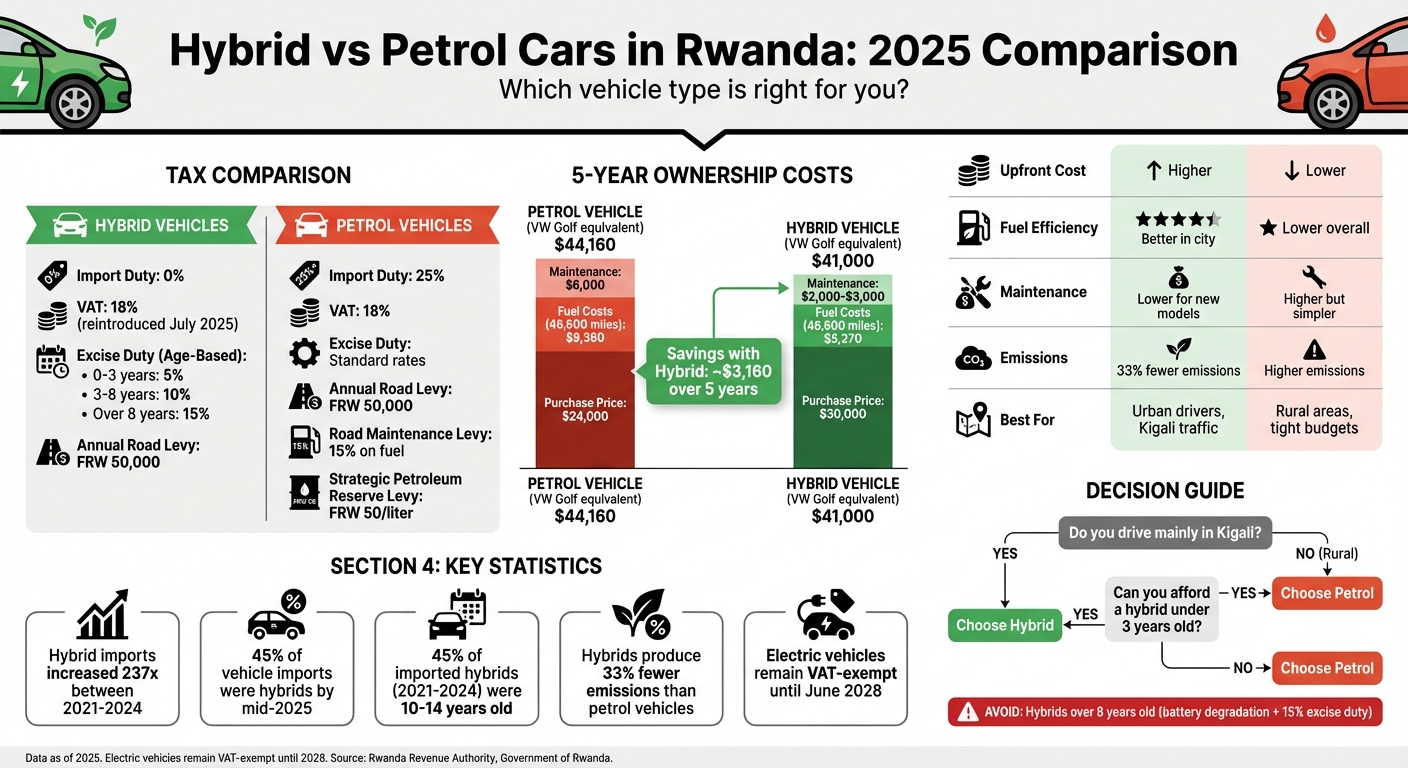
Taxes play a major role in determining how much you’ll spend on a car. Hybrid vehicles enjoy a significant edge with a 0% import duty, compared to the hefty 25% Common External Tariff applied to petrol vehicles. But since July 2025, this advantage has been reduced. The government reintroduced an 18% VAT on hybrids and added age-based excise duties to the mix.
Here’s a quick overview of the costs:
| Factor | Hybrid | Petrol |
|---|---|---|
| Import Duty | 0% | 25% |
| VAT | 18% (as of July 2025) | 18% |
| Excise Duty | 5% (<3 years), 10% (4–7 years), 15% (8+ years) | Standard rates apply |
| Fuel Efficiency | High when new; declines with age | Consistent over time |
| Annual Road Levy | FRW 50,000 (cars/jeeps) | FRW 50,000 (cars/jeeps) |
The age of the vehicle is a critical factor for hybrids. For example, importing a hybrid that’s less than three years old incurs just a 5% excise duty, but if it’s over eight years old, that jumps to 15%. These tax policies are designed to encourage newer, more efficient vehicles that align with Rwanda’s environmental goals.
Environmental Impact
Hybrids are built to produce fewer emissions compared to petrol cars – if their batteries are in good condition. But here’s the catch: many hybrids imported into Rwanda are older models, and their batteries are often degraded. Once the battery’s efficiency drops, the car relies heavily on its petrol engine, negating many of the environmental benefits.
If reducing emissions is a priority, it’s worth opting for hybrids that are less than three years old. These newer models are more likely to maintain their fuel efficiency and lower emissions for longer.
Performance in Different Driving Conditions
Performance is another key area where hybrids and petrol cars differ, especially depending on where and how you drive.
In Kigali’s stop-and-go traffic, hybrids shine. The electric motor operates efficiently at low speeds, and regenerative braking captures energy that would otherwise be wasted, helping to save on fuel.
However, things change over time. After about 10 years, hybrid batteries tend to degrade, and their performance starts to mirror that of petrol cars. For rural areas or long-distance travel – where specialized hybrid maintenance might not be readily available – a petrol car or a very new hybrid is often the more reliable choice.
"Now that Rwandans have become familiar with hybrid technology, our focus is on ensuring that newer models enter the market. That’s why we’ve structured excise duty rates based on the vehicle’s age." – Godfrey Kabera, Minister of State for National Treasury
This age-based tax policy is designed to nudge buyers toward newer hybrids, which are better equipped to deliver on both fuel efficiency and environmental goals.
sbb-itb-7bc66b5
Government Policies and Market Trends
Tax Policies and Incentives
In 2025, Rwanda introduced significant changes to its automotive tax policies to encourage the adoption of fully electric vehicles. These reforms have reshaped vehicle ownership costs, reflecting both performance and environmental priorities. While hybrid vehicles still benefit from a 0% import duty, they are now subject to an 18% VAT and age-based excise taxes. On the other hand, fully electric vehicles enjoy complete tax exemptions, a policy set to remain in place until mid-2028. The age-based excise tax structure is particularly aimed at pushing buyers toward newer hybrid models that are more fuel-efficient and emit fewer pollutants.
"Rwanda has reintroduced value-added tax (VAT) on hybrid vehicles to promote pure electric mobility." – Emmanuel Ntirenganya
Petrol vehicles, however, face steeper financial hurdles. In addition to a standard 25% import duty, these vehicles are now subject to a 15% road maintenance levy based on their Cost, Insurance, and Freight (CIF) value. Additionally, the strategic petroleum reserve levy has risen from FRW 32.73 to FRW 50 per liter. These tax increases are clearly designed to shift consumer preferences and align with the government’s push for greener technologies.
Market Trends and Vehicle Availability
These tax changes have had a noticeable impact on market trends and consumer behavior. Hybrid vehicle imports in Rwanda saw an extraordinary increase, skyrocketing by 237 times between 2021 and 2024. By mid-2025, hybrids accounted for nearly 45% of all vehicle imports. However, many of these hybrids were older models – a trend the new tax policies aim to curb. By incentivizing newer hybrids, the government hopes to further advance its goal of full electrification, aligning with the Second National Strategy for Transformation’s objectives through 2030.
Petrol vehicles, meanwhile, continue to hold their ground in rural areas and among buyers who prioritize simplicity and the availability of maintenance services. Despite the government’s push for electric and hybrid technologies, petrol cars remain a key part of the market, though they are increasingly burdened by higher operational costs due to new levies. Overall, Rwanda’s automotive market is undergoing a significant shift, with tax incentives driving interest in fully electric vehicles and encouraging hybrid owners to upgrade to newer models, even as petrol vehicles face growing financial pressures.
5-Year Cost of Ownership
When considering the total cost of owning a vehicle over five years, it’s important to look beyond just the sticker price. While petrol cars are cheaper upfront, hybrids often make up for their higher initial cost with savings on fuel and maintenance.
For example, a petrol car similar to a VW Golf costs about $24,000, whereas a hybrid version is priced around $30,000. That $6,000 price gap shrinks when you factor in operating costs. Over a distance of 46,600 miles, a petrol car (using 8L/100km) racks up about $9,360 in fuel expenses, based on $1.3 per liter. In contrast, a hybrid (at 4.5L/100km) spends only $5,270, saving approximately $4,090 in fuel over the same period.
Maintenance costs also differ significantly. Petrol vehicles typically require $1,200 annually (totaling $6,000 over five years), while hybrids cost between $400 and $600 per year (adding up to $2,000–$3,000 over five years). These lower maintenance costs are largely due to hybrids experiencing less engine wear and benefiting from regenerative braking, which extends brake life. However, both types of vehicles incur the same fixed annual road levy of FRW 50,000 (around $36). Additionally, petrol car owners must pay a 15% road maintenance levy on fuel purchases.
Here’s a breakdown of the 5-year ownership costs:
| Cost Component (5-Year Period) | Petrol Vehicle | Hybrid Vehicle |
|---|---|---|
| Purchase Price | $24,000 | $30,000 |
| Fuel/Energy Costs | $9,360 | $5,270 |
| Maintenance | $6,000 | $2,000–$3,000 |
| 5-Year Total | $44,160 | $41,000 |
Depreciation is another factor to keep in mind. After five years, both types of vehicles retain about 50% of their original value. However, hybrids tend to offer a slightly better return in absolute terms because of their higher starting price.
Which Should You Buy?
Deciding between a hybrid and a petrol vehicle comes down to a few key factors: where you drive, how much you’re ready to invest upfront, and how long you plan to keep the car. Recent policy changes by the Rwandan government have added some complexity to this decision. Let’s break down the costs, efficiency, and reliability to help you choose what works best for your lifestyle – whether you’re navigating city streets or venturing into rural areas.
If you’re an urban driver in Kigali, a newer hybrid (under three years old) could still be a smart financial choice, even with the reintroduced 18% VAT. While hybrids come with a higher price tag, they make up for it with outstanding fuel efficiency, especially in stop-and-go city traffic. However, it’s crucial to stick to recent models – older hybrids often lose their electric functionality over time, leaving you with a petrol-only vehicle.
For those on a tighter budget or driving mostly in rural areas, a petrol vehicle might be the better option. Petrol cars offer more predictable costs, and you won’t have to worry about battery degradation. While you’ll spend more on fuel in the long run, the lower upfront cost and the convenience of widespread petrol stations make them a practical choice.
One thing to avoid? Hybrids older than eight years. These vehicles not only face higher excise duties but are also prone to battery degradation, which diminishes their value and efficiency. If you’re thinking about a used hybrid, always check the battery’s condition before making a purchase.
If cutting emissions is your priority and you have access to charging stations, you might want to explore pure electric vehicles. They remain VAT-exempt until June 2028 and align with the government’s push for long-term infrastructure improvements.
FAQs
How do Rwanda’s new tax policies impact the cost of owning a hybrid vehicle?
Rwanda has revised its tax policies, introducing an 18% value-added tax (VAT) on hybrid vehicles, which replaces the previous tax exemption. On top of this, an age-based excise tax now applies: 5% for hybrids aged 0-3 years, 10% for those 3-8 years old, and even higher rates for vehicles older than eight years. These changes have made hybrid cars noticeably more expensive upfront.
Let’s break it down with an example: imagine a hybrid car priced at $25,000. The VAT alone adds $4,500 to the cost. If the car is three years old, an additional excise tax of $1,250 applies, pushing the total to $30,750 – and that’s before registration fees. These taxes not only increase the purchase price but also impact the car’s resale value and long-term ownership costs.
The government’s goal with these changes is to encourage the adoption of fully electric vehicles, which will remain VAT-exempt through 2028. As a result, hybrid cars have become a less appealing financial option for buyers in Rwanda compared to previous years.
What should you know about maintaining a hybrid vehicle in Rwanda?
Maintaining a hybrid vehicle in Rwanda isn’t too different from caring for a traditional car, but it does come with a few extra steps. Standard upkeep like oil changes and brake inspections is usually done once a year. However, hybrid cars have unique components – such as the high-voltage battery, inverter coolant, and electrical connections – that need occasional checks to keep everything running safely and efficiently.
Thanks to Rwanda’s mild climate, hybrid batteries tend to hold up well, but they might need replacing after 8–10 years or between 150,000 and 200,000 kilometers. Since this can be a pricey repair, it’s wise to plan for it in advance. To avoid unexpected costs and keep your car in great shape, always choose service centers with technicians trained to handle hybrid systems and equipped with the right tools. Regular inspections by experts can ensure your hybrid stays reliable for years to come.
Are electric vehicles a better choice than hybrids in Rwanda due to current incentives?
Electric vehicles are now the more budget-friendly option in Rwanda. Thanks to government policies, electric cars are exempt from taxes, while hybrid vehicles face an 18% VAT. This tax break makes going electric a smart financial move for anyone looking to cut down on initial expenses.
Beyond the savings, Rwanda is making a strong push toward e-mobility as part of the global effort to embrace greener practices. Opting for an electric vehicle not only lowers long-term running costs but also contributes to the nation’s progress toward environmentally friendly transportation.
Related Blog Posts
- Electric vs Petrol cars in Rwanda
- Petrol, Diesel or Hybrid: What to Choose in 2025?
- Car Price Trends in Rwanda: Petrol vs Hybrid vs Electric
- Hybrid Cars in Rwanda: Prices and Benefits