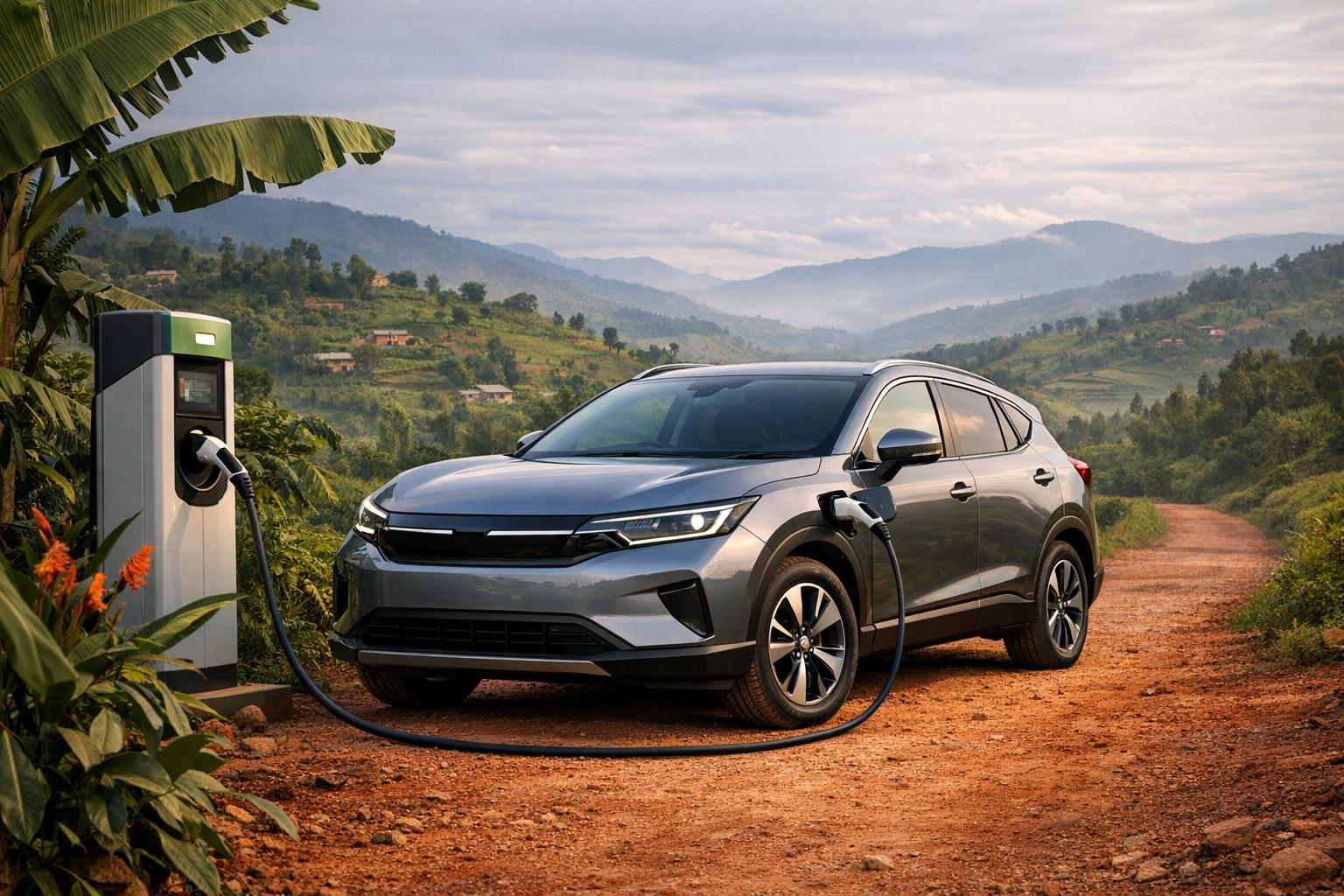
EV batteries in Rwanda typically last 8 to 15 years, depending on usage and care. The country’s mild climate helps reduce heat-related wear, but hilly terrain, stop-and-go traffic, and limited charging infrastructure can impact battery longevity. Here’s what you need to know:
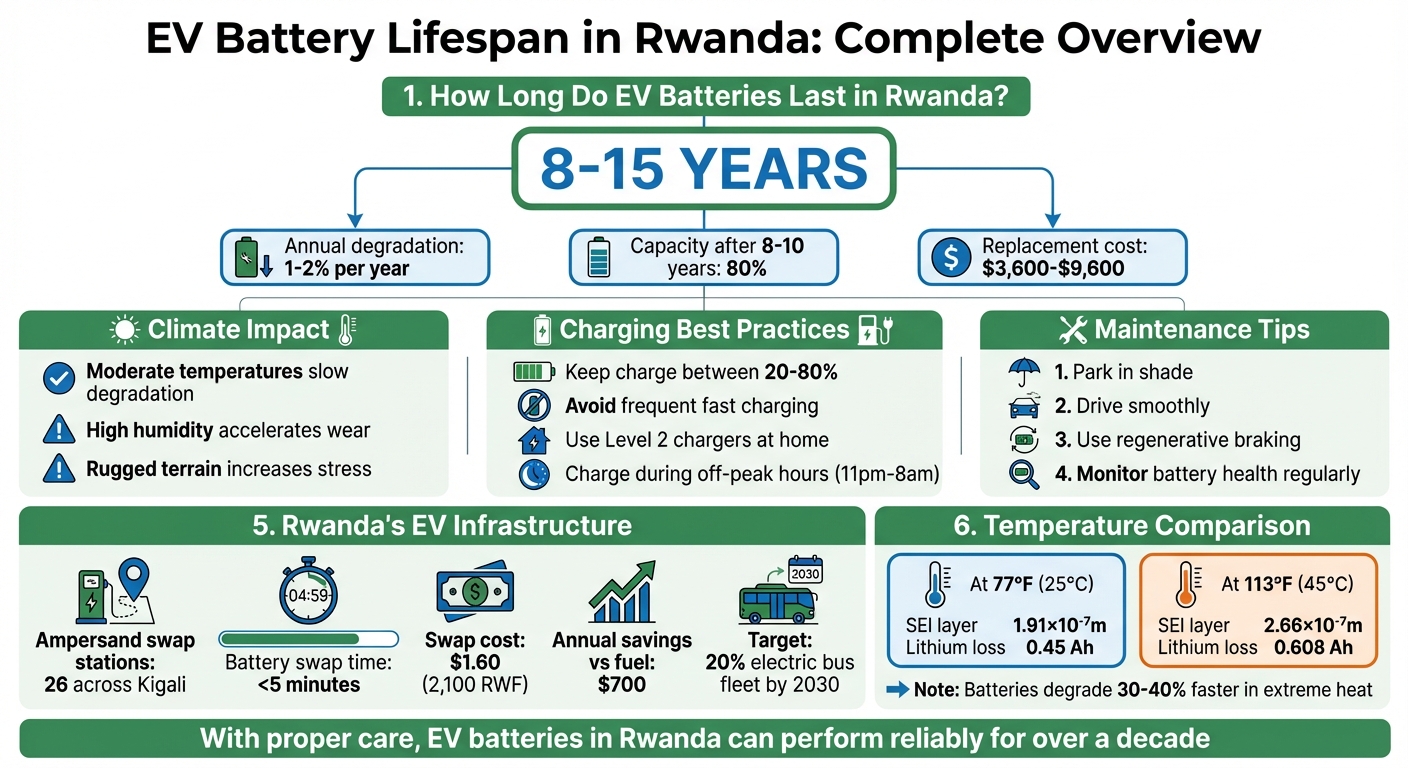
- Battery Lifespan: Most EV batteries degrade at 1–2% per year, retaining 80% capacity after 8–10 years. Proper care can extend this to 15 years or more.
- Climate Impact: Rwanda’s moderate temperatures slow degradation, but high humidity and rugged terrain can accelerate wear.
- Charging Habits: Keeping charge levels between 20–80% and avoiding frequent fast charging helps preserve battery health.
- Terrain Effects: Regenerative braking on hilly roads can improve range and slightly reduce wear, but steep inclines demand higher power output, increasing cycle aging.
- Cost of Replacement: Replacing an EV battery in Rwanda can cost $3,600–$9,600, making maintenance critical for long-term savings.
Key Maintenance Tips:
- Park smart: Shade reduces heat stress.
- Charge wisely: Use slower chargers and avoid draining the battery completely.
- Drive smoothly: Avoid sudden acceleration and hard braking.
With proper care and Rwanda’s growing EV infrastructure, most batteries can perform reliably for over a decade.
EV Battery Lifespan in Rwanda: Key Statistics and Maintenance Tips
Standard EV Battery Lifespan Expectations
Expected Battery Life and Capacity Retention
Most EV batteries are designed to last over a decade, with an annual capacity degradation of about 1% to 2%. This means they can potentially remain functional for 10 to 20 years.
"Modern systems (demonstrate) an average degradation rate of 1% to 2% annually – translating to lifespans of up to 20 years … often outlasting the vehicles." – Mabel Feng, Director of Product Management, Proterra
The health of an EV battery is typically measured by its State of Health (SoH), which compares its current capacity to what it had when new. Generally, a battery’s "first life" ends when its capacity drops to 80% of the original rating. To reassure buyers, manufacturers often provide warranties covering 8 to 10 years or 100,000 to 150,000 miles, guaranteeing at least 70% capacity retention during that period.
Tesla‘s real-world data highlights this durability. For instance, their Model S and Model X vehicles retained 88% of their original battery capacity after 200,000 miles, while the Model 3 and Model Y retained 85%. Laboratory tests have also shown that some battery cells can handle 2,000 equivalent full cycles, theoretically supporting up to 310,686 miles of driving.
These figures provide a general benchmark, but actual performance can vary significantly depending on local conditions and usage patterns. For example, the unique environment and driving conditions in places like Rwanda may influence these outcomes. Let’s explore the factors that can impact battery longevity.
What Affects Battery Longevity
While global averages offer a baseline, local factors such as climate, terrain, and charging habits play a significant role in determining how long an EV battery will last.
Battery degradation occurs in two primary ways: calendar aging (caused by the passage of time, whether the battery is used or not) and cycle aging (caused by repeated charging and discharging). Several factors can speed up these processes.
Charging habits are especially critical. For example, using DC fast chargers daily at 60 kW can reduce capacity by 22% over 10 years compared to slower Level 1 charging at 1.8 kW. Keeping the battery’s charge level between 20% and 80% helps reduce stress, as both very high and very low states of charge (SoC) can accelerate wear.
Temperature extremes also have a big impact. High temperatures can speed up calendar aging, while charging in freezing conditions can cause permanent damage to the anode due to lithium plating. A battery thermal management system can help, reducing degradation by about 0.5% in temperate climates.
Battery chemistry is another important factor. Lithium Iron Phosphate (LFP) batteries, which now make up almost 50% of the global market, can handle being charged to 100% with little degradation. On the other hand, Nickel Manganese Cobalt (NMC) batteries offer higher energy density but are best kept below 80% SoC to maintain long-term performance.
"The secret of longevity in the EV battery is oversizing and only operating in mid-range with plenty of ‘grace capacity’ as spare in the upper and lower bands." – Battery University
sbb-itb-7bc66b5
How Rwanda’s Climate Affects EV Batteries
Temperature and Humidity Effects
Rwanda’s warm climate significantly affects the lifespan of EV batteries. For instance, at a temperature of 113°F (45°C), the SEI (Solid Electrolyte Interphase) layer on the battery thickens to 2.66×10⁻⁷ m, with lithium loss reaching 0.608 Ah over 12,457 hours. In contrast, at 77°F (25°C), the SEI layer is thinner at 1.91×10⁻⁷ m, and lithium loss is only 0.45 Ah over the same period. This accelerated degradation means EV batteries in Rwanda often hit the 80% capacity mark 30–40% faster than in cooler environments.
"The higher the temperature, the higher was the rate of fading" – Aimable Ngendahayo, African Center of Excellence in Energy for Sustainable Development at the University of Rwanda
Humidity adds another layer of complexity. Over time, moisture can seep into battery components and packaging, triggering chemical reactions that weaken the cell structure. Add Rwanda’s rugged terrain and urban driving patterns to the mix, and the thermal stress on batteries intensifies even further.
Impact of Hills and Stop-and-Go Traffic
Rwanda’s hilly landscape presents unique challenges for EV batteries. Navigating mountainous terrain requires higher power output, which speeds up battery cycle aging. A study conducted in October 2024 examined two routes in Kigali – Jali Balayi and KN 206 Street. On the KN 206 route, the battery remained idle for 58% of the journey. This idling, combined with high charge levels, led to faster calendar aging compared to routes where the battery was consistently active.
Stop-and-go traffic in urban areas adds another layer of wear and tear. The frequent discharge and recharge cycles in such conditions accelerate battery degradation, especially when coupled with steep inclines. Together, these factors create a tough environment for EV owners in Rwanda.
Charging Infrastructure Limitations
Beyond environmental and mechanical stresses, Rwanda’s limited charging infrastructure also contributes to battery wear. Kigali has a shortage of charging stations, and grid instability forces many drivers to rely on fast charging and deep discharges, both of which are hard on batteries. While standard charging for electric motorcycles typically takes 6 to 8 hours, the lack of accessible stations often pushes drivers to use faster, more damaging options when they can find them.
This infrastructure gap means drivers frequently deplete their batteries to nearly 0% before recharging – a practice that significantly accelerates battery degradation compared to maintaining partial charge cycles.
Battery Maintenance Tips for Rwanda’s Conditions
Protecting Batteries from Heat and Moisture
Park smart. High temperatures in Rwanda can speed up battery wear. To minimize this, park in shaded or indoor areas whenever possible. If your EV is equipped with a preconditioning feature, use it to cool the battery while it’s still plugged in before you start driving. This simple step can help reduce thermal stress on the battery.
Another important tip: keep your battery connections secure. Driving on Rwanda’s hilly and often rough terrain can create vibrations that may loosen internal components over time. Check the battery hold-down hardware regularly to ensure everything stays in place and functions properly.
Combine these measures with thoughtful charging habits to further protect your battery.
Better Charging Methods
Keep your charge levels between 10% and 90%. Research from the University of Rwanda’s African Center of Excellence in Energy for Sustainable Development indicates that maintaining this range can reduce capacity fading by about 5% compared to fully draining and charging the battery. For daily use, set your charging limit to around 80%, and only charge to 100% when you need the extra range for a longer trip.
At home, use a Level 2 charger for routine charging. This method is gentler on the battery compared to frequent use of DC fast chargers, which increase battery temperature and speed up the formation of the SEI layer – an issue that raises internal resistance and affects overall battery life. Reserve fast charging for emergencies or long-distance travel to avoid unnecessary stress on the battery.
Your driving habits also play a big role in extending battery life.
Driving Techniques to Extend Battery Life
Rwanda’s challenging roads demand a driving style that prioritizes battery health. Smooth driving and efficient energy recovery are essential. Avoid sudden acceleration and hard braking, as these actions put extra strain on the battery. Instead, focus on driving smoothly and using regenerative braking whenever possible. In hilly areas, regenerative braking is especially useful – it captures energy during descents and feeds it back into the battery, reducing mechanical wear.
"Critical to Ampersand’s popularity among moto drivers in Kigali is the easy-to-use software that tells riders how much charge is left in their battery and provides tips on utilizing power based on their riding habits." – Josh Whale, CEO, Ampersand
If your EV offers a one-pedal driving mode, take advantage of it. This feature enhances regenerative braking and ensures smoother power application, which is particularly helpful in stop-and-go traffic or on steep inclines. Additionally, use your vehicle’s app or onboard software to monitor power usage in real time. Adjust your driving habits based on this data to improve efficiency and prolong battery life.
Electric Vehicle Performance in Extreme Weather Conditions
Technologies and Solutions for Rwanda’s EV Market
Rwanda is embracing a range of technologies and strategies to improve the performance and adoption of electric vehicles (EVs), especially in the context of its warm climate and rapidly growing market.
Cooling Systems in EV Models
Modern EVs rely on advanced thermal management systems to maintain optimal battery temperatures. These systems circulate coolant through the battery pack, helping to prevent overheating in Rwanda’s warm weather. While this technology slightly reduces driving range, it significantly extends battery life, making it a worthwhile trade-off.
To further protect batteries, automakers use heat shields and strategically position battery packs – often under the rear seat or trunk – to shield them from engine heat and road-generated heat. Additionally, many EVs now include smart maintenance software that monitors battery health in real time. For example, Lithium-Iron-Phosphate (LFP) batteries, known for their thermal stability, are designed to last up to 350,000 kilometers, making them well-suited for Rwanda’s conditions.
"The ‘smart maintenance system’ also enables Ampersand to efficiently manage and improve its battery fleet, as well as alerting the team to potential battery or vehicle repairs before they happen."
- Josh Whale, CEO of Ampersand
Battery Swapping and Recycling Initiatives
Battery swapping is gaining traction as a practical solution for EV users in Rwanda. This approach minimizes charging downtime and prevents the heat buildup associated with fast charging. Ampersand, for instance, operates a fleet of over 2,200 electric motorcycles supported by 26 swap stations across Kigali. A battery swap takes less than five minutes and costs around 2,100 Rwandan francs ($1.60), saving riders approximately $700 annually compared to fuel-powered motorcycles.
These swap stations also charge batteries under controlled conditions, often powered by solar energy, which reduces reliance on the national grid. On the recycling front, the government is working to implement Extended Producer Responsibility (EPR) schemes to manage used batteries, although specific programs are still in development.
Such efforts, combined with innovative business models, are helping to accelerate the adoption of EVs in Rwanda.
Government Support and Local Programs
Rwanda has introduced a range of incentives to encourage EV adoption. These include exemptions from import duties, excise duties, and VAT on EVs and their components. Charging station operators benefit from rent-free government land and access to the lowest industrial electricity tariffs. Additionally, off-peak charging between 11 p.m. and 8 a.m. comes with further discounts.
In March 2024, the government partnered with the United Nations Development Programme (UNDP) to transition Kigali’s 26,000 gas-powered moto-taxis to electric models. This initiative aims to cut the 13% of national emissions attributed to road transport. The government also launched Ecofleet Solutions, a state-owned enterprise focused on electrifying public transport, with a goal to convert 20% of the bus fleet to electric by 2030.
"Rwanda’s e-mobility incentives, particularly an electricity tariff and VAT exemption that lowers the cost of battery leasing for drivers, is inspiring other African countries to follow suit."
- Josh Whale, CEO of Ampersand
A standout project at the Nyabugogo transit hub will feature 18 fast chargers, an 800-kW rooftop solar system, and integrated battery storage. With an estimated cost of $7.7 million, this site is set to become a model for decentralized EV infrastructure across Rwanda.
Conclusion: Managing EV Batteries in Rwanda’s Climate
Rwanda’s mild temperatures and hilly landscapes provide a natural advantage for extending EV battery life. The absence of extreme heat reduces thermal stress on batteries, while the terrain enhances regenerative braking, which helps recharge batteries during downhill drives.
To make the most of these benefits, practical maintenance plays a key role. For example, keeping the battery charge between 10% and 90% and parking in shaded areas can slow capacity loss by around 5%. Additionally, charging during off-peak hours not only benefits the grid but also supports more sustainable energy use.
The country is steadily advancing its EV infrastructure. Ampersand’s network of 26 battery swap stations, with a swap costing about $1.60, is making EVs more accessible. The upcoming $7.7 million Nyabugogo transit hub, equipped with fast chargers and solar power systems, further highlights Rwanda’s dedication to clean transportation solutions.
With proper care, most EV batteries in Rwanda are expected to last between 8 and 15 years. Government incentives, smart charging systems, and technologies suited to Rwanda’s conditions make EV ownership increasingly practical and affordable. These measures ensure long-term reliability for EVs in the region.
Rwanda’s unique climate and geography underscore the importance of tailored strategies for EV maintenance and infrastructure. By adopting smart charging habits, reducing heat-related wear, and utilizing the growing network of charging and swapping stations, EV owners can extend battery life and contribute to a cleaner, more sustainable transportation future.
FAQs
How does Rwanda’s climate impact the lifespan of EV batteries?
Rwanda’s temperate climate, with average temperatures ranging from 59°F to 82°F, creates an optimal setting for preserving EV battery life. Unlike regions that experience extreme heat, Rwanda rarely sees temperatures above 104°F – a critical point where lithium-ion batteries begin to degrade more quickly. Additionally, the absence of harsh, freezing winters spares batteries from the extra strain caused by cold-weather heating needs.
These consistently mild conditions mean EV batteries in Rwanda tend to last longer compared to areas with more extreme weather. For local drivers, this translates into greater reliability and lower long-term costs, making Rwanda an ideal place for electric vehicles.
How can I maintain my EV battery for longer life in Rwanda?
To make your EV battery last longer in Rwanda’s climate, here are some practical tips to keep in mind:
- Charge smartly: Stick to Level 2 chargers for everyday charging. While fast chargers are convenient, they generate heat, which can gradually wear down your battery.
- Aim for balanced charge levels: Try to keep your battery charge between 20% and 80% during daily use. Avoid letting it sit at a full charge or completely drained for extended periods, as this can speed up battery wear.
- Take advantage of regenerative braking: Rwanda’s hilly landscape is perfect for regenerative braking, which not only recovers energy but also reduces strain on the battery during discharge cycles.
Other good habits include parking in shaded spots to prevent overheating, keeping the battery compartment clean, and ensuring your tires are properly inflated to reduce unnecessary battery strain. Lastly, regular battery health checks at a trusted service center can help you spot potential issues early and keep your EV in top shape.
How does Rwanda’s terrain affect EV battery life and performance?
Rwanda’s mountainous landscape plays a big role in how electric vehicle (EV) batteries perform. On downhill roads, regenerative braking offers a major benefit by turning the vehicle’s kinetic energy into electricity, giving the battery a small recharge and boosting overall efficiency. On the flip side, those steep uphill climbs demand extra power, which can generate heat and put added strain on the battery if not carefully managed.
To keep your EV battery in good shape, use regenerative braking effectively when heading downhill, avoid sudden acceleration on steep climbs, and try to maintain the battery’s temperature between 68°F and 77°F. By following these steps, you can navigate Rwanda’s challenging terrain while keeping your battery in top condition for the long haul.
Related Blog Posts
- How Rwanda’s Hills Affect EV Range
- Driving an electric car in Kigali: charging stations, tips & real autonomy
- Electric Cars in Rwanda: Models and Charging Points
- EV vs hybrid in Rwanda: what’s best in 2026 depending on your lifestyle?