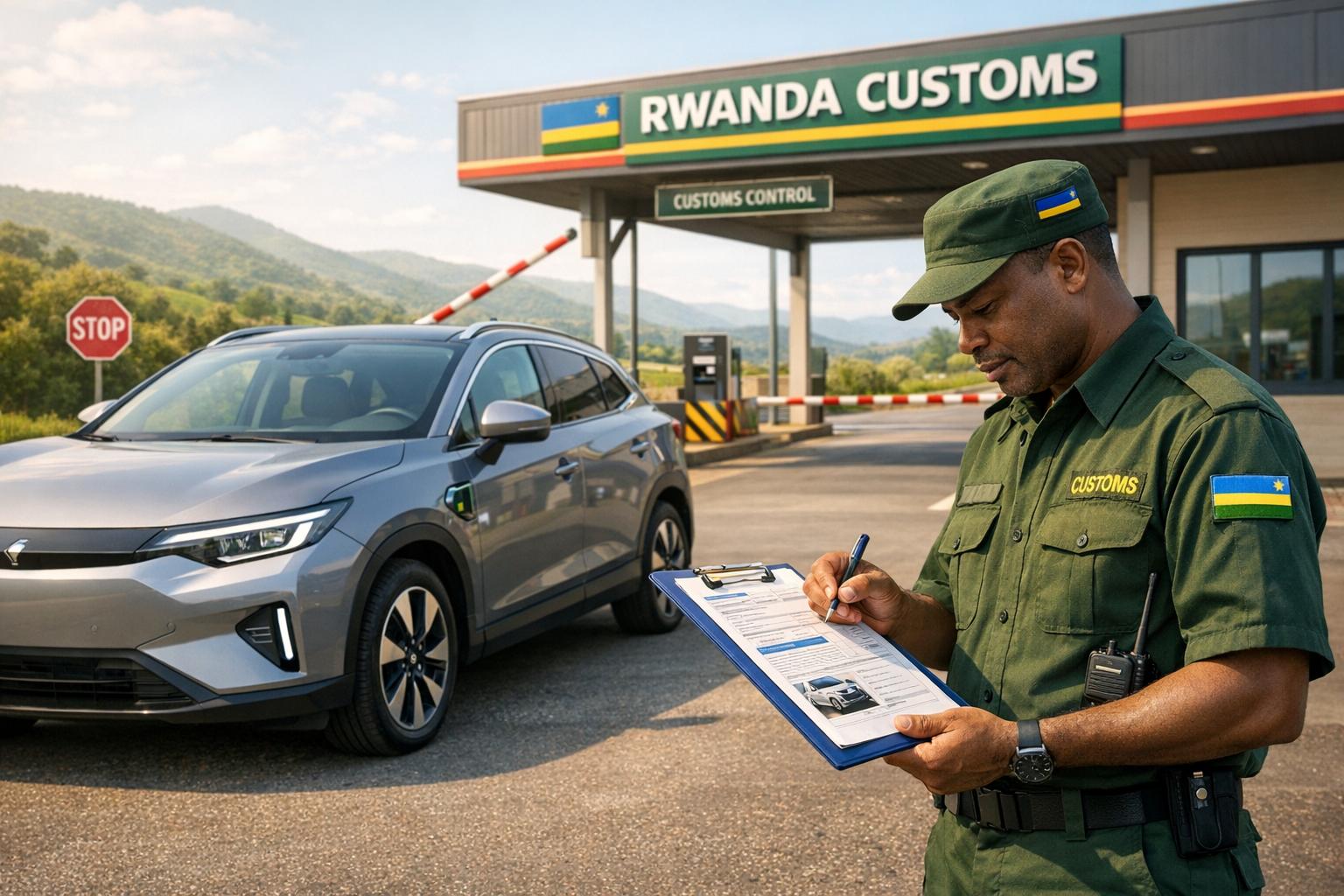
In 2026, Rwanda introduced 0% import duty for electric and hybrid vehicles, aiming to boost EV adoption and reduce emissions. Gasoline vehicles still face a 25% duty, but EVs enjoy VAT exemptions until June 30, 2028. Hybrid vehicles, however, now have excise duties (5%-15%) based on age. Importers must comply with customs rules, including using licensed clearing agents and digital tools like the Rwanda Electronic Single Window (ReSW).
Key Points:
- Tax Benefits: 0% import duty for EVs, VAT exemptions for EVs and charging equipment.
- Hybrid Vehicles: Excise duties apply (5%-15%).
- Required Documents: Bill of Lading, Commercial Invoice, Certificate of Origin, and RSB certification.
- Customs Process: Pre-shipment prep, declaration via ReSW, inspection, and tax payment.
- Additional Costs: Road levy (e.g., $42 for cars), environmental levy (0.2%), and compliance with e-waste regulations.
Quick Overview:
- Licensed clearing agents handle customs.
- Older EVs benefit from up to 80% depreciation under EAC rules.
- Global EV pricing changes may slightly increase costs, but Rwanda’s incentives remain favorable.
Rwanda’s policies make EV imports more affordable, but staying updated on tax reviews and working with experts ensures a smooth process.
EV Tax Policies and Incentives in Rwanda
Zero Import Duty and VAT Exemptions
Rwanda has taken bold steps to encourage the adoption of electric and hybrid vehicles by eliminating import duties on these vehicles through 2026. While gasoline-powered vehicles face a hefty 25% import tariff, electric and hybrid vehicles are exempt, with electric motorcycles also benefiting from this policy.
In addition to import duty exemptions, electric vehicles and their charging equipment enjoy VAT exemptions until June 30, 2028. However, hybrid vehicles are treated differently. They have been reclassified as taxable supplies and now face excise duties ranging from 5% to 15%, depending on their age. This distinction underscores the government’s preference for fully electric vehicles over hybrids.
These incentives are part of a broader strategy that includes reduced excise duties and specific tariff rules under the East African Community (EAC), which are explored further below.
Reduced Excise Duties and EAC Tariff Rules
Rwanda’s tax policies aim to simplify EV imports and promote a shift toward cleaner transportation. Traditional vehicles valued up to $60,000 (Cost, Insurance, and Freight) are subject to a 25% Common External Tariff (CET). However, vehicles priced above $60,000 enjoy additional incentives. According to MINECOFIN:
"While hosting high-level events and promoting the tourism sector, the incentives on cars above USD 60,000 will be extended to increase its stock".
For used electric vehicles, the EAC depreciation schedule determines their taxable value. Vehicles older than 10 years are depreciated by 80% of their original Free on Board (FOB) value, which serves as the base for calculating any applicable taxes or duties.
Other Fees and Levies
Although EVs are exempt from import duties and VAT, importers still face additional costs. These include a fixed annual road maintenance levy, an environmental levy, compliance with e-waste regulations, and a 15% excise duty on financial transaction commissions.
The annual road maintenance levy depends on the vehicle category. For example, cars and jeeps are charged 50,000 Rwandan francs annually, while larger vehicles like buses and trucks incur higher fees.
| Vehicle Category | Annual Road Levy (FRW) |
|---|---|
| Car, Jeep | 50,000 |
| Pickup truck, microbus, minibus, bus | 100,000 |
| Truck, half trailer | 120,000 |
| Trailer | 150,000 |
An environmental levy of 0.2% of the customs value is applied to items packaged in plastic materials. Additionally, EV importers must comply with e-waste regulations, as large lithium-ion battery packs are classified as electronic waste and require proper disposal. Lastly, the 15% excise duty on financial transaction commissions may impact international payments made for vehicle imports.
Required Documents for EV Import Clearance
Getting your electric vehicle (EV) through customs without a hitch depends on having the right paperwork. Importers must collaborate with licensed clearing agents who use the ReSW system. These agents, trained by the Rwanda Revenue Authority (RRA), handle duties and ensure all documents are in order. Below are the key documents you’ll need.
Bill of Lading and Commercial Invoice
Start with the basics: the Bill of Lading and Commercial Invoice. The Bill of Lading acts as proof of shipment and contains critical details for customs clearance. Meanwhile, the Commercial Invoice provides the full sale price, which is essential for determining the customs value. This invoice should include all payments tied to the sale, adjusted for cost, insurance, and freight (CIF). For used EVs, it must also align with the EAC depreciation schedule, which allows for 80% depreciation on vehicles older than 10 years and 20% depreciation for those 1–2 years old. Clearing agents verify these details using the RRA Valuation Gateway.
Certificate of Origin and Vehicle Conformity
The Certificate of Origin confirms where your EV was manufactured and ensures it qualifies for benefits under the EAC Customs Union. Additionally, your EV must meet safety and quality standards, which requires conformity documentation. As Rwanda is part of the EAC, all paperwork must adhere to harmonized rules of origin and valuation systems. Clearing agents also ensure that the correct Harmonized System (HS) codes, as outlined in the EAC Gazettes, are used to determine duty rates and exemptions.
Rwanda Standards Board (RSB) Certificates
The RSB certification ensures your EV meets Rwanda’s quality, safety, and environmental standards. Since motor vehicles and electrical components are classified as "High Risk Goods" by the Rwanda Inspectorate, Competition and Consumer Protection Authority (RICA), they undergo strict compliance checks. The Rwanda Standards Board explains:
"The product Certification is an attestation following assessment that; attributes, characteristics, quality, or status of goods, are in accordance with established standards".
To obtain this certification, you’ll need to submit an online application via the RSB portal (portal.rsb.gov.rw) and pay the required inspection and testing fees. All product labels and technical documents must be in English or French – translations are mandatory for documents in other languages to avoid rejection. Additionally, your EV must come with at least a one-year warranty for its electronic components. The RSB S-Mark is recognized across all EAC partner states, simplifying regional compliance.
EV Import Process: Step-by-Step Guide
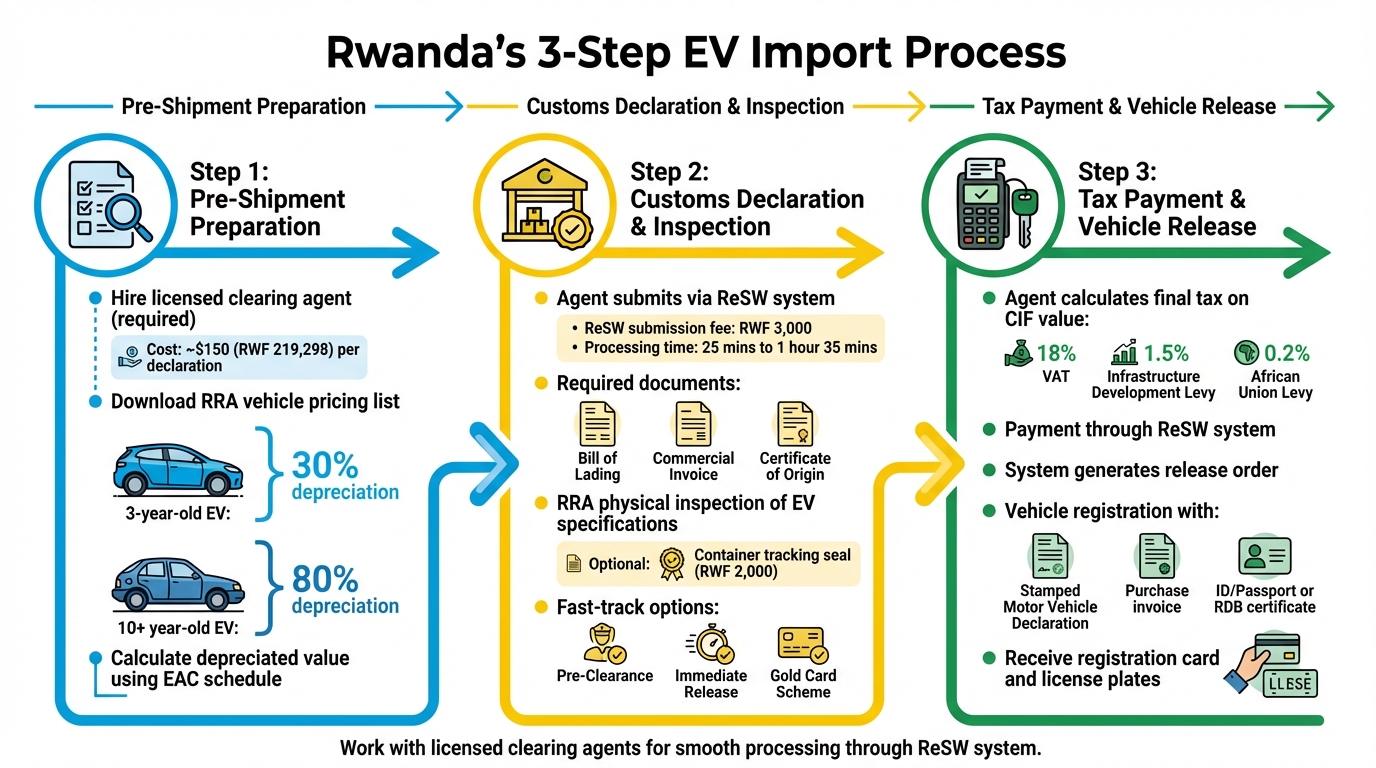
Rwanda EV Import Process: 3-Step Guide from Pre-Shipment to Vehicle Release
Importing an electric vehicle (EV) involves a series of well-defined steps. Once you’ve gathered all the required documents, the process moves through three main phases: pre-shipment preparation, customs declaration and inspection, and finally, tax payment and vehicle release.
Step 1: Pre-Shipment Preparation
Before your EV even leaves its origin country, you’ll need to hire a licensed clearing agent. Only these professionals are authorized to handle declarations in Rwanda. They have exclusive access to the Rwanda Electronic Single Window (ReSW) system and are trained by the Rwanda Revenue Authority (RRA) to assess duties accurately. Expect to pay about $150 (RWF 219,298) per declaration as per the Rwanda Freight Forwarders Association’s standard charges.
To estimate your tax liability, download the latest vehicle pricing list from the RRA website. For used EVs, you’ll also need to calculate the depreciated value using the East African Community (EAC) schedule. For example, a 3-year-old EV would see a 30% depreciation, while a vehicle over 10 years old would be depreciated by 80%. Getting these details sorted ahead of time ensures you’re prepared financially and avoids surprises when the vehicle reaches the border.
Step 2: Customs Declaration and Inspection
When your EV arrives at a Rwandan border post like Rusumo or Gatuna, or a dry port such as Gikondo Magerwa in Kigali, your clearing agent submits the customs declaration through the ReSW system. This online submission comes with a fee of RWF 3,000, and processing typically takes between 25 minutes and 1 hour 35 minutes. To complete the declaration, your agent will use documents like the Bill of Lading, Commercial Invoice, and Certificate of Origin.
Next, RRA officials conduct a physical inspection to verify the EV’s specifications. To speed up this process, you can take advantage of RRA facilitation schemes such as Pre-Clearance, Immediate Release of Goods, or the Gold Card Scheme for compliant taxpayers. If your EV is shipped in a container that requires tracking, you’ll need to pay an additional RWF 2,000 for electronic seals. Once customs declaration and inspection are completed, you’re ready to move on to payment and release.
Step 3: Tax Payment and Vehicle Release
After the inspection, your clearing agent calculates the final tax bill based on the vehicle’s CIF (Cost, Insurance, and Freight) value. Taxes include an 18% VAT, a 1.5% Infrastructure Development Levy, and a 0.2% African Union Levy. Payments are made through the ReSW system, which then generates a release order.
The last step is registering your vehicle. To do this, you’ll need to submit the stamped Motor Vehicle Declaration form from Customs, your purchase invoice, and identification documents (such as an ID or Passport for individuals, or an RDB certificate for companies). Once registration is complete, you’ll receive a motor vehicle registration card and license plates. With accurate documentation and an experienced clearing agent, the entire customs process – from declaration to release – can be handled smoothly and efficiently.
sbb-itb-7bc66b5
Impact of Global EV Export Policy Changes
The global trade landscape is evolving, and these shifts are directly influencing Rwanda’s electric vehicle (EV) import market. Starting in January 2026, China and the European Union have replaced punitive anti-subsidy tariffs with "price commitment agreements" that set minimum price floors for Chinese-made EVs. While these agreements specifically target the EU – where tariffs previously ranged from 7.8% to 35.3% – they reflect a broader strategy by Chinese manufacturers to adjust export pricing worldwide.
This shift means Rwandan importers will likely see fewer steep discounts from Chinese EV producers. According to Wang Bin, an analyst at Deutsche Bank:
"Minimum prices would technically temper sales volume, particularly for low-priced small electric cars".
Chinese manufacturers are now focusing on profit margins and building their brand reputation rather than competing solely on price. As a result, entry-level EV models are expected to carry higher base prices than in previous years, which will impact the total landed cost for Rwandan importers.
On the domestic front, Rwanda’s policies remain favorable. Despite the global pricing adjustments, the country has extended its 0% import duty for electric and hybrid vehicles, continuing to encourage EV adoption.
To adapt to these changes, keep an eye on Rwanda’s annual fiscal year announcements – typically released around June or July – for updates on EV tax exemptions. Importers should also ensure compliance with the new 2026 standards to avoid unexpected price fluctuations. For those bringing in used EVs, the East African Community’s harmonized depreciation schedule remains applicable.
While global price agreements may raise the upfront costs of Chinese EVs, Rwanda’s stable tax incentives help offset these increases, maintaining accessibility for importers. This balance of global and local factors ensures that, although costs may shift, Rwanda’s supportive policies continue to simplify the EV import process.
Working with Authorized EV Dealers in Rwanda
Benefits of Authorized Dealers
Importing an electric vehicle (EV) on your own can be a maze of customs paperwork, valuation challenges, and registration hurdles. In Rwanda, all importers are required to work with licensed clearing agents. Authorized dealers simplify this process by handling both the technical and administrative aspects, including in-house clearing services. This ensures your EV moves smoothly through the system, from pre-shipment to customs clearance.
One major perk of working with authorized dealers is their ability to ensure accurate tax assessments. They follow the EAC harmonized valuation system and depreciation schedule, which can lower the taxable Free on Board (FOB) rate by up to 80% for older vehicles. Additionally, they take care of essential tasks like issuing mandatory EBM invoices for registration and verifying compliance with Rwanda Bureau of Standards (RBS) requirements. Their expertise helps avoid costly errors and unnecessary delays.
These dealers also streamline declarations through the Rwanda Electronic Single Window (ReSW), cutting down on manual processing times. They handle everything from registration and ownership transfers to tax declarations. If you’re a corporate buyer, they’ll manage documents like RDB certificates, while individual buyers receive guidance on obtaining a Taxpayer Identification Number (TIN).
AutoMag.RW as a Local Resource

AutoMag.RW builds on the advantages offered by authorized dealers, providing local expertise to make EV importation even easier. The platform offers detailed guidance on Rwanda’s customs systems, including the Rwanda Electronic Single Window (ReSW) and the Electronic Cargo Tracking System (ECTS). This helps importers understand the necessary documentation and compliance steps before committing to a purchase. AutoMag.RW also connects users with trusted dealers across the country who are well-versed in Rwanda’s EV import regulations.
Another useful feature of AutoMag.RW is its valuation guidance through the RRA Valuation Gateway. This tool, which is based on the "Motor vehicle Price when New" list (last updated in July 2025), helps you estimate duties and taxes before shipping. Whether you’re importing a second-hand EV from abroad or buying a locally assembled model, AutoMag.RW links you with dealers who understand exemptions and registration processes. This includes centralized registration services at RRA Gikondo and Dubai Port at Masaka offices. By combining dealer networks with up-to-date regulatory tools, AutoMag.RW ensures a smoother, more efficient import experience for buyers.
Conclusion
In 2026, Rwanda’s decision to impose a 0% import duty on EVs, hybrids, and electric motorcycles – alongside an EAC depreciation schedule that can reduce taxable values by up to 80% for vehicles over 10 years old – offers a significant cost advantage compared to standard vehicles, which are subject to a 25% tariff. These incentives are reviewed annually, so it’s essential to check the latest updates through MINECOFIN’s "Citizen Guide".
To navigate the import process, partnering with a licensed clearing agent is crucial. They’ll help you file customs declarations via the Rwanda Electronic Single Window (ReSW) and ensure all necessary documents – like the Bill of Lading, Certificate of Origin, and RBS certificates – are in order. You can also use the RRA Valuation Gateway, specifically the "Motor vehicle Price when New" list (updated July 2025), to estimate duties accurately.
But importing an EV isn’t just about paperwork. Local expertise can make all the difference. AutoMag.RW streamlines the entire process by connecting you with trusted dealers who are well-versed in Rwanda’s EV regulations. Whether you’re bringing in a used Tesla or choosing a locally assembled option, their network handles everything – from ReSW declarations to vehicle registration – ensuring a hassle-free shift to electric mobility. Let the experts guide you toward a seamless EV ownership experience.
FAQs
What documents do I need to import an electric vehicle into Rwanda?
To bring an electric vehicle (EV) into Rwanda, you’ll need to gather and submit several important documents for customs clearance via the Rwanda Electronic Single Window (ReSW) system. Here’s what you’ll need:
- Air Waybill (for air shipments) or Bill of Lading (for sea shipments) to verify shipment details.
- A commercial invoice that outlines the vehicle’s value and transaction specifics.
- A packing list that details the contents of the shipment.
- An Import Declaration Form (IDF), which must be submitted electronically through ReSW.
- Your Tax Identification Number (TIN) and VAT registration number as the importer.
- A Certificate of Origin, especially for vehicles originating from COMESA or EAC member states.
- The vehicle’s registration or de-registration card from its country of origin (required for used EVs).
- Any applicable tax exemption or duty remission certificates, such as those for EV-specific excise tax exemptions.
These documents are essential to meet Rwanda’s import regulations, enabling you to clear customs, settle any required taxes, and register your electric vehicle for use on the road.
What tax incentives does Rwanda offer for electric vehicles compared to hybrid vehicles?
Rwanda provides notable tax breaks for electric vehicles (EVs) when compared to hybrid cars. Both categories benefit from a 0% import duty, removing the usual customs fees. However, EVs gain an extra edge with exemptions from VAT, excise, and withholding taxes. For models priced at or below $60,000, a reduced 25% East African Community (EAC) tariff applies first, followed by a full exemption.
On the other hand, hybrid vehicles, though free from import duty, still incur VAT and other taxes, leading to a heavier tax load than EVs. These incentives position EVs as a more economical and eco-conscious option for importers in Rwanda.
What do licensed clearing agents do during the EV import process in Rwanda?
Licensed clearing agents play a crucial role in helping importers navigate the customs clearance process for electric vehicles (EVs) in Rwanda. These professionals manage essential tasks like preparing and filing the Import Declaration Form (IDF), submitting required documents such as the commercial invoice, bill of lading, and tax identification details, and ensuring all paperwork aligns with Rwanda Revenue Authority (RRA) regulations.
When it comes to EV imports, clearing agents also confirm whether the vehicle qualifies for tax exemptions, including VAT and duty relief. They make sure all necessary exemption certificates are in order. Additionally, they liaise with the RRA to secure customs release, address any special clearance requests, and take care of fees or deposits on the importer’s behalf. Their expertise helps streamline the process, reducing the risk of delays, penalties, or mistakes.
Related Blog Posts
- 5 Steps To Import EVs Into Rwanda
- Car import duties in Rwanda: Updated costs and procedures for 2025
- Special EV Customs Rules: What Importers Need to Know
- Car Import Tax in Rwanda: Complete 2025 Guide