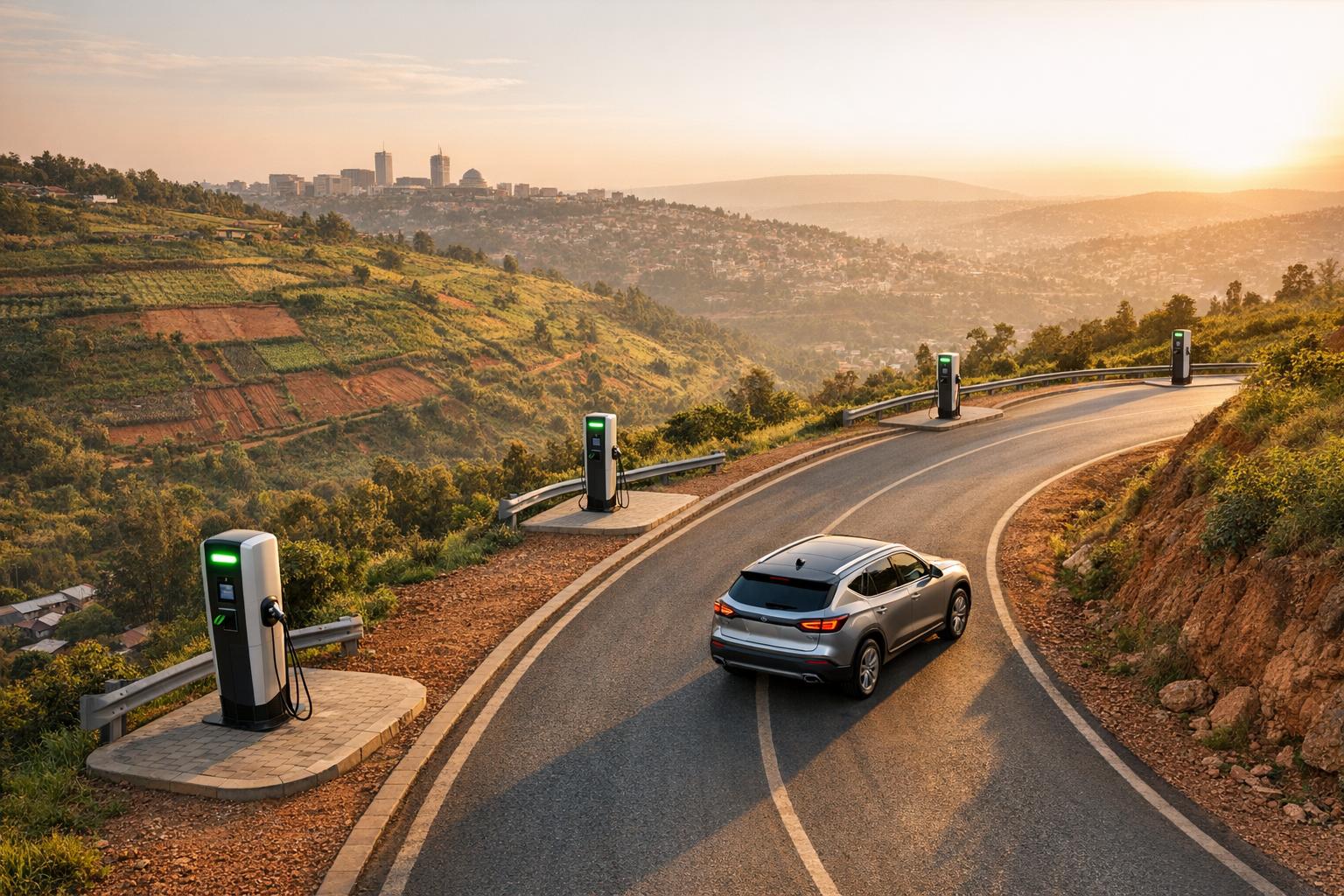
Extended-range electric vehicles (EREVs) are gaining traction in Rwanda, offering a practical solution for the country’s hilly terrain and limited charging infrastructure. These vehicles combine electric motors with a small gasoline generator, ensuring drivers aren’t stranded when battery power runs low. Here’s why they’re a smart choice for Rwandan drivers:
- Tackle Hills with Ease: EREVs deliver the torque needed for steep climbs and use regenerative braking to extend battery life.
- Lower Costs: Charging costs as little as $1.77 per 100 km compared to $7.20 for gasoline, saving drivers up to $1,357.50 annually.
- Reduced Emissions: With over 50% of Rwanda’s electricity from renewables, EREVs help cut greenhouse gas emissions.
- Government Incentives: Tax breaks and reduced import duties make EREVs more affordable, while charging station expansion supports long-distance travel.
Popular models like the BYD Tang and Tesla Model Y cater to Rwanda’s unique driving conditions, with options for both city commutes and rural trips. Whether you’re looking to save on fuel or embrace cleaner mobility, EREVs offer a practical way forward.
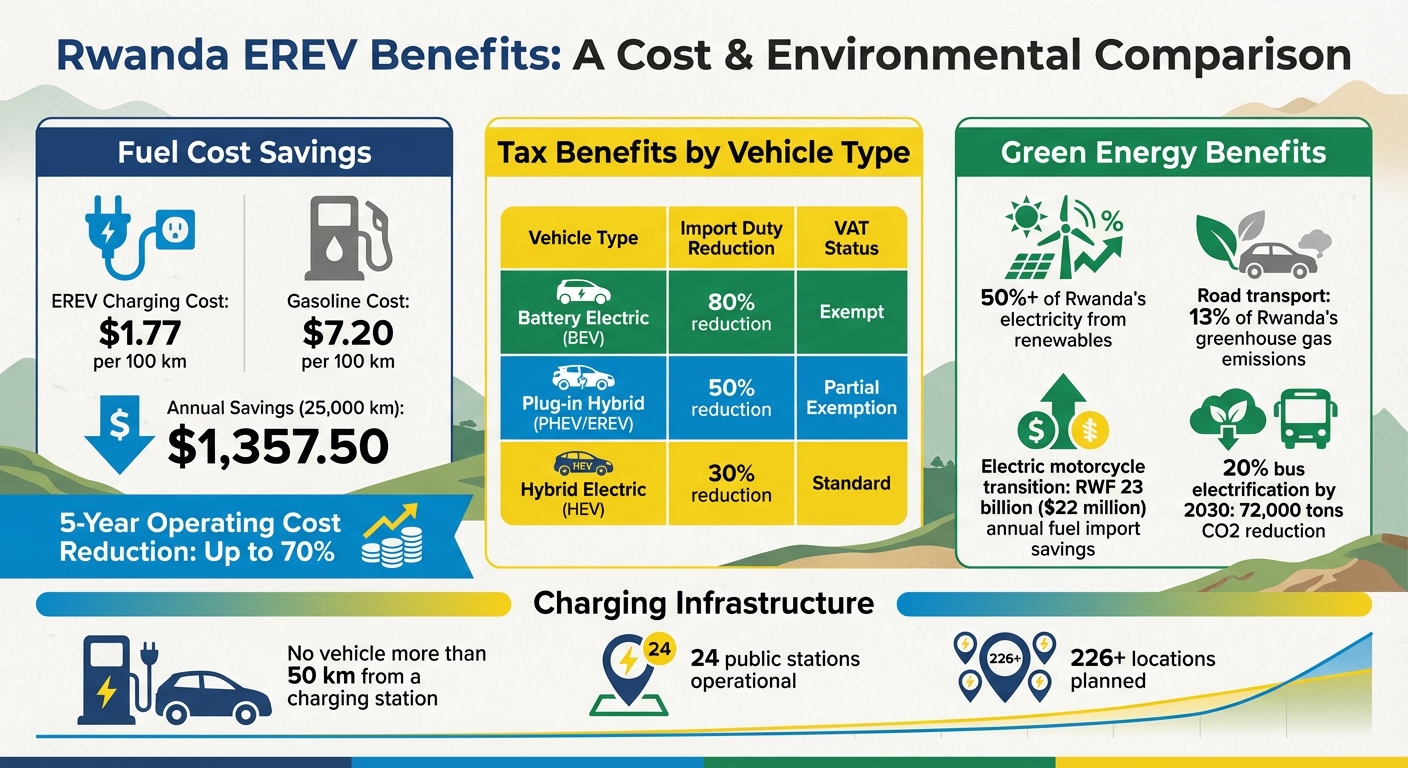
Rwanda EREV Cost Savings and Tax Incentives Comparison
Why Extended-Range EVs Work Well in Rwanda
Handling Hills and Long-Distance Driving
Rwanda’s hilly terrain presents unique challenges for vehicles, but extended-range EVs (EREVs) are more than up to the task. With their electric drivetrains, these vehicles provide plenty of torque to tackle steep climbs, while features like regenerative braking help maximize battery efficiency on the country’s varied landscapes. Plus, Rwanda’s moderate climate is a bonus, as it supports stable battery performance and extends battery life. For rural areas with uneven or unpaved roads, vehicles with higher ground clearance – like the Tesla Model Y or BYD Tang – are especially well-suited. This combination of performance and adaptability makes EREVs a smart and practical choice for Rwanda’s unique driving conditions.
Lower Fuel Costs and Cleaner Air
EREVs aren’t just about performance – they also deliver serious savings and environmental perks. Over five years, mid-range EVs can slash operating costs by up to 70%, which becomes even more appealing as gasoline prices climb. On top of that, their simpler drivetrains mean fewer maintenance headaches.
Environmentally, EREVs align perfectly with Rwanda’s green energy goals. Over half of the country’s electricity comes from renewable sources, so driving on battery power significantly cuts emissions. With road transport responsible for 13% of Rwanda’s greenhouse gas emissions, switching to electric vehicles can make a big difference. As Eng. Alfred Byiringiro, Director General for Transport at the Ministry of Infrastructure, notes:
"The incentives are expected to serve Rwanda’s long-term goal to be a carbon-neutral nation as articulated in its Vision 2050."
Even small steps toward electrification yield major results. For instance, transitioning to electric motorcycles could save Rwanda RWF 23 billion (about $22 million) annually in fuel imports. Meanwhile, plans to electrify 20% of buses by 2030 could cut emissions by 72,000 tons of CO2 equivalent. Paired with government incentives, these financial and environmental benefits make EREVs a compelling option.
Government Tax Breaks and EV Support
The Rwandan government has rolled out a range of incentives to make EREVs more accessible. The tax structure heavily favors electric and hybrid vehicles, as illustrated below:
| Vehicle Type | Import Duty Reduction | VAT Status |
|---|---|---|
| Battery Electric (BEV) | 80% | Exempt |
| Plug-in Hybrid (PHEV/EREV) | 50% | Partial Exemption |
| Hybrid Electric (HEV) | 30% | Standard |
These tax breaks significantly lower the upfront cost of EREVs. Additionally, charging stations enjoy the lowest industrial electricity tariff, with further discounts for off-peak home charging between 11 p.m. and 8 a.m.. To further support the EV ecosystem, companies can use government-owned land for charging station installations rent-free, and businesses in the e-mobility sector benefit from a reduced corporate income tax rate of 15%. These measures are boosting the charging infrastructure and making EREVs an increasingly practical choice for everyday use and long-distance travel.
Extended-Range EVs Explained: EV Driving Without the Anxiety
Extended-Range EV Models You Can Buy in Rwanda
AutoMag.RW, Rwanda’s top multi-brand electric vehicle retailer, offers a variety of extended-range EVs and plug-in hybrids from brands like Tesla, BYD, Leapmotor, and ROX. These vehicles combine cutting-edge technology with practicality, aligning perfectly with Rwanda’s growing support for eco-friendly transportation. Whether you’re cruising through Kigali or venturing beyond the city, there’s a model to suit your needs. Below are some standout options designed to handle Rwanda’s unique driving conditions.
BYD Extended-Range Models
BYD’s plug-in hybrids are a great match for Rwanda’s developing charging infrastructure. Models like the BYD Tang (PHEV) and BYD Song Plus DM-i provide an all-electric range of 30–80 km before switching to their gasoline engines. This versatility makes them perfect for both city commutes and longer drives. Designed with Rwanda’s hilly terrain in mind, these vehicles offer reliable performance. Pierre Toulotte, BYD Brand Manager, shared:
"Our plan is not only to sell a new car brand in Rwanda, but also to offer the customers an all-inclusive e-mobility package. That is why, we will offer top of the class vehicles and an adapted charging station, energy storage devices as well as solar panels".
Starting at 45+ million RWF, BYD models also benefit from a 50% reduction in import duties for plug-in hybrids, making them an attractive option.
Leapmotor Extended-Range Options

Leapmotor offers choices tailored for urban drivers. The Leapmotor T03 is a standout, designed for city efficiency and easy handling on Kigali’s streets. With a price range of 15 to 25 million RWF, its compact size and responsive torque make it a great fit for urban lifestyles. While the T03 is a fully battery-electric vehicle, it’s ideal for city dwellers. For those needing more range for rural travel, larger models would be a better fit.
ROX and Tesla Range-Extender Variants
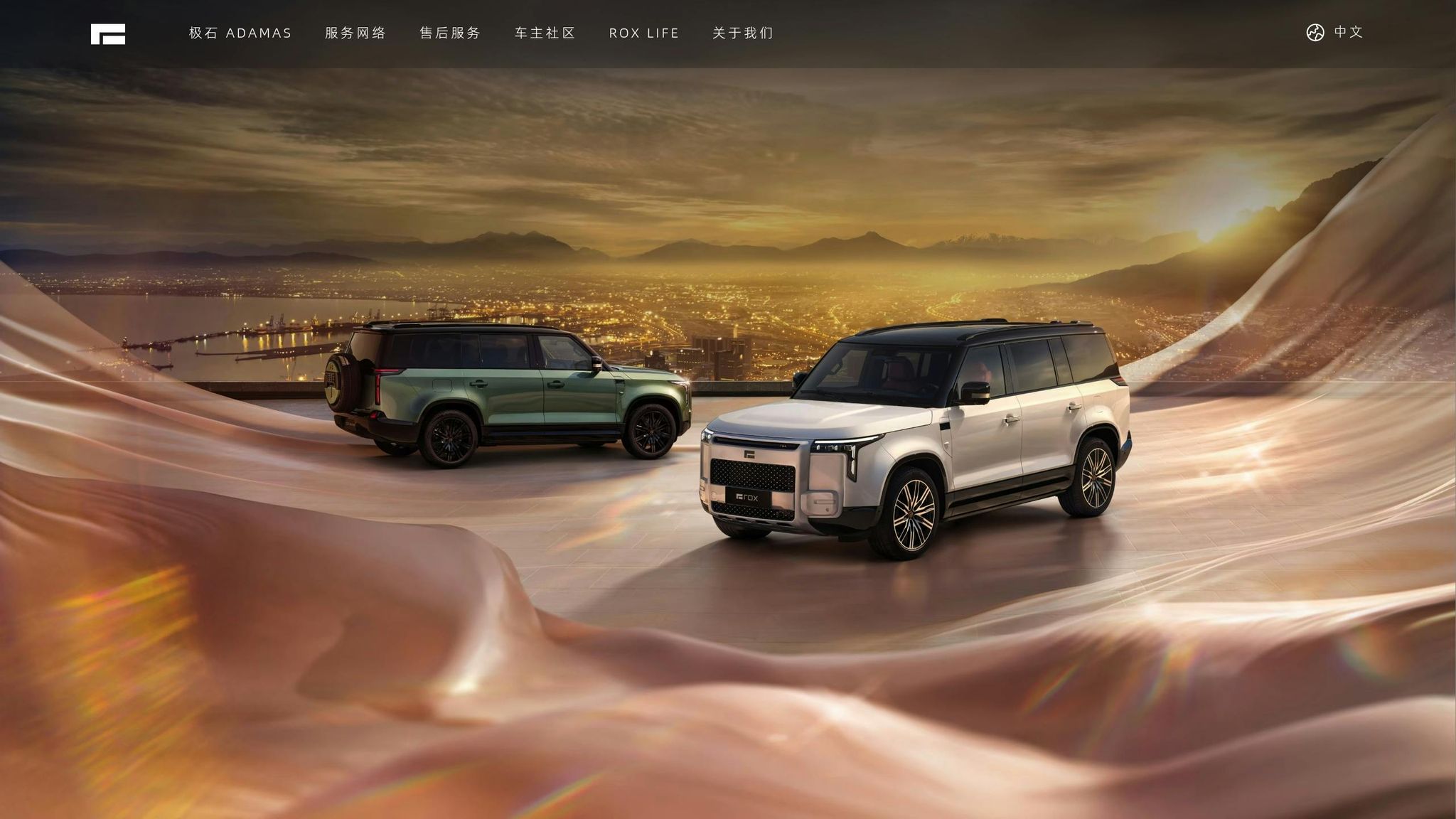
The ROX NX3 caters to mid-range buyers, priced between 25 and 45 million RWF. It offers balanced performance and significantly lower operating costs – up to 70% less than traditional gasoline vehicles over five years. Its range-extender technology ensures reliable performance across Rwanda’s varied road conditions.
For those seeking premium options, AutoMag.RW introduced the Tesla Model Y to Rwanda in March 2024. While the Model Y is a pure battery-electric vehicle, it benefits from an 80% import duty reduction and VAT exemption. With an impressive range of 200 to over 600 km, all-wheel drive, and high ground clearance, it’s well-suited for Rwanda’s diverse terrain. The growing network of DC fast chargers along major highways like Kigali-Musanze and Kigali-Rusumo further enhances its appeal. Tesla models start at 45+ million RWF, signaling Rwanda’s shift toward cleaner and more advanced mobility options.
sbb-itb-7bc66b5
Charging Stations and Support for EV Owners
Charging Stations Across the Country
Rwanda is making bold moves to ensure electric vehicle (EV) owners have easy access to charging stations. The national plan guarantees that no vehicle is ever more than 31 miles (50 km) from a charging point. Currently, there are 24 public charging stations for cars, but there’s a clear vision for growth. Geospatial analysis has identified over 226 potential locations for future charging stations across the country. The Ministry of Infrastructure (MININFRA) highlighted this ambition:
"Rwanda’s Ministry of Infrastructure (MININFRA) wants to see that no car travels more than 50 kilometres without having a place to plug in."
At the moment, most charging stations are concentrated in Kigali, conveniently located at places like shopping malls, office complexes, and petrol stations. However, efforts are underway to expand this network to highways, supporting long-distance travel. DC fast chargers are already operational on key routes, including Kigali-Musanze and Kigali-Rusumo.
For those who prefer home charging, installing a Level 2 charger – priced between 300,000 and 800,000 RWF – can significantly reduce charging time to 3–8 hours, compared to the 8–15 hours required with a standard outlet. Importantly, Rwanda’s charging network is powered by renewable energy sources such as hydroelectric and solar power, making it not only environmentally friendly but also cost-effective for EV drivers. This growing infrastructure is paving the way for greater convenience and savings for EV owners.
Benefits for Charging Station Users
The expanding network of charging stations isn’t just about accessibility – it’s also packed with perks for EV owners. One of the standout benefits is the reduced cost of charging, as electricity tariffs for EV charging are set at the lowest industrial rate. Williams Buningwire, Acting Spokesperson for the Rwanda Private Sector Federation, summed it up well:
"The transition to green mobility is a national effort. There are multiple benefits of electric vehicles compared to diesel-powered vehicles. They reduce air pollution and help save the money previously spent on fuel imports."
EV drivers with green license plates enjoy extra privileges, like preferential parking, free access to congestion zones, and complimentary commercial licenses. To encourage private investment in charging infrastructure, the government offers rent-free land to businesses setting up charging stations. On top of that, all charging equipment is fully exempt from VAT, customs duties, and excise taxes until at least June 2028. For added convenience, buyers purchasing through AUTO24.rw gain exclusive access to a dedicated charging network.
These initiatives not only make EV ownership more appealing but also underscore Rwanda’s commitment to a cleaner, more sustainable future.
How to Buy and Maintain Your EREV
Buying an EREV Through AUTO24.rw

Purchasing an extended-range EV (EREV) through AUTO24.rw, Rwanda’s leading multi-brand car marketplace, is a straightforward process. If you’re considering a used EREV, always request a State of Health (SoH) report to check the battery’s remaining capacity. Diane Uwase, an EV sales expert based in Kigali, emphasizes:
"Always request a battery health report before purchasing a second-hand EV. Some models on Auto24.rw already display this info in the listings."
Before finalizing your purchase, ensure there are no outstanding fines or legal issues tied to the vehicle. Once you’ve chosen your EREV, you’ll need to register it with the Rwanda Revenue Authority (RRA). Required documents include proof of purchase (like an invoice or sales agreement), importation paperwork (if applicable), a roadworthiness certificate, your National ID or passport, and proof of insurance.
The RRA provides both in-person and online registration options. Every vehicle must pass a technical inspection to ensure it meets safety and emission standards. Registration fees vary depending on the vehicle’s type, engine capacity, and age. Payments can be made via mobile money, bank transfer, or at designated centers. After approval, you’ll receive unique license plates and an official registration card. Once you’ve completed the purchase, proper maintenance is key to ensuring your EREV delivers long-term performance.
Keeping Your EREV in Good Condition
While extended-range EVs require less upkeep than traditional vehicles, they still need regular care. To preserve battery health, keep charge levels between 20% and 80%. Thanks to Rwanda’s moderate climate, EV batteries here typically last 12–15 years – longer than in regions with more extreme temperatures. Jean-Claude N., an EV technician in Kigali, explains:
"An EV battery doesn’t die overnight. It gradually loses capacity, just like your smartphone battery."
For the range-extender engine, stay on top of oil changes and filter replacements as needed. Regenerative braking reduces wear on brake pads, but you should still flush brake fluid every three years and lubricate calipers in dusty conditions. Battery weight can lead to faster tire wear, so make it a habit to rotate your tires and check tread depth regularly. Inspect the cooling system every six months to avoid overheating, and install manufacturer-recommended software updates to improve battery management.
Installing a Level 2 home charger is a smart, cost-effective option for daily charging, with prices ranging from 300,000 to 800,000 RWF. AUTO24.rw buyers often benefit from integrated charging support. By staying proactive with maintenance, your EREV will remain reliable for both everyday use and longer trips.
Planning for Long Road Trips
Rwanda’s expanding network of DC fast chargers makes road trips with an EREV more convenient, with stations already set up at key locations. Before heading out, check your battery’s SoH. For instance, if your range drops from 300 km (186 miles) to 220 km (137 miles), it may indicate battery aging. Updating your vehicle’s software can also help optimize battery performance.
Rwanda’s hilly terrain, especially in areas like Musanze and Huye, can actually work in your favor. Downhill driving activates regenerative braking, which helps extend your range. Use your navigation system to plan charging stops and aim to keep the battery above 20%. DC fast chargers are perfect for quick top-ups during trips, but keep in mind that charging slows significantly once the battery hits 80% to protect its cells.
Many modern EREVs, such as the Kia EV6 and Peugeot e-3008, come with Vehicle-to-Load (V2L) capabilities. This feature lets you power external devices (up to 3.6 kW) during stops or emergencies. When parking, opt for shaded or indoor areas to prevent unnecessary heat buildup in the battery. Francois Habimana, an EV fleet manager in Kigali, notes:
"Replacing a battery is costly, but with proper care, most Rwandan EV drivers won’t need to think about it for at least a decade."
Why Extended-Range EVs Make Sense for Rwanda
Extended-range EVs (EREVs) are a natural fit for Rwanda’s challenging terrain, offering a blend of performance, cost efficiency, and environmental advantages. The country’s hilly landscape requires vehicles with high torque to tackle steep inclines, and electric motors deliver that instant power. The range extender ensures the battery stays charged during longer uphill drives, making these vehicles particularly well-suited for Rwanda’s roads. Additionally, high ground clearance is crucial for navigating uneven rural roads and large speed bumps. As Allan Kweli, Head of Operations at Volkswagen Mobility Solutions Rwanda, explained:
"The unevenness in road infrastructure and the height of speed-bumps turned out to be too challenging for the e-Golf, which has a relatively low ground clearance".
Beyond performance, EREVs offer impressive savings and environmental benefits.
Charging an EREV costs roughly $1.77 per 100 km, compared to $7.20 for gasoline. For a driver covering 25,000 km annually, this translates to potential savings of up to $1,357.50. With fuel prices having surged by 60% recently, EREVs allow drivers to complete their daily commutes on affordable electricity while retaining a gasoline engine for longer trips when needed.
EREVs also align with Rwanda’s environmental goals. Over half of the country’s electricity comes from renewable sources, meaning every mile driven on battery power generates minimal emissions. Currently, road transport contributes 13% of Rwanda’s total greenhouse gas emissions. Transitioning to EREVs can also reduce the country’s dependence on imported fossil fuels, which account for 40% of foreign exchange spending. Dr. Jimmy Gasore, Minister of Infrastructure, emphasized:
"The Government of Rwanda is committed to accelerating the transition to electric mobility as part of our climate and development agenda".
Additionally, government incentives help lower the upfront cost of EREVs, and the expanding charging network – with plans for 200 public chargers nationwide – makes now an ideal time to consider investing in an extended-range EV.
FAQs
Are extended-range EVs suitable for Rwanda’s hilly terrain?
Yes, extended-range electric vehicles (EREVs) are a great match for Rwanda’s hilly terrain. Powered by an electric motor, they provide smooth, quiet rides, making them perfect for navigating both bustling cities and rugged, mountainous areas. And when the battery starts to run low, a gasoline-powered generator steps in to keep the vehicle going, ensuring steady performance even in places where charging stations might be hard to find.
This blend of electric power and backup support makes EREVs a reliable option for Rwanda. They handle steep roads with ease while easing concerns about running out of charge. Plus, their hybrid setup promotes cleaner transportation without sacrificing practicality in tough environments.
What are the financial advantages of owning an extended-range EV in Rwanda?
Owning an extended-range electric vehicle (EV) in Rwanda comes with notable financial perks, thanks to supportive government policies and the efficiency of EV technology. Until 2028, the Rwandan government has eliminated import duties, VAT, and excise taxes on EVs, significantly lowering their upfront cost. On top of that, the government is backing the development of charging infrastructure by offering incentives like rent-free land and special electricity rates, which help cut down ongoing expenses.
Extended-range EVs also bring substantial savings on fuel and maintenance. In Rwanda, drivers can save up to $840 annually due to reduced fuel costs and fewer maintenance requirements – EVs have fewer moving parts compared to traditional gas-powered cars. When you combine these savings with tax breaks and lower electricity rates for charging, extended-range EVs emerge as an economical and practical option for both urban and rural drivers.
What incentives does the Rwandan government offer for buying extended-range EVs?
The Rwandan government has rolled out several measures to make extended-range electric vehicles (EVs) more affordable and easier to own. Since April 2021, EVs, hybrid cars, and electric motorcycles have been exempt from import duties, which has helped bring down their prices. Looking ahead, starting July 1, 2025, fully electric vehicles will enjoy even greater tax breaks. These include exemptions from VAT, customs duties, excise duties, and withholding taxes – benefits that will last until June 30, 2028.
To encourage the shift to EVs, Rwanda is also focusing on building a reliable charging network. The government is providing rent-free land, introducing special electricity rates, and implementing a national plan for charging stations. These efforts reflect Rwanda’s dedication to cutting emissions and advancing green technology.
Related Blog Posts
- How Rwanda’s Hills Affect EV Range
- Electric vs Petrol cars in Rwanda
- Electric Cars in Rwanda: 2025 Guide for New Buyers
- Electric Cars in Rwanda: Models and Charging Points