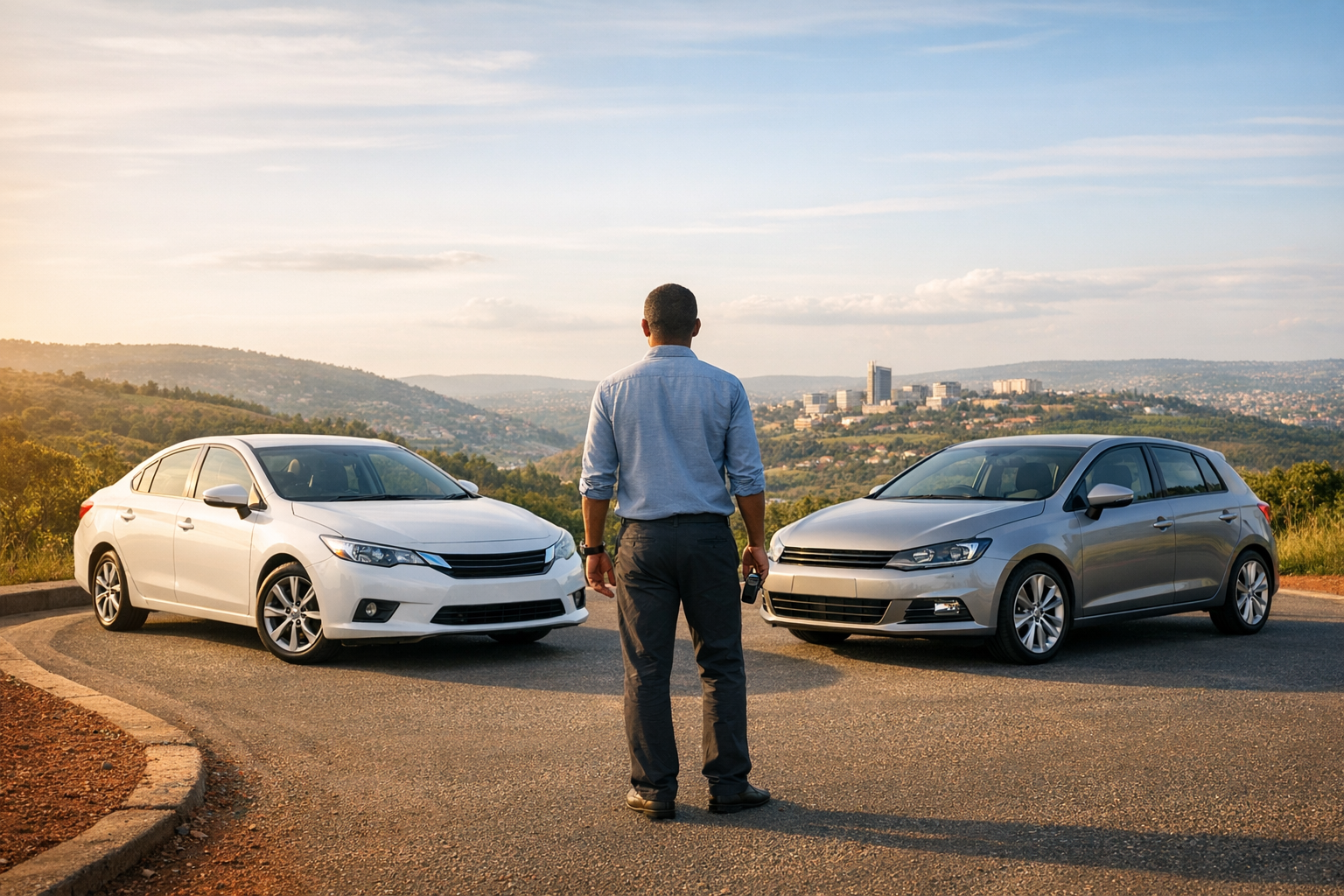
Rwandan drivers face a key decision when choosing between Japanese and European cars. Japanese brands like Toyota and Suzuki dominate the market due to their reliability, affordability, and easy maintenance. European brands, including Volkswagen and Kia, are gaining attention for their modern features and local assembly efforts but come with higher costs and complex servicing needs.
Key Takeaways:
- Japanese Cars: Known for durability, fuel efficiency, and affordable maintenance. Examples: Toyota RAV4 (10–14 km/l) and Suzuki Swift (18–22 km/l).
- European Cars: Offer advanced technology and comfort but require specialized servicing. Examples: Volkswagen T-Cross (urban-focused) and Kia Sportage (versatile, 10–13 km/l).
Quick Comparison:
| Aspect | Japanese Cars | European Cars |
|---|---|---|
| Initial Cost | Lower, strong resale value | Higher, faster depreciation |
| Fuel Efficiency | 14–22 km/l (compact models) | Varies, prioritizes performance |
| Maintenance | Affordable, easy to service | Costly, needs specialized tools |
| Parts Availability | Widely available | Limited outside cities |
| Best Use | City and rural roads | Urban and highway driving |
Japanese vehicles are ideal for Rwanda’s rugged terrain and budget-conscious buyers, while European cars cater to those seeking luxury and advanced features.
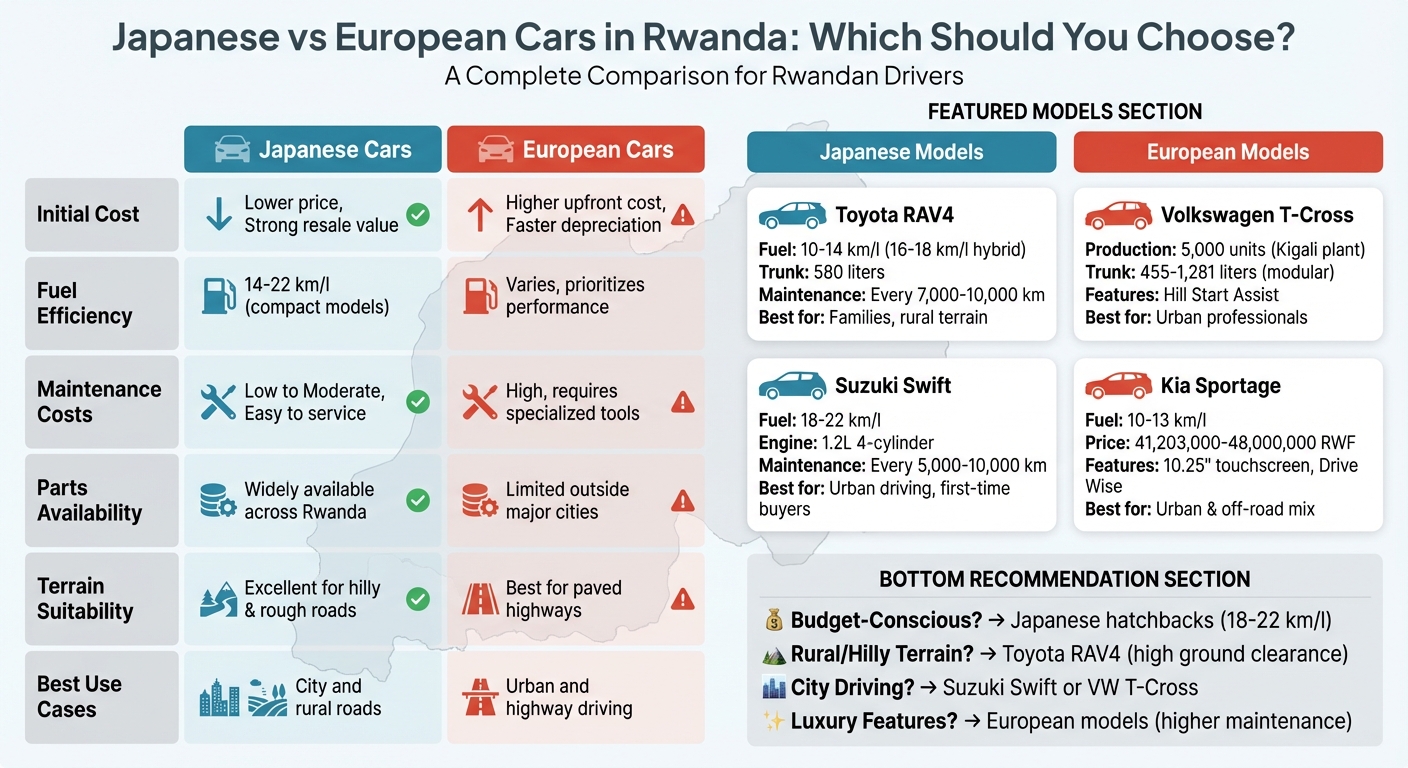
Japanese vs European Cars in Rwanda: Complete Comparison Guide
Why European cars are more work compared to Japanese cars. Simplicity is reliability
1. Toyota RAV4
The Toyota RAV4 stands out as one of the most budget-friendly SUVs for Rwandan drivers in 2025, thanks to Toyota’s strong presence in the region and a reliable network of service options. With spare parts readily available and mechanics familiar with Toyota vehicles, maintaining a RAV4 is straightforward and stress-free.
When it comes to performance, the RAV4 impresses with its fuel efficiency. The standard model offers 10–14 km/L (23–33 mpg), while the hybrid version delivers an even better 16–18 km/L (37–42 mpg).
"Whether you’re driving in downtown Kigali or on the winding roads to Musanze, the RAV4 has your family covered." – Jean Baptiste Habumugisha, Automag.rw
Maintenance is manageable, with oil changes recommended every 7,000–10,000 km (4,300–6,200 miles). For hybrid models, regular battery checks every six months are advised to keep performance consistent over time.
The RAV4’s design caters to Rwanda’s diverse terrains, offering high ground clearance, optional AWD-i for better traction, and a spacious 580-liter (20.5 cu. ft.) trunk. Whether navigating rural roads or city streets, the RAV4 proves to be a reliable and practical choice for families and adventurers alike.
2. Suzuki Swift
The Suzuki Swift is a popular choice for first-time buyers and urban drivers in Rwanda, ranking as the 5th most affordable car option for 2025, according to recent market data. Its affordability and compact design make it a standout option for navigating Rwanda’s busy city streets. Additionally, it’s widely available in the second-hand market, competing closely with other budget-friendly models.
Fuel efficiency is one of the Swift’s strongest selling points. With an impressive range of 18–22 km/L (42–52 mpg), it offers better mileage than many cars in its class, prioritizing cost savings over raw power. The 2025 model comes equipped with a 1.2L 4-cylinder engine and a CVT transmission, ensuring smooth and reliable performance tailored to urban conditions.
"The Suzuki Swift is a stylish and fun-to-drive car that offers excellent fuel economy and low running costs. It’s perfect for young drivers and city dwellers." – Jean Baptiste Habumugisha, AutoMag Rwanda
Another advantage of the Swift is its low maintenance costs. Thanks to its straightforward engineering and the availability of Japanese spare parts locally, upkeep is both affordable and hassle-free. Routine servicing is recommended every 5,000–10,000 km (3,100–6,200 miles), making it a practical choice for drivers looking to minimize expenses.
The Swift truly excels in Kigali’s congested streets. Its compact size and easy maneuverability make it perfect for city driving, though it’s less suited for rugged upcountry roads. For urban drivers seeking a fuel-efficient, low-cost, and stylish vehicle, the Suzuki Swift is a dependable option that delivers on all fronts.
3. Volkswagen T-Cross
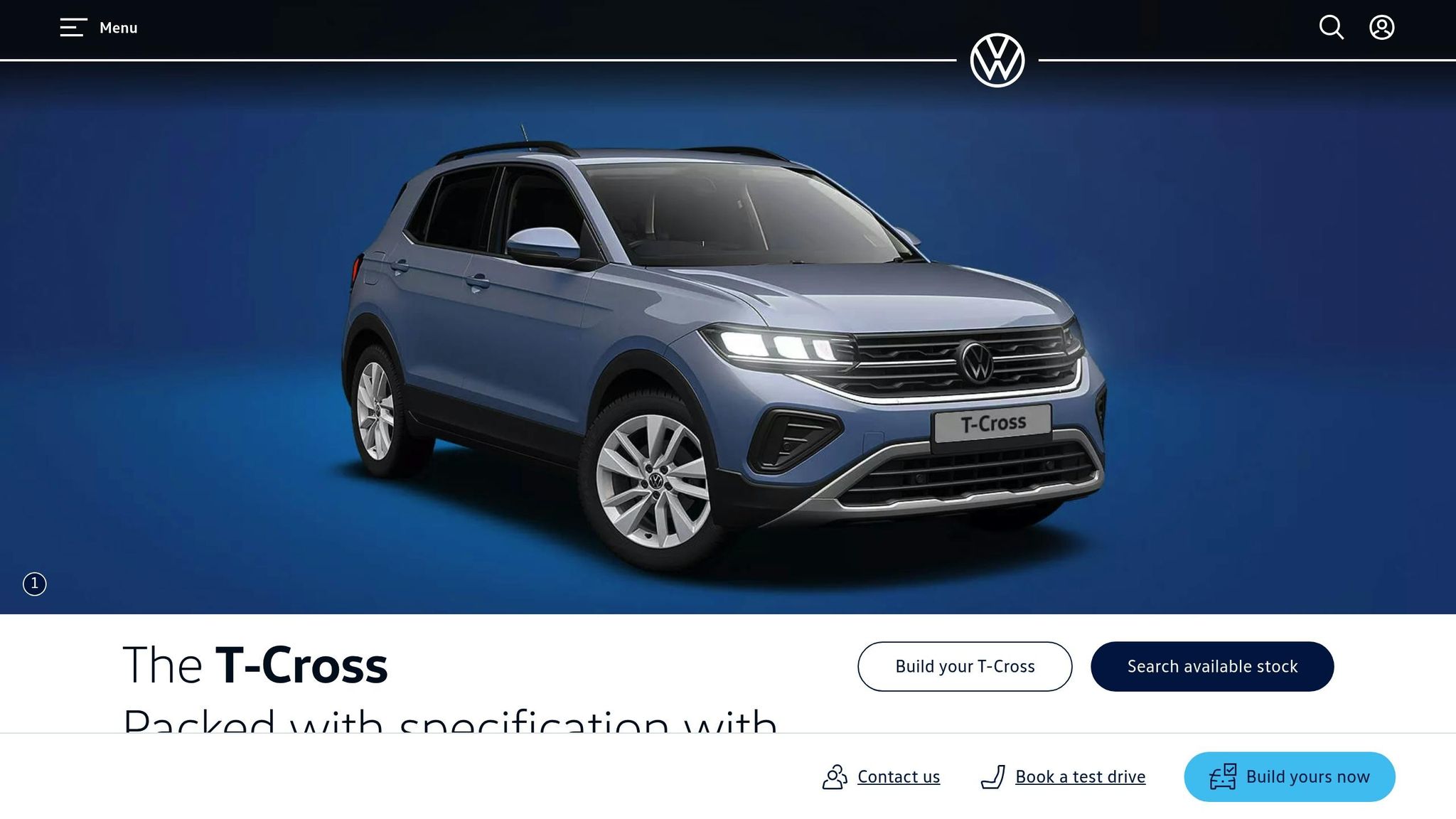
When it comes to European options, the Volkswagen T-Cross offers a refined choice for urban driving enthusiasts. Locally assembled at the Kigali plant and exclusively distributed by CFAO Mobility, this vehicle brings European craftsmanship closer to home. The production goal for the T-Cross stands at 5,000 vehicles, making it a notable addition to Rwanda’s automotive landscape.
The T-Cross is tailored for Rwanda’s diverse roads, balancing city comfort with the ability to handle moderate hilly terrain. Features like Hill Start Assist provide extra traction on slopes, a practical advantage for the country’s inclines. That said, as a front-wheel drive vehicle, it’s not the best fit for extremely rough terrain.
"Volkswagen benefits from a premium image associated with European manufacturing quality. Local assembly reinforces the brand’s perception as a partner in Rwanda’s economic development." – Équipe de rédaction, Koto.rw
On the maintenance front, costs can be higher due to the need for genuine parts and specialized servicing through CFAO Mobility.
The T-Cross shines in urban settings. Its modular trunk offers flexibility, ranging from 455 liters to 1,281 liters (about 16–45 cubic feet) when the rear seats are folded. Meanwhile, its raised seating and lumbar support ensure comfort on longer drives. However, for those tackling rugged terrain, a Japanese 4×4 might be a better choice.
4. Kia Sportage
The Kia Sportage, a strong rival to the Toyota RAV4, is priced between 41,203,000 RWF and 48,000,000 RWF. It’s available in both new and used options, making it accessible to a range of buyers.
With a fuel efficiency of approximately 10–13 km/l, the Sportage handles Kigali’s bustling streets with ease while also being well-suited for unpaved rural roads. Its performance strikes a balance between urban convenience and rugged reliability. Local owner Ziba shared their experience, noting "100% reliability" after driving 10,000 km.
"Each model represents excellent long-term value, especially considering their low maintenance costs and proven dependability."
– SBT News
Maintenance costs for the Sportage are considered "Moderate", similar to the Toyota RAV4. Kia’s reputation for reliability enhances its appeal, and as the brand gains traction in Rwanda, local mechanics are becoming more familiar with servicing these vehicles. Additionally, the availability of spare parts has improved alongside Kia’s growing market presence.
The Sportage is packed with modern features, including the Drive Wise safety system and a 10.25-inch touchscreen. These advanced technologies give it an edge over older Japanese models, making it an attractive option for drivers who value up-to-date features while still needing a vehicle capable of handling Rwanda’s challenging terrain.
sbb-itb-7bc66b5
Fuel Efficiency and Performance on Rwandan Roads
Rwanda’s roads are as diverse as its landscapes. From the bustling streets of Kigali to the steep, winding highways toward Musanze and the rugged, unpaved rural routes, vehicles face a variety of challenges. In this context, fuel efficiency isn’t just about saving money – it’s about ensuring reliability across different terrains.
The Suzuki Swift shines in city driving, offering impressive fuel efficiency of 18–22 km/l (42–52 MPG). On the other hand, the Toyota RAV4, with its 2.5L engine, provides 10–14 km/l (24–33 MPG) in mixed conditions. Its hybrid model pushes efficiency even further, reaching up to 40 MPG, aided by smooth e-CVT handling that performs well on steep inclines.
European models also bring competitive options. The Volkswagen T-Cross, featuring 1.0L to 1.5L turbocharged engines, balances fuel efficiency with low emissions, making it a favorite among urban professionals. Meanwhile, the Kia Sportage, available with 2.0L or 2.4L engines, offers 10–13 km/l (roughly 24–31 MPG), making it a versatile choice for both city streets and uneven rural roads. The table below breaks down these models, showcasing their strengths for Rwanda’s unique driving conditions.
| Model | Engine | Fuel Economy | Best Use in Rwanda |
|---|---|---|---|
| Suzuki Swift | 1.2L–1.4L | 18–22 km/l (42–52 MPG) | Urban driving in Kigali |
| Toyota RAV4 | 2.5L 4-Cyl | 10–14 km/l (24–33 MPG) | Long-distance, rural terrain |
| Toyota RAV4 Hybrid | 2.5L Hybrid | 40 MPG combined | City and highway mix |
| Kia Sportage | 2.0L–2.4L | 10–13 km/l (24–31 MPG) | Urban and off-road mix |
| VW T-Cross | 1.0L–1.5L Turbo | Efficient performance, low emissions | Urban professionals |
Performance on Rwanda’s roads isn’t just about fuel economy. Features like ground clearance and torque are equally crucial. For example, the Toyota RAV4 offers higher ground clearance and optional all-wheel drive, making it ideal for rural and upcountry driving. Meanwhile, the Suzuki Swift, with its compact size and lightweight frame, is perfectly suited for navigating Kigali’s busy streets.
Maintenance Costs and Spare Parts Access
In Rwanda, keeping vehicles running smoothly often comes down to two things: affordable maintenance and easy access to spare parts. Japanese brands like Toyota and Suzuki have carved out a strong foothold in the market, thanks to their extensive network of parts suppliers and skilled mechanics. This means quicker repairs and lower costs compared to many European brands.
The difference in maintenance costs often boils down to design philosophies. Japanese manufacturers follow the "Kaizen" principle, which focuses on continuous improvement and modular designs that make repairs simpler and faster. On the other hand, European brands like Volkswagen lean toward more intricate systems that require specialized tools and diagnostics. This complexity can lead to higher labor costs and longer repair times in Rwanda.
For example, Toyota vehicles, known for their durability, average about $5,996 in maintenance costs over 10 years. Japanese models, often rated at least 4/5 globally, are built to last over 300,000 kilometers. In contrast, some European cars may start experiencing issues after 150,000–200,000 kilometers. The following table highlights maintenance costs and spare parts availability for popular models:
| Model | Annual Maintenance Cost | Parts Availability | Best For |
|---|---|---|---|
| Suzuki Swift | Low | High | Urban commuting |
| Toyota RAV4 | Moderate | High | Off-road & long-distance travel |
| Toyota Corolla | Low | High | City & highway driving |
| Kia Sportage | Moderate | Moderate | City & suburban driving |
| Volkswagen T-Cross | High | Limited/Moderate | Executive & urban use |
Japanese cars also stand out for their spare parts availability. Whether it’s a Toyota Corolla or a Suzuki Swift, you’ll find parts readily available in Kigali and beyond, ensuring minimal downtime during repairs. On the flip side, sourcing parts for European models like the Volkswagen T-Cross can be a headache. These often require special orders, adding to both the cost and inconvenience.
Additionally, imported vehicles need a few tweaks to handle Rwanda’s local conditions. Common upgrades include improved cooling systems, enhanced air filters, anti-rust coatings, and regular use of fuel system cleaners to combat environmental challenges.
Suitability for Rwanda’s Terrain, Climate, and Long-Term Ownership
Rwanda’s hilly terrain and its combination of paved and unpaved roads require vehicles that can handle tough conditions. Japanese SUVs like the Toyota Land Cruiser and Nissan Patrol are well-suited for this, thanks to their sturdy suspension systems and efficient cooling mechanisms. These features make them reliable in hot climates and during stop-and-go traffic situations. On the other hand, European vehicles often rely on complex suspension systems and advanced electronics, which can be more prone to issues under harsh conditions.
When it comes to long-term durability, the difference between these two vehicle types is clear. Japanese manufacturers focus on simplicity and ruggedness, building cars that can withstand a variety of climates. In contrast, European brands prioritize performance and luxury, which often require more meticulous maintenance.
Rwanda’s wet and dusty climate presents additional challenges for vehicles. Japanese cars are designed to endure harsh environments and can remain dependable even with irregular maintenance. Their simpler designs mean fewer electronic components that could fail due to moisture or dust. European vehicles, however, with their more intricate electronic systems, may face difficulties in such conditions – especially in areas where specialized mechanics are hard to find outside major cities.
Practical considerations also come into play when sourcing vehicles in Rwanda. Buyers should be aware that only left-hand drive cars are permitted for permanent use. It’s also important to understand local import regulations and ensure that vehicles meet compliance standards.
Environmental concerns are becoming increasingly relevant in Rwanda, as the country works to reduce its carbon footprint by adopting electric vehicles and hybrids. Japanese brands have been leaders in this area, offering fuel-efficient models and hybrid technologies. For long-term ownership in Rwanda, Japanese vehicles offer clear advantages: straightforward designs, affordable maintenance, and strong resale value. These factors make them a smart choice for navigating Rwanda’s unique automotive needs.
Pros and Cons
This section outlines the strengths and challenges of Japanese and European vehicles, focusing on their suitability for Rwandan drivers. It distills the key points discussed earlier, offering a clear comparison of what each type brings to the table.
Japanese vehicles have a solid foothold in Rwanda, and for good reason. Their straightforward mechanical designs make it easier to find skilled mechanics, even in rural areas. Popular models like the Toyota Corolla and Toyota Premio also hold their value well in the local market, making them a practical choice for many.
European brands, including BMW, Volkswagen, and Mercedes-Benz, stand out for their luxury features and exceptional highway performance. However, these perks come with higher maintenance requirements and costs.
While both types face similar import duties, their upkeep costs set them apart. Japanese cars are known for their low maintenance, while European vehicles often need specialized parts and services, which can quickly add up.
Here’s a quick comparison of the two:
| Aspect | Japanese Cars | European Cars |
|---|---|---|
| Initial Cost | Lower with strong resale value | Higher upfront cost with faster depreciation |
| Fuel Efficiency | 14–22 km/l for compact models | Varies; often prioritizes performance over economy |
| Maintenance | Low to moderate | Higher, requiring specialized services |
| Terrain Suitability | Handles hilly and rough roads well | Best for paved highways |
| Parts Availability | Easy to find across Rwanda | Limited outside major cities |
With Rwanda’s focus on sustainability, Japanese vehicles continue to appeal for their dependability, affordability, and ability to handle the country’s diverse road conditions.
Conclusion
Rwandan drivers should choose vehicles that align with their specific needs and the country’s unique driving conditions. Japanese cars, particularly Toyota models, stand out for their combination of affordability, reliability, and performance. For example, the Toyota Corolla offers impressive fuel efficiency of 14–18 km/l and requires minimal maintenance, making it a popular choice for many.
For buyers on a budget, Japanese hatchbacks are an excellent option, delivering fuel efficiency of 18–22 km/l and low maintenance costs. They also benefit from easy access to spare parts, making them practical for day-to-day use. Meanwhile, for those frequently traveling across Rwanda’s hilly terrain or rough rural roads, vehicles like the Toyota RAV4 – with its high ground clearance – provide the durability and traction needed to tackle these challenges.
European models, while offering advanced technology and luxurious interiors, come with higher price tags and maintenance costs. This makes them less appealing for many Rwandan drivers focused on long-term affordability.
Overall, Japanese vehicles dominate Rwanda’s auto market for good reason. Whether driving in Kigali or navigating rural areas, these cars are built to handle the local terrain, fit within modest budgets, and offer reliable spare part availability – making them a practical and dependable choice.
FAQs
Why are Japanese cars more common in Rwanda than European cars?
Japanese cars dominate the roads in Rwanda, and it’s not hard to see why. They’re celebrated for their reliability, affordability, and durability, traits that make them a perfect match for the country’s challenging road conditions and varying climate. Among these, brands like Toyota stand out, thanks to their reputation for handling rough terrain with ease while staying fuel-efficient and relatively inexpensive to maintain.
Another big advantage of Japanese vehicles is their lower maintenance costs and the easy availability of spare parts – a critical factor for Rwandan drivers. On the other hand, European cars often come with higher repair expenses and may struggle with Rwanda’s rugged roads, making them less practical for daily use in the region.
What are the main maintenance challenges of owning a European car in Rwanda?
Owning a European car in Rwanda can be a bit tricky, especially when it comes to keeping it in good condition. These cars are often built for smoother roads, so they might struggle with Rwanda’s rougher terrain. This can lead to quicker wear and tear, which means more frequent repairs and higher maintenance costs.
Another hurdle is finding spare parts and skilled mechanics. Genuine parts for European brands can be scarce and pricey, thanks to steep import duties and taxes. On top of that, these cars are often more complex, requiring technicians with specialized training. This can mean longer waits for repairs and higher service fees.
Rwanda’s climate also adds to the challenge. Dust, humidity, and bumpy roads can take a toll on these vehicles. While European cars are known for their great performance in ideal conditions, they might not always be the most practical or budget-friendly option for Rwanda’s unique environment.
Which is more fuel-efficient for Rwandan roads: Japanese or European cars?
Japanese cars, such as the Toyota Prius and Honda Fit, are well-known for their impressive fuel efficiency. The Prius, for instance, delivers over 50 miles per gallon (MPG), while the Honda Fit offers a range of about 40-47 MPG. This makes them a great choice for navigating Rwanda’s mix of urban streets and varied terrain. Their reliability and ability to handle different road conditions while saving on fuel are key reasons for their popularity.
European cars, in comparison, typically provide moderate fuel efficiency. While some compact European models can rival Japanese cars in city driving, they often use more fuel when tackling rugged or unpaved roads. That said, newer hybrid models from European manufacturers are starting to narrow the efficiency gap.
For Rwandan roads, Japanese cars generally offer better fuel efficiency, making them a top pick for drivers looking to save on fuel costs in both city and rural areas.
Related Blog Posts
- Cheapest cars to maintain in Rwanda
- Top car brands in Rwanda
- Cheapest Cars to Maintain in Rwanda
- Best Cars to Import to Rwanda for Budget Buyers