Electric vehicles (EVs) are becoming more attractive in Rwanda due to lower running costs compared to petrol cars. Here’s the bottom line:
- Fuel Costs: Driving an EV for 15,000 km annually costs about $265.50, while a petrol car costs $1,080. Over three years, that’s a savings of $2,443.50.
- Maintenance: EVs require less maintenance since they have fewer moving parts, saving an additional $600–$1,550 over three years.
- Purchase Price: EVs are pricier upfront ($30,000 vs. $25,000 for petrol cars), but government incentives like tax exemptions help offset this.
- Resale Value: EVs depreciate faster (45–55% in 3 years), while petrol cars retain more value (30–40%).
Quick Comparison
| Category | Electric Vehicle (EV) | Petrol Vehicle |
|---|---|---|
| Purchase Price | $30,000 (with incentives) | $25,000 |
| Fuel/Charging Costs | $796.50 (3 years) | $3,240.00 (3 years) |
| Maintenance | $500–$700 | $1,340–$2,050 |
| Resale Value (3 yrs) | $13,500–$16,500 | $15,000–$17,500 |
| Total Cost (3 yrs) | $15,545–$18,305 | $14,350–$18,895 |
Conclusion: EVs are cheaper to run and maintain but have higher upfront costs and faster depreciation. Petrol cars may suit those with lower mileage or budget constraints, while EVs are better for high-mileage drivers in Kigali, where charging infrastructure is well-developed.
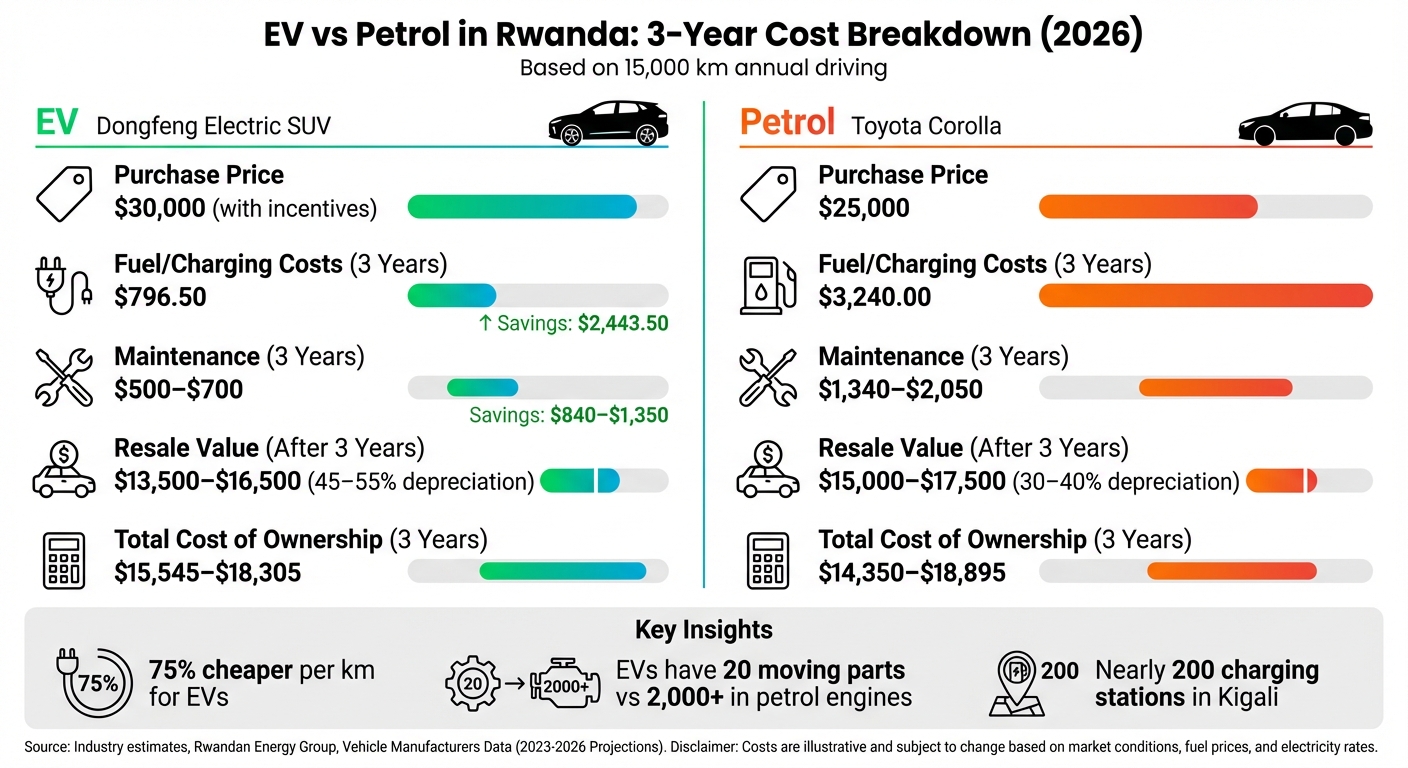
EV vs Petrol Car 3-Year Cost Comparison in Rwanda 2026
Inside KABISA: Rwanda‘s EV Revolution | WIB Documentary
sbb-itb-7bc66b5
Vehicle Models Used for Comparison
This section focuses on comparing two popular choices in Rwanda’s 2026 automotive market: the Dongfeng Electric SUV and the Toyota Corolla. These models highlight the differences between electric and gasoline-powered vehicles for buyers navigating this key decision.
The Dongfeng Electric SUV comes with a higher price tag but is equipped with advanced electric technology. Its battery range easily supports daily commutes in Rwanda, particularly in Kigali, where EV drivers benefit from nearly 200 charging stations. The electric powertrain, with just 20 moving parts, drastically reduces the likelihood of mechanical failures compared to traditional internal combustion engines.
On the other hand, the Toyota Corolla is a more affordable option upfront and benefits from an extensive service network throughout Rwanda. However, its internal combustion engine, with over 2,000 moving parts, results in higher maintenance demands over time.
This analysis assumes an annual mileage of 15,000 km (approximately 9,320 miles), a figure that aligns well with the capabilities of electric vehicles. Features like regenerative braking in EVs extend brake pad lifespans, often exceeding 112,000 km. Additionally, the Rwandan government’s supportive measures – such as import duty exemptions for electric vehicles and reduced electricity tariffs for charging – further enhance the appeal of EVs.
Purchase Price and Government Incentives
The Dongfeng Electric SUV comes with a steeper upfront price compared to the Toyota Corolla, which can be a hurdle for many buyers in Rwanda who are working within tight budgets. To help make EVs more accessible, the government has introduced incentives that significantly lower the effective purchase price. While the initial cost may seem high, the long-term financial benefits can make up for it through reduced maintenance and fuel expenses.
Electric vehicles eliminate many of the routine maintenance tasks that petrol cars require, leading to noticeable savings over time. On top of that, the cost of charging is far lower than fueling a petrol vehicle. With electricity priced at around $0.118 per kWh, it costs about $1.77 to drive 100 km. In comparison, petrol costs approximately $7.20 per 100 km, assuming $1.20 per liter. For someone driving 15,000 km annually (around 9,320 miles), this translates to a savings of roughly $814.50 each year.
Beyond individual savings, Rwanda’s EV strategy also strengthens energy security by reducing reliance on imported oil and tapping into local renewable energy sources like solar and hydropower. This dual benefit of personal cost savings and national energy independence contributes to a lower overall cost of ownership over a three-year period, which will be explored further in the next sections.
Fuel and Charging Costs Over 3 Years
Over three years, the cost difference between running an electric vehicle (EV) and a petrol car becomes quite clear. In Rwanda, electricity costs $0.118 per kWh, while petrol is priced at $1.20 per liter. On average, an EV consumes about 15 kWh per 100 km (62 miles), costing $1.77, whereas a petrol car burns approximately 6 liters of fuel, amounting to $7.20 for the same distance.
This stark contrast translates to EVs being about 75% cheaper per kilometer. The reason lies in efficiency – EVs convert over 85% of their electrical energy into motion, while petrol engines operate at just 20–35% efficiency, losing much of their energy as heat. These figures set the foundation for a deeper dive into three-year running costs.
Paul Frobisher Mugambwa, who switched to a leased Mitsubishi Outlander hybrid, shared his experience: his monthly charging costs for a 7 km (4.3-mile) commute were just $40, compared to $150 spent on petrol. Similarly, Joshua Nshuti from Greenleaf Motors highlighted the growing interest in EVs:
"As fuel prices have increased by 60% in the last few months, we see a growing demand for the Outlander, as it gives clients the opportunity to half their fuel costs."
These real-life examples emphasize the long-term savings of EVs. For someone driving 15,000 km annually (9,320 miles), the yearly cost of charging an EV comes to $265.50, while petrol expenses soar to $1,080.00. The table below breaks down the total costs over three years.
Cost Comparison Table: Fuel vs. Charging
| Year | EV Charging Cost (15,000 km) | Petrol Fuel Cost (15,000 km) | Annual Savings |
|---|---|---|---|
| Year 1 | $265.50 | $1,080.00 | $814.50 |
| Year 2 | $265.50 | $1,080.00 | $814.50 |
| Year 3 | $265.50 | $1,080.00 | $814.50 |
| 3-Year Total | $796.50 | $3,240.00 | $2,443.50 |
Maintenance and Operating Costs Over 3 Years
Electric vehicles (EVs) tend to have much lower maintenance costs compared to petrol-powered cars, primarily due to their simpler design. EVs have far fewer moving parts, which means many of the routine maintenance tasks required for petrol vehicles simply aren’t necessary.
For instance, petrol cars require regular oil changes every 5,000–10,000 km (3,100–6,200 miles), costing $80–$150 annually. They also need periodic replacements for spark plugs, timing belts, fuel filters, and exhaust components. EVs, on the other hand, mainly require tire rotations, cabin air filter replacements, and occasional battery system coolant checks.
Another area where EVs shine is brake maintenance. Thanks to regenerative braking, EV brake pads often last between 50,000 and 75,000 miles, with many drivers exceeding 70,000 miles before needing replacements. By comparison, petrol vehicle brake pads typically need replacing every 20,000–35,000 miles. This difference results in noticeable savings over time. However, the heavier weight of EV batteries can lead to faster tire wear – up to 10–20% more than petrol cars – making proper tire maintenance essential for optimizing performance and range.
That said, EVs aren’t maintenance-free. Their battery packs, which weigh between 450 and 500 kg (990–1,100 lbs), contribute to the increased tire wear mentioned earlier. Additionally, in regions like Rwanda, a lack of trained mechanics for EV-specific repairs can lead to higher service costs and longer downtimes. As Kigali-based EV owner Paul Frobisher Mugambwa pointed out:
"If you buy an imported Chinese electric SUV, who is going to fix your car when it breaks down?"
On the bright side, Rwanda offers tax exemptions on EV spare parts and batteries (100% VAT and import duty exemptions), which helps offset some of these challenges and enhances the cost-effectiveness of EV ownership.
Maintenance Cost Comparison Table
| Maintenance Item | Electric Vehicle (3 Years) | Petrol Vehicle (3 Years) |
|---|---|---|
| Oil & Filter Changes | $0 (Not required) | $240–$450 |
| Brake Pads/Rotors | Minimal (inspection only) | ~$200–$400 |
| Spark Plugs/Timing Belts | $0 (Not required) | $150–$300 |
| Tire Replacements | Higher frequency (10–20% faster wear) | Standard wear |
| Routine Servicing | $500–$600 | $750–$900 |
| Total Estimated Maintenance | ~$500–$700 | ~$1,340–$2,050 |
Resale Value and Total 3-Year Ownership Cost
Electric vehicles tend to depreciate faster than their gas-powered counterparts. On average, EVs lose about 45%–55% of their value within three years, compared to 30%–40% for traditional petrol sedans. This is largely due to the rapid pace of battery technology improvements, which can make older EV models seem outdated. Additionally, price reductions on new EVs can significantly impact the resale value of used models.
The numbers back this up. For instance, a $55,000 electric SUV typically drops to a resale value of $27,000–$30,000 after three years. Meanwhile, a similar petrol SUV retains a greater percentage of its value over the same period.
Concerns about battery health also play a role in resale value, particularly in markets like Rwanda. However, the reality is that modern EV batteries are more durable than many assume. They degrade at an average rate of just 2.3% per year, maintaining 80%–90% of their capacity after 8–10 years. This longevity helps ease depreciation fears for buyers who are well-informed.
Rwanda’s tax policies further lighten the financial load of EV ownership. The government offers 100% VAT and import duty exemptions on EV spare parts and batteries, valid through June 30, 2028. These incentives help lower the overall cost of ownership, making EVs more appealing in the long run. As the used EV market evolves and awareness of battery durability grows, resale values are expected to stabilize.
When you factor in tax breaks, lower maintenance costs, and reduced fuel expenses, the total three-year ownership cost of an EV becomes clearer. The table below highlights the cost differences between EVs and petrol vehicles over three years.
Total Cost of Ownership Table
| Cost Category | Electric Vehicle (3 Years) | Petrol Vehicle (3 Years) |
|---|---|---|
| Purchase Price | $30,000 (with tax exemptions) | $25,000 |
| Fuel/Charging Costs | $1,440 ($40/month × 36 months) | $5,400 ($150/month × 36 months) |
| Maintenance & Servicing | $500–$700 | $1,340–$2,050 |
| Annual Road Levy (FRW 50,000) | ~$105 | ~$105 |
| Resale Value After 3 Years | $13,500–$16,500 (45%–55% depreciation) | $15,000–$17,500 (30%–40% depreciation) |
| Net 3-Year Ownership Cost | $15,545–$18,305 | $14,350–$18,895 |
This comparison shows that while the upfront cost of an EV may be higher, factors like tax incentives and lower fuel and maintenance expenses can make the overall ownership cost competitive with petrol vehicles over three years.
Wrapping It Up
After a thorough three-year analysis, it’s clear that electric vehicles (EVs) in Rwanda come with trade-offs. While the initial purchase price is higher and depreciation happens faster, the significantly lower operating costs make EVs an appealing option for many drivers. For instance, a driver covering 15,000 kilometers annually can save around $2,443.50 in fuel costs over three years. Add to that the lower cost per kilometer and reduced need for maintenance – no oil changes, timing belt replacements, or exhaust repairs – and EVs start to make a lot of sense. These perks help offset the higher upfront expense, especially for those who drive extensively.
If you’re primarily driving in Kigali, where the charging infrastructure is well-developed, the savings on fuel and maintenance can easily outweigh the initial investment. However, your driving habits will ultimately decide if an EV is the right fit for your budget. For those ready to explore this option, check out the latest EV listings and expert advice on Rwanda’s automotive market at AutoMag.RW.
FAQs
At what yearly mileage does an EV become cheaper than petrol in Rwanda?
Electric vehicles (EVs) in Rwanda offer a compelling cost advantage over time. While the exact yearly mileage isn’t detailed, EV owners can save up to 50% on energy and maintenance costs over five years. This includes over $4,600 in fuel savings when charging at home. For drivers covering a typical annual distance of 12,000 to 15,000 miles (20,000 to 24,000 km), an EV often becomes more economical than a petrol car after accounting for its initially higher purchase price.
How much does home charging vs public charging change EV costs in Kigali?
Home charging in Kigali offers a much cheaper alternative to public charging, costing as little as 7 cents per mile, compared to the 19–21 cents per mile typical for petrol vehicles. On average, monthly home charging expenses are about 10,000 Rwf, a fraction of the 60,000 Rwf spent on fuel for gas-powered cars. While public charging stations provide added convenience, they tend to be more expensive due to tariffs. However, thanks to government subsidies, charging electric vehicles remains more budget-friendly overall.
What should I check about battery health before buying a used EV in Rwanda?
Before purchasing a used EV, it’s crucial to examine the battery’s State of Health (SoH), capacity, and any signs of degradation. Make sure to verify the remaining warranty and take note of the actual driving range it currently offers. These details will give you a clearer picture of the EV’s condition, helping you gauge its reliability and value over time.
Related Blog Posts
- Electric vs Petrol cars in Rwanda
- Car Price Trends in Rwanda: Petrol vs Hybrid vs Electric
- EV or petrol car for Rwanda: what’s better in the long term?
- Rwanda EV Market 2026: What’s Changing (Prices, Incentives, Charging)