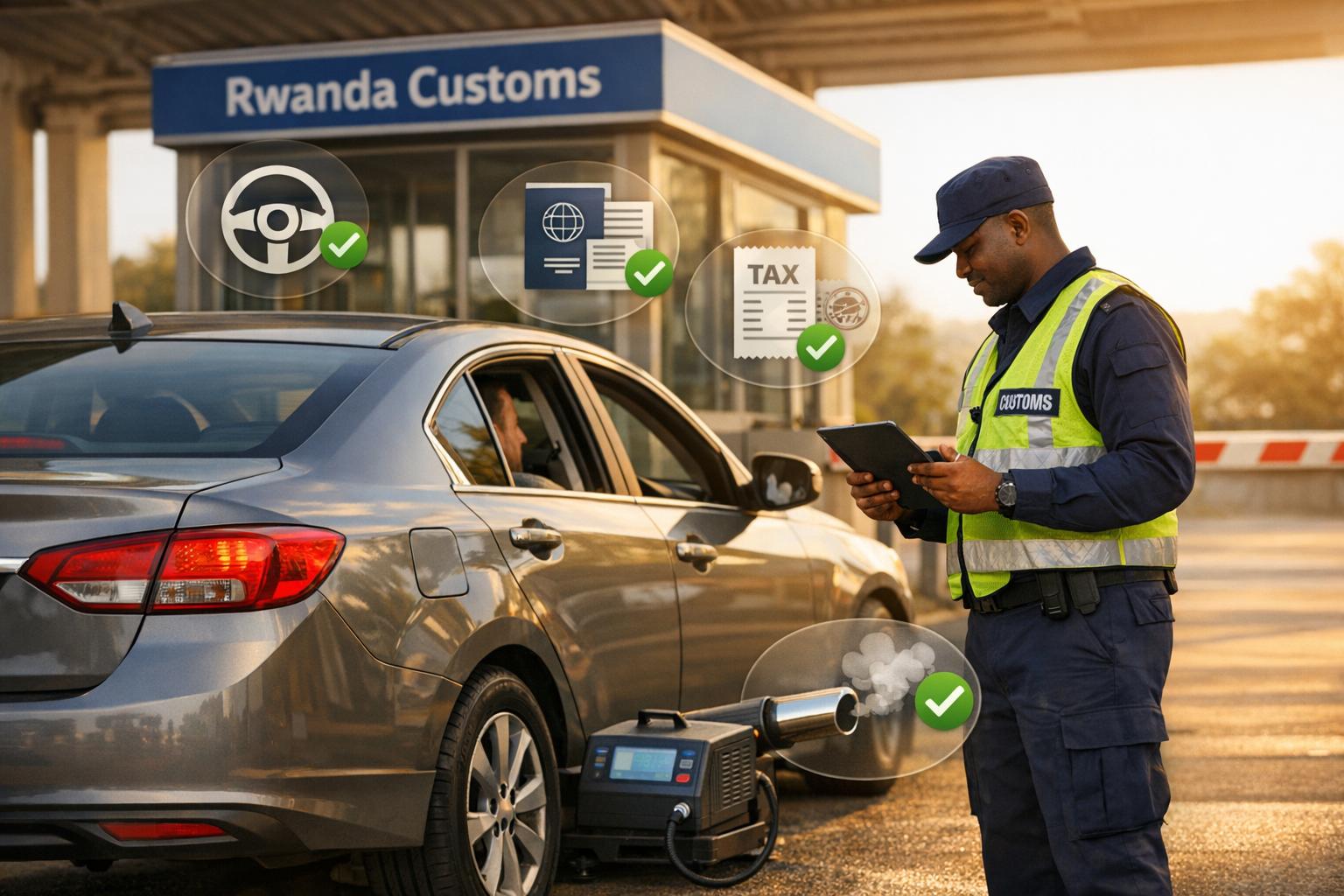
Importing a car into Rwanda can be tricky if you’re not familiar with the latest rules. Vehicles are often rejected at customs due to emissions failures, age restrictions, steering position issues, incorrect paperwork, or tax miscalculations. Since 2025, Rwanda has enforced stricter Euro 4 emissions standards and introduced new taxes, making compliance more challenging. If your car doesn’t meet these requirements, it won’t clear customs, costing you time and money.
Key Takeaways:
- Only Left-Hand Drive (LHD) vehicles are allowed for permanent import; Right-Hand Drive (RHD) vehicles are limited to temporary stays.
- Vehicles must meet Euro 4 emissions standards, and older models are often disqualified.
- Essential documents include the Bill of Lading, commercial invoice, and registration paperwork.
- Taxes include 25% customs duty, 18% VAT, and other levies based on engine size and vehicle age.
- Electric and hybrid cars are exempt from customs taxes if valued above $60,000.
How to Avoid Rejection:
- Verify emissions compliance with proper documentation.
- Ensure the vehicle meets age and steering requirements.
- Double-check all paperwork for accuracy.
- Calculate taxes using the CIF value and consult a licensed clearing agent.
Why Vehicles Get Rejected at Rwanda Customs
Failing Emissions Standards
As of August 18, 2025, all imported vehicles must comply with Euro 4 emissions standards. This effectively places a limit on the age of vehicles, as older models often fail to meet these requirements. Vehicles that do not meet these standards will not pass the inspection process.
Vehicle Age and Steering Position Rules
Rwanda allows only Left-Hand Drive (LHD) vehicles for permanent importation. Right-Hand Drive (RHD) vehicles are permitted solely for temporary stays of up to two weeks. Additionally, older vehicles that fail to meet the Euro 4 standards are automatically disqualified. Apart from these technical restrictions, errors in documentation can also prevent vehicles from clearing customs.
Missing or Wrong Import Documents
Incomplete or incorrect documentation is another common reason for rejection. Essential documents such as Registration/De-registration Cards, TIN information, shipping documents (Air Way Bill or Bill of Lading), the Import Declaration Form (IDF), and the COMESA Certificate of Origin must be accurate and complete. Any mismatch between the commercial invoice, packing list, and the vehicle’s actual specifications can result in rejection.
Wrong Tax and Duty Calculations
Errors in tax calculations, including import taxes, VAT, or excise duties, often cause delays. The 2025 tax changes added more complexity, introducing environmental levies and higher taxes on petroleum products. Customs clearance requires precise and full payment of all applicable taxes. Collaborating with an experienced clearing agent who understands the updated tax framework can help avoid these costly mistakes. Alongside meeting technical requirements, ensuring accurate documentation and tax payments is critical for a smooth clearance process.
sbb-itb-7bc66b5
G63 vs G580 in Rwanda: How to Save $150K in Taxes
How to Make Sure Your Vehicle Passes Customs
Now that you understand why vehicles can be rejected at customs, here’s how to ensure your vehicle meets all the necessary requirements.
Verifying Emissions Compliance
Start by requesting the emissions certification from the seller. Once you have it, confirm its validity with the manufacturer or an authorized agency. If the vehicle lacks proper emissions documentation, it’s best to avoid the purchase altogether.
Checking Vehicle Age and Steering Position
Rwanda only permits left-hand drive (LHD) vehicles for permanent registration. Right-hand drive vehicles are allowed, but only for a maximum of two weeks. Before buying, make sure the steering is on the left-hand side. Also, check the title or de-registration certificate and ensure the VIN sticker is intact and clearly visible.
Getting All Required Documents Ready
Having the right paperwork is critical. Gather these documents before shipping your vehicle:
- The original Bill of Lading
- A commercial invoice
- An international insurance policy (green card)
- The registration or de-registration certificate
Double-check that the commercial invoice and packing list match the vehicle’s actual specifications. Any discrepancies could lead to rejection. Keep both physical and digital copies of all documents for added security.
Calculating Taxes and Duties Correctly
Use the CIF value (Cost, Insurance, and Freight) to calculate import costs. Customs duty is set at 25%, with additional VAT and excise duties applied. Registration fees vary depending on engine size, ranging from 75,000 RWF for engines under 1,000 cc to 560,000 RWF for engines over 4,501 cc. To avoid errors, work with a licensed clearing agent who knows Rwandan import regulations and can confirm all calculations before you finalize your purchase.
Complete Guide to Importing a Vehicle into Rwanda
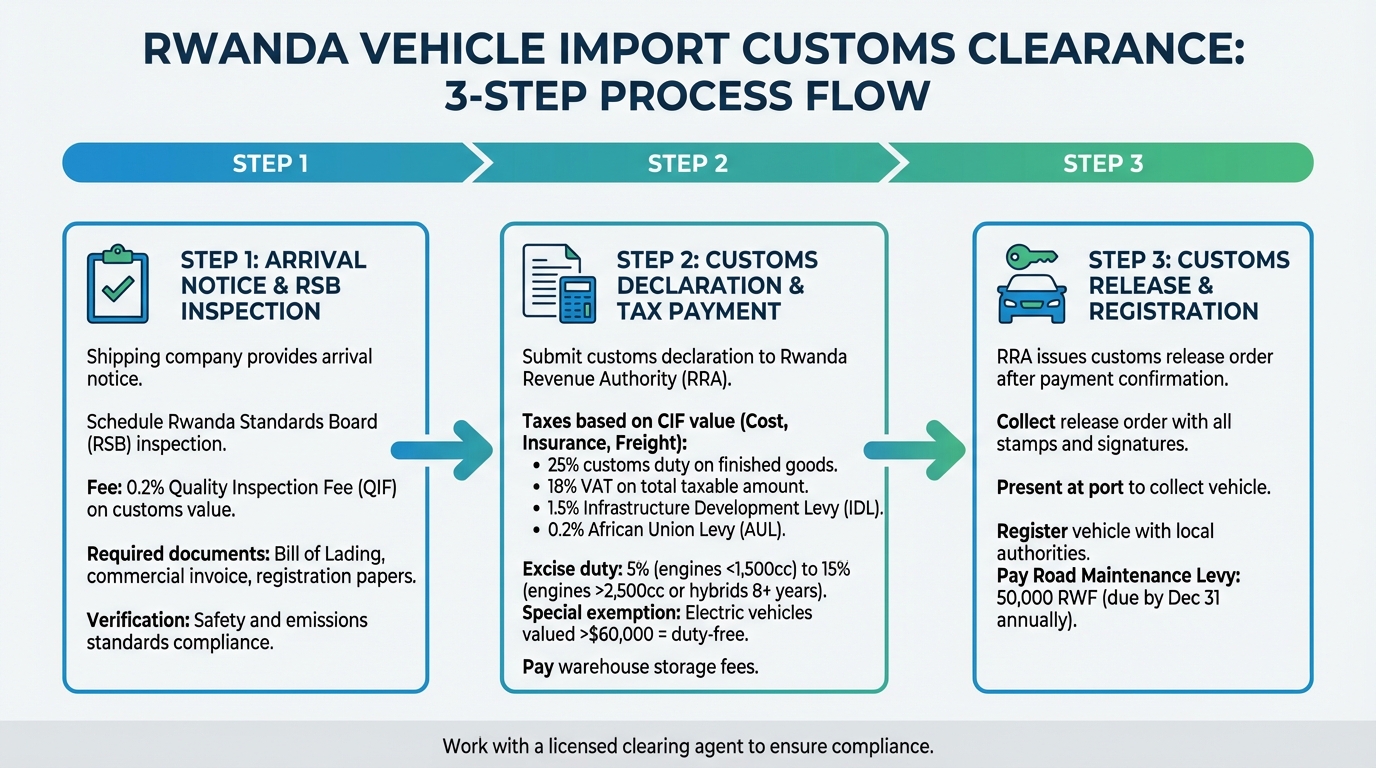
Rwanda Vehicle Import Process: 3-Step Customs Clearance Guide
Bringing a vehicle into Rwanda involves a series of procedures, from inspections to paperwork and tax payments. Here’s a breakdown of the steps you’ll need to follow to ensure your vehicle is legally ready for the road.
First Steps: Arrival Notice and RSB Inspection
When your vehicle arrives at the port or border, the shipping company or freight forwarder will provide an arrival notice. This document confirms that your vehicle has entered Rwanda and is ready for inspection. The next step is to contact the Rwanda Standards Board (RSB) to schedule a quality inspection. The RSB applies a 0.2% Quality Inspection Fee (QIF) based on the customs value of your vehicle.
This inspection ensures your vehicle complies with safety and emissions standards. Be prepared to present key documents like the original Bill of Lading, commercial invoice, and registration papers so inspectors can verify them against the vehicle itself. Once the inspection is complete, you can move on to the customs process.
Customs Steps: Submitting Forms and Paying Taxes
After passing the RSB inspection, you’ll need to submit your customs declaration and manifest to the Rwanda Revenue Authority (RRA). As previously outlined, duties are calculated based on the CIF (Cost, Insurance, and Freight) value of the vehicle. Standard imports are subject to a 25% customs duty on finished goods, along with 18% VAT on the total taxable amount.
Other charges include a 1.5% Infrastructure Development Levy (IDL) and a 0.2% African Union Levy (AUL). Excise duty rates vary depending on the engine size and vehicle age. For example, vehicles with engines under 1,500cc incur a 5% excise duty, while those over 2,500cc or hybrids older than eight years face a 15% rate. Notably, electric vehicles valued above $60,000 will be exempt from customs duties starting in the 2025/2026 fiscal year.
Make sure to pay any warehouse storage fees before proceeding, as unpaid fees can delay the clearance process. All taxes and fees must be settled before you can move to the final step.
Final Steps: Getting Customs Release
Once all customs paperwork and payments are complete, you’ll need to obtain a customs release order. The RRA will issue this document after confirming that all duties and taxes have been paid. Collect the release order from customs and present it at the port. Double-check that the document includes all required stamps and signatures before leaving.
After securing the release, the next step is to register your vehicle with local authorities. You’ll also need to pay the annual Road Maintenance Levy, which is 50,000 RWF for cars and jeeps and must be paid by December 31 each year. Keep all relevant documents handy for the vehicle registration process.
Conclusion: What You Need to Know for Smooth Vehicle Imports
Why Vehicles Get Rejected
Understanding why vehicles get rejected at Rwanda customs can help you avoid common mistakes. The most frequent issues include restrictions on right-hand drive vehicles and problems with documentation or tax calculations. A notable challenge arises with electric vehicles when the 2025/2026 duty rates are misapplied. Specifically, vehicles valued above $60,000 qualify for full duty exemption, while those at or below this price are subject to a 25% tariff under the EAC Common External Tariff. Keeping these details in mind is crucial for a hassle-free import process.
How to Ensure a Smooth Import Process
- Check Vehicle Classification: Electric vehicles priced above $60,000 are exempt from customs duties, while those at or below this threshold face a 25% tariff. For buses, seating capacity matters: buses with 50+ seats are duty-free, while those seating 25–49 passengers incur a 10% duty.
- Verify Documentation: Ensure all paperwork is accurate and complete. This includes confirming the vehicle is left-hand drive and that documents correctly detail specifications like engine capacity (measured in cubic centimeters).
- Double-Check Tax and Fees: Use the latest duty and tax rates to calculate all costs. Working with a customs broker can help you avoid errors and ensure compliance with regulations, saving you time and preventing delays.
FAQs
How can I confirm my car meets Euro 4 before I buy it?
To check if your car meets Euro 4 standards, start by reviewing the vehicle’s documentation, like the registration papers or manufacturer specifications. These usually note whether the car complies. You can also request an emissions certificate or a certificate of compliance from the seller for confirmation. For imported vehicles, examine the import documents or reach out to the manufacturer or dealer directly to verify that the emissions standard explicitly states Euro 4 compliance.
Can I convert a right-hand-drive car to left-hand drive for Rwanda?
Converting a right-hand-drive car to left-hand drive for use in Rwanda isn’t explicitly detailed in the available information. However, Rwanda predominantly permits left-hand-drive vehicles, while right-hand-drive cars are only allowed for a short two-week period. Such conversions typically involve extensive modifications and could be subject to customs rules. To determine whether conversions are permitted and what requirements must be met, it’s best to review Rwanda’s official import regulations or reach out to the country’s customs authorities for clarification.
What extra fees apply besides duty and VAT?
When dealing with Rwanda customs, you might face more than just duty and VAT. Additional charges, such as taxes or fees, can arise due to new regulations or updates in tax laws. These costs can change over time, so it’s important to stay updated by reviewing the latest tax and customs guidelines to avoid surprises.
Related Blog Posts
- How to Import a Car into Rwanda: 2025 Procedures and Costs
- Your complete guide to importing a car into Rwanda in 2025
- Import a Car from France to Rwanda: Costs, Duties, and Tips for Kigali
- How to Register an Imported Car in Rwanda