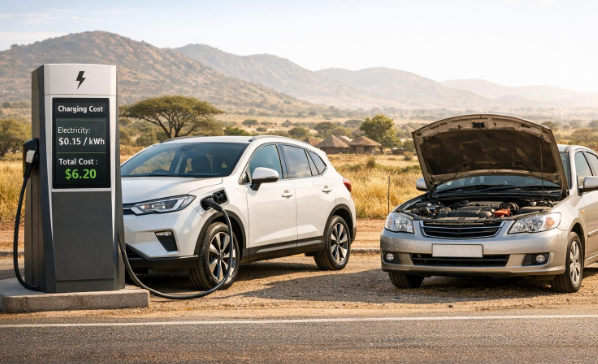
Petrol just hit RWF 2,938/litre in Rwanda. Here’s what that actually means for EV vs combustion running costs in 2026.
EV vs ICE Running Costs in Rwanda: What It Actually Costs to Drive in 2026
Petrol prices in Rwanda climbed to RWF 2,938 per litre in early 2026, driven largely by global oil market volatility tied to the Iran-US-Israel conflict that began in late February. That single number is doing more to push Rwandan drivers toward electric vehicles than any awareness campaign could. At Longtai Rwanda, an EV dealer, staff reported selling 80 electric vehicles in April 2026 alone — before the month had even ended — a jump one employee directly attributed to drivers reacting to the ongoing fuel price crisis.
The import numbers tell the real story
According to Alfred Byiringiro, a Senior Technical Advisor for Transport at Rwanda’s Ministry of Infrastructure, the country imported just 512 fully electric cars between 2020 and 2024. Compare that to the nine months between July 2025 and the end of March 2026, when 1,555 fully electric cars were imported — roughly triple the entire previous four-year total, in less than a year. That’s not gradual adoption; that’s a genuine inflection point, and it’s happening specifically because the running-cost math has shifted so sharply against petrol and diesel.
What charging actually costs versus fueling up
Rwanda offers a preferential electricity rate specifically for EV charging stations: around $0.10/kWh (roughly RWF 145/kWh) during peak hours, compared to the standard commercial rate of about $0.20/kWh (roughly RWF 290/kWh). Set that against petrol at RWF 2,938/litre, and the gap is stark even before you account for the fact that electric motors are inherently more efficient than combustion engines at converting energy into actual movement.
The maintenance side adds up too
Beyond fuel, EVs simply have fewer things that wear out. There’s no combustion engine requiring regular oil changes, no exhaust system, and regenerative braking means brake pads last considerably longer than on a comparable petrol vehicle — something that matters even more given Rwanda’s hilly terrain and the constant braking that comes with it.
Don’t forget the upfront side of the equation
Running costs are only half the picture. Rwanda applies a 0% import duty on EVs, compared to 25% on combustion vehicles valued up to $60,000 — a real structural cost difference before you’ve driven a single kilometer. That gap alone can offset a meaningful chunk of any higher sticker price an EV might carry over a comparable petrol model, depending on the specific vehicles being compared.
So is switching actually worth it right now?
The honest answer depends heavily on where and how you drive. If you’re mostly moving around Kigali, where public charging infrastructure has grown to nearly 200 stations, the cost case for going electric is strong and getting stronger every time fuel prices climb. If your driving regularly takes you well outside the city into areas where charging infrastructure hasn’t caught up yet, a hybrid or a well-maintained petrol vehicle may still make more practical sense for now — even if it’s the more expensive option to run per kilometer.
Where to go from here
If you’re weighing a used petrol or hybrid vehicle against the switch, auto24.rw is worth checking for current listings to get a realistic sense of what’s actually available and at what price point locally. And if the numbers here have you leaning toward going electric, EV24.africa is a solid place to explore real EV import options built around exactly the incentive structure driving this shift. For continued coverage as fuel prices and EV adoption keep moving — and they clearly are — automag.rw will keep tracking where the numbers land next.