In 2026, choosing between Toyota, Nissan, and Suzuki in Rwanda depends on your budget, driving needs, and terrain. Here’s a quick breakdown:
- Toyota: Dominates the market with 40% share. Known for reliability, availability of spare parts, and models like the RAV4 and Hilux, it’s perfect for both city and rural driving. Higher upfront costs but low maintenance.
- Nissan: Holds 15% market share. Offers modern features, comfort, and options like the X-Trail and Navara. Ideal for tech-savvy buyers but with higher maintenance costs and fewer service centers.
- Suzuki: A growing choice since 2024. Affordable, fuel-efficient models like the Swift and Alto are great for city driving. Limited suitability for rough terrain but excellent for budget-conscious buyers.
Quick Comparison:
| Feature | Toyota | Nissan | Suzuki |
|---|---|---|---|
| Market Share | 40% | 15% | Growing since 2024 |
| Strength | Reliability, durability | Tech, comfort | Affordability, economy |
| Best Terrain | All-terrain | Highways, light off-road | Urban, light countryside |
| Maintenance Cost | Low | High | Very low |
| Ideal Use | Rural trips, long-term | Comfort, tech-forward | Budget urban commuting |
For Kigali city drivers, Suzuki offers cost-effective options, while Toyota hybrids like the RAV4 save on fuel. For rural drivers, Toyota’s Hilux or Land Cruiser is a better fit. Nissan suits those prioritizing comfort and advanced tech but may cost more to maintain.
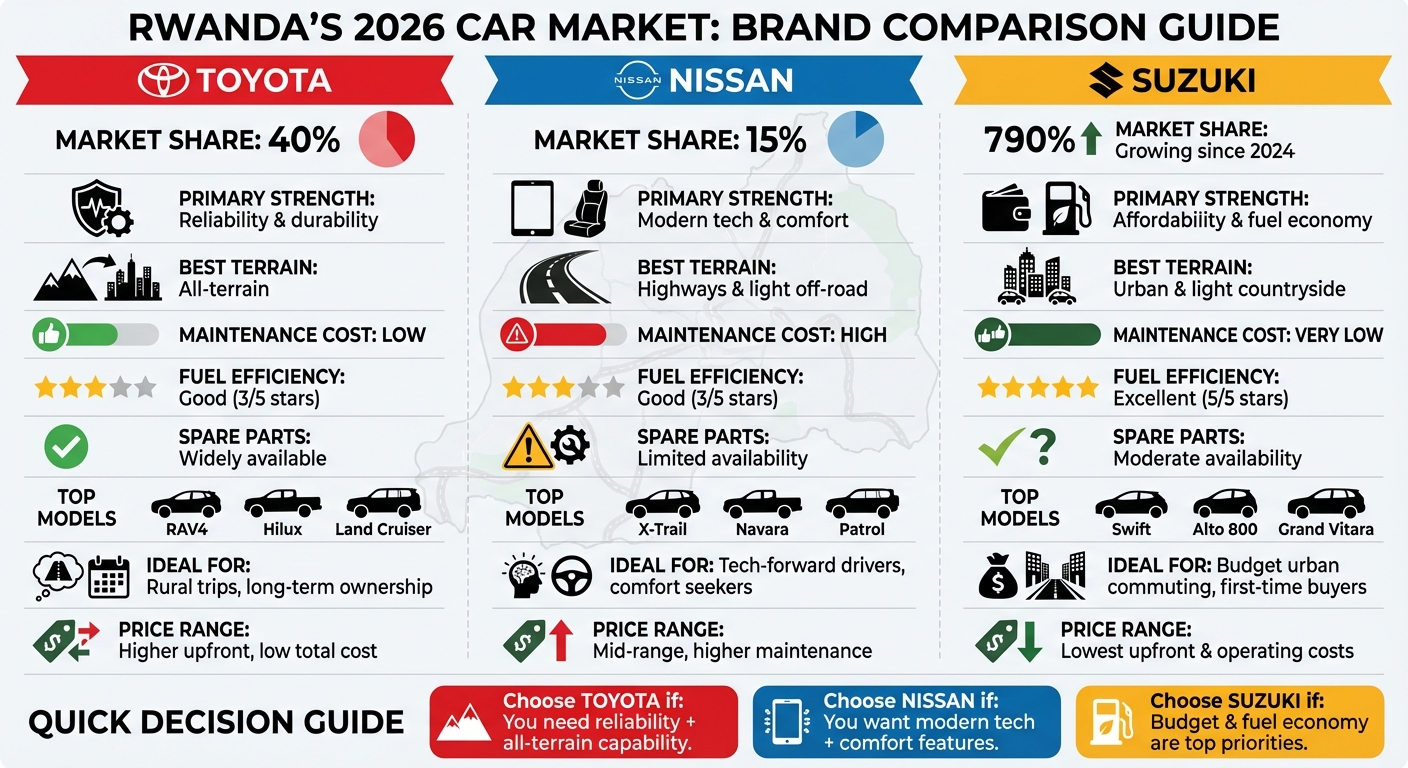
Toyota vs Nissan vs Suzuki Rwanda 2026 Car Comparison Guide
What To Consider When Buying a Car in Rwanda (2026)
Choosing the right car in Rwanda means weighing the initial cost, long-term expenses, ability to handle the terrain, and access to reliable maintenance and parts.
Price and Budget
When setting your budget, think beyond just the sticker price. Factor in the total cost of ownership, which includes fuel, insurance, and maintenance. Some brands may seem affordable upfront but could end up costing more over time if spare parts are pricey or hard to find. Balancing these costs is key to making a smart decision.
Also, keep in mind how fuel efficiency can impact your daily expenses.
Fuel Efficiency and Availability
Fuel costs can quickly become a major expense. Look for cars with good fuel economy, measured in either liters per 100 kilometers (L/100 km) or miles per gallon (mpg). For example, Suzuki models like the Swift have gained popularity since 2024, particularly for urban driving, thanks to their efficiency and practicality. Diesel engines tend to perform better for highway and rural driving, while gasoline engines are often simpler and less expensive to maintain.
But fuel efficiency isn’t the only thing to consider – how the car handles Rwanda’s roads is just as important.
Terrain and Road Conditions
Rwanda’s roads range from well-paved city streets in Kigali to unpaved, slippery paths in rural areas, especially during the rainy seasons (March–May, September–December). If you plan to drive outside Kigali, look for vehicles with high ground clearance and durable suspension systems. Models like the Toyota Land Cruiser are excellent for rural trips, while compact cars are better suited for city driving and tight parking spaces.
Spare Parts and Service Access
Reliable access to spare parts and service is just as important as the car itself. Toyota dominates the market in Rwanda with a 40% share, largely because of its fuel efficiency, durability, and the easy availability of spare parts. Brands with official local representation, such as Toyota through CFAO Group or Nissan via Afrimotors, ensure you won’t waste time hunting for parts. A strong local support network means fewer headaches and more time enjoying your car.
Toyota: Reliability and Range
Toyota dominates Rwanda’s automotive market, holding a 40% share thanks to its extensive network of spare parts and service centers. Here’s a closer look at some of Toyota’s standout models tailored to Rwanda’s varied driving conditions.
Top Toyota Models
The Toyota RAV4 is a flexible SUV that performs well in both city and rural settings. With a ground clearance of 195 mm (7.7 in) and optional All-Wheel Drive, it handles diverse terrains with ease. Its spacious 580-liter (20.5 ft³) trunk and fuel-efficient hybrid option, which consumes just 5.5 L/100 km, make it a great choice for families traveling across the country.
The Toyota Hilux is built to handle Rwanda’s rugged roads. With a ground clearance of 293–310 mm (11.5–12.2 in) and a powerful 2.8GD engine producing 500 Nm of torque, it’s ready for steep climbs and challenging terrains. The Hilux also boasts an 80-liter (21.1 gal) fuel tank, allowing for long journeys without frequent refueling. Its braked towing capacity of up to 3,500 kg makes it a reliable option for heavy-duty tasks.
For urban drivers in Kigali, the Toyota Corolla remains a dependable sedan. Meanwhile, the Land Cruiser Prado appeals to those seeking luxury combined with off-road capability. For budget-conscious city drivers, the Toyota Yaris offers an economical, entry-level option.
Performance and Fuel Economy
Toyota’s models are designed to meet the driving demands of Rwanda, offering a balance of performance and efficiency.
The RAV4 2.0L petrol engine delivers 173 HP and 203 Nm of torque, with a fuel consumption rate of 6.5–6.8 L/100 km (34.6–36.2 mpg) in mixed driving. This makes it suitable for daily commutes and weekend getaways to places like Musanze or Rubavu. The hybrid version takes efficiency a step further, consuming just 5.5 L/100 km (42.8 mpg), which translates to substantial savings over time.
The Hilux lineup offers two diesel options: a 2.4L engine generating 150 HP and a more robust 2.8L engine with 204 HP and 500 Nm of torque. These engines are known for their durability on both highways and tougher rural roads. Transmission options include manual and automatic (CVT for the RAV4 and a 6-speed system for the Hilux), catering to different driving preferences.
Safety is another strong point across Toyota’s lineup. Many models feature Toyota Safety Sense, which includes advanced features like lane departure alerts and adaptive cruise control – ideal for navigating Rwanda’s winding highways. The RAV4 comes equipped with 7 airbags, ABS, Vehicle Stability Control (VSC), and Hill-start Assist. Meanwhile, the Hilux offers Trailer Sway Control, ensuring stability during towing.
Toyota Model Comparison Table
| Model | Engine | Ground Clearance | Fuel Economy | Best Use Case |
|---|---|---|---|---|
| RAV4 Hybrid | 2.5L Hybrid | 195 mm (7.7 in) | 5.5 L/100 km (42.8 mpg) | City commuting & inter-district travel |
| RAV4 Petrol | 2.0L Petrol (173 HP) | 195 mm (7.7 in) | 6.5–6.8 L/100 km (34.6–36.2 mpg) | Urban families & light off-road driving |
| Hilux 2.4GD | 2.4L Diesel (150 HP) | 293–310 mm (11.5–12.2 in) | Diesel efficiency | Rural work & rough terrain |
| Hilux 2.8GD | 2.8L Diesel (204 HP) | 310 mm (12.2 in) | Diesel efficiency | Heavy-duty towing & extreme off-road |
| Corolla | Various petrol engines | Standard sedan | Good fuel economy | Kigali urban commuting |
| Land Cruiser Prado | Various | High | Moderate | Premium/off-road & rural driving |
All Toyota models come with a 3-year/100,000 km warranty, provided through the official CFAO/Toyota Rwanda network. Regular maintenance, such as oil changes every 7,000–10,000 km and monthly tire pressure checks (especially in dusty areas like Nyagatare), ensures optimal performance. For hilly regions like Musanze, opting for AWD or 4×4 variants is highly recommended for better handling on steep inclines. These features underline Toyota’s dedication to providing reliable vehicles for Rwandan drivers.
Nissan: Comfort and Features
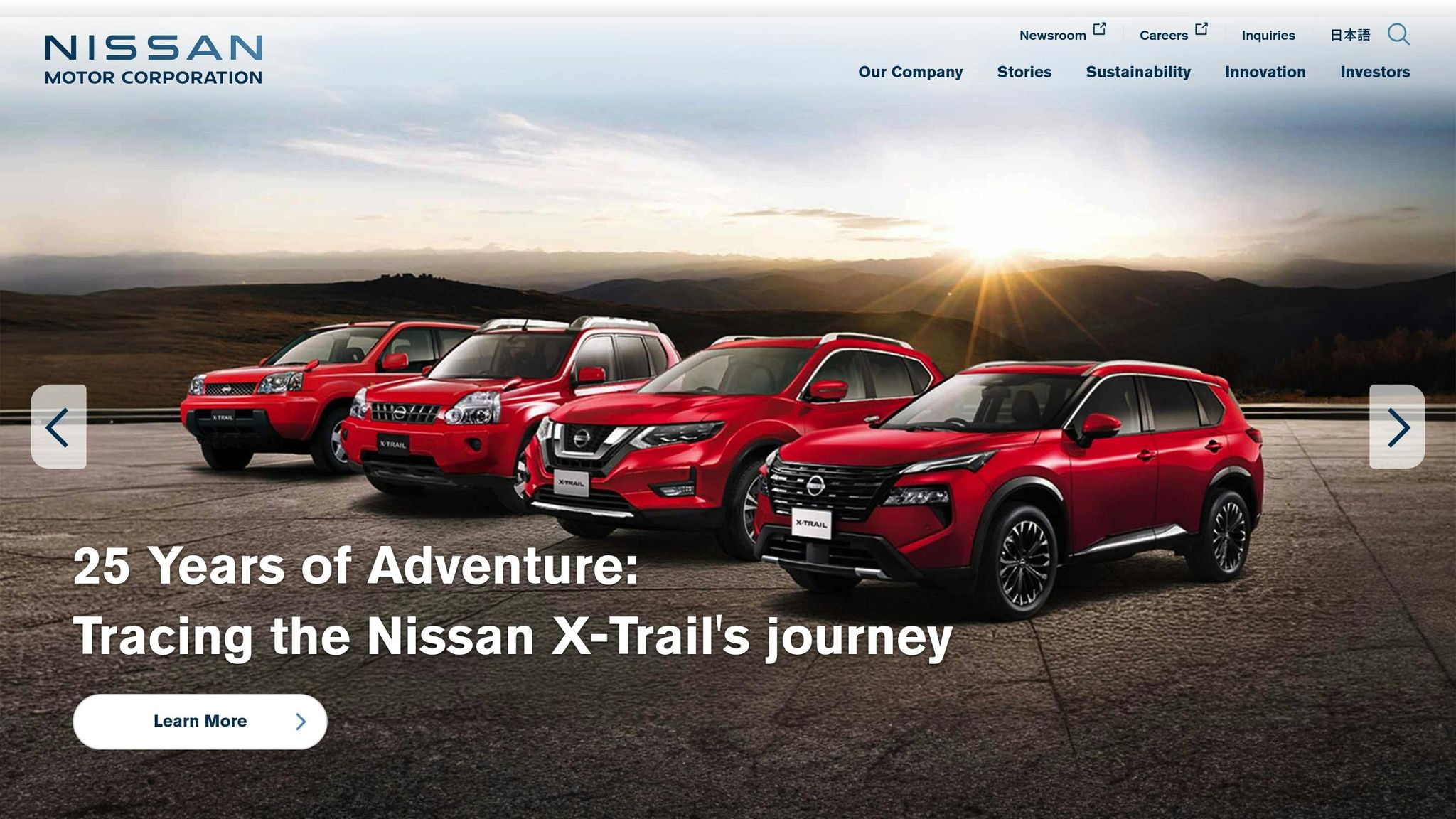
Nissan commands about 15% of Rwanda’s automotive market, establishing itself as a forward-thinking alternative to Toyota. Through its official distributor, Afrimotors, Nissan caters to Rwandan buyers who value advanced technology and comfort over rugged durability. While Toyota’s spare parts are easier to find, Nissan sets itself apart with near-luxury interiors and state-of-the-art driver assistance systems.
Here’s a closer look at Nissan models that combine innovation and comfort to meet the needs of Rwandan drivers.
Top Nissan Models
The Nissan X-Trail (known as the Rogue in some regions) is Nissan’s response to the RAV4, offering families a tech-packed SUV. It features dual 12.3-inch screens for infotainment and driver information, as well as Tri-Zone Automatic Temperature Control, ensuring a comfortable ride from Kigali to Rubavu. Its "Divide-N-Hide" cargo system provides six ways to organize up to 74.1 cubic feet of cargo space, making it versatile for errands and weekend getaways. Powered by a 1.5L VC-Turbo engine producing 201 HP and 225 lb-ft of torque, the X-Trail is well-suited for Rwanda’s hilly landscapes.
The Nissan Note stands out for its fuel efficiency, delivering approximately 20 km/L (47 mpg). It comes equipped with Nissan Safety Shield 360, which includes features like a 360-degree camera, blind-spot monitoring, and lane-departure warnings – perfect for navigating busy city streets and tight parking spots. For those seeking a compact crossover, the Nissan Qashqai offers modern styling, decent ground clearance, and practicality for occasional trips to rural areas.
For the pickup segment, the Nissan Navara competes directly with the Hilux, boasting 4×4 capability, 187 HP, and an Intelligent Around View Monitor that simplifies maneuvering through narrow or uneven terrain. On the luxury SUV side, the Nissan Patrol impresses with a 5.6L V8 engine delivering 400 HP, an all-mode 4×4 system, and a 13-speaker Bose sound system. Automotive expert Jean Baptiste Habumugisha remarked in August 2025:
"For drivers in Rwanda who demand both rugged utility and modern luxury, the Nissan Patrol Rwanda 2025 is hard to beat."
Pros and Cons
Nissan’s standout feature is its interior comfort and advanced technology. The "Zero Gravity Seats" are designed to reduce fatigue during long drives, making trips to Musanze or Huye more enjoyable. High-end trims offer quilted semi-aniline leather-appointed seats, rivaling the luxury of premium brands. The Head-Up Display projects key information onto the windshield, while the 3D Enhanced Intelligent Around View Monitor includes an "Invisible Hood View", allowing drivers to see obstacles directly under the front bumper – an invaluable tool for navigating potholes and uneven roads during Rwanda’s rainy season.
However, Nissan faces challenges in the Rwandan market. Spare parts are less accessible than Toyota’s, leading to longer and more expensive repair times. Maintenance costs are generally higher, and Nissan vehicles tend to depreciate faster than their Toyota counterparts. Additionally, the limited service network outside of Kigali can be a hurdle for those who frequently travel to rural areas.
Nissan Model Comparison Table
| Model | Engine | Ground Clearance | Fuel Economy | Starting Price | Ideal For |
|---|---|---|---|---|---|
| Note | Petrol | Standard hatchback | 20 km/L (47 mpg) | ~$1,800 (used imports) | Kigali city commuting & fuel efficiency |
| Qashqai | Petrol/Turbo | Compact crossover | Good economy | Mid-range | Urban families & light travel |
| X-Trail (Rogue S) | 1.5L VC-Turbo (201 HP) | Standard SUV | Moderate | $29,090 | Family trips & tech-focused buyers |
| X-Trail (Rogue Platinum) | 1.5L VC-Turbo (201 HP) | Standard SUV | Moderate | $38,990 | Premium comfort & advanced features |
| Navara | 4×4 Diesel (187 HP) | High | Diesel efficiency | $22,000–$40,000 | Heavy-duty work & rural roads |
| Patrol | 5.6L V8 (400 HP) | High (raised) | Lower (V8) | ~$96,000 | Luxury SUV & extreme off-road |
The 2026 Nissan Rogue (X-Trail) earned the 2026 Best Buy Award from Consumer Guide Automotive for the 12th consecutive year and was recognized as an IIHS TOP SAFETY PICK. While these accolades highlight Nissan’s strengths, Rwandan buyers must weigh its superior comfort and technology against Toyota’s unmatched reliability and broader service network before making a decision.
sbb-itb-7bc66b5
Suzuki: Low Cost and Efficiency
Suzuki made its mark on Rwanda’s automotive market in 2024, appealing to budget-conscious buyers. Known for its affordable design and low upkeep costs, Suzuki has become a go-to option for those looking to cut down on vehicle expenses in Kigali’s bustling urban environment. Let’s take a closer look at Suzuki’s top models and how they meet the demands of both city and countryside driving in Rwanda.
Top Suzuki Models
Suzuki’s lineup emphasizes affordability and practicality, offering something for nearly every type of driver. For those on a tight budget, the Suzuki Alto 800 serves as an excellent entry-level option. Priced at approximately RWF 6,239,793 (around $7,000), it features a compact 796 cc engine that delivers impressive fuel efficiency at 4.4 L/100 km (53 mpg). With a ground clearance of 160 mm, it’s well-suited for Kigali’s paved roads, though it might not handle rural terrain as effectively.
The Suzuki Swift, a standout in the Rwandan market, offers a bit more space and comfort while maintaining strong fuel economy at 4.9 L/100 km (48 mpg) and low CO₂ emissions of 117 g/km. Its 1.2L engine is powerful enough for navigating Kigali’s hilly streets, and its compact size makes it ideal for tight urban spaces.
For families or those venturing into the countryside, the Suzuki Grand Vitara provides a sturdier build and elevated driving position, making it a better fit for uneven roads and occasional off-road conditions. On the other hand, the Suzuki Carry is a practical choice for small businesses, offering an affordable solution for light commercial needs and deliveries.
Fit for Rwanda
Suzuki’s strengths lie in its fuel efficiency and city-friendly design, which make models like the Alto and Swift perfect for Kigali’s daily commuters. With rising fuel costs, these models help drivers save money while navigating urban traffic. Suzuki’s lightweight HEARTECT platform, seen in models like the Dzire (weighing just 890 kg or 1,962 lbs), enhances fuel efficiency further. Features like the "Auto Start-Stop" system in the Celerio and S-Presso add even more savings during stop-and-go traffic.
However, Suzuki does face challenges on Rwanda’s rural roads. Most models lack the ground clearance and rugged build needed for unpaved routes, where competitors like Toyota’s SUVs have a clear advantage. While spare parts are available through suppliers such as Biguhu Global Engineering (BGE) in Kigali, the network isn’t as extensive as Toyota’s. Still, Suzuki’s low maintenance costs help keep overall ownership expenses manageable.
"Suzuki has established itself as a popular choice in the Rwandan market starting in 2024, with the Suzuki Swift becoming a flagship model thanks to its affordable price, excellent fuel efficiency, and ease of driving." – Équipe de rédaction, Koto.rw
Suzuki Model Comparison Table
| Model | Engine | Fuel Economy | Starting Price | Ideal For |
|---|---|---|---|---|
| Alto 800 | 796 cc | 4.4 L/100 km (53 mpg) | ~$7,000 (RWF 6.2M) | Budget city commuting & first-time buyers |
| Swift | 1.2L Petrol | 4.9 L/100 km (48 mpg) | Price varies | Daily Kigali driving & young professionals |
| Celerio | Petrol | 4.2 L/100 km (56 mpg) | Price varies | Maximum fuel savings in city traffic |
| Grand Vitara | SUV (Hybrid) | ~6.0 L/100 km (39 mpg) | Price varies | Mixed city/countryside use & small families |
| Carry | Commercial | Diesel efficiency | Price varies | Light commercial work & deliveries |
Suzuki scored 75 out of 100 in the 2021 Consumer Reports Auto Reliability Survey. While it doesn’t quite match Toyota’s reputation for durability or resale value, Suzuki stands out as a cost-effective option for Rwandan buyers focused on affordability, low operating costs, and ease of use in urban areas. It’s a strong contender for those looking for a practical alternative to more established brands.
Toyota vs Nissan vs Suzuki: Side-by-Side Comparison
Price and Maintenance Costs
Toyota vehicles tend to come with a higher upfront price tag, but they make up for it with lower maintenance expenses, thanks to a well-established spare parts network. Suzuki, on the other hand, offers budget-friendly purchase prices and keeps repair costs to a minimum. Nissan strikes a balance between the two, offering competitive pricing, though its maintenance costs are slightly higher due to more advanced technology.
Fuel Efficiency and Dependability
When it comes to fuel efficiency, Suzuki takes the lead for city driving, offering economical options that are perfect for urban environments. Toyota, however, stands out for its combination of fuel efficiency and power, along with a reputation for reliability. This reputation is evident in its commanding 40% share of Rwanda’s automotive market. Nissan delivers a solid mix of fuel efficiency and modern engine technology, but it doesn’t quite match Toyota’s durability or Suzuki’s focus on economy.
Terrain Handling and Use Cases
Toyota vehicles, such as the Land Cruiser and Prado, are built to handle everything from Kigali’s bustling streets to rugged rural roads. Suzuki shines in urban environments with nimble models like the Swift, while also offering options like the Grand Vitara for light countryside adventures. Nissan bridges the gap with vehicles designed to combine modern features and off-road capabilities, making them suitable for both highway cruising and rural exploration. The table below highlights these differences.
Brand Comparison Table
| Feature | Toyota | Nissan | Suzuki |
|---|---|---|---|
| Market Share | 40% | 15% | Growing popularity since 2024 |
| Primary Strength | Reliability & parts availability | Modern design & technology | Fuel efficiency & affordability |
| Best Terrain | Urban and all-terrain | Highways and off-road | Urban and light countryside |
| Maintenance Cost | Low – easy access to parts | Higher – advanced technology | Very low – simple engineering |
| Recommended Use | Long-term durability & rural trips | Tech-forward driving & off-roading | Budget-friendly urban commuting |
Best Choices for Rwandan Buyers in 2026
Based on our detailed analysis of various models, here are some top vehicle recommendations tailored to meet the needs of Rwandan buyers in 2026.
For city commuters, Toyota’s hybrid models – particularly the RAV4 Hybrid – stand out as a smart investment. While the upfront cost might be higher, the long-term savings on fuel make it worthwhile. With a fuel consumption rate of just 5.5 L/100 km (42.8 mpg), this model is perfect for navigating Kigali’s busy streets, especially with rising fuel costs in Rwanda. Jean Baptiste Habumugisha from AutoMag.RW highlights the appeal:
"Fuel prices in Rwanda can be a burden for frequent drivers, which is why Toyota’s hybrid technology is a game-changer".
Additionally, the availability of spare parts and low maintenance needs make Toyota hybrids a reliable option for daily use.
For rural families, the Toyota RAV4 with All-Wheel Drive is an excellent choice. Its high ground clearance and durability make it ideal for traveling on unpaved roads, whether for family trips or market errands.
Small business owners have different priorities, and there are versatile options to consider. For businesses requiring heavy-duty performance, the Toyota Hilux is a standout. Known for its durability, it’s a favorite among African drivers, with 78% of African Toyota owners naming it their top brand. For urban-based startups focused on deliveries or commuting, the Suzuki Swift offers impressive fuel efficiency and low maintenance costs. Meanwhile, the Nissan Frontier combines modern features with competitive pricing, making it a great fit for businesses that need both capability and technology.
These recommendations are based on a thorough review of price, performance, and efficiency, ensuring every Rwandan driver can find the perfect match for their needs. For more in-depth reviews and insights, check out AutoMag.RW.
FAQs
What should I consider when choosing between Toyota, Nissan, and Suzuki in Rwanda?
When choosing between Toyota, Nissan, and Suzuki in Rwanda, several factors come into play: reliability, cost, availability of spare parts, and how well the vehicle handles local driving conditions. Toyota has a strong foothold in the market, offering easy access to parts and services. It’s also known for its dependability and holds its resale value well. Nissan offers some advanced options, like electric vehicles, but maintenance can be pricier. Suzuki, on the other hand, is often more budget-friendly upfront but provides fewer models designed for rugged or challenging terrain.
Another key consideration is fuel efficiency and how the vehicle performs on Rwanda’s roads. Toyota hybrids, such as the RAV4 Hybrid, provide excellent fuel savings, while models like the Hilux are perfect for off-road and hilly areas. Nissan’s electric vehicles might attract environmentally conscious buyers, though the lack of charging infrastructure could be a drawback. Suzuki, while affordable, might not offer the versatility needed for Rwanda’s varied landscapes. Ultimately, take into account your budget, driving habits, and long-term expenses to find the right fit for Rwanda’s unique driving conditions.
Why are spare parts and service centers important when choosing a car in Rwanda?
The availability of genuine spare parts and dependable service centers significantly impacts the overall cost and ease of owning a car in Rwanda. Take Toyota, for example – its extensive parts distribution network often translates to lower repair costs, quicker turnaround times for fixes, and better resale value. These factors make it a smart choice for many car buyers.
In contrast, owning a car from a brand with limited parts availability can mean higher repair bills and frustratingly long waits for replacements. For drivers in Rwanda, picking a brand with accessible service centers and readily available parts can make a big difference, ensuring smoother ownership and helping to avoid unexpected expenses.
Which car brand is the most fuel-efficient for city driving in Kigali?
For navigating the bustling streets of Kigali, Toyota takes the lead as the most fuel-efficient option. Its hybrid models, such as the Toyota Prius and Corolla Cross Hybrid, offer impressive mileage. The Prius boasts approximately 57 MPG in city driving, while the Corolla Cross Hybrid delivers around 52 MPG (4.5 L/100 km). These numbers make Toyota hybrids a smart choice for cutting down on fuel costs in urban settings.
By comparison, Nissan and Suzuki models available in Rwanda fall short in terms of fuel efficiency, particularly when it comes to hybrid technology. For those prioritizing eco-friendly and cost-effective daily commutes, Toyota’s hybrids are the clear winner.
Related Blog Posts
- Cheapest cars to maintain in Rwanda
- Top car brands in Rwanda
- 5 Reasons Toyota Cars Dominate in Rwanda
- Best Cars to Import to Rwanda for Budget Buyers