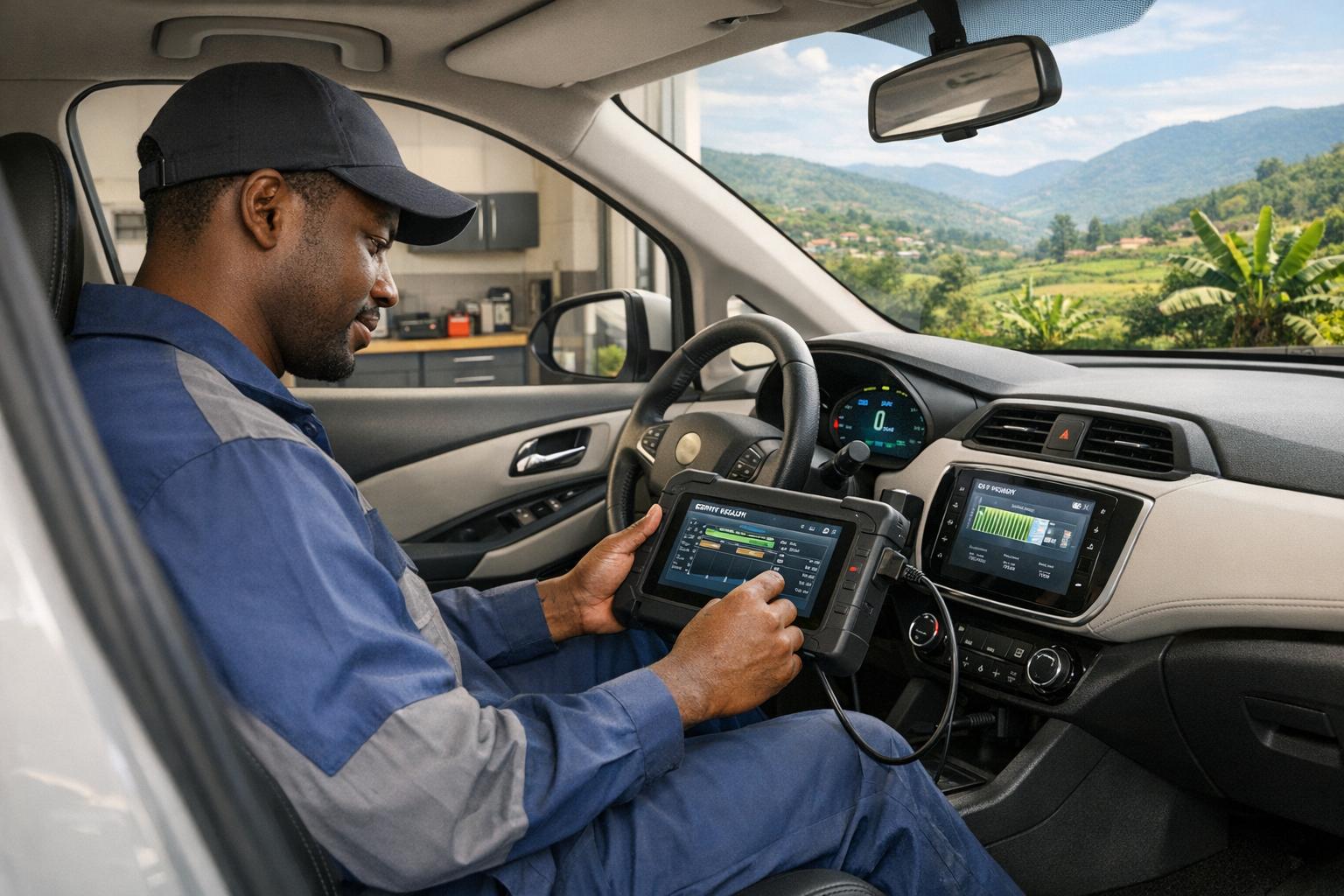
When buying a used EV in Rwanda, the battery’s condition is the most important factor to assess. Here’s why: replacing a battery can cost between $8,000 and $22,000, depending on the model. To avoid unexpected expenses, you need to evaluate the battery’s State of Health (SOH), driving range, and charging history. Here’s a quick guide:
- SOH: A percentage showing how much capacity remains compared to when the battery was new. Above 85% is good; below 70% suggests significant wear.
- Dashboard Data: Most EVs display battery health and range estimates. For example, Tesla models show projected range, which can be compared to the original EPA rating.
- Range Test: Fully charge the EV, drive it, and measure the actual range against its advertised performance. This reveals how well the battery performs in real-world conditions.
- OBD-II Scanners: Tools like LeafSpy or ScanMyTesla provide detailed diagnostics, including cell voltage balance and charging history.
- Professional Inspections: Experts can perform advanced tests, such as thermal imaging and electrochemical analysis, to identify hidden issues.
Factors like Rwanda’s hilly terrain and charging habits also impact battery health. Frequent fast charging or driving in steep areas can accelerate wear. Always check for a transferable battery warranty, which typically lasts 8 years or 100,000 miles.
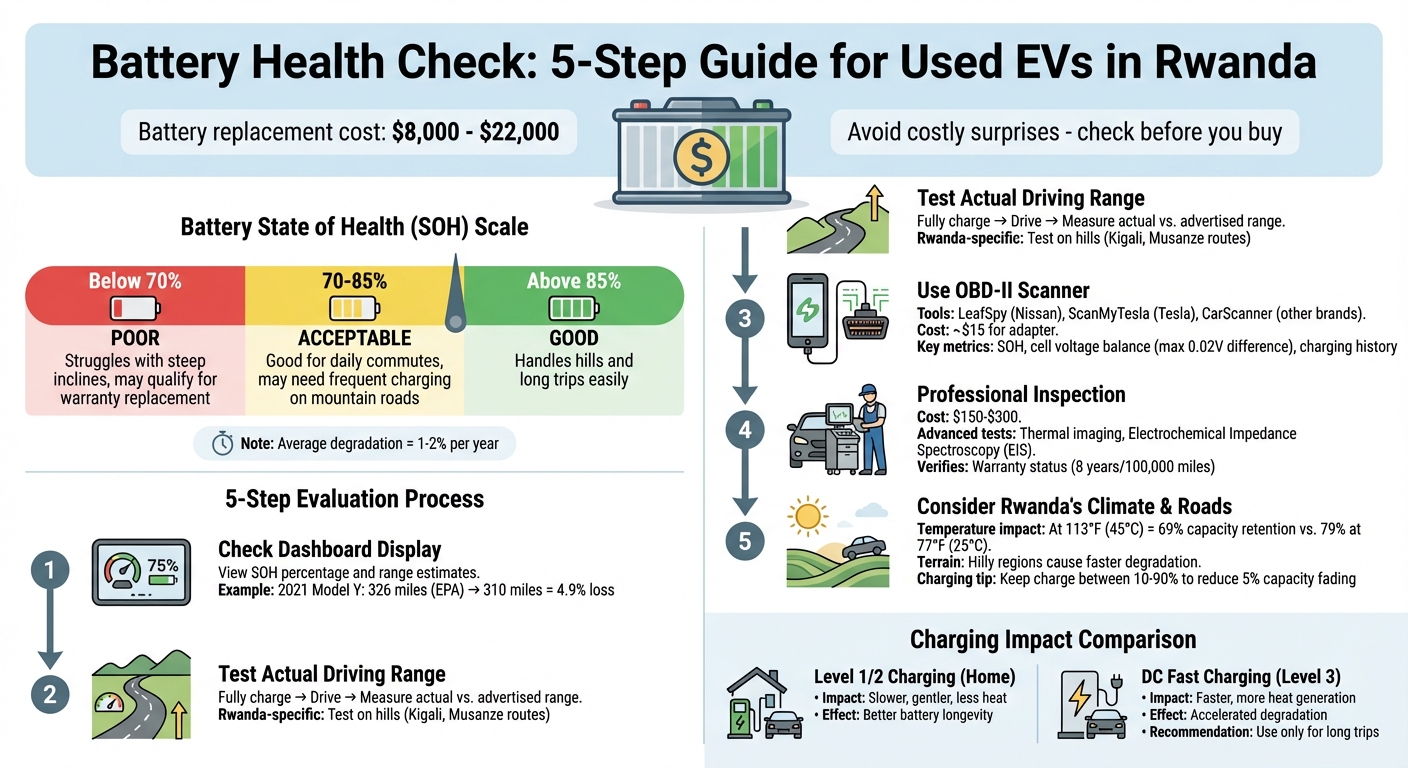
EV Battery State of Health Guide for Rwanda
EV Battery Health Test | How Much Battery Capacity Has It Lost?
Step 1: Check the Dashboard Display
Start by glancing at the dashboard for a quick battery status update. Most electric vehicles (EVs), including Tesla and Leapmotor models commonly found in Rwanda, showcase battery information right on their screens. There’s no need for extra tools – just know where to look for the details. From there, you can learn how to access specific battery data for different EV models.
Accessing Battery Data on Tesla and Leapmotor Models
For Tesla vehicles, you can switch the display from percentage to miles. Head into your settings and toggle the option to display miles. When charging to 100%, the screen will show the maximum projected range. Compare this number to the car’s original EPA rating to gauge battery degradation. For instance, if a 2021 Model Y (originally rated for 326 miles by the EPA) now shows 310 miles, it means the battery has experienced about a 4.9% capacity loss.
Tesla also offers a Service Mode for more detailed diagnostics. Tap the car icon on the touchscreen, go to "Software", and hold down the model name until a password prompt appears. Enter "service" to unlock the advanced menu. Alternatively, use the Tesla mobile app: go to "Request Service" > "Battery & Charging" > "Range" to initiate a remote diagnostic. This compares your vehicle’s current performance against expected degradation metrics.
Reading the Battery Health Numbers
Once you’ve accessed the battery data, it’s time to interpret the State of Health (SOH) values. The SOH percentage indicates how much capacity the battery retains compared to when it was new. Here’s a breakdown of what these numbers mean, especially for Rwanda’s driving conditions:
| State of Health (SOH) | Condition | Implications for Rwandan Driving |
|---|---|---|
| Above 85% | Good | Easily handles hills and long trips without causing range anxiety. |
| 70% to 85% | Acceptable | Works well for daily commutes but may require more frequent charging on mountain roads. |
| Below 70% | Poor | Struggles with steep inclines and may even qualify for a warranty replacement. |
On average, EV batteries lose about 1–2% of capacity per year. Tesla batteries, in particular, tend to lose around 12% after 200,000 miles. Many Tesla owners report only 5–10% range loss even after driving 150,000 miles or more. It’s worth noting that the first 5% of capacity often diminishes relatively quickly – sometimes within the first 1.5 years – before the rate of degradation slows down.
For Rwanda’s hilly terrain, keep in mind that a battery at 80% SOH might perform adequately on flat roads but could struggle on steeper climbs.
Step 2: Test the Actual Driving Range
Rwanda’s diverse terrain makes testing an electric vehicle’s driving range in real-world conditions essential. While dashboard data provides an estimate, hitting the road reveals how the battery performs in actual usage. A real-world range test helps identify any battery capacity loss and gives a clearer picture of its health. The process is straightforward: charge the battery to 100%, drive until it needs recharging, and measure the distance traveled. Let’s break down how to conduct this test effectively.
How to Run a Range Test
Begin by fully charging the vehicle and noting the estimated range displayed on the dashboard. This figure, often called the estimated range indicator, serves as your starting point . Next, map out a route that reflects typical Rwandan driving conditions. For example, you might test the car on Kigali’s steep hills or the high-altitude roads leading to Musanze. These routes challenge the battery, as climbing hills consumes more energy, while descending can recover some charge thanks to regenerative braking.
As you drive, monitor how the estimated range decreases compared to the actual distance traveled. A well-functioning battery will show a steady, linear depletion. However, sudden drops in range might signal internal issues . Keep an eye on the energy consumption display, which often shows usage in kilowatt-hours (kWh) per 100 miles.
If possible, test the vehicle in both city and highway conditions. City driving, with frequent stops and starts, uses energy differently than the consistent speeds of highway driving. Additionally, conducting an overnight test can reveal if the battery experiences any "vampire drain", where energy is lost while the car is idle.
Finally, compare the actual distance covered during your test to the vehicle’s original EPA-rated range. For instance, if a car initially rated for 200 miles now only delivers 160 miles in similar conditions, that suggests a 20% loss in capacity. This is significantly higher than the average annual degradation rate of 1.8%.
"The advertised range of an electric vehicle may vary depending on factors such as driving conditions, temperature, and battery health. During a test drive, pay attention to the vehicle’s actual range compared to its advertised range." – FLO
Step 3: Use an OBD-II Scanner for Detailed Data
While dashboard displays and range tests give you a general idea, an OBD-II scanner digs deeper, accessing data stored in the car’s Battery Management System (BMS). By connecting directly to the vehicle’s diagnostic port, this tool provides detailed insights like the State of Health (SOH), individual cell voltages, and charging history. For anyone buying a used EV in Rwanda, this level of detail can help identify potential problems before making the purchase. The next step is choosing the right scanner and app for your specific EV model.
Picking the Right Scanner and App
The scanner and app you need will vary depending on the EV model. For Nissan Leaf owners, the LeafSpy app works best – use LeafSpy Pro for models from 2018 onward, and the standard version for 2011–2017 models. Tesla users can rely on ScanMyTesla, which pairs with an OBD-II adapter to provide in-depth readings. For other brands like Volkswagen, Kia, Hyundai, or Chevrolet, CarScanner offers compatibility across multiple models.
These apps require a Bluetooth or Wi-Fi OBD-II dongle to function. Popular options include OBDLink CX, LELink, and ELM327-based adapters, which typically cost around $15. The diagnostic port is usually located under the steering wheel or inside the fuse box. Simply plug in the dongle, pair it with your device via Bluetooth, and open the app.
What to Look for in the Scanner Data
Once connected, focus on key battery metrics. The SOH is a critical indicator of the battery’s remaining capacity. A reading above 85% is generally considered good, 70–85% is acceptable, and anything below 70% suggests significant degradation. Since EV batteries typically degrade at a rate of about 1.8% per year, a three-year-old vehicle should ideally show an SOH in the mid-90% range.
Pay close attention to cell voltage balance as well. A healthy battery should have no more than a 0.02V difference between the highest and lowest cell voltages. Larger discrepancies could point to a weak cell affecting overall performance. Reviewing the charging history is also valuable – it helps differentiate between gentle Level 1/Level 2 charges and the more demanding DC fast charges. Frequent fast charging can accelerate battery wear, so a car with a history of many quick charges might show greater degradation than its SOH suggests.
Battery temperature data is another factor to consider, especially given Rwanda’s warm climate. High temperatures can speed up battery degradation, though liquid-cooled systems (like those in Teslas) generally handle heat better than older air-cooled setups, such as those in early Nissan Leafs. For the most accurate results, run the diagnostic scan when the battery’s State of Charge is between 20% and 80%. Testing below 20% can sometimes expose hidden imbalances.
"The state of your EV’s battery health should be checked regularly. The Battery Health Report is one of the key benefits of our Kia e-Care service." – Kia
sbb-itb-7bc66b5
Step 4: Get a Professional Battery Inspection
An EV’s battery is a major investment, so getting a professional inspection is a smart move to protect your purchase. While OBD-II scanners can give you some useful insights, they don’t come close to the level of detail that a professional inspection offers. Experts rely on specialized equipment and high-voltage expertise to assess battery health in ways that consumer tools simply can’t match. Typically, a thorough battery health report from a dealer or specialized service center costs between $150 and $300. This upfront cost can help you avoid expensive surprises later on. Plus, this detailed evaluation sets the stage for more advanced diagnostics.
Professional testing digs deeper than what your dashboard or smartphone app can reveal. For example, technicians use thermal imaging to spot hotspots or temperature variations in the battery pack, which can point to cooling system problems early on. They also perform Electrochemical Impedance Spectroscopy (EIS), a technique that measures how electrical current flows through the battery at different frequencies. This helps identify aging or damaged cells. On top of that, physical inspections check for issues like corrosion, damage to the battery casing, or wear on high-voltage components – all of which could pose safety risks.
In Rwanda, reputable service centers and authorized EV dealers offer comprehensive battery inspections and detailed State of Health reports. Certified pre-owned EVs often come with partial battery warranties, adding an extra layer of protection for your investment.
Why Professional Testing Matters
The biggest benefit of professional testing is its ability to pinpoint the "weakest link" in your battery pack. Since the overall capacity of the battery depends on its weakest module, even one failing cell can compromise the entire pack. Unfortunately, dashboard displays only show average performance, which can hide these cell-level issues. As Brandon August, Technical Contributor at Recurrent Auto, puts it:
Battery testing is essential to ensure that EVs are safe, reliable, and perform correctly over their long lifetime.
Professional reports go further by including cell voltage balance checks, which can catch early signs of failing modules or Battery Management System (BMS) problems. They also verify the battery’s charge rate on both Level 2 and DC fast chargers to ensure it’s accepting power at the expected speeds. Additionally, confirming the warranty status is crucial – most manufacturers offer an 8-year or 100,000-mile (160,000 km) battery warranty. Verifying that this warranty is still active and transferable can provide significant peace of mind.
Step 5: Consider Rwanda’s Climate and Roads
When evaluating an EV’s battery health in Rwanda, it’s not just about the technical diagnostics. The country’s geography and climate play a big role in how well a battery holds up over time. Rwanda’s warm temperatures and hilly terrain can significantly impact battery performance and longevity.
How Heat and Hills Affect Batteries
Rwanda’s climate often sees temperatures climbing to 86°F (30°C) or more, which can put a lot of stress on lithium-ion batteries. Higher temperatures speed up chemical reactions inside the battery, causing it to degrade faster and lose capacity. Research shows that at 113°F (45°C), a battery retains only about 69% of its capacity after 12,457 hours, compared to roughly 79% at a cooler 77°F (25°C). This means EVs operating in Rwanda’s hotter regions are likely to experience faster battery wear.
The terrain adds another layer of complexity. Rwanda’s hills, such as those found in areas like Muhanga, make EV batteries work harder. Steep climbs force the battery to discharge at higher rates, which can wear out internal components more quickly. Aimable Ngendahayo from the African Center of Excellence in Energy for Sustainable Development highlights this issue:
The EVs that operate in the region with higher elevation (hilly region) combined with a flat surface… lose their capacity rapidly compared to those operating in regions where the energy from the lithium-ion battery assists for the entire mileage.
To slow down capacity loss, it’s best to avoid fully draining the battery. Keeping the charge level between 10% and 90% can reduce capacity fading by about 5%.
When assessing a used EV in Rwanda, think about where it’s been driven. An EV mostly used on Kigali’s relatively flat roads is likely to have less battery wear than one frequently tackling the steep inclines around places like Musanze or Huye. Also, check if the car has a liquid-cooled battery system, as these are better at managing heat compared to air-cooled systems. These environmental factors, combined with diagnostic data, provide a fuller picture of battery health.
Charging Station Availability and Battery Impact
Rwanda’s network of charging stations is growing, thanks to efforts by companies like Ampersand and Volkswagen Rwanda. However, the type of charging used can greatly influence battery life. DC fast charging (Level 3) is convenient but generates more heat, speeding up battery degradation compared to the slower, gentler Level 2 home charging. Charging habits matter a lot when it comes to preserving battery health.
For everyday use, stick to Level 1 or Level 2 charging and save fast charging for longer trips or emergencies. Simple habits, like parking in shaded areas, can also help reduce heat exposure and slow battery wear.
When evaluating a used EV, find out how it was charged. A vehicle primarily charged with Level 1 or Level 2 chargers will likely have a healthier battery compared to one frequently charged with DC fast charging.
Conclusion
When evaluating a used EV in Rwanda, it’s essential to focus on battery data, actual driving range, thorough diagnostics, professional inspections, and overall environmental considerations. These steps work together to help you avoid unexpected expenses and ensure you end up with a reliable vehicle.
After completing the basic checks, detailed diagnostics provide a clearer picture of the battery’s performance. This includes a dashboard check, a range test, and using an OBD-II scanner to analyze cell balance and temperature history. Keep in mind that dashboard estimates might be inaccurate if the car has been idle for too long. A simple test drive could also miss deeper issues like hidden cell imbalances or internal resistance problems.
For a more comprehensive evaluation, professional inspections are invaluable. These inspections offer precise battery health reports, uncover hidden issues, and confirm the warranty status. Specialized facilities like IZI Battery Lab can perform tests directly through the Battery Management System (BMS). These tests, which generally cost between $150 and $300, provide critical insights into the battery’s State of Health (SoH), identify weak cells, and assess high-voltage components and cooling systems. As Paul Burgess, CEO of Startline Motor Finance, explains:
Probably the number one fear that consumers have when buying an electric used car is that the battery will fail or otherwise degrade very quickly.
Professional evaluations help address this concern with reliable data. Additionally, ensure that the battery warranty – commonly 8 years or 100,000 miles (160,000 km) – is transferable, as this can safeguard your investment. A State of Health above 85% is considered strong, while anything below 70% may signal the need for costly repairs or even a battery replacement.
FAQs
How does Rwanda’s terrain impact the battery health of a used EV?
Rwanda’s rolling hills and steep slopes can actually work in favor of an EV’s battery. When driving through areas like Musanze or Huye, the regenerative braking system steps in to convert the car’s kinetic energy into electricity, feeding it back into the battery. This process not only recharges the battery but also reduces how much energy is drained during trips, which can help slow down battery wear over time.
That said, the constant elevation changes and stop-and-go traffic can put some extra strain on the battery. Even so, the advantages of regenerative braking typically outweigh the stress, helping EVs maintain their range and extend their battery life in Rwanda’s hilly terrain.
How can I tell if a used EV’s battery is significantly degraded?
Signs of battery wear in a used EV can show up in several ways. One of the most obvious is a shortened driving range compared to what the vehicle originally offered. You might also encounter frequent warning messages about the battery or system, along with issues like slower charging speeds or charges that don’t fully complete. Another telltale sign is erratic state-of-charge readings, where the battery percentage seems to jump around unpredictably.
If you want a clearer picture of the battery’s condition, diagnostic tools can measure its remaining capacity, often shown as a percentage of the battery’s original capacity. A significantly lower percentage points to noticeable degradation. Don’t forget to factor in local conditions, such as Rwanda’s hilly terrain and climate, which can influence how the battery ages over time.
Why should you get a professional battery inspection before buying a used EV?
Evaluating the health of an EV’s battery isn’t something you can easily do on your own. These high-voltage battery systems are intricate and require specialized tools and expertise that only trained professionals possess. A professional inspection can accurately measure the battery’s capacity, assess its overall condition, and ensure it’s safe to use.
Relying on DIY methods might leave you blind to critical issues, such as subtle signs of wear or hidden safety risks. Choosing a professional inspection not only gives you a clear understanding of the battery’s state but also helps you avoid costly surprises in the future.
Related Blog Posts
- Buying a used electric car in Rwanda: guide for first-time buyers
- How Long Do EV Batteries Last in Rwanda’s Climate?
- EV Maintenance in Rwanda: What Breaks, What Doesn’t (2026)
- EV Resale Value in Rwanda: Which Models Hold Value Best in 2026