Rwanda offers reduced or zero import duties on specific vehicle categories to support green transportation and economic priorities. Here’s what you need to know:
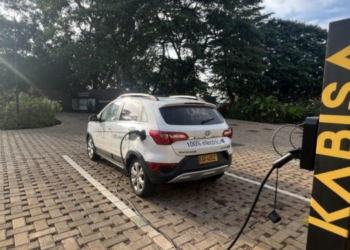
- Electric Vehicles (EVs): 0% import duty and VAT exemption until June 30, 2028. Batteries and charging equipment are also tax-free.
- Hybrid Vehicles: Reduced import duty by 25%, but VAT (18%) and excise duties (5%-15%, depending on vehicle age) still apply.
- Public Transport Vehicles: Buses with 50+ seats and minibuses carrying over 14 passengers are fully exempt from excise tax.
- Heavy-Duty Trucks: 0% duty for trucks over 20 tons; 10% for those between 5–20 tons.
- Luxury Vehicles for Tourism: Duty applies only to the CIF value up to $60,000; amounts above that are exempt.
- Industrial Machinery: Construction equipment used in infrastructure projects qualifies for 0% duty.
Eligibility
- Importers (individuals or businesses) of EVs and hybrids.
- Public transport operators and logistics companies.
- Returning Rwandan residents importing personal vehicles.
- Tourism/event organizers using high-end vehicles.
- Companies under specific government programs like MBRP.
How to Apply
- Use the Rwanda Electronic Single Window (ReSW) platform.
- Submit required documents: Bill of Lading, Commercial Invoice, Import Declaration Form, Tax ID, and proof of vehicle specs.
- For returning residents: Additional embassy recommendation and proof of legal stay abroad are needed.
- Licensed clearing agents handle customs processes.
Key Costs
- VAT (18%), withholding tax (5%), excise duties (varies), and registration fees ($58–$432 based on engine size) apply even with exemptions.
Rwanda’s vehicle import policies aim to lower costs for eligible importers while promoting green and efficient transport solutions. Ensure your documents are accurate and submitted on time to maximize savings.
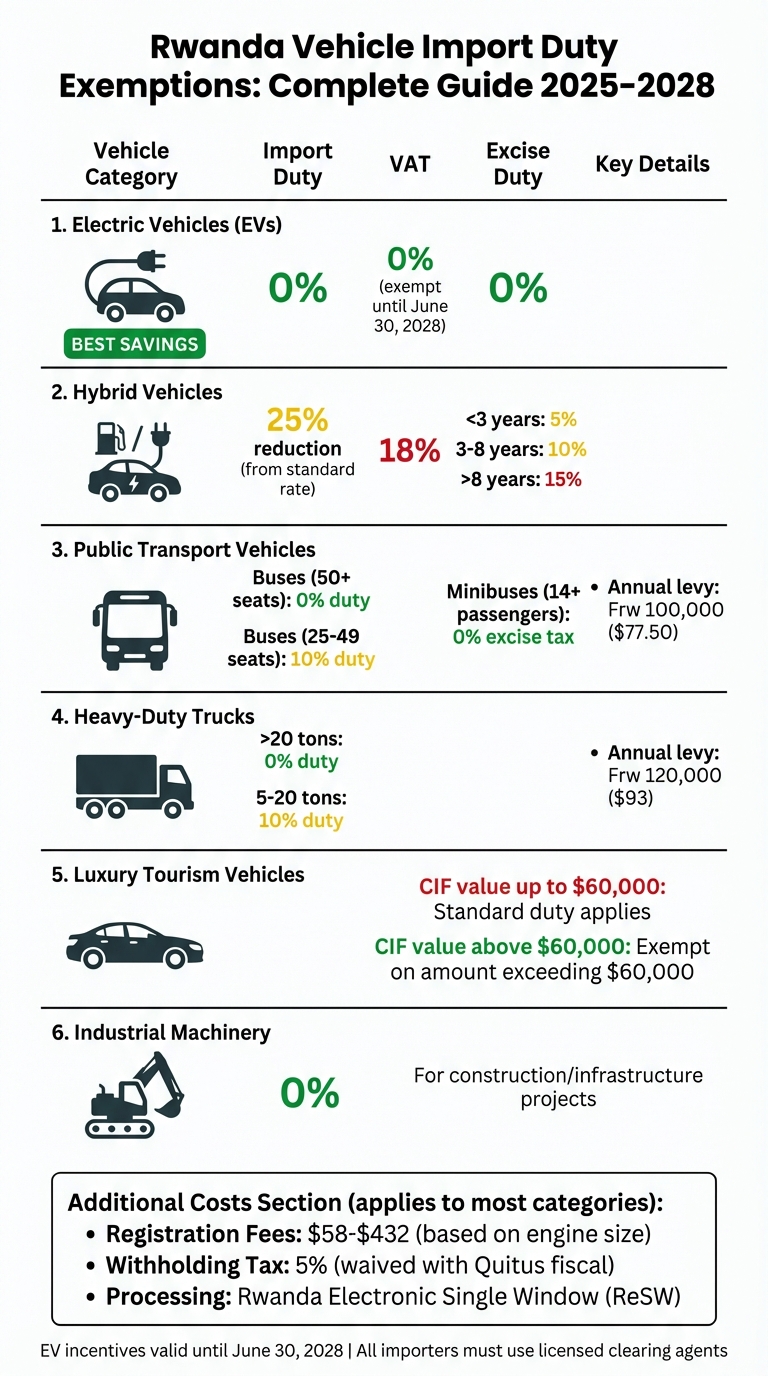
Rwanda Vehicle Import Duty Exemptions by Category 2025-2028
How Much Does It Cost to Ship a Car to Rwanda? | A-1 Auto Transport Pricing & Shipping Guide
sbb-itb-7bc66b5
Vehicle Types That Qualify for Duty Exemptions
Rwanda’s 2025/2026 reforms outline specific exemptions for certain vehicle categories. These measures are designed to support environmental goals, improve public services, and promote industrial growth.
Electric Vehicles (EVs)
Electric vehicles (EVs) benefit the most under these reforms. They are completely exempt from import duties, avoiding the usual 25% tariff applied to other vehicles. Additionally, EVs, along with their batteries and charging equipment, are exempt from VAT until June 30, 2028. This means even high-end models, like an $80,000 EV, bypass hefty taxes, making them more accessible.
Hybrid Vehicles
Hybrid vehicles receive fewer benefits compared to fully electric ones. While they enjoy a 25% reduction in import duties, they still face an 18% VAT, a 5% withholding tax, and excise duties that increase with the vehicle’s age. For example, excise rates are 5% for hybrids under three years old, 10% for those between three and eight years old, and 15% for vehicles older than eight years. A four-year-old hybrid valued at $20,000 would incur a $2,000 excise fee in addition to VAT and withholding tax.
Public Transport and Utility Vehicles
Vehicles used for public transport and essential utility services also qualify for tax relief. Minibuses and buses with seating for more than 14 passengers are fully exempt from excise tax, regardless of their fuel type. Similarly, utility vehicles like trucks, single-cabin pickups designed for goods transport, and specialized vehicles – such as ambulances, refrigerated trucks, and vehicles adapted for persons with disabilities – are also exempt. Tourism service vehicles fall under this category as well. However, these vehicles are subject to an annual road maintenance levy: Frw 100,000 (approximately $77.50) for pickups, microbuses, minibuses, and buses, and Frw 120,000 (around $93) for trucks and half-trailers.
Industrial and Machinery Vehicles
Construction and industrial machinery used for infrastructure projects qualify for a 0% import duty, provided their purpose is proven.
Who Qualifies for Duty Exemptions
Rwanda Revenue Authority Requirements
The Rwanda Revenue Authority (RRA) sets specific criteria for duty exemptions, tailored to different vehicle types and their intended purposes. Importers of electric and hybrid vehicles – whether individuals or businesses – benefit from a 0% import duty rate. Public transport providers importing buses with 50 or more seats are eligible for full duty exemptions, while buses with 25–49 seats qualify for a reduced duty rate of 10%, instead of the usual 25%.
Logistics companies enjoy a 0% duty rate for road tractors and heavy-duty vehicles exceeding 20 tons, while vehicles between 5–20 tons are subject to a reduced rate of 10%. Tourism and event organizers can access incentives for vehicles with CIF (Cost, Insurance, and Freight) values above $60,000. According to the Ministry of Finance and Economic Planning (MINECOFIN):
"While hosting high-level events and promoting the tourism sector, the incentives on cars above USD 60,000 will be extended to increase its stock."
Returning Rwandan residents who have lived abroad can also benefit from specific exemptions under RRA procedures. Additionally, goods imported for use by the Armed Forces Shop (AFOS) are exempt from duty, and companies participating in the Manufacture and Build to Recover Program (MBRP) may qualify for exemptions on related machinery.
To complete the exemption process, ensure your application includes clear evidence of vehicle specifications.
Required Documents and Proof of Use
Once you confirm eligibility through RRA guidelines, submitting accurate documentation becomes essential to claim the exemption. Applications are processed via the Rwanda Trade Portal, where you must upload all required documents. These include detailed records of vehicle specifications, such as seating capacity, gross weight, and engine type, to determine the applicable exemption.
For high-value vehicles, ensure that CIF records are precise, especially for claims on incentives beyond the $60,000 threshold. Public transport providers must demonstrate that their vehicles will be used for passenger services, while logistics companies need to verify the commercial use of their vehicles for transporting goods. The Rwanda Trade Portal provides step-by-step instructions for motor vehicle imports, covering exemptions for returning Rwandans as well as duty remission schemes.
How to Apply for Duty Exemptions
Submitting Your Application Through the RRA Portal
To handle motor vehicle registration and customs processes, use the Rwanda Electronic Single Window (ReSW) platform. Before logging in, gather all necessary documents: Bill of Lading/Airway Bill, Commercial Invoice, Packing List, Import Declaration Form (IDF), and your Tax Identification Number (TIN). If you’re importing a personal vehicle, you’ll also need a copy of your passport or Rwandan ID.
For returning residents, additional steps are required. Submit a request letter to the Commissioner General of the RRA, along with a recommendation from a Rwandan Embassy, proof of legal stay abroad, a one-year vehicle logbook, insurance documents, and confirmation that the vehicle is left-hand drive. Note: Right-hand drive vehicles are not eligible for duty exemptions.
To complete the process, work with a licensed clearing agent who will submit your documents and handle tax calculations through the RRA portal. Customs value is assessed based on the CIF (Cost, Insurance, and Freight) price. For used vehicles over 10 years old, an 80% depreciation is applied to the FOB rate. Depending on the exemption scheme, you may also need to complete Form R1 for duty remission or Form C17 for goods entry under remission regulations.
Once submitted, it’s important to understand processing times and the remaining taxes even after exemptions.
Processing Times and Remaining Taxes
The RRA doesn’t specify exact timelines for duty exemption applications, but related services offer some clues. For instance, Taxpayer Identification Numbers are issued in about 5 minutes, and Tax Clearance Certificates are processed within one working day. Duty remission approvals under EAC regulations are valid for 12 months from the date they are published in the Gazette.
Even with a full duty exemption, you’ll still need to cover other costs. Importers are typically responsible for 18% VAT, 5% Withholding Tax, and a Consumption Tax that varies by vehicle type. However, if you hold a "Quitus fiscal" – a certificate for taxpayers in good standing – you can skip the 3% or 5% withholding tax at customs. Registration fees depend on engine capacity, ranging from 75,000 RWF ($58) for engines under 1,000 cc to 560,000 RWF ($432) for engines above 4,501 cc. Additional expenses include warehouse handling fees and securing a goods exit note.
For those importing electric vehicles, there are extra opportunities to save.
Tips for EV Importers
If you’re importing an electric vehicle (EV), aim to complete the process by June 30, 2028, to take advantage of current incentives. These include a 0% import duty and potential VAT exemptions, which can significantly lower your costs. Be sure to include clear documentation of the vehicle’s electric powertrain specifications to avoid delays during processing.
Regular importers may want to apply for a Quitus fiscal to bypass customs withholding tax. Returning residents importing personal vehicles should finalize the process within three months of arriving in Rwanda. After clearing customs, ensure the vehicle is registered at designated locations like Gikondo before driving it on Rwandan roads.
Conclusion
Rwanda’s exemptions make importing vehicles easier while encouraging progress toward greener transportation. These duty exemptions offer notable savings for eligible importers, covering categories like electric and hybrid vehicles, public transport fleets, and heavy-duty logistics equipment.
To apply, you’ll need precise documentation and the help of licensed clearing agents via the RRA portal. Keep in mind that VAT, withholding, and excise duties still apply. For electric vehicle importers, it’s crucial to monitor annual policy updates, as incentives are reviewed regularly.
"This intends to accelerate the transition to Electric Vehicles and reduce greenhouse gas emissions from vehicle transportation." – Ministry of Finance and Economic Planning (MINECOFIN)
Rwanda’s ongoing policy adjustments and dedication to sustainable transport reflect its drive toward a greener future. By knowing your eligibility and submitting accurate paperwork, you can simplify the import process and maximize your benefits.
FAQs
Do used cars qualify for any exemptions?
Used cars can sometimes be imported into Rwanda without paying duties, but this depends on certain conditions. For instance, electric vehicles or cars that fall under specific exemption policies may qualify. That said, the majority of used vehicles will still incur import duties unless they clearly meet the criteria for an exemption.
Can I still pay VAT even if import duty is 0%?
Yes, VAT still applies even when the import duty is set at 0%. VAT is a separate tax that is calculated based on the total value of the imported vehicle. This means you are required to pay VAT regardless of whether or not any import duty is charged.
What proof does RRA need to approve an exemption?
To get an exemption approved by the Rwanda Revenue Authority (RRA), you’ll need to provide proof of ownership. This means submitting a logbook that shows you’ve owned the item for at least one year, along with evidence of insurance coverage for that same period. Double-check that all your documents are correct and current before sending in your application.
Related Blog Posts
- Rwanda’s EV Incentives: What Drivers Need to Know
- Car import duties in Rwanda: Updated costs and procedures for 2025
- Car Import Tax in Rwanda: Complete 2025 Guide
- How to Import a Car to Rwanda: Step-by-Step and Costs