Rwanda is reshaping its car market with policies that favor electric vehicles (EVs) over gas-powered and hybrid models. Here’s what you need to know:
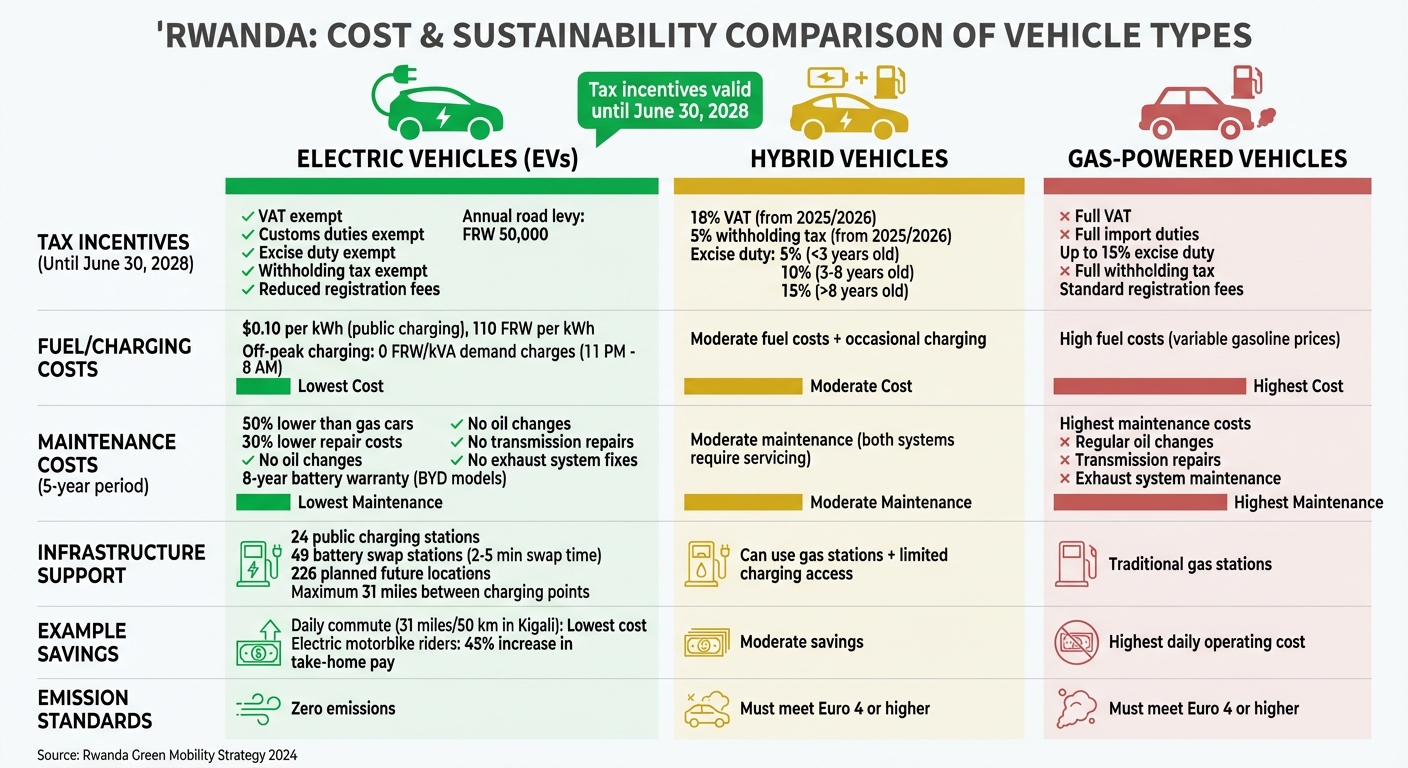
- Tax Incentives: EVs are exempt from VAT, customs duties, excise duty, and withholding tax until June 30, 2028, making them cheaper to import. Hybrid and gas-powered cars face higher taxes, especially older models.
- Charging Infrastructure: Rwanda has 24 public charging stations and 49 battery swap stations, with plans for 224 more locations. Electricity rates for EV charging are capped at 50% of industrial rates.
- Emission Standards: New regulations require imported vehicles to meet Euro 4 standards or higher, discouraging older, high-emission cars.
- Cost Savings: EVs have lower maintenance and fuel costs compared to traditional vehicles, making them a financially attractive choice over time.
Rwanda’s green mobility strategy is pushing for cleaner transportation options, with 20% of public transport targeted to run on electricity by 2030. For car buyers, it’s a good time to consider EVs for long-term savings and reduced taxes.
Government Policies and Incentives for Buyers
Tax Breaks and Import Incentives
Rwanda is making a strong push to reduce the cost of owning electric vehicles (EVs). Until June 30, 2028, EVs are entirely exempt from major import taxes. This includes exemptions on vehicles, charging equipment, and spare parts – a significant financial relief for potential buyers.
On the other hand, hybrid vehicles will see changes starting in 2025. They’ll face an 18% VAT and a 5% withholding tax in the 2025/2026 fiscal year. Gas-powered cars, however, remain subject to full taxation, including VAT, excise duties (up to 15%), import duties, and withholding taxes.
Financial Support Programs for EV Purchases
The government is also taking steps to support the broader EV ecosystem. These initiatives aim to reduce costs for early adopters and businesses transitioning to electric fleets. Companies involved in EV assembly, charging infrastructure, or battery-swapping stations are eligible for benefits like tax breaks, streamlined licensing processes, and land allocations. Logistics and transport operators switching to EVs can enjoy a reduced corporate income tax rate of 15%, while investments exceeding $50 million qualify for a 7-year tax holiday.
"The incentives will also play a role to mobilize investment into the e-mobility sector which has fast emerged as a top sector on demand."
- Alfred Byiringiro, Director General for Transport.
New Rules for Gas-Powered Vehicles
To discourage reliance on traditional vehicles, the government has introduced age-based taxation. Hybrid vehicles are now subject to excise duties of 5% for models under 3 years old, 10% for those aged 3-8 years, and 15% for older models. Additionally, all imported gas-powered and hybrid vehicles must comply with Euro 4 or higher emission standards.
"In line with our commitment to environmental protection and reducing emissions, we want full-electric vehicles to become the preferred choice."
- Minister Godfrey Kabera, Minister of State for National Treasury.
These policies are not just about promoting EV adoption – they’re also designed to make high-emission vehicles less appealing. By reducing the financial burden of EV ownership and tightening regulations on traditional cars, Rwanda is paving the way for a cleaner, more sustainable future in transportation.
sbb-itb-7bc66b5
Infrastructure for Electric Vehicles
Charging Stations Across Rwanda
Rwanda has established more than 200 EV charging stations nationwide, with Kigali alone hosting around 35 chargers for electric cars and 165 for electric motorbikes. These stations are conveniently placed at key locations like shopping malls, office complexes, and the Kigali Convention Center.
To bolster this network, the government has developed a master plan ensuring that no electric vehicle will need to travel more than 31 miles without access to a charging point. Additionally, geospatial analysis has pinpointed 226 potential sites for future stations, focusing on an "infrastructure first" strategy to address range anxiety before EV adoption scales up.
The charging options include AC (Type 2) chargers, which can fully charge a vehicle in 3–6 hours overnight, and DC fast chargers (using CCS2 or GBT standards), capable of reaching 80% charge in just 20–30 minutes. For prospective EV buyers, understanding connector compatibility is crucial – CCS2 is becoming the standard for European and American models, while GBT remains prevalent in Chinese vehicles. These developments ensure that both urban and rural users have access to dependable, fast-charging solutions.
Solar-powered charging stations, equipped with battery storage, guarantee uninterrupted service even during power grid fluctuations. Companies like Meshpower and Kabisa are leading these initiatives, ensuring 24/7 reliability. Moreover, electricity rates for EV charging have been capped at $0.10 per kilowatt-hour – half the standard industrial rate – making EV operation more cost-effective. This extensive charging network pairs well with innovative solutions like battery swapping, easing the transition to electric mobility in urban areas.
Battery Swap Services and Repair Shops
Complementing the charging network, battery swap services provide a quick and efficient solution, particularly for electric motorbike users. By July 2025, Rwanda had 49 battery swap stations, with 32 located in Kigali and managed by Ampersand. This system allows riders to exchange a depleted battery for a fully charged one in just 2–5 minutes, supporting a fleet of over 5,200 electric motorbikes. These savings on fuel and maintenance have increased riders’ take-home pay by as much as 45%.
"The transformation is real. Electric mobility is not just an environmental choice but also an economic one."
- Teddy Mugabo, CEO, Rwanda Green Fund (FONERWA)
Specialized EV maintenance centers are also enhancing after-sales services. In 2024, CFAO Mobility Rwanda introduced Rwanda’s first BYD dealership in Kigali, offering dedicated services and an eight-year battery warranty for models like the Atto 3 and Dolphin. Additionally, companies such as Volkswagen Rwanda and Kabisa have established EV repair services in Kigali, with repair costs estimated to be 30% lower than those for traditional gas-powered vehicles. These advancements in battery swapping and maintenance align with Rwanda’s vision of making green mobility affordable and accessible in the long term.
Inside KABISA: Rwanda’s EV Revolution | WIB Documentary
Comparing Ownership Costs: Gas vs. Electric
EV vs Gas vs Hybrid Cars in Rwanda: Tax & Cost Comparison 2024-2028
Rwanda’s focus on sustainable mobility puts electric vehicles (EVs) in the spotlight. Here’s how EV ownership stacks up against gas-powered cars in terms of costs.
Purchase Price and Tax Savings
While EVs come with a higher upfront price tag, tax exemptions help close the gap. For EVs that fall under a specific CIF (Cost, Insurance, and Freight) threshold, multiple tax exemptions apply.
Gas-powered vehicles, on the other hand, are subject to standard import taxes and registration fees. EVs benefit from reduced or even waived registration costs, while hybrids face moderate tax rates, offering a middle ground. These tax breaks can quickly offset the initial higher cost of an EV.
But the real difference emerges when you consider operating expenses.
Gas Prices vs. Electricity Costs
Charging an EV is far cheaper than filling up a gas tank. Public charging stations in Rwanda charge 110 Rwandan Francs per kilowatt-hour, which is significantly lower than residential electricity rates. This translates to about $0.10 per kWh for public charging.
For example, a commuter driving 31 miles (50 km) daily in Kigali spends much less on electricity than a petrol car owner covering the same distance. Fleet operators see even bigger savings by charging vehicles during off-peak hours (11 PM to 8 AM), when demand charges drop to zero FRw/kVA under Time-of-Use tariffs. Even though Rwanda’s electricity costs are among the highest in mainland Africa at roughly $0.193/kWh, EV charging remains a cost-effective alternative to the unpredictable prices of gasoline.
These savings on fuel are further enhanced by the lower maintenance costs of EVs.
Maintenance and Repair Costs
EVs generally cost 50% less to maintain over five years compared to gas-powered cars. This is because EVs have fewer moving parts, eliminating the need for oil changes, transmission repairs, or exhaust system fixes.
The main maintenance tasks for EVs involve checking battery connectors, cooling systems, and tire pressure. Rwanda’s hilly landscape also works in favor of EV owners, as regenerative braking reduces brake wear and extends battery life. Moreover, companies like CFAO offer eight-year battery warranties on models such as the BYD Atto 3 and Dolphin, giving owners added peace of mind.
For those charging at home, installing a Level 2 charger (at least 7 kW) is a smart move. It allows for consistent overnight charging, which is gentler on the battery compared to frequent fast charging, helping to maintain battery health over time.
Buying Guide for Car Shoppers in Rwanda
Selecting the Right EV for Your Needs
When choosing an electric vehicle (EV) in Rwanda, your driving habits and typical routes play a big role. For city dwellers in Kigali, Battery Electric Vehicles (BEVs) are an excellent choice. They offer lower running costs and are supported by Kigali’s growing fast-charging network. On the other hand, if you often travel to rural areas where charging stations may be scarce, Plug-in Hybrid Electric Vehicles (PHEVs) can provide peace of mind with their gasoline backup engines.
If your routes include hilly terrains, look for EVs with strong regenerative braking systems to maximize energy efficiency. For example, the Hyundai Kona Electric boasts a range of about 298 miles (480 km) per charge, while the Nissan Leaf offers around 149 miles (240 km). If you’re considering a used EV, make sure to check the battery’s health and the condition of the charging system before making your purchase.
Once you’ve identified the EV that fits your needs, it’s time to explore financing options to make ownership more affordable.
Financing Options for EV Purchases
Rwanda offers several tax incentives to make EV ownership more attractive. Until June 30, 2028, electric vehicles are exempt from VAT, customs duties, excise duty, and withholding tax. To maximize these benefits, ensure the imported EV has a CIF (Cost, Insurance, and Freight) value of $60,000 or less. Additionally, annual road levies are capped at FRW 50,000, and certain EV models may qualify for reduced registration fees.
When securing insurance, look for policies that cover battery replacement and home charging equipment. Platforms like AUTO24.rw can assist with navigating customs processes, registration, and Rwanda’s evolving tax policies, making the purchase process smoother.
After buying your EV, focus shifts to charging and maintaining your vehicle for optimal performance.
Managing Charging and Maintenance
Rwanda’s growing charging infrastructure makes it easier to keep your EV powered. For home charging, installing a Level 2 charger with a capacity of 7 kW or higher can reduce charging times to 4–8 hours, compared to the 8–15 hours required by a standard household outlet. Installation costs typically range from FRW 300,000 to FRW 800,000 (about $220–$590), including any necessary electrical upgrades. Charging overnight during off-peak hours saves on electricity costs and helps maintain battery health.
For trips around Kigali, apps like PlugShare or ChargeMap can guide you to the 24 public charging stations and 49 battery swap stations currently available in Rwanda. Regularly monitor your tire pressure, as underinflated tires can increase rolling resistance and reduce your EV’s range. Routine maintenance for EVs in Rwanda primarily involves checking battery cooling systems and keeping software updated. Specialized service centers are now equipped to handle these needs.
Conclusion: What’s Next for Car Buyers in Rwanda
Rwanda’s push toward green mobility is transforming the car market, creating new opportunities for early adopters. Thanks to existing tax incentives, importing an electric vehicle (EV) is much more affordable compared to traditional fuel-powered cars. On top of that, the government is actively working on expanding the charging infrastructure, with 224 new locations already planned.
The numbers reflect this shift: EV imports are expected to hit 512 units by 2024, and electricity tariffs for EV charging have been capped at just 50% of standard industrial rates.
For car buyers in Rwanda, timing is everything. Purchasing an EV before the tax holiday ends offers the most savings. Meanwhile, those leaning toward hybrids should focus on newer models to take advantage of reduced excise rates. These policies are steering the market away from older vehicles and accelerating the move toward full electrification, making cleaner technology the most cost-effective choice.
To make the transition even smoother, innovative financing options are being introduced. With Rwanda aiming to have 20% of its public transport fleet electric by 2030, the momentum for green mobility is only growing stronger.
The combination of a growing charging network, supportive policies, and a wider range of vehicles makes the switch to electric more accessible than ever. Early adopters stand to gain the most from these incentives and the ongoing improvements in infrastructure. It’s a great time to embrace Rwanda’s green mobility revolution.
FAQs
Which EVs qualify for Rwanda’s tax exemptions?
Electric vehicles (EVs) qualifying for Rwanda’s tax exemptions include fully electric cars, hybrid cars, and electric motorcycles. Starting July 1, 2025, these vehicles will be exempt from import duty, VAT, and excise duty. The goal of this initiative is to make environmentally friendly transportation options more affordable and accessible for consumers.
Can I rely on charging outside Kigali for long trips?
Rwanda has developed an EV charging network that ensures no electric vehicle travels more than 50 kilometers without access to a charging station. With over 224 potential sites identified across the country, even long-distance trips outside Kigali are manageable for EV owners.
What should I check before buying a used EV in Rwanda?
Before buying a used electric vehicle (EV) in Rwanda, it’s important to do your homework. Start by reviewing the vehicle’s history – look for any signs of past accidents, odometer tampering, or unresolved ownership issues. Next, calculate the total import costs, which include duties and registration fees, and make sure all the legal paperwork is in order.
You’ll also want to evaluate the EV’s maintenance requirements and check if there are reliable service networks nearby to handle repairs or part replacements. Lastly, think about charging options. While EV charging stations are increasing, rural areas might still have limited access, so plan accordingly.
Related Blog Posts
- Rwanda EV Import Duty Exemptions Explained
- Rwanda’s EV Incentives: What Drivers Need to Know
- Electric Cars in Rwanda: 2025 Guide for New Buyers
- EV Policy Updates for 2025/2025 in Rwanda