Rwanda’s electric vehicle (EV) market is transforming in 2026, driven by falling battery costs, government incentives, and a growing charging network. Here’s what you need to know:
- EV Prices Are Dropping: Battery costs are now $80/kWh, making EVs as affordable as gas-powered cars. Tax exemptions on EVs and charging equipment reduce costs further, while hybrids face higher taxes, pushing buyers toward fully electric vehicles.
- Government Incentives: Buyers benefit from zero VAT, no import duties (on EVs under $60,000), and reduced corporate taxes for e-mobility businesses. These policies are encouraging both personal and commercial EV adoption.
- Charging Infrastructure Expansion: Over 224 charging sites have been mapped, ensuring stations are no more than 31 miles apart. Electricity tariffs for EV charging are capped at 50% of standard industrial rates, and renewable energy powers most stations.
The market is expected to grow from $450M in 2025 to $690M in 2026, with e-motorcycles and electric buses leading the way. Rwanda’s Vision 2050 plan and clean energy goals are setting the stage for long-term growth in e-mobility.
Rwanda EV Market 2026: Key Statistics, Prices, and Incentives
EV Price Changes in Rwanda by 2026
EV Prices Compared to Gas-Powered Vehicles
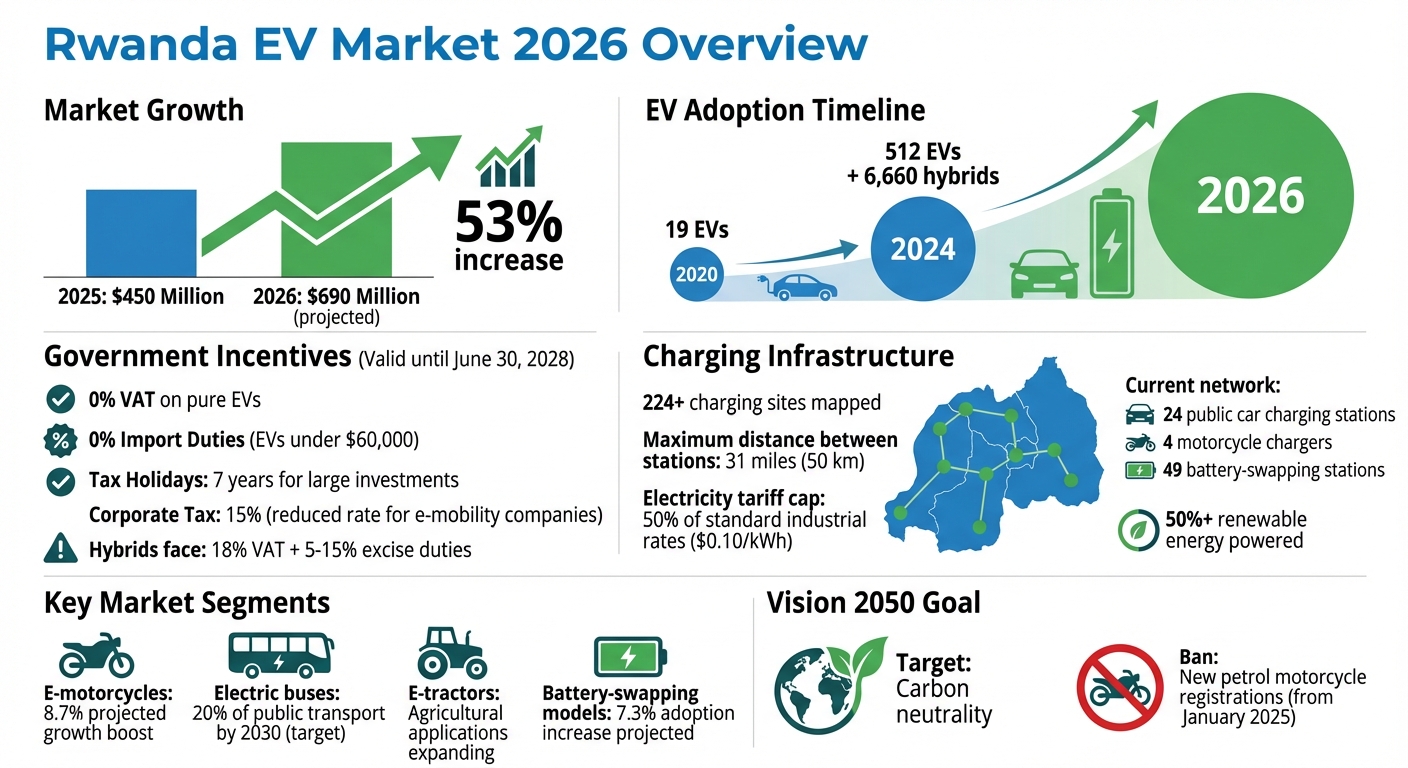
In Rwanda, the cost of electric vehicles (EVs) is steadily aligning with that of gas-powered cars. A major factor driving this shift is the VAT exemption on pure EVs and imported charging equipment, which will remain in place until June 30, 2028. This policy provides a noticeable pricing advantage for EVs over traditional gas vehicles.
On the other hand, hybrids have faced increased costs since 2025, as they are subject to an 18% VAT and age-based excise duties. This makes hybrids a less appealing option for buyers compared to battery electric vehicles (BEVs). These evolving tax policies are shaping a clear distinction between BEVs and plug-in hybrid electric vehicles (PHEVs) in the market.
Expected EV Prices in 2026
The current tax incentives are driving consumer interest toward BEVs, aligning with Rwanda’s larger push for e-mobility. These measures are not just influencing preferences but are also reshaping the market landscape.
Thanks to these government exemptions, BEVs are expected to reach cost parity with similar gas-powered vehicles in the coming years. In contrast, PHEVs face a competitive disadvantage due to the 18% VAT and additional excise duties, which significantly increase their overall ownership costs. This disparity is expected to further tilt the market in favor of BEVs by 2026.
sbb-itb-7bc66b5
Government Support Programs for EV Buyers
Tax Breaks and Financial Support
Starting July 1, 2025, Rwanda’s government introduced tax exemptions to encourage electric vehicle (EV) adoption. These incentives will run until June 30, 2028, giving buyers a three-year window to take advantage of significant savings.
The financial perks are hard to ignore. EV buyers are exempt from the 18% VAT, excise taxes of up to 15%, and a 5% withholding tax usually applied to conventional vehicles. Import duties are also waived for EVs valued under $60,000 (CIF value). However, annual road levies still apply, ranging from FRW 50,000 for cars to FRW 150,000 for larger trucks. These exemptions extend beyond vehicles, covering charging equipment, batteries, and EV-specific spare parts, which lowers the overall cost of ownership.
The results speak for themselves. Between 2020 and 2024, EV imports jumped from 19 to 512 units. These policies have also spurred innovative projects, such as Volkswagen‘s GenFarm e-tractor rollout, which highlights how financial incentives can drive practical applications in sectors like agriculture.
These tax breaks are a key part of Rwanda’s broader clean transportation goals.
National Clean Transportation Plans
As part of its Vision 2050 strategy, Rwanda is pushing for carbon neutrality, with electric mobility playing a critical role in reducing emissions from transportation. By 2030, the government aims to have 20% of its public transport fleet converted to electric. This transition is supported by the country’s renewable energy grid, where over 50% of electricity comes from hydroelectric and solar sources.
To tackle range anxiety, especially in rural areas, the Ministry of Infrastructure is working on an EV charging master plan. This plan ensures charging stations are no more than 31 miles (50 km) apart, with 224 future charging locations already mapped out for nationwide coverage. Additional measures include offering rent-free land for charging stations built on state-owned property and capping electricity tariffs for EV charging at 50% of standard industrial rates. Together, these efforts address both the upfront and long-term costs of owning an EV.
This integrated approach – combining financial incentives and infrastructure development – is already reshaping Rwanda’s transportation landscape.
How Incentives Affect EV Sales
The impact of these programs is clear, with adoption rates rising and expected to grow even faster through 2026. For comparison, Kenya’s similar policies led to a five-fold increase in EV registrations in 2023, suggesting Rwanda could see similar results.
Rwanda’s electric vehicle market is projected to grow from $0.45 billion in 2025 to $0.69 billion in 2026. Tax reforms are also shifting preferences toward battery electric vehicles, as hybrids now face 18% VAT and age-based excise duties of 5% to 15%. Commercial fleet operators stand to gain the most – electrifying vehicles like boda-bodas (motorcycle taxis) could cut emissions by 85%.
E-mobility companies in Rwanda enjoy additional benefits, including a reduced 15% corporate tax rate, 7-year tax holidays for large-scale investments, and tax-free imports of manufacturing equipment within Special Economic Zones. Companies like Ampersand are scaling up battery-swapping stations for electric motorbikes, while Tailing Electric Vehicle has set up a manufacturing plant in the Gahanna Industrial Zone to produce electric tricycles, scooters, and bikes.
Charging Network Development by 2026
Growth in Public Charging Stations
Rwanda is making strides in expanding its charging network to support the growing adoption of electric vehicles (EVs), aligning with its broader goals of e-mobility. The Ministry of Infrastructure has laid out a master plan to ensure that no EV driver is more than 31 miles (50 kilometers) away from a charging station, guaranteeing convenient access for travelers across the country.
A detailed geospatial analysis has pinpointed over 226 potential sites for charging infrastructure, prioritizing high-traffic areas, existing gas stations, and commercial properties. By late 2024, the network featured 24 public charging stations for cars, offering both AC and DC options, 4 direct chargers for motorcycles, and 49 battery-swapping stations catering primarily to commercial two-wheelers.
Private companies are playing a major role in this development. Ampersand is focused on establishing battery-swapping stations for electric motorcycles, while Volkswagen Rwanda and BasiGo are setting up charging points for passenger vehicles and electric buses. These efforts are supported by public-private partnerships, with the government providing tax incentives and private investors managing installation and operations.
This growing network not only enhances EV accessibility but also opens the door to incorporating renewable energy sources into the charging infrastructure.
Clean Energy for Charging Stations
Rwanda’s charging stations are largely powered by renewable energy, thanks to the country’s investments in hydroelectric and solar power systems. The Ministry of Infrastructure has prioritized integrating these sustainable energy sources into all new charging stations.
By March 2026, the impact of EVs on local economies was already evident. For instance, in Nyamagabe District, the use of EVs for transporting animal feed helped cut chicken feed prices from FRW 700 to FRW 500 per kilogram. Vicent Uwimana, Acting Director of Agriculture and Animal Resources, highlighted the efficiency of this approach:
"The whole network uses renewable energy, evidencing that the new model of transport is more efficient than petrol or gas."
2026 Charging Network Statistics
Rwanda’s charging network has expanded rapidly, reflecting the nation’s commitment to sustainable transportation. From just 19 EVs in 2020, the fleet grew to 512 EVs by 2024, alongside 6,660 hybrid vehicles, supported by a robust charging infrastructure. The network now includes fast chargers for passenger vehicles and buses, as well as specialized motorcycle chargers and battery-swapping facilities designed to minimize downtime.
New policies are also encouraging property developers and businesses to install EV charging stations in office buildings, shopping malls, and residential areas. This initiative allows drivers to charge their vehicles overnight or during work hours, reducing dependence on public charging stations. Combined with the identification of over 226 future sites, this strategy ensures the network will continue to grow through 2026 and beyond.
Market Developments and Business Opportunities
Rwanda’s Clean Energy Commitments
Rwanda is making bold moves toward a greener future by transitioning from internal combustion engines to electric vehicles (EVs) as part of its broader green economy strategy. Central to this vision is the country’s Vision 2050 plan, which aims for carbon neutrality, with EV adoption forming a key pillar of its transportation goals. Over 50% of Rwanda’s electricity now comes from renewable sources, which significantly reduces the operational costs of EVs.
To accelerate this transition, Rwanda has introduced a ban on new petrol motorcycle registrations starting January 2025. This move is expected to drive demand for electric two-wheelers and create opportunities for local manufacturers. On top of that, the government has rolled out tax holidays and zero-duty incentives for EVs, making them more competitive with traditional vehicles.
These initiatives are creating fertile ground for new market opportunities and driving innovation across various industries.
Growing EV Market Segments
Electric two-wheelers are at the forefront of Rwanda’s EV market growth. Local assembly plants are ramping up production, and specialized applications, particularly in agriculture, are emerging as game-changers. E-motorcycles are seen as a "leapfrog" technology, with experts predicting an 8.7% boost in market growth within just two years. Companies like Tailing Electric Vehicle have already set up operations in the Gahanna Industrial Zone, producing electric tricycles, scooters, and bikes for both local and regional markets.
The agricultural sector is also embracing electrification. For instance, Volkswagen’s GenFarm e-tractor initiative showcases how tax breaks and renewable energy infrastructure are enabling the electrification of farming equipment. Meanwhile, BasiGo, a key player in the region, secured $42 million in early 2024 to deploy 1,000 electric buses across Kenya and Rwanda. Their "Pay-As-You-Drive" battery leasing model is making it easier for fleet operators to adopt EVs by lowering upfront costs.
Battery-swapping models are another innovation reshaping the market. By separating battery costs from vehicle prices, these models are projected to drive a 7.3% increase in market adoption. Additionally, OEM-fintech partnerships are introducing micro-leasing options, enabling middle- and lower-income buyers to lease EVs with flexible payment terms. This approach is expected to contribute to a 6.1% market growth boost.
Industry Players and Partnerships
Rwanda’s relatively small size and well-developed infrastructure make it an ideal testing ground for EV innovation. Unlike many other nations, Rwanda isn’t weighed down by legacy internal combustion engine supply chains. This allows local manufacturers to fully embrace battery electric vehicle (BEV) architectures without the need for transitional technologies.
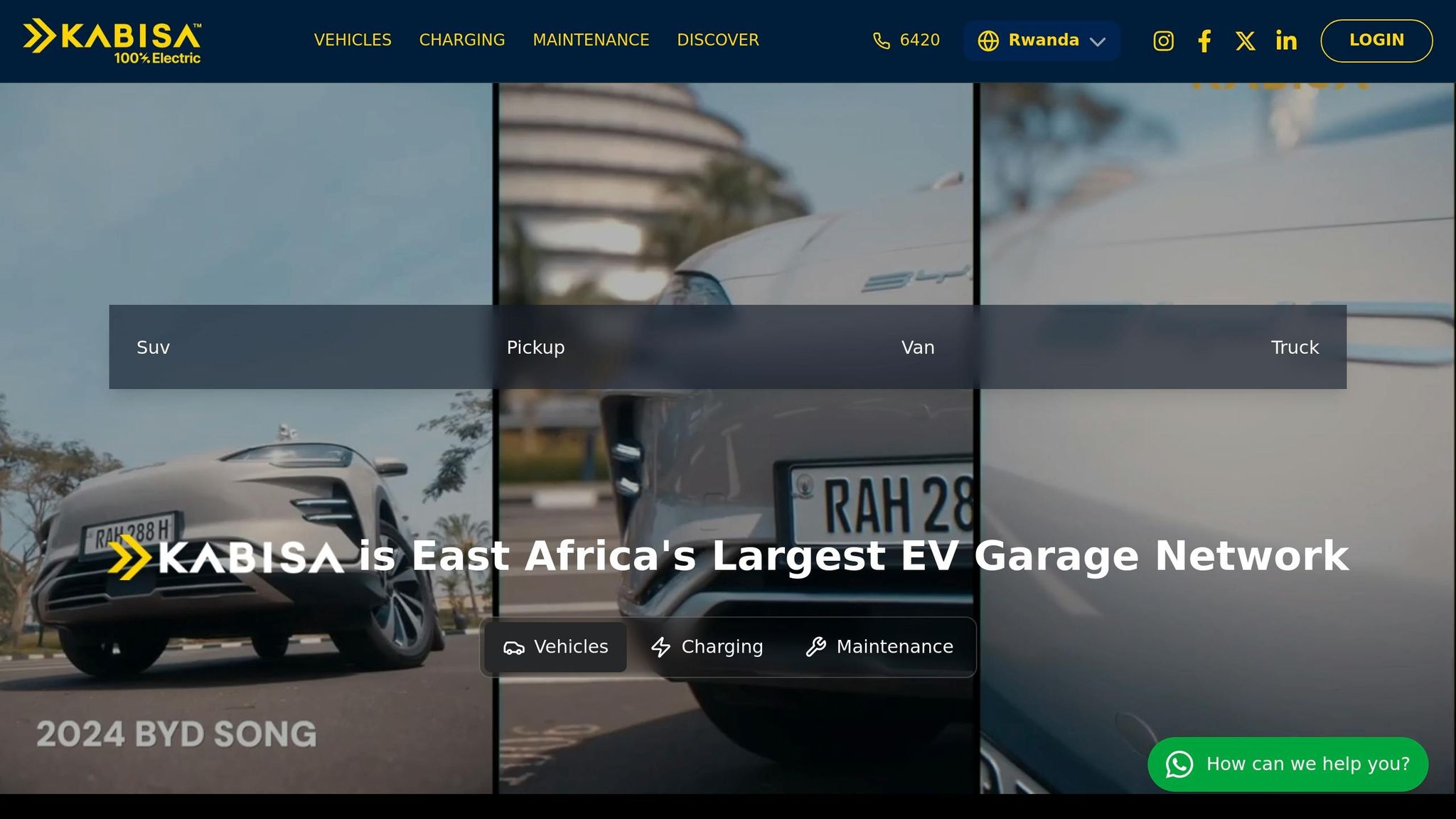
In February 2025, Kabisa launched Rwanda’s first ultra-fast charging hub at the SP Kanombe station in Kigali. Equipped with 240 kW chargers across six bays, the hub can charge vehicles in just 15–25 minutes. Speaking about the launch, Managing Director Pophia Muhoza noted:
"an important step in our progress towards an ultra-fast, convenient network across the entire region."
This charging hub benefits from government-backed incentives, including capped electricity tariffs at $0.10 per kWh and rent-free land. Meanwhile, the Rwanda Green Fund (Ireme Invest) is stepping in with critical funding for private sector EV projects, fostering collaboration between public and private stakeholders.
AUTO24.rw is another key player driving EV adoption. The company specializes in certified second-hand EVs and has become the largest importer of electric vehicles in Rwanda, offering consumers more options.
Regional integration through the African Continental Free Trade Area (AfCFTA) is also boosting Rwanda’s EV market by creating supply-chain efficiencies. As local battery production scales up, the cost of BEVs is expected to drop, positioning Rwanda as a potential manufacturing hub for the region.
Inside KABISA: Rwanda’s EV Revolution | WIB Documentary
Conclusion
Rwanda’s electric vehicle (EV) market is set to undergo a major shift by 2026, driven by dropping prices, strong government backing, and a growing network of charging stations.
The cost of EVs is steadily decreasing, with the market projected to grow from $450 million in 2025 to $690 million in 2026, thanks to lower battery costs. Government initiatives are fueling this growth with measures like zero-duty incentives and tax holidays, making it easier for consumers to access e-motorcycles and e-tractors. Meanwhile, the charging infrastructure is expanding under a master plan that ensures stations are no more than 31 miles apart, supported by capped electricity tariffs at 50% of standard rates.
Tax exemptions and reduced duties are helping to bring down the overall cost of EV ownership. For businesses and industry players, keeping an eye on the charging infrastructure developments and forming partnerships with local EV manufacturers could open up new opportunities. For eco-conscious consumers, Rwanda’s reliance on renewable energy makes EV adoption even more appealing.
These efforts are creating a strong foundation for growth across all EV market segments. Beyond 2026, Rwanda’s EV market is expected to continue its upward trajectory, supported by clean energy goals under Vision 2050, regional trade through AfCFTA, and advancements like battery-swapping systems and agricultural e-tractors. Together, these trends are paving the way for Rwanda’s transition to a zero-emission future.
FAQs
Do I qualify for Rwanda’s EV tax breaks, and for how long?
Rwanda offers impressive tax incentives for electric vehicle (EV) buyers and importers. These include complete exemptions from VAT, import duty, and excise duty. The program runs through at least 2028, making EVs more affordable and accessible by reducing overall costs significantly.
What EV charging options will be easiest in 2026 (fast charging vs. battery swapping)?
By 2026, fast charging is predicted to become the go-to option for electric vehicle (EV) users in Rwanda, largely due to the steady growth of the charging network. In contrast, battery swapping is expected to play a less prominent role in the country’s EV market.
Will an EV cost less to own than a gas car in Rwanda by 2026?
By 2026, owning an electric vehicle (EV) in Rwanda is projected to cost less than owning a gas-powered car. Drivers could save over $800 annually on fuel and maintenance, thanks to lower operating expenses, making EVs a more budget-friendly option.