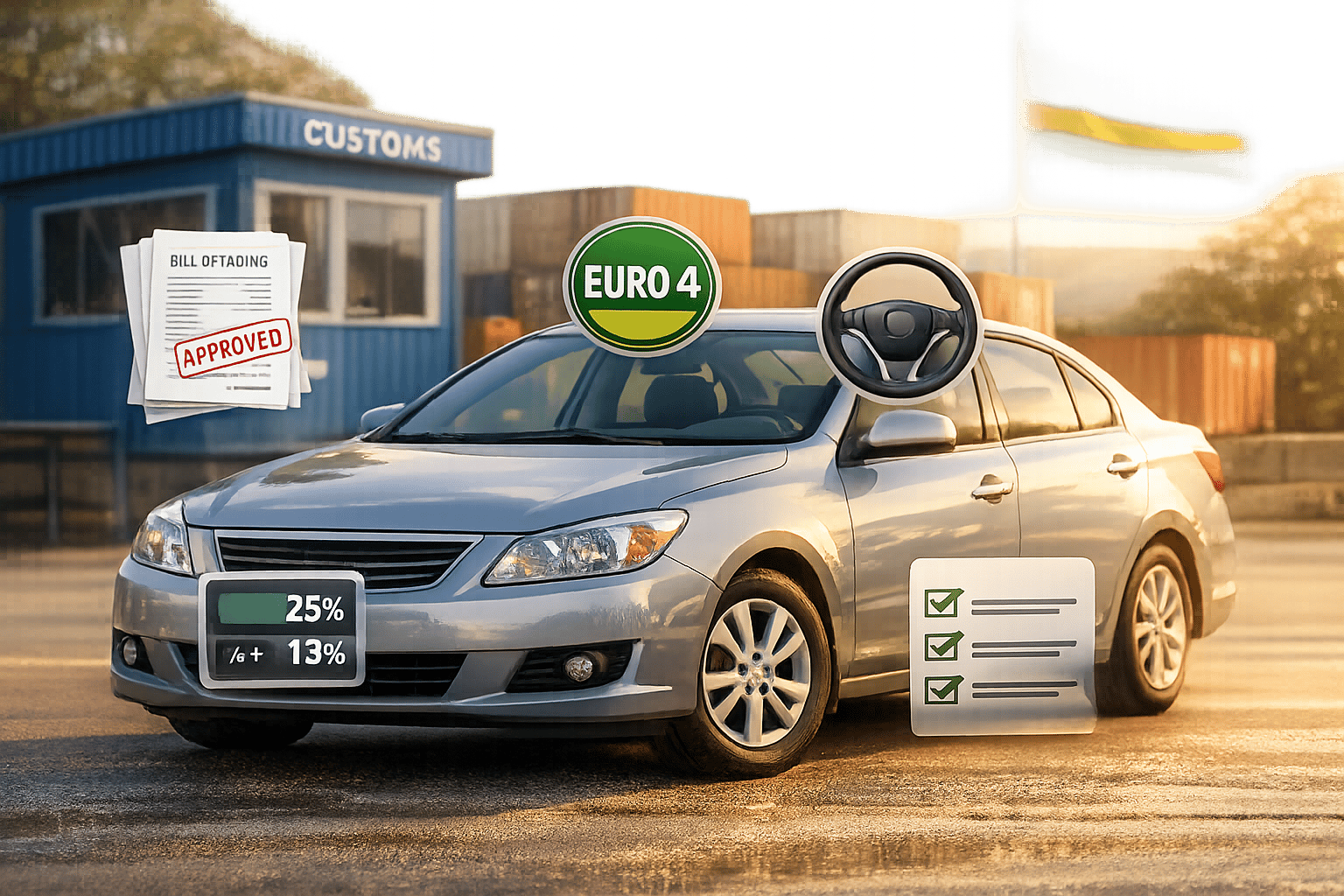
Importing a used car into Rwanda can be cost-effective, but it requires strict adherence to regulations to avoid delays and hefty fees. Here’s what you need to know:
- Key Costs: Taxes on a $24,000 car can total around $13,150, including customs duty (25%), VAT (18%), and withholding tax (5%).
- Euro 4 Emission Standards: Since August 18, 2025, all vehicles must meet Euro 4 standards, with compliance verified via inspection reports.
- Required Documents: Essential paperwork includes the Bill of Lading, Certificate of Origin, Commercial Invoice, Logbook, and Vehicle Inspection Certificate.
- Customs Process: Use the Rwanda Electronic Single Window (ReSW) to submit documents. Missing paperwork can lead to storage fees of up to 4% of the car’s value in 15 days.
- Vehicle Requirements: Only left-hand drive vehicles are allowed for permanent import. Right-hand drive vehicles are restricted to 14-day temporary use.
- Registration Fees: Costs range from 75,000 RWF to 560,000 RWF based on engine size, plus annual safety and emissions checks.
Proper preparation, including hiring a licensed customs agent, ensures smooth clearance and avoids costly delays.
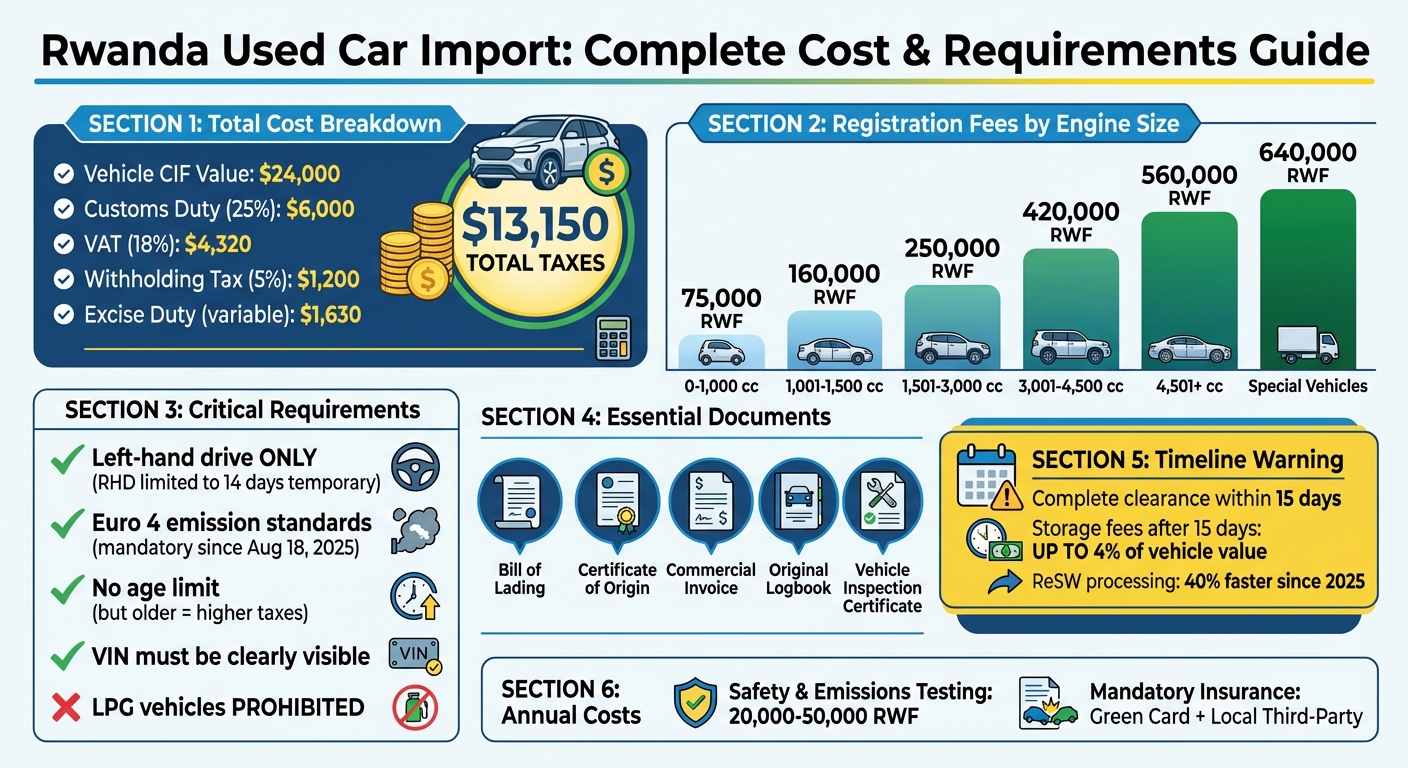
Rwanda Used Car Import Costs and Tax Breakdown for $24,000 Vehicle
How Much Does It Cost to Ship a Car to Rwanda? | A-1 Auto Transport Pricing & Shipping Guide
sbb-itb-7bc66b5
Documents Needed for Customs Clearance
Getting all your paperwork in order before your vehicle arrives in Rwanda is crucial to avoid unnecessary delays and costs. Since Rwanda now uses the Electronic Single Window (ReSW) system, all documents must be uploaded digitally – paper submissions are no longer accepted. Missing even one document can stall the process and leave you with hefty storage fees.
The Rwanda Revenue Authority (RRA) requires several key documents to begin customs clearance. At a minimum, you’ll need:
- Bill of Lading: Proof of shipment.
- Certificate of Origin: Indicates where the vehicle was manufactured.
- Commercial Invoice: Lists the purchase price.
- Original Logbook or Title Deed: Proof of ownership.
- Vehicle Inspection Certificate: Confirms compliance with safety and emission standards.
You’ll also need to submit an Import Declaration Form (IDF) through the ReSW platform and provide proof of duty and VAT payments once calculated.
If this sounds overwhelming, hiring a licensed customs broker registered with the RRA can make things much easier. These professionals handle document submissions through ReSW, ensuring everything is accurate and complete. Since the platform’s upgrade to ASYCUDA World in 2025, clearance times have improved by 40%, but only if your documents are in order from the start.
Bill of Lading
The Bill of Lading serves as proof that your vehicle has been shipped and is in transit. For cars arriving via sea freight – most commonly through the Port of Mombasa – this document is issued by the shipping company. It acts as both a receipt for the cargo and a title document. Without it, you won’t be able to get the "notice of arrival" (avis d’arrivee) or access the cargo manifest required by customs.
Your shipping company will provide the original Bill of Lading once the vehicle is loaded onto the ship. Make sure to upload this document to ReSW. Double-check that it includes all necessary vehicle details, such as the VIN (Vehicle Identification Number), make, model, and year. Any discrepancies with other paperwork can cause delays.
If you’re managing the process on your own, ensure the shipping company gives you a clear, original copy – blurry scans or photocopies will be rejected. If you’ve hired a clearing agent, they’ll handle this step for you.
Certificate of Origin
The Certificate of Origin is critical because it determines the taxes and duties you’ll pay. Vehicles manufactured in COMESA member countries may qualify for reduced import taxes. Without this certificate, customs will apply standard duty rates.
This document is typically issued by the manufacturer or the Chamber of Commerce in the country where the vehicle was made. For instance, a Toyota built in Japan would need a certificate from a Japanese authority, while a car assembled in Kenya might qualify for COMESA benefits if documented correctly.
Always verify the certificate’s authenticity before submitting it digitally to avoid penalties or audits.
Vehicle Inspection Certificate
The Vehicle Inspection Certificate, sometimes called a "vignette", ensures your vehicle meets Rwanda’s safety and Euro 4 emission standards. This requirement has been in place since August 18, 2025. The Rwanda Standards Board (RSB) conducts these inspections when the vehicle arrives, checking for compliance with legal requirements.
To complete the inspection, you’ll need:
- The vehicle’s logbook (Carte Jaune).
- Proof of payment for the inspection fee.
- Valid insurance.
- Your National ID or Resident Card.
If the vehicle fails the inspection due to mechanical issues, you’ll have 14 days to make repairs and schedule a re-inspection at 20% of the original fee. However, brand-new vehicles are exempt from inspections for the first two years after manufacture.
Book your inspection through the Irembo platform, where you can pay fees and schedule your appointment. Without this certificate, customs won’t release your vehicle, and you’ll face daily storage fees at the port. Getting this step right will save you time and money.
| Document | Purpose | Issuer |
|---|---|---|
| Bill of Lading | Proof of shipment and ownership during transit | Shipping Company |
| Certificate of Origin | Proves manufacturing location; affects duty rates | Chamber of Commerce/Manufacturer |
| Vehicle Inspection Certificate | Confirms safety and Euro 4 emissions compliance | Rwanda Standards Board (RSB) |
| Commercial Invoice | Details purchase price for CIF valuation | Vehicle Seller/Dealer |
| Original Logbook | Legal proof of ownership from country of export | Previous Owner/Dealer |
Vehicle Requirements: Age, Emissions, and Steering Position
When importing a vehicle, it’s essential to meet specific rules regarding age, emissions, and steering configuration. These standards are not just technicalities – they directly affect customs clearance and can lead to delays or extra fees if not followed.
Maximum Age for Imported Vehicles
Rwanda does not impose an age limit on used vehicle imports. However, older vehicles come with higher taxes. For instance:
- Vehicles with engines over 2,500cc or hybrids older than eight years are taxed at 15%.
- Vehicles under three years old with engines below 1,500cc incur just a 5% tax.
Additionally, all imported vehicles must have a clearly visible VIN (Vehicle Identification Number) sticker. Customs will reject any vehicle with a missing, damaged, or unreadable VIN. It’s also worth noting that vehicles running on LPG (Liquefied Petroleum Gas) are completely prohibited for import.
Emissions Standards and Environmental Rules
Beyond age-related taxes, your vehicle must meet Rwanda’s emissions standards. Starting August 18, 2025, all vehicles – both new and used – must comply with Euro 4 emission standards.
- New vehicles: Require an official inspection report and Euro 4 certification from the manufacturer.
- Used vehicles: Must provide an emissions compliance statement.
During the clearance process, you’ll also need an environmental levy statement. To avoid complications, double-check that the vehicle’s manufacturing year and technical specifications align with Euro 4 requirements.
Left-Hand Drive Requirement
Steering configuration is another critical factor. Rwanda only permits left-hand drive (LHD) vehicles for permanent importation and registration. This aligns with the country’s right-hand traffic system.
Right-hand drive (RHD) vehicles, on the other hand, are only allowed temporarily – for a maximum of 14 days. After this period, RHD vehicles cannot be registered for permanent use. Any attempt to do so will result in rejection by customs and the Rwanda Revenue Authority.
How to Clear Customs: Step-by-Step Process
Getting your vehicle through customs involves a series of steps, each with its own set of requirements. Here’s a breakdown of what you need to do at every stage.
Before Your Vehicle Arrives
First, make sure your vehicle meets all entry requirements. For example, vehicles must be left-hand drive. You’ll also need the original logbook or title deed to prove ownership.
Next, hire a licensed clearing agent registered with the Rwanda Revenue Authority (RRA). Double-check their credentials and agree on fees upfront to avoid surprises. Since vehicles are usually shipped through major East African ports, coordinate shipping logistics and insurance early on.
It’s also essential to calculate your estimated costs. Use the CIF (Cost, Insurance, and Freight) value as a starting point. Customs Duty is 25% of the CIF value, VAT is 18%, and Excise Duty depends on the engine capacity and age of the vehicle. Check the RRA website for an accurate estimate specific to your vehicle. Once you’ve prepared everything, you’re ready for the inspection phase.
Customs Inspection and Verification
When your vehicle arrives in Rwanda, it will undergo a physical inspection by the Rwanda Standards Board (RSB). Inspectors will check the steering position, the vehicle’s age, and the Pre-export Verification of Conformity (PVoC) certificate.
This inspection ensures your vehicle meets safety and emission standards. Starting August 18, 2025, proof of Euro 4 compliance is required for customs clearance. After passing the inspection, you can move on to the payment and release phase.
Final Payment and Vehicle Release
Once the inspection is complete, your clearing agent will calculate the taxes using the Rwanda Electronic Single Window (ReSW). You’ll need to pay Customs Duty (25%), VAT (18%), and Withholding Tax (5%). Additionally, pay the warehouse handling fee promptly to avoid storage charges.
After all payments are processed, you’ll receive a "goods exit note" that allows you to physically remove your vehicle from customs. The final step is paying registration fees, which vary based on engine capacity. Fees range from 75,000 RWF for smaller engines (0–1,000 cc) to 560,000 RWF for larger engines (4,501 cc and above). Once you’ve paid, you’ll receive your number plates and Yellow Card registration book. Following these steps ensures a smooth and timely registration process without unnecessary delays.
Import Taxes and Fees: Complete Breakdown
Customs Duty, VAT, and Excise Taxes
Rwanda calculates taxes on used vehicles using the East African Community (EAC) harmonized valuation system. The process begins with the "Price when New" (FOB value), which is listed in an official reference maintained by the Rwanda Revenue Authority, last updated in July 2025. This value is then adjusted using a standardized depreciation rate based on the vehicle’s age.
For instance, a vehicle that is 3 to 4 years old with an original FOB price of $20,000 depreciates by 40%, leaving a taxable value of $12,000. Taxes on this amount include:
- 25% Customs Duty: $3,000
- 18% VAT: $2,160
- 5% Withholding Tax: $600
For vehicles over 10 years old, depreciation is capped at 80%, meaning at least 20% of the original value remains taxable.
Additionally, a consumption tax (excise tax) is applied based on engine size and vehicle type. This tax is separate from the base duties, so it’s important to account for it when calculating the total cost. Other fees, such as registration and handling, are also part of the overall expenses.
Registration Fees and Other Costs
After paying customs taxes, vehicles must be registered, with fees determined by engine capacity. For example:
- Vehicles with 0 to 1,000 cc cost 75,000 RWF to register.
- Larger vehicles with 4,501 cc and above require a fee of 560,000 RWF.
- Special vehicles incur an even higher fee of 640,000 RWF.
In addition to registration, you’ll need to cover warehouse handling fees, which must be settled before obtaining your goods exit note. Another requirement is an environmental levy statement, which is part of the clearance process. Planning for these additional costs can help you avoid unexpected expenses at the final stage.
Tax Rates by Vehicle Type
| Fee/Tax Type | Rate/Cost |
|---|---|
| Customs Duty | 25% |
| Value Added Tax (VAT) | 18% |
| Withholding Tax | 5% |
| Consumption Tax | Variable |
| Registration (0-1,000 cc) | 75,000 RWF |
| Registration (1,001-1,500 cc) | 160,000 RWF |
| Registration (1,501-3,000 cc) | 250,000 RWF |
| Registration (3,001-4,500 cc) | 420,000 RWF |
| Registration (4,501 cc+) | 560,000 RWF |
| Registration (Special Vehicles) | 640,000 RWF |
For those eligible, a Duties and Taxes Exemption Certificate allows you to bypass standard duties entirely. This exemption applies primarily to specific individuals or organizations, such as those receiving gifted vehicles, provided they obtain a Gift Certificate. Applications for exemption certificates are processed digitally through the Rwanda Electronic Single Window (ReSW), which has streamlined clearance times.
Registration and Compliance After Customs Clearance
How to Register Your Imported Vehicle
Once your vehicle clears customs, the next step is registering it with the Rwanda Revenue Authority (RRA) to obtain your number plates and Yellow Card. If you’re registering as an individual, make sure you have your Taxpayer Identification Number (TIN) and a passport-size photo. For companies, you’ll need to provide a complete RDB trading license or other official documentation, like an RGB registration for NGOs or an RCA certificate for cooperatives. Additionally, you’ll need your Registration/De-registration Card from the vehicle’s country of origin.
The registration process usually takes one to three days, especially if you submit your documents digitally through the Rwanda Electronic Single Window (ReSW). However, if further checks, such as emissions audits, are required, it may take up to a week. Submitting your documents early can help speed things up.
Once you’ve paid the registration fee, which depends on your vehicle’s engine capacity, you’ll receive your number plates and Yellow Card on the spot. After this, your focus should shift to securing proper insurance and meeting any post-clearance safety requirements.
Required Insurance Coverage
After registration, obtaining the necessary insurance is crucial. To legally drive your imported vehicle, you’ll need an International Insurance Policy, also known as a Green Card. This policy is required during the import process and must remain valid while the vehicle is in use. In addition, once your vehicle is registered, you’ll need to get local third-party insurance that meets the standards set by Rwanda National Police. Keep proof of this coverage with your Yellow Card at all times.
Seasoned importers suggest arranging your local insurance policy as soon as you receive your plates to avoid penalties or complications during roadside inspections. It’s also a good idea to budget for any additional insurance costs to avoid unexpected expenses.
Safety and Emissions Testing
Your vehicle must meet emissions standards as part of the registration process. After clearing customs, it will undergo safety checks at authorized centers to ensure the brakes, lights, and tires are in good condition and that the vehicle is roadworthy.
Failing to meet emissions or safety requirements can lead to penalties or even the impounding of your vehicle, so double-check that all your documentation is accurate before submission. Once your vehicle is registered, it will also need annual safety and emissions renewals. These checks typically include bi-annual roadworthiness tests, which cost between RWF 20,000 and 50,000. Missing renewal deadlines can result in fines or even the revocation of your plates.
How to Avoid Delays and Penalties
Double-Check All Documents
Errors or missing paperwork – like the PVoC, Certificate of Origin, or Import Permit – can bring the clearance process to a standstill. Even small mistakes, such as inaccuracies in vehicle valuation, can delay things further.
Before shipping, make sure your vehicle complies with the Rwanda Standards Board’s rules on age and safety. Prepare a complete set of documents, including the Bill of Lading, Commercial Invoice, Certificate of Origin, and proof of duty/VAT payment. Double-check that the details on your Commercial Invoice match the vehicle specifications exactly, as inconsistencies can hold up the process.
Once your documents are in order, the next step is to work with a professional who can guide you through the digital clearance system.
Hire a Licensed Customs Agent
A licensed customs broker can help you avoid unnecessary delays and expenses. Since 2025, the Rwanda Electronic Single Window (ReSW) has cut average import clearance times by 40%. However, navigating this system effectively requires experience. Licensed agents handle key tasks like submitting the Import Declaration Form (IDF) and processing electronic tax exemption certificates through the ReSW platform.
These professionals also ensure compliance with the Euro 4 emission standards, which became mandatory for vehicle imports on August 18, 2025. They work to complete the clearance process within the 15-day window after arrival, helping you avoid the 4% warehouse storage penalty that kicks in for delays. To protect yourself from fraud, only hire clearing agents registered with the Rwanda Revenue Authority.
Once you’ve secured expert assistance, it’s time to prepare for the full range of costs involved.
Plan for Extra Costs
In addition to the basic fees outlined earlier, plan for additional expenses like customs broker fees, inspection charges, and expedited processing costs. Your total expenses will include:
- Customs duty: 25% of the CIF value
- VAT: 18%
- Excise duty: Based on engine capacity
- Broker fees
- Inspection and registration charges
Don’t forget that CIF-based taxes also include insurance and freight costs, so factor those into your budget. To avoid hidden fees, agree on customs broker charges before starting the process. Use the Rwanda Revenue Authority’s website to estimate your taxes and ensure you have the funds ready for immediate payment. Running out of money mid-process can lead to storage fees and unnecessary delays in clearance.
Conclusion
Bringing a used car into Rwanda requires careful planning and strict compliance with the country’s import regulations. You’ll need key documents like the Bill of Lading, Certificate of Origin, and proof of Euro 4 compliance. It’s also critical to understand the tax structure and vehicle requirements. For instance, vehicles must predominantly be left-hand drive, as right-hand drive vehicles are only permitted temporarily. Missing any of these details can result in frustrating delays during the clearance process.
For a car with a CIF value of $24,000, you can expect to pay between $13,100 and $13,350 in taxes, which include customs duty, VAT, and processing fees. On the other hand, hybrid and electric vehicles offer significant tax relief due to excise duty exemptions, making them a more affordable choice for those looking to cut costs.
To streamline the process, consider hiring a licensed customs agent through the Rwanda Revenue Authority. These professionals are experienced with the Rwanda Electronic Single Window (ReSW) platform and can help ensure your emission compliance documents meet the August 18, 2025, standards. They can also save you from costly delays by managing the intricate steps involved in vehicle clearance.
Once your vehicle clears customs, the next steps include registering it with your TIN, obtaining number plates, securing a yellow card, and purchasing mandatory insurance. These final steps are essential to ensure your car is legally ready for the road in Rwanda.
FAQs
How do I estimate my total landed cost before shipping?
To calculate the total cost of importing a used car into Rwanda, you’ll need to factor in several taxes and fees based on the car’s CIF (Cost, Insurance, and Freight) value. Here’s a breakdown of the main costs:
- Customs duty: 25% of the CIF value.
- Value-Added Tax (VAT): 18%.
- Withholding tax: 5%.
- Infrastructure levy: 1.5%.
- African Union levy: 0.2%.
In addition to these, you’ll also need to pay registration fees, which vary depending on the engine size. These fees can range anywhere from RWF 75,000 to RWF 560,000.
What happens if my car fails the Euro 4 inspection?
If your car doesn’t pass the Euro 4 inspection in Rwanda, it means it falls short of the country’s emission standards required for import and registration. This can lead to delays, fines, or even rejection during customs clearance. To steer clear of these problems, make sure your vehicle meets Euro 4 standards before proceeding.
How can I avoid storage penalties if my documents are delayed?
To steer clear of storage penalties when bringing a used car into Rwanda, it’s smart to collaborate with a registered clearing agent. They can help ensure your paperwork is accurate and submitted on time. Take the extra step to double-check all documents before handing them in. Using the Rwanda Revenue Authority’s electronic systems can also help make the process smoother. Staying organized and ahead of deadlines reduces the chances of delays, which could lead to penalties or even having your vehicle detained.
Related Blog Posts
- How to register a used car in Rwanda
- Rwanda Vehicle Registration: Tax and Duty Breakdown
- Import a Car from France to Rwanda: Costs, Duties, and Tips for Kigali
- Car Import Rules in Rwanda 2026: Taxes, Age Limits and Key Changes Explained