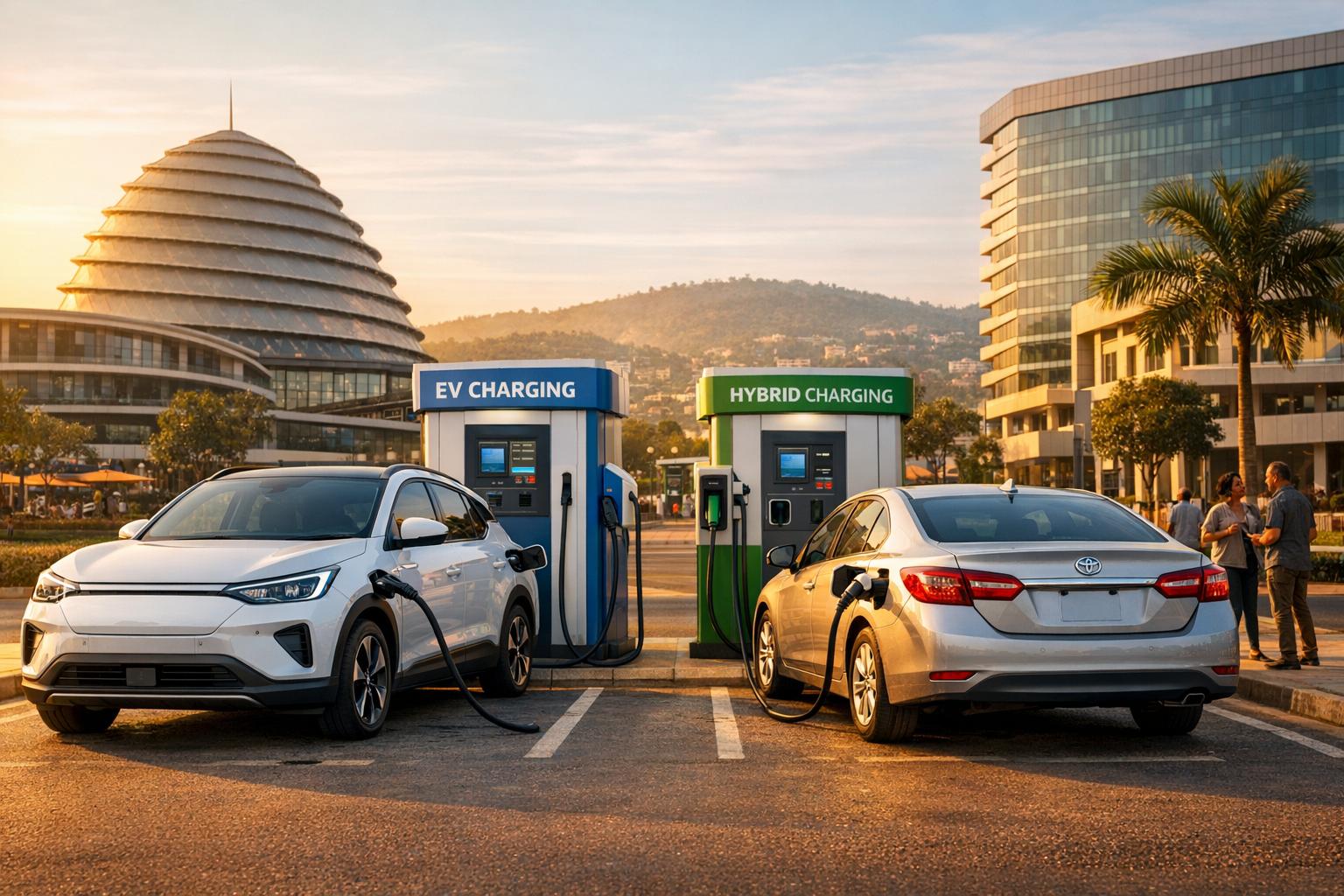
In 2026, choosing between an electric vehicle (EV) and a hybrid in Rwanda depends on your driving habits, location, and budget. Here’s what you should know:
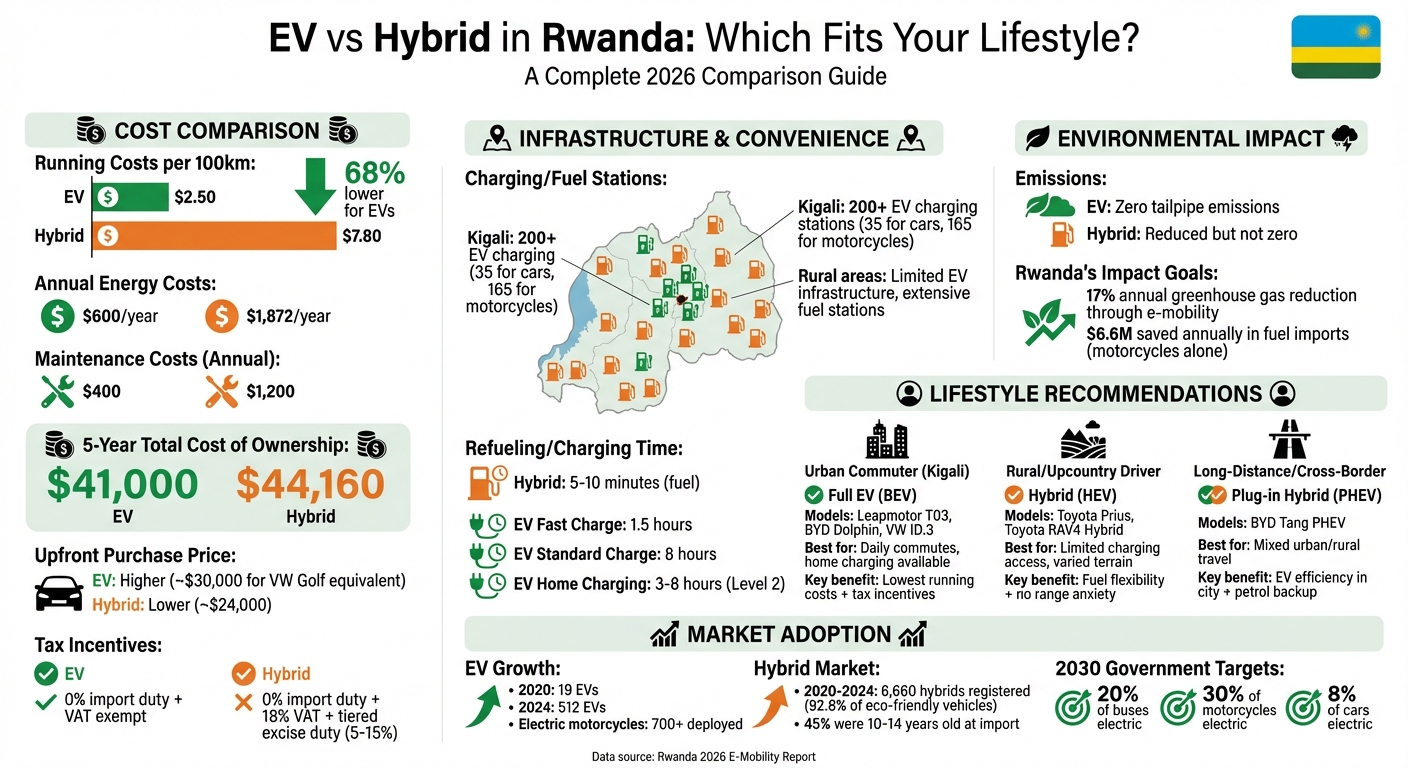
- EVs are ideal for Kigali residents with short commutes, thanks to low running costs ($2.50 per 100 km), tax exemptions, and growing charging infrastructure (200+ stations). They’re cheaper to maintain but require reliable access to charging.
- Hybrids suit rural drivers or those traveling long distances. They offer flexibility with dual power sources (electric + gasoline) and don’t rely on charging stations, which remain sparse outside Kigali.
- Costs: While EVs have higher upfront costs, they save money long-term with lower energy and maintenance expenses. Hybrids, though taxed at 18% VAT, remain practical for areas with limited infrastructure.
- Environmental Impact: EVs produce no emissions, aligning with Rwanda’s goal to cut greenhouse gases by 17% annually. Hybrids, while cleaner than gas vehicles, still emit pollutants.
Quick Comparison
| Factor | EVs | Hybrids |
|---|---|---|
| Best For | Urban commutes (Kigali) | Rural areas, long-distance travel |
| Running Cost | $2.50 per 100 km | $7.80 per 100 km |
| Upfront Cost | Higher | Lower |
| Maintenance | Cheaper | Moderately higher |
| Charging/Fueling | Requires charging stations | Uses gasoline, no charging needed |
| Environmental Impact | Zero emissions | Reduced but not zero |
The choice boils down to your lifestyle. If you live in Kigali and have access to charging, an EV is cheaper and cleaner. If you frequently travel to rural areas or across borders, hybrids offer reliability and convenience.
EV vs Hybrid in Rwanda 2026: Cost, Infrastructure & Lifestyle Comparison
Rwanda’s EV and Hybrid Market in 2026
EV Adoption in Rwanda
Rwanda’s electric vehicle (EV) scene has undergone a remarkable transformation. By 2024, the country had 512 fully electric vehicles on its roads – a massive leap from just 19 in 2020. Today, there’s a growing variety of EV options catering to different lifestyles and budgets.
For urban drivers in Kigali, compact models like the Leapmotor T03, BYD Dolphin, and VW ID.3 are popular choices. These cars are perfect for navigating the city’s hilly terrain and narrow streets. On the other hand, for those needing greater range or heading into rural areas, options like the Tesla Model Y, BYD Tang (PHEV), and Xiaomi SU7 provide higher ground clearance and longer driving distances.
Electric motorcycles have seen even faster growth. Companies such as Spiro and Ampersand have deployed over 700 electric motorcycles equipped with battery-swapping technology. This system allows riders to exchange drained batteries for fully charged ones in just minutes. In a bold move to accelerate the transition, Kigali banned new petrol motorcycle registrations starting in 2025, pushing the entire two-wheeler market toward electric models. With prices starting at just $500, electric motorcycles are becoming an affordable option for many riders.
Commercial fleets are also embracing electrification. Models like the BYD T3, JAC iEV7S, and VW ID. Buzz Cargo are gaining traction, while Kigali’s public transport system is working toward electrification as well. Backed by Ecofleet Solutions, the city aims for 20% of its buses to be electric by 2030. Although EV adoption is growing rapidly, hybrids still play a key role for drivers with different needs.
Hybrid Vehicle Adoption
Hybrids have long dominated Rwanda’s eco-friendly vehicle market. Between 2020 and 2024, 6,660 hybrid vehicles were registered, accounting for 92.8% of all eco-friendly vehicle imports. Models like the Toyota Prius and Toyota RAV4 Hybrid remain favorites, thanks to their fuel efficiency and the convenience of refueling at any gas station across the country.
While EVs are gaining momentum, hybrids continue to appeal to drivers who face challenges with limited charging infrastructure. However, in 2025, Rwanda reintroduced an 18% VAT on hybrid vehicles, ending their previous tax exemption. This policy aims to discourage the import of older, less efficient hybrids – 45% of hybrids imported between 2021 and 2024 were between 10 and 14 years old. To further regulate the market, a new excise duty structure was introduced: 5% for hybrids under three years old, 10% for those three to eight years old, and 15% for those over eight years. These changes align with Rwanda’s efforts to expand its charging network, but for many, the reliability of fuel remains a practical fallback.
"When these hybrid cars get very old, they only operate using the fuel-powered part. As a result, we are not fully achieving our goal of promoting e-mobility." – Godfrey Kabera, Minister of State for National Treasury
Despite the reintroduced taxes, hybrids remain a practical choice for drivers traveling outside Kigali or across borders, where charging stations are still sparse. As Joshua Nshuti from Greenleaf Motors puts it, "A hybrid vehicle eliminates the range anxiety as it can switch to gasoline, which is relevant as we are still far behind with charging infrastructure in Rwanda". Meanwhile, pure electric vehicles remain VAT-exempt and carry 0% import duty, making them a more affordable option for buyers who can manage their charging needs.
sbb-itb-7bc66b5
Cost of Ownership Comparison
Purchase Price
When it comes to the upfront cost, electric vehicles (EVs) generally come with a higher price tag than hybrids. For instance, a VW Golf-equivalent EV is priced around $30,000, while a comparable gas-powered car costs about $24,000. Under the current 2024/2025 fiscal policy, both EVs and hybrids benefit from a 0% import duty. However, EVs have an edge because they are fully exempt from VAT, unlike hybrids, which are subject to standard VAT rates and tiered excise duties: 5% for vehicles under three years old, 10% for those between three and eight years, and 15% for those over eight years old. For those looking for budget-friendly options, electric motorcycles start at just $500, and a growing second-hand EV market is making these vehicles even more accessible.
"The Government decided to extend incentives on Electric & Hybrid vehicles and Electric motorcycles to pay an import duty rate of zero. This intends to accelerate the transition to Electric Vehicles and reduce greenhouse gas emissions." – Rwanda Revenue Authority
Energy and Running Costs
One of the most compelling reasons to consider an EV is the dramatic difference in energy costs. In Rwanda, electricity at charging stations is subsidized to $0.10 per kWh, while the standard rate is $0.20 per kWh. By contrast, petrol costs approximately $1.30 per liter. This translates to an estimated operating cost of $2.50 per 100 km for an EV, compared to $7.80 per 100 km for a gas-powered vehicle – roughly a 60% savings on running costs. Over the course of a year, an EV owner might spend about $600 on electricity, while fuel expenses for a hybrid or gas vehicle could reach $1,872.
For motorcycle users, the savings are also notable. A single battery charge, which covers about 60 km, costs between $1.00 and $1.50. On the other hand, 1 liter of petrol – good for around 35 km – costs $1.30. Rwanda’s push for electric motorcycles is expected to cut fuel import costs by approximately $6.6 million annually. These lower running costs significantly reduce the overall cost of ownership.
Maintenance and Repairs
Maintenance is another area where EVs come out ahead. Thanks to their simpler design – fewer moving parts and no need for oil changes, transmission repairs, or exhaust system maintenance – EVs are less expensive to maintain. Annual maintenance for an EV averages around $400, compared to $1,200 for a gas or hybrid vehicle. Over five years, the total cost of ownership for an EV is estimated at $41,000, compared to $44,160 for a similar gas-powered car.
Still, there are challenges. Rwanda has a limited number of qualified EV technicians. As Paul Frobisher Mugambwa, an accountant in Kigali, notes:
"If you buy an imported Chinese electric SUV, who is going to fix your car when it breaks down?"
Additionally, Rwanda’s rugged terrain and high speed bumps can pose problems for EVs with low ground clearance. This can lead to costly battery repairs. Allan Kweli, Head of Operations at Volkswagen Mobility Solutions Rwanda, explained:
"The unevenness in road infrastructure and the height of speed-bumps turned out to be too challenging for the e-Golf, which has a relatively low ground clearance"
To address repair costs, the government offers VAT exemptions on EV spare parts and batteries. Buyers are encouraged to choose high-clearance EV models to better handle Rwanda’s road conditions, which could help avoid some of these issues.
Charging, Fueling, and Convenience
Charging Infrastructure in Kigali and Beyond
Kigali has positioned itself as Rwanda’s hub for e-mobility, boasting nearly 200 charging stations by late 2024. Of these, 35 cater specifically to cars, while the remaining 165 are designed for electric motorcycles. For urban drivers, this network offers convenience along with lower charging rates – about half the standard cost. However, the power grid faces challenges, with a reported 136% loading in 2024. High-power chargers, such as 20 kW units, can push transformer loads to over 80% at critical substations, signaling the need for grid upgrades.
Outside Kigali, the infrastructure is far less developed. For rural EV owners, home charging becomes essential. Installing a Level 2 (240-volt) home charger ensures vehicles are fully charged and ready each morning. These factors underline the varying levels of convenience for charging, depending on location and travel needs.
Fuel Availability and Cross-Country Travel
When it comes to cross-country and cross-border travel, hybrids have a distinct edge. Rwanda’s extensive network of petrol stations ensures consistent fuel availability, even in remote areas, and this network extends into neighboring countries where EV charging infrastructure remains sparse.
Take, for example, the Kabisa team, led by Marumbo Sichinga and Rodrigue Mucyo. They completed a 2,400 km (approximately 1,500 miles) round trip from Kigali to Nairobi. While they utilized a 30 kW DC fast charger at an SP station in Kigali, they faced challenges in Mbarara, Uganda, where no public chargers were available. This resulted in an 8-hour overnight charge using a distribution box. The entire trip cost about $25 in charging fees, a stark contrast to the $131 it would have cost in diesel for a traditional pickup. This scenario underscores why hybrids remain a practical choice for long-distance travel.
Time and Convenience Factors
Charging times and refueling times differ significantly, further shaping the convenience of each option. Filling a hybrid’s fuel tank takes just 5–10 minutes, while EV charging can range from 1.5 hours with a DC fast charger to up to 8 hours using standard AC charging. As Jeremiah Brockman, President of the Wisconsin Electric Vehicle Association, points out:
"Every morning when we wake up, the car is ‘full’ and ready for us to do our driving for the day."
For urban commuters who charge overnight at home, this is rarely an issue. However, long-distance travelers need to plan ahead, using tools like PlugShare to locate chargers and maintain a buffer charge, especially in areas where rural chargers may be unreliable. Urban EV owners in Kigali also enjoy perks like free parking and access to congestion zones through "Green License Plates", benefits that hybrids don’t offer. These considerations emphasize the need to match your vehicle choice with your typical travel patterns and priorities.
Lifestyle-Based Recommendations
Urban Commuters and Kigali Residents
If you’re living in Kigali, electric vehicles (EVs) make a lot of sense. The average daily commute in the city is well within the range of most EV batteries. Plus, with nearly 200 charging stations concentrated in the capital, finding a place to charge is rarely an issue. That said, most EV owners rely on home charging – about 80–90% of EV charging happens either at home or at work. This means you can start each day with what’s essentially a "full tank." Installing a Level 2 home charger costs between 300,000–800,000 RWF (around $230–$615) and can cut charging times down to just 3–8 hours.
For city dwellers, compact battery electric vehicles (BEVs) like the Leapmotor T03 or BYD Dolphin are a smart choice. These vehicles benefit from an 80% reduction in import duties and a full VAT exemption, making them more affordable. On top of that, they’re incredibly cheap to run – just $2.50 per 100 km (about 62 miles), compared to $7.80 for a gasoline-powered car. If you occasionally venture out of the city, hybrids can provide the added flexibility you need. While EVs shine in Kigali, the story is quite different for those living in rural areas.
Rural and Upcountry Drivers
For drivers in rural or mountainous regions like Musanze or Huye, hybrids are often the better option. The limited availability of charging stations outside Kigali makes hybrids more practical, as they can rely on Rwanda’s extensive network of fuel stations. This eliminates the worry about running out of charge, especially in areas where electricity access may be inconsistent.
The rugged terrain in these areas also poses challenges for EVs. Steep inclines can drain batteries faster, and while regenerative braking helps recover some energy on downhill stretches, the lack of charging stations remains a significant hurdle. EVs might work for predictable, short trips in rural areas if you have a reliable home power supply, but hybrids offer the flexibility needed for longer or more unpredictable journeys. Additionally, vehicles with higher ground clearance are better suited for upcountry roads, and hybrids are easier to maintain since local mechanics are more familiar with their components.
Long-Distance and Cross-Border Travelers
For those who frequently travel long distances within Rwanda or across borders into neighboring East African countries, hybrids are the most practical choice. The regional EV charging network is still in its early stages, and hybrids provide the security of dual power sources – electric and gasoline – so you’re less likely to be stranded.
Long-distance EV travel in Rwanda requires careful planning, as charging stations outside urban centers are scarce. While hybrids may have slightly higher running costs, they offer unmatched reliability and the convenience of universal refueling. For drivers who value flexibility and peace of mind over the lowest possible operating costs, hybrids remain the go-to option for long-distance and cross-border trips.
Environmental and Policy Considerations
Rwanda’s Climate Goals and E-Mobility Policies
Rwanda is making bold strides to curb emissions by shifting to electric vehicles. With road transport contributing 13% of the nation’s greenhouse gas emissions, the government has set ambitious targets: by 2030, they aim to electrify 20% of buses, 30% of motorcycles, and 8% of cars. These goals, laid out in the National Strategy for Transformation (NST2) and Vision 2050, reflect Rwanda’s dedication to achieving a carbon-neutral future.
The government is prioritizing fully electric vehicles, particularly in the public transport sector. For instance, all new buses in Kigali are mandated to be electric, with Ecofleet Solutions, a state-owned company, spearheading this transformation. To further discourage the use of internal combustion engine vehicles, Rwanda is planning to introduce a carbon tax, limit the import of second-hand cars to those under five years old, and enforce stricter emission standards, requiring compliance with Euro 4 or higher. François Zirikana, E-mobility Specialist for the City of Kigali, explained:
"The government also plans to introduce a carbon tax to discourage polluting vehicles, impose a five-year age limit for imported second-hand cars and enforce existing emission measures".
These initiatives not only aim to cut emissions but also promise cleaner air in Rwanda’s urban areas.
Emissions and Air Quality Benefits
Electric vehicles (EVs) bring a significant advantage: zero tailpipe emissions. This makes them a game-changer for improving air quality in cities like Kigali. While hybrid vehicles are cleaner than traditional gasoline-powered ones, they still rely on fuel and emit pollutants. Fully transitioning to e-mobility is expected to reduce Rwanda’s greenhouse gas emissions by 17% annually. Moreover, electrifying the motorcycle taxi fleet alone could save the country around $22 million in fuel import costs every year. These outcomes align with Rwanda’s broader vision for sustainable transportation and climate action.
Battery Recycling and Disposal
As Rwanda works to cut emissions, managing used batteries sustainably has become a critical part of its e-mobility strategy. The government is developing regulations for battery waste management and implementing Extended Producer Responsibility (EPR) programs, which require manufacturers to handle the disposal of end-of-life batteries. Tarek Keskes, Energy Specialist at the World Bank, highlighted the potential of these efforts:
"Regulations, producer responsibility schemes, and recycling investments will transform the battery waste challenge into an opportunity".
In October 2025, the World Bank announced a $7.7 million investment in electric vehicle infrastructure at Kigali’s Nyabugogo transit hub. This project will integrate rooftop solar panels and battery storage systems. While large-scale battery recycling infrastructure is still in its early stages, these initiatives underscore Rwanda’s commitment to building a circular economy around electric mobility.
Conclusion: Choosing the Right Vehicle for Your Lifestyle
Rwanda’s automotive market is evolving quickly, and deciding between an EV (electric vehicle) and a hybrid largely depends on how and where you drive. For residents in Kigali with consistent daily commutes, full EVs are an excellent choice. These vehicles offer lower energy costs, reduced maintenance expenses, and attractive tax incentives, including an 80% reduction on import duties. With plenty of urban charging stations and the convenience of overnight home charging, range anxiety becomes less of a concern for city dwellers.
On the other hand, if your lifestyle involves frequent trips outside Kigali, hybrids provide the versatility you need. Hybrids and plug-in hybrids are especially practical for drivers traveling to rural areas or crossing borders where charging infrastructure is still developing. The gasoline engine in these vehicles ensures you won’t have to plan routes solely based on charger availability. For those splitting time between urban and rural areas, a plug-in hybrid like the BYD Tang offers the best of both worlds – electric efficiency in the city and dependable petrol power for longer trips.
Here’s a quick breakdown of which vehicle type might suit your lifestyle best:
| Lifestyle Profile | Recommended Vehicle Type | Primary Benefit |
|---|---|---|
| Urban Commuter (Kigali) | Full EV (BEV) | Lower running costs, tax incentives, and easy charging |
| Rural / Upcountry Driver | Hybrid (HEV) | No reliance on chargers; better for areas with limited infrastructure |
| Long-Distance / Cross-Border | Plug-in Hybrid (PHEV) | Combines petrol flexibility with EV benefits in town |
| Commercial Fleet / Taxi | Full EV (BEV) | Around 60% lower operating costs and high durability |
When making your decision, it’s important to consider the total cost of ownership over five years rather than just the upfront price. Over this time frame, EVs are estimated to cost approximately $41,000, compared to $44,160 for traditional vehicles. If you’re planning to install a home charger, expect an additional cost ranging from 300,000 to 800,000 RWF, which should be factored into your budget. Additionally, Rwanda’s moderate climate is a bonus for EV owners, as it helps maintain battery performance. Batteries in this environment typically last between 8 and 15 years, avoiding the rapid degradation seen in harsher climates.
FAQs
What are the key advantages of choosing an EV instead of a hybrid in Kigali?
Choosing an electric vehicle (EV) in Kigali offers several appealing advantages:
- Lower costs and government support: EV owners enjoy tax exemptions and subsidies, which can cut annual expenses by up to $840 on fuel and maintenance compared to hybrids or gas-powered cars.
- Growing charging network: Kigali boasts 24 public fast-charging stations and 49 battery-swap locations, with plans to add 38 more chargers. This expanding network ensures EV owners can recharge with ease.
- Ideal for city driving: Most EVs, like the BYD Dolphin or Tesla Model Y, deliver ranges exceeding 250 miles – perfect for Kigali’s daily commutes without needing a gas-powered backup.
- Cleaner and more efficient: With over half of Rwanda’s electricity coming from renewable energy, EVs significantly reduce carbon emissions compared to hybrids. Plus, Kigali’s mild weather helps batteries maintain their efficiency over time.
For those in Kigali prioritizing affordability, convenience, and sustainability, EVs provide a smart and eco-conscious solution for urban travel.
How does Rwanda’s charging infrastructure affect owning an EV in 2026?
Rwanda’s electric vehicle (EV) charging network is still in its early stages, making EVs most practical for drivers in Kigali, where the majority of charging stations are concentrated. As of early 2025, the country had about 24 public fast-charging stations and 49 battery-swap locations, mostly situated in urban areas. In rural parts of the country, the scarcity of charging points makes hybrid vehicles a more convenient option, as they can easily refuel at regular gas stations.
Plans to expand the infrastructure are already in motion. By 2026, the government, alongside private investors, aims to establish 38 additional charging stations. These new stations will focus on key urban centers and major travel routes. As the network grows, EVs will become a more practical choice not just for city commutes but also for longer journeys, particularly along important travel corridors.
What are the costs of owning an EV versus a hybrid in Rwanda?
Electric vehicles (EVs) in Rwanda often come with a lower upfront price compared to hybrids, thanks to tax exemptions that make them more affordable. These exemptions – covering VAT, customs duties, and excise taxes – are in place until mid-2028. For instance, popular EV models like the BYD Dolphin are priced between $25,000 and $30,000, while hybrids like the Toyota Prius range from $25,000 to $35,000. Larger hybrids, such as the Honda CR-V Hybrid, can cost anywhere from $35,000 to $45,000.
When it comes to running costs, EVs have a clear edge. With electricity in Rwanda costing about $0.20 per kWh and gasoline priced at roughly $1.30 per liter, charging an EV is about six times cheaper than refueling a hybrid. Maintenance is another area where EVs shine, as they have fewer moving parts, which translates to lower upkeep costs. Drivers can save up to $840 annually on fuel and maintenance compared to hybrids. While hybrids are more fuel-efficient than traditional gas-powered cars, they still require regular fueling and engine maintenance, which increases their long-term operating costs. For urban drivers especially, EVs often deliver a lower total cost of ownership, aided by Rwanda’s growing network of charging stations and battery-swap facilities.
Related Blog Posts
- Popular Hybrid and Electric Cars in Rwanda
- Top 5 Compact EVs for Rwanda in 2025
- Electric vs Petrol cars in Rwanda
- Car Price Trends in Rwanda: Petrol vs Hybrid vs Electric