Wondering whether to go hybrid or fully electric in Rwanda this year? Here’s what you need to know:
- Full EVs: Perfect for Kigali residents. They’re tax-free (0% VAT, import duty exemptions), cost less to operate (around $2.50/100 km), and require minimal maintenance. Charging is convenient in urban areas, with nearly 200 stations available. However, rural trips can be challenging due to limited charging infrastructure.
- Hybrids: Reliable for rural and long-distance drivers. They combine fuel and electric power, making them flexible where charging stations are sparse. However, higher taxes (18% VAT, excise duties) and maintenance costs make them less attractive for city use.
Quick Comparison:
| Feature | Full EV | Hybrid |
|---|---|---|
| Tax Benefits | 0% VAT, 80% import duty cut | 18% VAT, 30–50% duty cuts |
| Operating Costs (5 years) | 70% less than gas vehicles | Moderate |
| Charging/Refueling | Home charging (~$300–800 setup) | Fuel stations everywhere |
| Best For | Kigali drivers, short commutes | Rural areas, long trips |
If you’re in Kigali, a full EV is the smarter choice for cost savings and convenience. For rural drivers, hybrids balance flexibility and practicality.
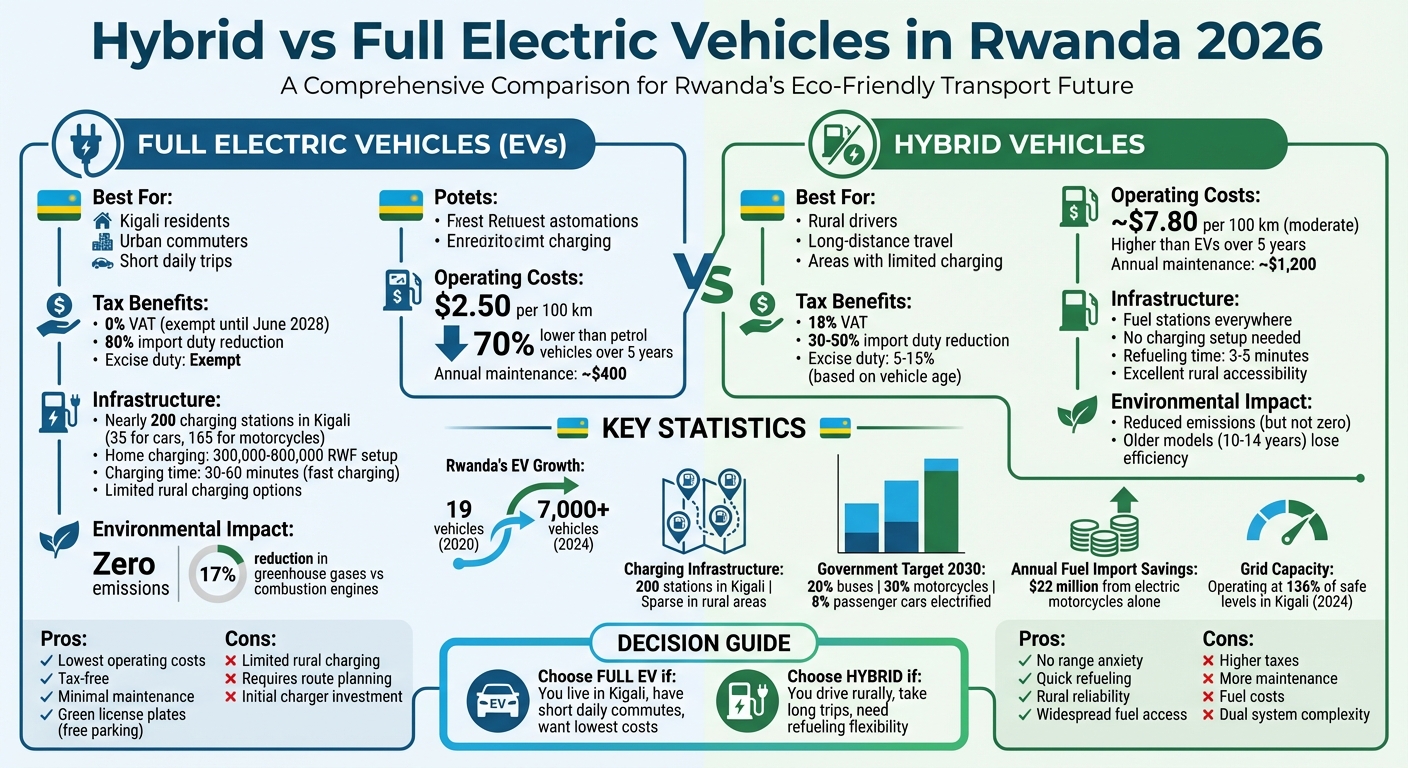
Hybrid vs Full EV Comparison in Rwanda 2026: Costs, Benefits and Best Use Cases
Rwanda’s EV Infrastructure and Policies in 2026
Charging Stations and Grid Capacity
Rwanda has made strides in expanding its charging network, but a clear divide remains between urban and rural areas. By early 2026, Kigali offers nearly 200 charging stations – 35 for cars and 165 for electric motorcycles. For those commuting within the capital, charging is convenient and widely available. However, traveling beyond city limits presents challenges, as rural areas still lack sufficient coverage. This can make long-distance trips in a fully electric vehicle tricky without careful planning.
To bridge these gaps, Rwanda has adopted dual charging standards – CCS2 and GB/T. This ensures compatibility with both European and Chinese EV models. A notable example is the Nyabugogo multi-modal transit hub, which now features 18 chargers powered by an 800-kW rooftop solar system equipped with battery storage.
Kigali’s electricity grid, however, faces growing strain. In 2024, the network operated at 136% of safe loading levels, and peak demand is projected to jump by 64% by 2030. To alleviate this pressure, the government is promoting "smart charging" strategies. These encourage EV owners to charge during off-peak hours or when solar energy production is highest, potentially easing grid stress by up to 15%. With over half of Rwanda’s electricity already coming from hydroelectric and solar sources, EV charging in the country is inherently eco-friendly.
Government Policies and Incentives
Rwanda has shifted its focus to fully electric vehicles (EVs). While hybrids and EVs once shared similar tax breaks, the 2025/2026 policies now grant full EVs complete tax exemptions, whereas hybrids are subject to VAT and a 5% withholding tax. This change underscores Rwanda’s dedication to phasing out fossil fuels entirely.
EV owners enjoy additional perks, such as green license plates that allow free parking and access to congestion zones. Charging station operators benefit from subsidized electricity rates of $0.10/kWh, which is half the standard rate. Investors in e-mobility also receive incentives like a 15% corporate tax rate, potential seven-year tax holidays, and rent-free land for building charging stations.
"The Government of Rwanda is committed to accelerating the transition to electric mobility as part of our climate and development agenda." – Dr. Jimmy Gasore, Minister of Infrastructure for Rwanda
These policies have fueled remarkable growth in Rwanda’s EV market. The combined EV and hybrid fleet grew from just 19 vehicles in 2020 to over 7,000 by 2024. The government has set ambitious targets for 2030, aiming to electrify 20% of buses, 30% of motorcycles, and 8% of passenger cars. A 2025 ban on new petrol motorcycle registrations in Kigali further accelerates this transition. Electric motorcycles alone are expected to save Rwanda $22 million annually in fuel imports. These forward-thinking policies are not just reshaping transportation but also reducing costs and environmental impact for vehicle owners.
Hybrid Vehicles: Benefits and Available Models
Benefits of Hybrids
Hybrid vehicles strike a practical balance for drivers in Rwanda. These cars use a combination of a petrol or diesel engine and an electric battery, ensuring reliable mobility without relying on charging stations – a key advantage in areas outside Kigali where charging infrastructure is still developing. Between 2020 and 2024, hybrids dominated Rwanda’s market for eco-friendly vehicles, making up 92.8% (6,660 units) of all green vehicle imports. Their ability to seamlessly switch between electric power for city driving and fuel for longer journeys has made them a popular choice among Rwandan drivers. By 2026, hybrids had become a trusted and familiar technology across the country.
However, the government has introduced policies to encourage the import of newer, more efficient hybrids. These policies include an 18% VAT and age-based excise duties – 5% for vehicles under three years old and 15% for those over eight years old. This is significant, as nearly 45% of hybrids imported between 2021 and 2024 were 10 to 14 years old, which can affect performance due to declining battery efficiency.
"When these hybrid cars get very old, they only operate using the fuel-powered part. As a result, we are not fully achieving our goal of promoting e-mobility." – Godfrey Kabera, Minister of State for National Treasury
These benefits and policy changes highlight the importance of choosing the right hybrid model for both efficiency and long-term value.
Popular Hybrid Models in Rwanda
Rwanda offers a range of well-known hybrid models. The Toyota Prius leads the pack as one of the most recognized options. The 2026 Toyota Prius LE features a 2.0L 4-cylinder hybrid engine, delivering 194 horsepower and achieving up to 57 MPG combined. For those who need all-wheel drive, the Prius LE AWD offers 196 horsepower and 54 MPG combined.
For drivers seeking more space, the Toyota RAV4 Hybrid combines the practicality of an SUV with the efficiency of a hybrid, making it a great choice for daily commutes and trips to Rwanda’s national parks.
In October 2024, Akagera Motors introduced the KIA Niro Plus (Hybrid) at their showroom, showcasing the growing variety of modern hybrids available in Rwanda. This reflects a dramatic 237-fold increase in hybrid imports between 2021 and 2024.
When buying a hybrid through local dealerships, it’s essential to check the manufacturing date and the condition of the battery. Opting for a newer model not only ensures better fuel efficiency and performance but can also help reduce taxes – a critical factor during this transitional period in Rwanda’s automotive market.
Full Electric Vehicles: Benefits and Available Models
Benefits of Full EVs
Full electric vehicles (EVs) are a game-changer when it comes to reducing emissions. They run entirely on electricity, often sourced from renewable energy, meaning they produce zero emissions. This makes them an excellent choice for anyone looking to shrink their carbon footprint.
From a financial perspective, full EVs come with some serious perks in Rwanda. Owners benefit from an 80% import duty reduction, full VAT exemption, lower annual road taxes, and priority registration. In comparison, hybrids only qualify for a 30% duty reduction and may soon face an 18% VAT. Add to that the lower operating costs – no fuel expenses, fewer moving parts, and minimal maintenance – and EVs become a smart long-term investment, especially as fuel prices continue to rise.
Rwanda’s mild climate is another plus for EVs. The moderate temperatures help maintain battery performance and extend its lifespan. For those commuting in Kigali, EVs are particularly convenient. The average daily commute easily fits within the range of most EVs, and compact models handle the city’s hilly streets without a problem.
"In line with our commitment to environmental protection and reducing emissions, we want full-electric vehicles to become the preferred choice." – Godfrey Kabera, Minister of State for National Treasury
Charging is straightforward too. Most EV owners can cover 80–90% of their charging needs at home. A Level 2 charger, priced between 300,000–800,000 RWF, can fully charge a vehicle in 3–8 hours overnight. For longer trips or quick recharges, DC fast chargers are conveniently located along major highways and at business hubs.
Popular EV Models in Rwanda
Rwanda’s EV market is growing, with several models available to suit different driving needs. Compact vehicles like the Leapmotor T03 and BYD Dolphin are ideal for Kigali’s urban environment. They’re easy to maneuver and handle the city’s hilly terrain efficiently. For those seeking a slightly larger option, the VW ID.3 offers practicality without sacrificing performance.
For drivers who need more range or higher ground clearance – perfect for rural roads or weekend getaways – the Tesla Model Y and Xiaomi SU7 deliver both. They also support fast charging, making them great for extended trips. Businesses and fleet operators aren’t left out either. Models like the BYD T3, JAC iEV7S, and VW ID. Buzz Cargo are designed for durability and optimized range, helping reduce overall ownership costs.
Between 2020 and 2024, Rwanda imported only 512 fully electric cars, which made up just 7% of green vehicle imports. However, with the government now prioritizing battery electric vehicles (BEVs) over older hybrids, the stage is set for a major shift. By 2026, full EV adoption in Rwanda could see a significant boost.
Cost of Ownership Comparison: Hybrids vs Full EVs
Ownership Costs Breakdown
Rwanda’s evolving EV policies and infrastructure set the stage for a closer look at the total costs of owning hybrids versus full EVs. Here’s how they stack up when you consider the five-year total cost – factoring in purchase price, taxes, operating costs, and maintenance.
Full EVs come with hefty tax incentives, including an 80% import duty reduction and 0% VAT (valid until June 2028), making them a more attractive option financially. Hybrids, on the other hand, face higher tax rates: 30–50% duty reductions and 18% VAT, along with excise duties that vary by the vehicle’s age.
"Investing in a BEV now maximizes long-term tax benefits and ensures compliance with future urban mobility regulations." – AUTO24.rw
When it comes to operating costs, EVs take the lead. Over five years, mid-range EVs slash operating costs by 70% compared to petrol vehicles, while entry-level EVs cut total ownership costs by 20–30% compared to their petrol counterparts. This is largely because EVs eliminate fuel expenses entirely and require less maintenance, thanks to their simpler design without a combustion engine. Hybrids, however, still need maintenance for both their traditional engine and electric components, which drives up long-term costs.
EV owners do face an initial expense for home charging setups. Installing a Level 2 charger can cost between 300,000 and 800,000 RWF. However, most EV owners charge at home or work 80–90% of the time, and with over half of Rwanda’s electricity coming from renewable sources, charging costs remain minimal. Some owners even choose solar off-grid systems, which cost around $2,700 to install and bring charging expenses to less than 4% of total ownership costs. These low charging costs further enhance the financial appeal of full EVs.
Annual fees are another factor to consider. All non-government cars are subject to a fixed road maintenance levy of 50,000 RWF per year, while pickups and minibuses pay 100,000 RWF.
| Cost Component | Full Electric Vehicle (BEV) | Hybrid Vehicle (HEV/PHEV) |
|---|---|---|
| Purchase Price Range | 15,000,000 – 45,000,000+ RWF | Lower base price offset by higher taxes |
| Import Duty Reduction | 80% | 30% (HEV) to 50% (PHEV) |
| VAT | 0% (Exempt until June 2028) | 18% |
| Excise Duty | Exempt | 5% to 15% (based on age) |
| Home Charger Installation | 300,000 – 800,000 RWF | Not required |
| Annual Road Levy | 50,000 RWF (cars/jeeps) | 50,000 RWF (cars/jeeps) |
| Maintenance Costs | Low (no engine) | High (engine + motor) |
| Operating Costs (5 years) | 70% lower than petrol | Moderate |
This breakdown highlights how full EVs offer compelling long-term savings, especially in maintenance and operating costs, making them a strong choice for drivers in Rwanda.
sbb-itb-7bc66b5
Akagera Motors launches hybrid electrical vehicles
Charging and Refueling Practicality: Hybrids vs Full EVs
Driving in Rwanda presents a unique decision-making process when it comes to charging electric vehicles (EVs) versus refueling hybrids. In Kigali, EVs have a clear advantage, thanks to nearly 200 charging stations, including 35 specifically for cars. For city dwellers, charging at home or work is not only convenient but also affordable. With subsidized electricity priced at $0.10 per kWh, charging an EV costs about $2.50 per 100 kilometers, much cheaper than the $7.80 per 100 kilometers spent on fuel for traditional vehicles. However, hybrids still offer the undeniable convenience of quick refueling.
Once you venture outside Kigali, the story changes. Charging infrastructure is sparse, making hybrids the more practical option. With Rwanda’s extensive network of fuel stations, hybrids can be refueled in just 3 to 5 minutes. This makes them a reliable choice for drivers traveling long distances or navigating the country’s rugged terrain.
Kigali’s electricity grid, which is expected to operate at 136% of its safe capacity in 2024, highlights another challenge for EVs. To manage demand, the city has implemented smart charging solutions and solar-powered hubs like the Nyabugogo transit hub. This facility alone boasts 18 chargers powered by an 800-kW rooftop solar system. Still, EV owners may need to charge during off-peak hours to help ease the strain on the grid. These grid limitations emphasize the importance of choosing a vehicle that suits your driving needs, balancing daily convenience with long-term costs.
Pros and Cons of Hybrids and EVs
Here’s a quick breakdown of how full EVs compare to hybrids in practical terms:
| Feature | Full Electric Vehicles (EVs) | Hybrid Vehicles |
|---|---|---|
| Kigali Accessibility | High (nearly 200 charging stations) | Widespread fuel station network |
| Rural Accessibility | Limited charging options | Extensive fuel station coverage |
| Charging/Refueling Speed | 30–60 minutes (fast charging) | 3–5 minutes |
| Daily Commute Costs | ~$2.50 per 100 km | ~$7.80 per 100 km |
| Long-Distance Travel | Requires route planning | Quick refueling eliminates range anxiety |
| Grid Dependence | High; relies on smart charging and solar hubs | Low; independent of the grid |
| Annual Maintenance | Around $400 | Around $1,200 |
Environmental Impact and Government Incentives
Rwanda’s push toward a greener automotive future is backed by a combination of environmental benefits and strong government incentives. Full electric vehicles (EVs) are a cornerstone of this strategy, cutting greenhouse gas emissions by 17% compared to traditional combustion engines. These reductions are vital to Rwanda’s broader climate goals, which aim to eliminate 14.86 million tonnes of carbon emissions between 2025 and 2035. Notably, the transport sector accounts for 49% of the country’s $12 billion mitigation plan. These numbers highlight the critical role EVs play in Rwanda’s carbon reduction efforts and its evolving fuel policies.
The government has also taken a fresh look at hybrid vehicles, and the findings have been less encouraging. Data shows that older hybrids often lose their environmental edge as their batteries degrade, leaving many to rely solely on their fuel-powered systems. Minister of State for National Treasury Godfrey Kabera explained:
"When these hybrid cars get very old, they only operate using the fuel-powered part. As a result, we are not fully achieving our goal of promoting e-mobility."
This realization prompted a shift in policy to prioritize full EVs.
To accelerate EV adoption, the government has introduced a range of financial incentives. Pure electric vehicles now enjoy complete tax exemptions, a benefit extended until June 2028. In contrast, hybrids face an 18% VAT as well as excise duties based on vehicle age – 5% for cars under three years old, 10% for those between three and eight years old, and 15% for those older than eight years. EV owners also gain perks like green license plates, which come with free public parking and unrestricted access to congestion zones.
The support for e-mobility doesn’t stop there. The government is providing rent-free land for the development of charging stations and has updated building codes to require EV-ready infrastructure in all new construction projects. These measures are expected to reduce oil imports by 15% annually, saving the country approximately Rwf 20 billion each year.
World Bank Country Manager Sahr Kpundeh emphasized the broader implications of this transition:
"Electric mobility is not only about cleaner buses. It is about building the foundations of a modern economy powered by sustainable energy."
Policymakers have made their stance clear:
"In line with our commitment to environmental protection and reducing emissions, we want full-electric vehicles to become the preferred choice."
With a goal of having 70% of new vehicle registrations as EVs by 2035, Rwanda is aligning its financial, environmental, and infrastructure strategies to make full-electric vehicles the standard choice for the future.
Best Choice for Rwandan Drivers in 2026
Your ideal vehicle choice for 2026 depends on where and how you drive. For Kigali residents, fully electric vehicles (EVs) are the way to go. Kigali’s extensive charging infrastructure makes EVs a practical option, and the city’s average daily commutes easily fall within the range of most EVs. Plus, the financial perks are hard to ignore: EVs benefit from an 80% reduction in import duties and are fully exempt from VAT, while hybrids receive a smaller 30–50% duty reduction. Operating costs are also much lower – powering an EV costs about $2.50 per 100 kilometers, compared to $7.80 for gasoline-powered cars, and annual maintenance drops from roughly $1,200 to just $400. Installing a home charging station, which costs between 300,000 and 800,000 RWF, can cover most of your charging needs – up to 90%. These factors make EVs a perfect fit for Kigali’s urban environment.
However, for rural drivers, the story is different. If you frequently travel outside Kigali, a plug-in hybrid (PHEV) might be a better choice. As Joshua Nshuti from Greenleaf Motors explains:
"A hybrid vehicle eliminates the range anxiety as it can switch to gasoline, which is relevant as we are still far behind with charging infrastructure in Rwanda"
This makes hybrids a practical option for those who want the efficiency of electric driving for local trips but need the reliability of gasoline for longer journeys.
Road conditions also play a big role. Rwanda’s rugged terrain and high speed bumps mean that vehicle design matters just as much as cost and infrastructure. Low-clearance vehicles often struggle, as Allan Kweli from Volkswagen Mobility Solutions Rwanda points out:
"The unevenness in road infrastructure and the height of speed-bumps turned out to be too challenging for the e-Golf, which has a relatively low ground clearance"
To handle these challenges, SUVs or crossovers with higher ground clearance, such as the BYD Tang or VW ID.4, are better suited for Rwanda’s roads.
With potential emissions-free zones on the horizon for Kigali, the government’s commitment to EVs is clear. As AUTO24.rw highlights:
"Investing in an EV now ensures you benefit from maximum tax advantages before policy shifts"
For city drivers, fully electric vehicles are already the present and the future. For those in rural areas, a hybrid offers the best of both worlds: electric efficiency for short trips and gasoline reliability for longer ones.
FAQs
What tax benefits are available for electric and hybrid vehicles in Rwanda?
Rwanda has rolled out generous tax breaks for electric vehicles (EVs), making them a more appealing option compared to hybrids. EVs enjoy a full exemption from import-related taxes, including 0% import duty, no VAT, and no excise or withholding taxes. These exemptions are in place through June 2028, effectively removing any tax burden at the point of entry.
Hybrids, on the other hand, receive only a 0% import duty benefit. However, they are subject to the standard 18% VAT, which was reinstated in February 2025 to curb the import of older hybrid models. Additionally, hybrids do not qualify for excise tax exemptions, which further increases their cost.
As of 2026, this tax policy positions EVs as the more affordable and environmentally friendly choice for Rwandans aiming to cut down on vehicle ownership expenses.
How does Rwanda’s charging network affect the practicality of EVs?
Rwanda’s EV charging network is heavily centered in Kigali, making electric vehicles practical for city dwellers but less so for those venturing beyond urban areas. As of early 2025, the country had just 24 public fast chargers and 49 battery-swap stations, with plans to add 38 more, primarily along major highways. For drivers in rural areas or those taking longer trips, this limited infrastructure often makes hybrid vehicles a more reliable choice due to their flexibility.
For urban commuters, the current setup offers some convenience. Fast chargers can fully recharge an EV in under an hour, while battery-swap stations provide a quick alternative, allowing drivers to replace their battery packs in just a few minutes. Adding to the appeal, Rwanda’s electricity costs are relatively low – around $0.20 per kWh – making EVs cheaper to operate compared to traditional gasoline-powered cars. However, expanding the charging network remains essential to ensure EVs are a practical option for drivers throughout the country.
What should rural drivers in Rwanda consider when deciding between a hybrid and a fully electric vehicle (EV)?
When deciding between a hybrid and an EV in Rwanda, rural drivers need to weigh factors like charging infrastructure, driving range, and costs. In Rwanda, charging stations are predominantly located in urban centers like Kigali. This makes hybrids a more practical option for rural areas, as they can switch to gasoline when charging stations are scarce. Fully electric vehicles, however, depend entirely on having a reliable power source or battery-swap stations, which might not be easily accessible in remote locations.
Hybrids tend to offer a longer total range – usually exceeding 460 miles – and are better equipped to handle Rwanda’s hilly landscapes and longer trips. EVs, while generally cheaper to maintain and operate thanks to lower electricity costs, typically have a shorter range of around 250–300 miles per charge. Another consideration is maintenance: hybrids often have more widely available mechanical support in rural areas, whereas EVs may need specialized services that are harder to find outside major cities. To make the best decision, think about your usual travel distances, how easily you can access charging or fuel, and what fits within your budget.
Related Blog Posts
- Popular Hybrid and Electric Cars in Rwanda
- Electric vs Petrol cars in Rwanda
- EV vs hybrid in Rwanda: what’s best in 2026 depending on your lifestyle?
- Should You Buy Hybrid or Petrol in Rwanda?