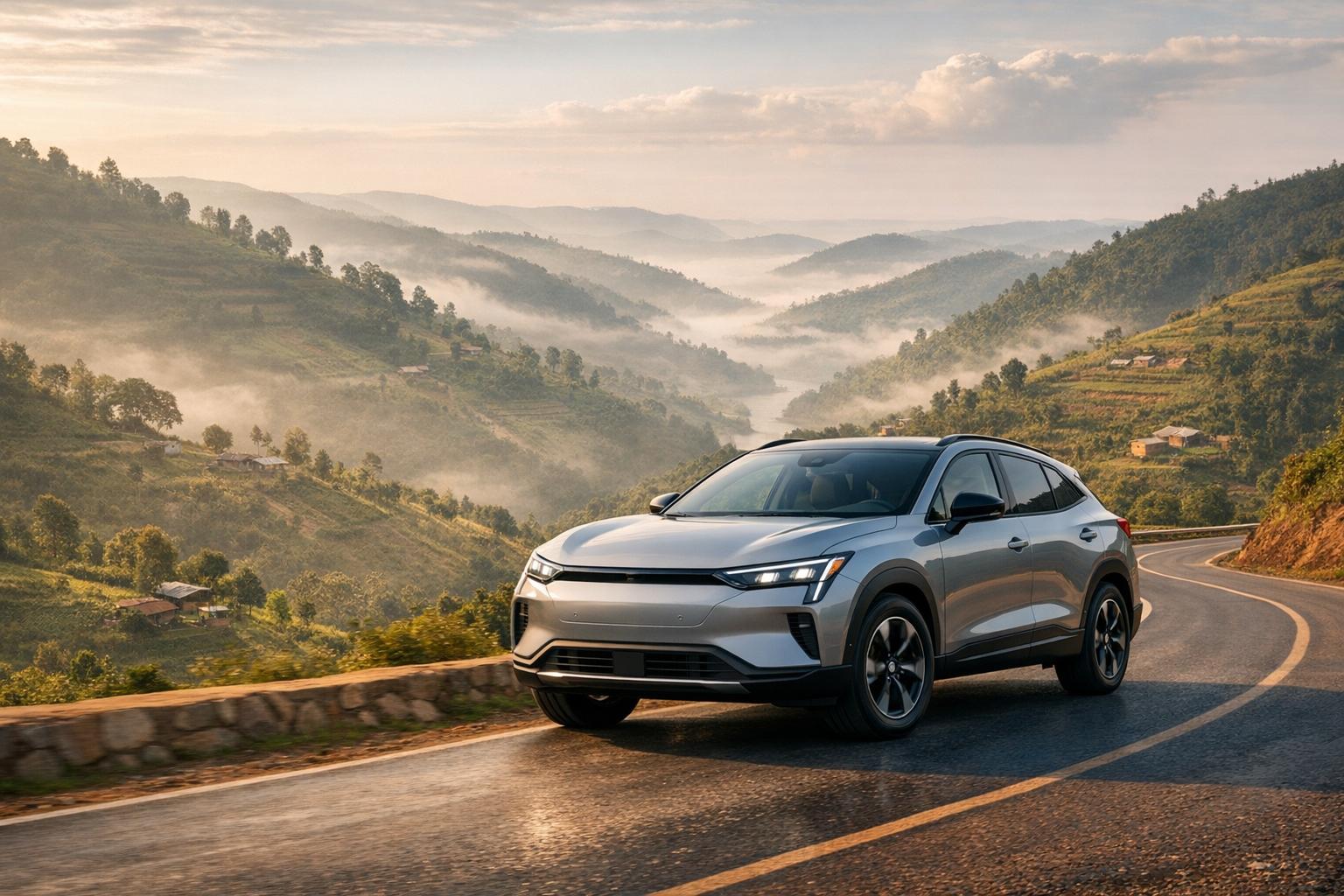
Rwanda’s hilly terrain and expanding EV market make choosing the right electric vehicle essential in 2026. Key factors for Rwandan drivers include strong torque for steep climbs, long battery range for intercity travel, and sufficient ground clearance for rural roads. With government incentives like reduced import duties and VAT exemptions, EVs are more accessible than ever. Here’s a quick look at top EVs suited for Rwanda:
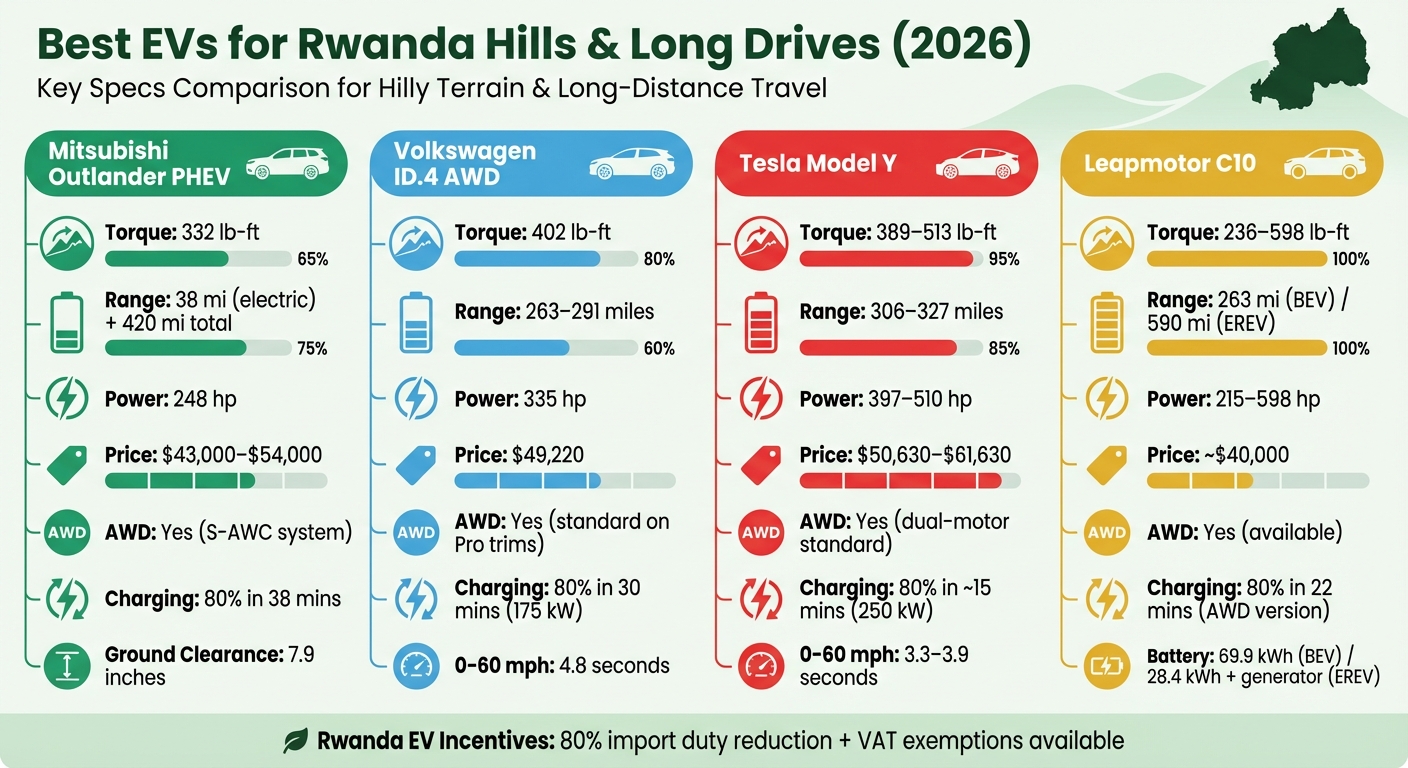
- Mitsubishi Outlander PHEV: Combines 248 hp, 332 lb-ft torque, 38 miles electric range, and 420 miles total range. Priced around $43,000–$54,000.
- Volkswagen ID.4 AWD: Offers up to 291 miles range, 335 hp, and fast charging. Starts at $49,220.
- Tesla Model Y: Delivers up to 327 miles range, 397 hp, and rapid charging. Prices begin at $50,630.
- Leapmotor C10: Affordable with 263 miles range (BEV) or 590 miles (EREV). AWD option available.
Each model caters to Rwanda’s unique driving needs, from urban commutes to rural adventures. Below is a quick comparison of their key features.
Quick Comparison
| Model | Torque | Range | Starting Price | AWD | Charging Speed |
|---|---|---|---|---|---|
| Mitsubishi Outlander PHEV | 332 lb-ft | 38 mi (electric) + 420 mi total | $43,000–$54,000 | Yes | 80% in ~38 mins (CHAdeMO) |
| Volkswagen ID.4 AWD | 402 lb-ft | 263–291 mi | $49,220 | Yes | 80% in 30 mins (175 kW) |
| Tesla Model Y | 389–513 lb-ft | 306–327 mi | $50,630–$61,630 | Yes | 80% in ~15 mins (250 kW) |
| Leapmotor C10 | 236–598 lb-ft | 263 mi (BEV) / 590 mi (EREV) | ~$40,000 | Yes | 80% in ~22 mins (84–150 kW) |
These EVs are paving the way for a greener and more efficient future in Rwanda. Whether you prioritize performance, range, or affordability, there’s an option for every driver.
Best EVs for Rwanda 2026: Performance and Range Comparison
1. Mitsubishi Outlander PHEV
The 2026 Mitsubishi Outlander PHEV packs a punch with 248 horsepower and 332 lb-ft of torque, courtesy of its 2.4-liter engine combined with two electric motors. This setup ensures it can tackle Rwanda’s steep hills with ease.
Torque for Hills
Equipped with Mitsubishi’s Twin Motor Super-All Wheel Control (S-AWC) system, the Outlander PHEV manages power independently for each wheel. It also features a "Power" mode and terrain-specific settings, perfect for maintaining traction on challenging inclines. The vehicle sprints from 0 to 60 mph in just 6.6 seconds, noticeably faster than the gas-only version, which takes 8.2 seconds. As Zach Doell from US News & World Report remarked:
"Mitsubishi has done an amazing job of tuning its all-wheel-drive system (Super-All Wheel Control). I was stunned by how much grip the Outlander Plug-In Hybrid had on sheer ice."
This impressive torque system transitions smoothly into a standout battery performance.
Battery Range
The Outlander PHEV offers 38 miles of pure electric driving, ideal for urban commutes, and a combined range of 420 miles when switching between electric and gas power. Its 20.0 kWh lithium-ion battery can recharge to 80% in about 38 minutes when using a DC fast charger. However, it’s important to note that the vehicle uses a CHAdeMO plug, so buyers should confirm local charging station compatibility.
While the range is impressive, the Outlander PHEV is also engineered for Rwanda’s varied road conditions.
AWD Availability
The standard S-AWC system utilizes electric motors at both the front and rear axles, while the "Series Hybrid" mode allows the gas engine to act as a generator, providing extra torque for uphill climbs. Paddle shifters let drivers adjust regenerative braking, enabling one-pedal control on extended descents. With 7.9 inches of ground clearance, the Outlander PHEV is equally capable on Kigali’s paved streets and the gravel roads of rural areas.
Pricing for the 2026 model starts around $43,000, with higher trims like the Platinum Edition reaching up to $54,000. In Rwanda, PHEVs enjoy a 50% reduction in import duties and partial VAT exemptions, making them a more budget-friendly option. Additionally, the vehicle comes with a 10-year/100,000-mile powertrain warranty, adding peace of mind for buyers.
2. Volkswagen ID. Series EVs
The 2026 Volkswagen ID.4 AWD packs a punch with 335 horsepower and 402 lb-ft of torque, making it more than capable of tackling Rwanda’s steep and winding roads.
Torque for Hills
With a 0-60 mph acceleration time of just 4.8 seconds, the ID.4 Pro S AWD handles highway merges and climbs with ease. For Rwanda’s hilly terrain, its AWD system includes a "Traction mode", which ensures all-wheel drive remains active at speeds up to 12 mph. Additionally, the "B" drive setting improves regenerative braking on steep descents. John Faulkner, Road Test Editor at Clean Fleet Report, noted:
"The ID.4 Pro S AWD cruised at or above highway speeds with confidence, passing big rigs was not an issue thanks to the instant torque at any speed."
These features not only enhance driving performance but also help optimize battery efficiency, which is crucial for long trips across Rwanda.
Battery Range
The ID.4 offers an impressive 263 to 291 miles of EPA-estimated range, depending on the drivetrain. The RWD Pro model leads with 291 miles, while AWD versions deliver 263 miles. Considering Rwanda’s longest stretch is about 155 miles, this range is more than sufficient for cross-country travel. Real-world highway tests at 75 mph showed the AWD Pro S achieving 240 miles, making it a reliable choice for extended drives.
AWD Availability
All-wheel drive is standard on the Pro, Pro S, and Pro S Plus trims, starting at $49,220. AWD models also come with an extra 0.7 inches of ground clearance, making them better suited for off-road adventures. With a tight 36.4-foot turning radius, the ID.4 is well-equipped for maneuvering through Rwanda’s narrow mountain roads. Additionally, Rwanda’s 80% import duty reduction and VAT exemption for electric vehicles make the ID.4 a more budget-friendly option compared to its sticker price. Its thoughtful design pairs seamlessly with the country’s growing charging infrastructure.
Charging Infrastructure
The ID.4 supports 175 kW DC fast charging, allowing an 80% charge in just 30 minutes. It also includes a 2-year Electrify America Pass+ for convenient charging access. For home charging, a 240V Level 2 charger adds approximately 20 miles of range per hour. With Rwanda’s expanding network of DC fast chargers along major highways, the ID.4’s charging capabilities align perfectly with the nation’s infrastructure growth.
3. Tesla Model Y
The Tesla Model Y continues to make waves as a high-performance EV, perfectly suited for Rwanda’s rugged and hilly terrain. Its combination of power, efficiency, and advanced features makes it a standout choice.
The 2026 Tesla Model Y packs a punch with its impressive performance and range. The Long Range AWD model boasts 397 horsepower and 389 lb-ft of torque, while the Performance variant ramps it up to 510 horsepower and 513 lb-ft of torque.
"The all-wheel-drive system does a great job harnessing its zippiness, putting the power to all four tires with nary a chirp, even when punching the throttle." – Consumer Reports
Built for Steep Climbs
The dual-motor system equips the Model Y to handle steep inclines without breaking a sweat. It accelerates from 0 to 60 mph in just 3.9 seconds for the Long Range model and a blazing 3.3 seconds for the Performance version. A retuned suspension, Hill Hold Control, and dual regenerative braking modes ensure stability and control on uneven surfaces. With 6.6 inches of ground clearance and three skid plates, it’s ready to tackle challenging roads.
Impressive Range
The Long Range AWD version offers an EPA-estimated range of 311 miles when equipped with 20-inch wheels, and up to 327 miles with 19-inch wheels. Real-world highway tests at 70 mph have shown ranges between 252 and 331 miles depending on conditions. The Performance model delivers 306 miles of range, while MotorTrend testing highlighted a notable improvement in the 2026 Long Range AWD, which increased its real-world range from 229 miles in the 2023 model to 252 miles.
Standard AWD
Both the Premium (Long Range) and Performance trims come with all-wheel drive as standard. Starting prices are approximately $50,630 for the Long Range and $61,630 for the Performance model. The dual-motor system, featuring a front induction motor and a rear permanent-magnet synchronous motor, delivers instant torque to all four wheels. Car and Driver gave the Model Y a 9/10 rating, praising its quick acceleration and extended range. This AWD capability is invaluable for navigating slippery or steep roads.
Fast Charging Made Easy
Charging the Model Y is quick and convenient. It supports 250 kW DC fast charging, adding about 15 miles of range per minute. At a Tesla Supercharger, drivers can gain up to 169 miles in just 15 minutes, while public fast chargers have added 194 miles in 30 minutes during real-world tests. This fast-charging capability, combined with its impressive range, makes the Model Y a reliable option for long trips.
sbb-itb-7bc66b5
4. Leapmotor Models (e.g., C10)
The Leapmotor C10 brings a mix of powertrain flexibility and affordability to Rwanda’s growing EV market. This mid-size crossover SUV is available in two versions: a pure electric (BEV) model and a range-extended (EREV) option. These choices make it well-suited for Rwanda’s varied driving conditions, from steep hills to longer journeys across the countryside.
Torque for Hills
The rear-wheel-drive C10 is equipped with a 160 kW (215 hp) motor that generates 320 Nm (236 lb-ft) of torque, ensuring smooth and controlled performance – perfect for Rwanda’s hilly terrain. For those needing even more power, the all-wheel-drive (AWD) version, launched in October 2025, delivers a robust 446 kW (598 hp). This version also includes four levels of regenerative braking and one-pedal driving, making steep descents much easier to handle. Whether navigating sharp inclines or uneven roads, the C10 is designed to meet the challenge.
Battery Range
The BEV variant of the C10 is powered by a 69.9 kWh battery, providing a range of 424 km (263 miles) under WLTP standards. The EREV model, which pairs a 28.4 kWh battery with a 1.5-liter gasoline generator, extends the driving range to an impressive 950 km (590 miles). This extended range is particularly useful for longer trips in areas where charging infrastructure is still developing.
AWD Availability
The all-wheel-drive version of the C10, introduced in 2025, features dual motors and an upgraded 81.9 kWh battery pack. This setup enhances the vehicle’s performance, offering better traction and stability for climbing steep roads or navigating unpaved paths common in Rwanda. The AWD model combines high performance with practicality, making it a strong contender for drivers seeking reliability in diverse conditions.
Charging Infrastructure
The C10 supports DC fast charging, but the standard model’s charging speed is limited to 84 kW, which is slower compared to many competitors offering 150 kW or more. However, the AWD version improves on this, allowing a recharge from 30% to 80% in just 22 minutes. Additionally, Leapmotor’s partnership with Stellantis enhances its service and parts availability through an established dealer network, giving it an edge over many newer Chinese brands.
Pros and Cons
Here’s a side-by-side look at the strengths and trade-offs of electric vehicles designed to handle Rwanda’s hilly terrain and long-distance travel.
| Model | Pros | Cons |
|---|---|---|
| Volkswagen ID. Series | – The ID.4 provides an EPA-estimated range of 263–291 miles, with an all-wheel-drive option for better traction. – High safety rating of 8.5/10. – Starting price is approximately $46,570. | – Comes with a higher starting price. – Slower charging speeds compared to Tesla’s Supercharger network. |
| Tesla Model Y | – Impressive range of up to 327 miles. – 389 lb-ft of combined torque, perfect for tackling steep climbs. – Access to Tesla’s Supercharger network, which can add about 15 miles of range per minute. – Starting price is around $41,630. | – Ride quality can feel firm. – Heavy reliance on screen-based controls, which some users find frustrating. |
These comparisons underscore how each EV aligns with Rwanda’s unique driving needs, providing a foundation for deeper evaluation.
For navigating Rwanda’s steep and winding roads, certain features stand out. All-wheel drive is crucial, as it enhances traction by distributing power to both axles – essential for climbing hills. Additionally, electric drivetrains deliver quick acceleration, a must-have for handling steep inclines. Meanwhile, regenerative braking systems capture energy during downhill drives, boosting efficiency on mountainous routes.
When it comes to cost, the Tesla Model Y offers a competitive starting price paired with strong performance. On the other hand, the Volkswagen ID.4, while priced higher, compensates with advanced safety features.
Conclusion
After reviewing the options, the Tesla Model Y AWD emerges as the top pick for tackling Rwanda’s steep hills and long-distance drives in 2026. With its dual-motor all-wheel-drive system delivering 375–397 hp, it provides excellent traction for climbing and uses regenerative braking to recover energy on those frequent descents. Starting at $41,630, it also boasts high-speed charging that adds 182 miles in just 15 minutes, making it a reliable choice for both challenging terrain and extended trips.
For drivers looking for a mix of range and affordability, the Volkswagen ID.4 offers a compelling alternative. Its RWD Pro model delivers up to 291 miles per charge, making it a great option for navigating Rwanda’s longest routes with ease.
Rwanda’s push for electric mobility is accelerating in 2026 with expanded ABB charging networks and alignment with Vision 2050 goals for a carbon-neutral future. As the country’s EV infrastructure continues to grow, now is the time to make the switch.
Explore the latest 2026 EV lineup tailored for Rwanda’s unique roads at AutoMag.RW. As the nation’s leading EV dealer – and the first to bring Teslas, Leapmotor, and other advanced models to Rwanda – AutoMag.RW offers certified vehicles and localized support to ensure your transition to electric driving is smooth and confident.
FAQs
Why is the Tesla Model Y a great choice for Rwanda’s hilly terrain and long drives?
The 2026 Tesla Model Y Long Range AWD stands out as a fantastic choice for Rwanda’s diverse and often challenging road conditions. With its dual-motor all-wheel-drive system and a 75 kWh battery, it delivers a solid range of around 280 miles (450 km). This setup ensures the power and grip needed to tackle steep inclines and navigate uneven or unpaved surfaces effortlessly.
Tesla has equipped the Model Y with a retuned suspension that smooths out the ride, making it capable of handling the bumps and potholes found on Rwanda’s mountainous roads. Add to that its confident cornering and a wide windshield that enhances visibility, and you’ve got a vehicle that feels right at home on winding ascents and descents.
The Model Y also offers ample cargo space, making it practical for carrying luggage or supplies. Coupled with access to Tesla’s dependable Supercharger network, it’s a reliable companion for long-distance journeys and the rugged terrain that Rwanda often presents.
How do government incentives impact the cost of EVs in Rwanda?
Currently, there isn’t much detailed information about government incentives in Rwanda that might impact the affordability of electric vehicles (EVs). In some countries, like the U.S., tax credits and price reductions are set to make EVs more accessible by 2026. However, similar policies or plans specific to Rwanda aren’t readily documented.
If you’re thinking about purchasing an EV in Rwanda, it’s a good idea to look into local regulations or speak directly with dealerships. They might be able to provide insights into any available tax breaks, subsidies, or import duty reductions that could help lower the overall cost of owning an EV.
What charging options are available for electric vehicles in Rwanda?
Rwanda is making strides in developing an electric vehicle (EV) charging network to keep up with its increasing number of EVs. The government is focusing on setting up public fast-charging stations, especially in Kigali and along key highways, ensuring drivers can easily recharge during longer journeys across the country’s challenging, hilly landscapes.
Beyond public charging options, many EV owners are opting for home charging setups, which allow them to conveniently recharge their vehicles overnight. This combination of public and private charging solutions is making EV ownership more practical for both everyday commutes and longer trips throughout Rwanda.
Related Blog Posts
- How Rwanda’s Hills Affect EV Range
- Top 5 Compact EVs for Rwanda in 2025
- Rwanda’s EV Road Projects: Progress and Impact
- Electric Cars in Rwanda: Models and Charging Points