Want to save on fuel costs in Rwanda? Here’s how you can cut down fuel use, lower expenses, and reduce wear on your car. Rwanda’s hilly terrain and traffic congestion can make driving costly, but small changes make a big difference.
Key Tips to Save Fuel:
- Maintain Your Car: Regular tune-ups, timely oil changes, and clean air filters improve engine efficiency.
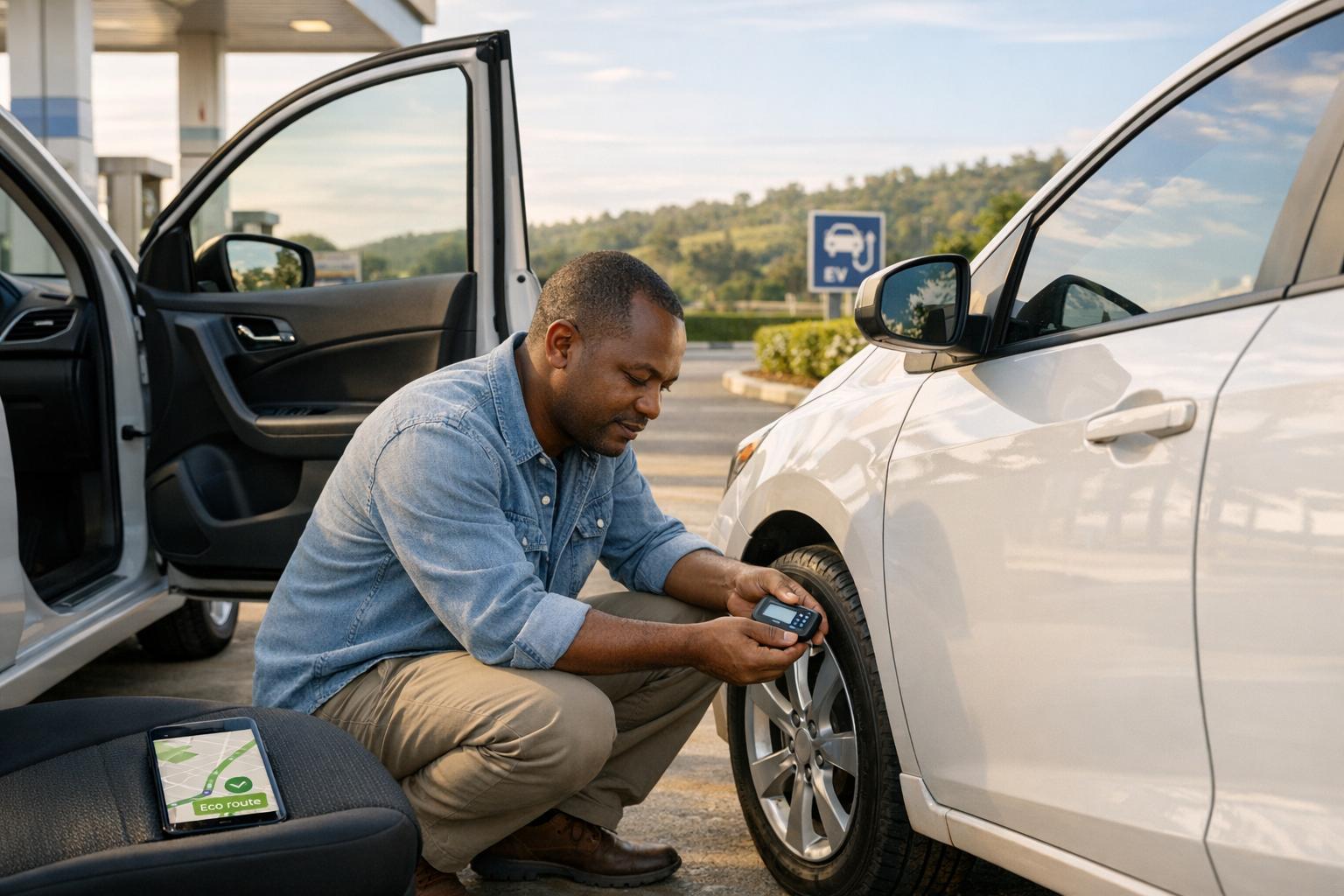
- Check Tire Pressure: Under-inflated tires increase fuel use by up to 11%. Check monthly for best results.
- Drive Smarter: Avoid idling, accelerate smoothly, and use the right gear for hills.
- Plan Trips: Combine errands and use apps to avoid traffic in Kigali.
- Reduce Drag: Remove roof racks and close windows at high speeds to improve mileage.
- Consider Electric Vehicles (EVs): EVs are tax-friendly in Rwanda and cost less to operate long-term.
These steps not only save money but also help reduce fuel imports and emissions. Start small – check your tires, drive efficiently, or explore EV options for even bigger savings.
Fuel Efficiency Impact: Maintenance, Driving Habits, and Vehicle Upgrades in Rwanda
How to save money on fuel in any car – 10 fuel saving tips that actually work
Keep Your Vehicle Well-Maintained
Taking care of your vehicle isn’t just about keeping it running – it’s about making it run efficiently. In Rwanda, where dusty roads, steep hills, and constant stop-and-go traffic are the norm, regular maintenance can make a huge difference. Dirt and metal particles build up fast on challenging roads, and neglecting upkeep forces your engine to work harder than it should. Keeping your car in good shape helps maintain the right air-fuel mixture for efficient combustion, saving fuel and extending your engine’s life.
Even your brakes and fluid levels can impact fuel economy more than you might think. Issues like sticking brake calipers or worn pads cause "brake drag", where brakes don’t fully release, leading to extra fuel consumption just to maintain speed. In Rwanda’s hilly areas, such as the roads to Musanze or Rubavu, reliable brakes are essential – not just for safety but to prevent unnecessary strain during steep climbs and descents. Let’s dive into the key maintenance tasks that will keep your car running smoothly.
Engine Tune-Ups and Oil Changes
A well-tuned engine is essential, especially when navigating Rwanda’s rough terrain. Regular tune-ups ensure your engine performs efficiently, even on demanding roads. Timely oil changes are particularly important, as they remove dirt and metal particles that accumulate faster in dusty conditions. Always stick to the motor oil grade recommended by your vehicle’s manufacturer to minimize internal friction and keep your engine running smoothly.
Air Filter and Spark Plug Checks
The air filter is your engine’s first line of defense against dust and dirt, but it can clog quickly in Rwanda’s dusty environment. A clogged filter restricts airflow, forcing the engine to burn more fuel to compensate. If you frequently drive on unpaved roads or in high-dust areas, inspect your air filter often and replace it as needed to maintain peak performance.
Spark plugs are another critical component. If your car struggles to start, misfires, or lacks acceleration, it’s time to replace the spark plugs. Faulty plugs disrupt combustion, wasting fuel and reducing performance. This can be especially frustrating when navigating Rwanda’s hilly terrain, where your engine needs to handle varying loads efficiently.
Brake System and Fluid Levels
In Rwanda’s hilly regions and Kigali’s busy traffic, your brakes endure heavy use. A poorly maintained brake system doesn’t just compromise safety – it also increases fuel consumption. Drag caused by worn brake pads or sticking calipers forces the engine to work harder. To keep your brakes in top shape, schedule regular inspections for brake pads, discs, and fluid at trusted car care centers in Kigali.
Don’t forget about other fluids either. Regularly check and top up coolant, brake fluid, power steering fluid, and transmission fluid. Low or contaminated fluids can create extra resistance, making your engine burn more fuel to compensate. Keeping these systems well-lubricated reduces strain and improves overall efficiency.
Maintain Your Tires Properly
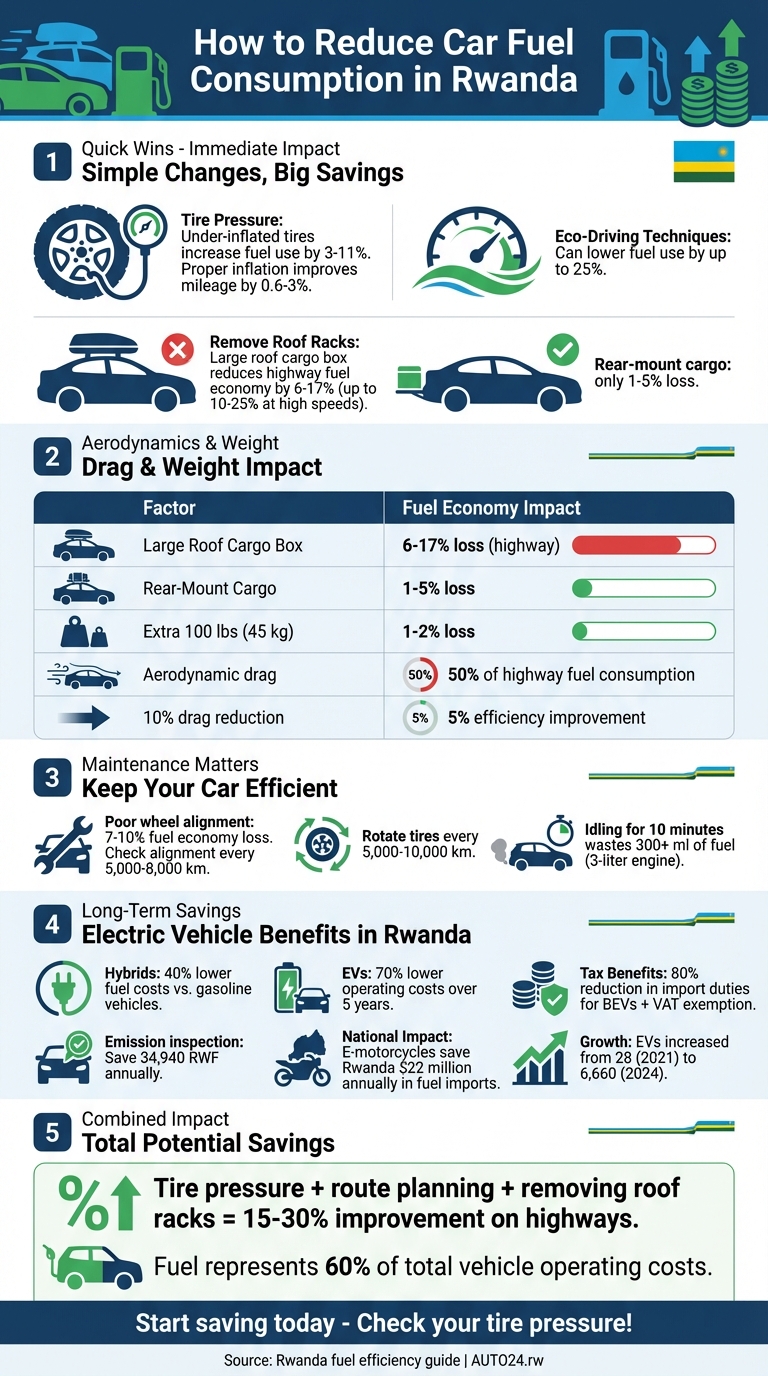
Your tires play a big role in fuel efficiency. Under-inflated tires create more rolling resistance, which means 3%–11% of your fuel is used just to overcome that drag. On Rwanda’s roads, keeping your tires in good shape is crucial for saving fuel and money.
When properly inflated, tires can improve your mileage by 0.6% to 3%. On the flip side, every 1 PSI drop in tire pressure can lower your mileage by about 0.2%. But don’t overdo it – over-inflated tires are more prone to damage from impacts and can wear unevenly.
Let’s break down how to maintain your tire pressure and alignment for better efficiency.
Check Tire Pressure Monthly
Make it a habit to check your tire pressure once a month and before any long trips. Tires naturally lose air over time, and temperature changes can also impact their pressure. For the most accurate reading, check your tires when they’re cold – either after the car has been parked for at least three hours or driven less than 1.2 miles (2 km).
Don’t just go by the "Max PSI" written on the tire’s sidewall. Instead, use the recommended pressure found inside your driver’s side door jamb or in the owner’s manual. For most passenger vehicles, this is usually between 28 and 36 PSI. If you’re carrying a heavy load or driving on steep terrain, you might need to adjust the pressure slightly higher, but always stay within safe limits. Many modern cars have a Tire Pressure Monitoring System (TPMS) that alerts you when pressure drops 25% below the recommended level. However, it’s still a good idea to check manually for accuracy.
Tire Alignment and Rotation
Rwanda’s roads, with their potholes and curbs, can easily throw off your wheel alignment. Misaligned wheels increase drag and fuel consumption, cutting efficiency by as much as 10%. The U.S. Environmental Protection Agency notes that poor alignment can lower fuel economy by about 7%. If your car pulls to one side, your steering wheel feels off-center, or your tire treads show uneven wear (like "feathering"), it’s time for an alignment check.
Experts recommend checking your wheel alignment every 5,000–8,000 km (3,100–5,000 miles) or after hitting a significant bump. Regular tire rotation – every 5,000 km (about 3,100 miles) to 10,000 km (about 6,200 miles) – is also key for even tread wear. Since front and rear tires wear differently due to steering and weight distribution, rotating them helps balance out the wear. When combined with proper inflation, these practices not only improve fuel efficiency but also extend the life of your tires, which is especially important on Rwanda’s challenging roads.
Drive Efficiently on Rwandan Roads
Your driving habits play a big role in fuel consumption, especially when navigating Rwanda’s hilly landscapes and bustling urban streets. Making a few adjustments to how you drive can help you save fuel. These tips work hand-in-hand with regular maintenance and proper tire care.
Accelerate Smoothly and Avoid Idling
Quick, aggressive acceleration puts unnecessary strain on your engine and burns more fuel. Instead, accelerate gradually and try to anticipate stops ahead. Coasting to a gentle stop is far more efficient than slamming on the brakes.
In Kigali’s traffic, idling can quickly waste fuel. If you’re stuck in traffic or expect to be stopped for more than a minute, turn off your engine to save fuel. Heavy congestion is common during peak hours in Kigali, so planning your trips outside these times can spare you the frustration of stop-and-go driving while also conserving fuel.
Use the Right Gear and Avoid Overspeeding
Navigating Rwanda’s mountainous terrain requires thoughtful gear management. When climbing hills, avoid using high gears that overwork your engine. On the other hand, driving in low gears at high speeds increases your engine’s RPM, forcing it to burn more fuel. Always match your gear to the terrain and your speed for better efficiency.
Speed consistency matters too. While it might be tempting to speed up on open roads, maintaining a steady, moderate pace can significantly improve fuel economy. If you’re driving on highways, cruise control can help you avoid unnecessary speed fluctuations that waste fuel.
Plan Ahead for Traffic and Weather
Strategic planning can make a big difference in fuel efficiency. Use navigation apps to find the quickest routes and avoid traffic jams in Kigali. Combining several errands into one trip can also help, as a warmed-up engine is far more efficient than starting it multiple times for short trips.
Weather and timing also play a role. During Rwanda’s long dry season (late June to August), temperatures typically range from 73°F to 82°F (23°C to 28°C). Planning your routes to avoid delays caused by weather or traffic can help you drive more efficiently.
sbb-itb-7bc66b5
Reduce Drag and Vehicle Weight
Car weight and aerodynamics play a huge role in fuel consumption, especially on Rwanda’s hilly terrain. Aerodynamic drag – the resistance your car faces as it moves – grows significantly as speed increases. On highways, drag can account for about 50% of a passenger car’s fuel consumption. Here’s a simple equation to keep in mind: trim aerodynamic drag by 10%, and you could see a 5% improvement in highway fuel efficiency. Likewise, shedding 100 pounds from your car can improve fuel efficiency by 1%–2%.
Even small tweaks can make a noticeable difference. These aerodynamic principles don’t just apply to car design; they also impact how you drive.
Close Windows at High Speeds
Driving with open windows might feel refreshing, but at highway speeds – above 50 mph (around 80 km/h) – it creates drag that can reduce fuel efficiency by as much as 10%. While using the air conditioner does consume some engine power, it’s often more efficient than battling the drag caused by open windows at high speeds. On the flip side, at city speeds, feel free to roll the windows down and only use the AC when absolutely necessary.
Additionally, external accessories like roof racks or cargo boxes add drag and weight, which can further hurt your fuel economy.
Remove Unnecessary Roof Racks and Cargo
Unused roof racks and cargo accessories can be a hidden fuel drain. For instance, a large roof-top cargo box can reduce fuel economy by 6% to 17% on highways, and at speeds between 65 mph and 75 mph, the loss can jump to 10% to 25%.
"A large, blunt roof-top cargo box, for example, can reduce fuel economy by around 2% to 8% in city driving, 6% to 17% on the highway, and 10% to 25% at Interstate speeds." – U.S. Department of Energy
The fix? Remove roof racks and cargo boxes as soon as you’re done using them. If you need extra storage, rear-mounted boxes or trays are a better option, as they only reduce highway fuel economy by 1% to 5%. Also, take a moment to declutter your car – clearing out heavy items from your trunk and back seats can lead to noticeable savings. For those who regularly haul goods, reducing excess weight is an easy way to stretch your fuel further.
| Cargo Type | Highway Fuel Economy Impact |
|---|---|
| Large Roof-Top Cargo Box | 6% – 17% loss |
| Rear-Mount Cargo Box/Tray | 1% – 5% loss |
| Extra 100 lbs (45 kg) | 1% – 2% loss |
Plan Your Routes and Use Quality Fuel
After ensuring proper vehicle maintenance and adopting efficient driving habits, it’s time to focus on smart route planning and fuel choices. In bustling cities like Kigali, traffic congestion often forces drivers into stop-and-go driving, which drains fuel and strains engines. On top of that, poor-quality fuel can quietly undermine your car’s performance, making it burn more fuel to achieve the same output. By carefully planning your routes and choosing reliable fuel stations, you can stretch your fuel further and drive more efficiently.
Use Navigation Apps to Avoid Traffic
Apps like Google Maps are invaluable for finding the quickest routes and steering clear of traffic jams, especially in Kigali’s busy streets. These tools also help you dodge fuel-wasting obstacles. For more advanced features, platforms like Cartrack Delivery can optimize routes to cut down on travel time and fuel use. However, if you’re driving through rural areas in Rwanda, be cautious with GPS recommendations – some routes may be impassable or outdated. In such cases, asking locals for guidance is often the best approach.
Combine Errands into Single Trips
Planning multiple errands into a single trip is another simple yet effective way to save fuel. This approach reduces the number of "cold starts", which are much less fuel-efficient than driving with an already warmed-up engine. In fact, several short trips with cold starts consume more fuel than one continuous journey. By grouping tasks into a single loop, you can also cut down on unnecessary backtracking and reduce the overall distance traveled. In cities like Kigali, this method is particularly useful for avoiding peak traffic times, which helps minimize the fuel wasted while idling. Did you know that a 3-liter engine can waste over 300 milliliters (more than a cup) of fuel for every 10 minutes it idles?.
Choose Reliable Local Fuel Stations
The quality of fuel you use plays a significant role in your vehicle’s efficiency. Low-grade or contaminated fuel not only burns less efficiently but can also clog your fuel injectors over time. On the other hand, premium or high-quality fuels, especially those recommended by your vehicle’s manufacturer, can improve mileage and engine performance. In Rwanda, the Rwanda Utilities Regulatory Authority (RURA) oversees fuel quality under strict regulations, such as Regulation N° 09/R/GP-EWS/RURA/2023, designed to protect consumers and ensure fuel meets national standards. Avoid fuels with sulfur levels exceeding 10 ppm, as they can damage your engine and exhaust system. To ensure you’re getting clean, reliable fuel, stick to stations that comply with RURA’s guidelines.
Consider Fuel-Efficient or Electric Vehicles
Once you’ve optimized your current vehicle’s performance through maintenance and better driving habits, upgrading to a fuel-efficient or electric vehicle could be a smarter, long-term choice. In Rwanda, the government actively encourages this shift by offering substantial tax breaks. For example, Battery Electric Vehicles (BEVs) benefit from an 80% reduction in import duties and are fully exempt from VAT. With over half of Rwanda’s electricity coming from renewable sources, modern EVs are particularly well-suited for the country’s terrain. Their high torque handles steep slopes with ease, while regenerative braking systems recover energy on descents. Here’s a closer look at how these vehicles can save you money and reduce fuel expenses.
Benefits of Fuel-Efficient Vehicles
Fuel-efficient cars, including hybrids, offer a clear financial advantage by cutting fuel consumption. Hybrids, for instance, can lower fuel costs by as much as 40% compared to traditional gasoline vehicles. Meanwhile, mid-range EVs have operating costs that are up to 70% lower over five years. In Rwanda, fully electric vehicles come with additional perks, such as exemption from mandatory motor vehicle emission inspections, saving owners 34,940 RWF annually. For those hesitant about fully switching to electric, plug-in hybrids offer a middle-ground solution with a 50% reduction in import duties and partial VAT exemptions.
The financial benefits are already evident. In May 2024, Ampersand – a Kigali-based electric motorcycle company – revealed that its fleet of over 2,200 e-motorcycles was clocking over 1.2 million kilometers each week. CEO Josh Whale shared:
"For a motorcycle driver with a petrol bike, the energy costs are around $2,000 a year. With us, that cost is reduced by about a third".
One driver, Numukobwa Dative, reported a 35% boost in her weekly income after switching to an Ampersand e-motorcycle. Each of these bikes also cuts approximately 2 tons of CO₂ emissions annually. These real-life examples highlight the financial and environmental gains of adopting electric vehicles, which are becoming increasingly accessible in Rwanda.
Electric Vehicle Options from AUTO24.rw

If you’re exploring EV options, AUTO24.rw offers the most extensive selection in Rwanda. By April 2025, their inventory included affordable models like the Leapmotor T03 (priced between 15–25 million RWF) and luxury choices such as the Tesla Model Y (starting at 45 million RWF). They also simplify the transition with turnkey home charging installation services, which range from 300,000 to 800,000 RWF, and access to their exclusive charging network.
Most EV owners in Rwanda charge their vehicles at home, with a full charge taking 3–8 hours using a Level 2 charger. Public charging infrastructure is rapidly expanding, with new stations being added monthly across Kigali and along major routes like the Kigali–Musanze highway. The AUTO24.rw team emphasizes:
"Investing in a BEV now maximizes long-term tax benefits and ensures compliance with future urban mobility regulations".
Switching to electric vehicles doesn’t just benefit individual users – it has a broader economic impact. For example, the adoption of electric motorcycles alone is expected to save Rwanda $22 million annually in fuel import costs. Choosing an EV is not only a step toward reducing personal expenses but also a meaningful contribution to strengthening Rwanda’s energy independence.
Conclusion
Cutting down on fuel consumption in Rwanda starts with smart habits like proper vehicle maintenance, efficient driving, and thoughtful planning. Simple eco-driving techniques – such as smooth acceleration and maintaining steady speeds – can lower fuel use by up to 25%. Routine maintenance tasks, like checking tire pressure monthly and replacing air filters, not only enhance fuel efficiency but also extend your vehicle’s lifespan, saving you money in the long run. Considering that fuel accounts for around 60% of a vehicle’s total operating costs, these adjustments are a no-brainer for anyone looking to reduce expenses.
Small changes can lead to big financial benefits. For instance, keeping tires inflated to the recommended pressure, removing unnecessary roof racks, and planning routes to avoid Kigali’s notorious traffic jams can improve fuel efficiency by 15% to 30% on highways – and even more in stop-and-go traffic. Beyond saving money, these practices promote safer driving and align with Rwanda’s efforts to lower CO2 emissions.
If you’re thinking long-term, making the switch to electric vehicles (EVs) offers the greatest potential for savings and sustainability. Thanks to government incentives, EVs are becoming more accessible, and their adoption in Rwanda has skyrocketed – from just 28 vehicles in 2021 to an impressive 6,660 in 2024. This shift highlights the growing appeal of sustainable transportation.
Ready to make a difference? Start small – check your tire pressure, plan your next trip more efficiently, or explore Rwanda’s expanding EV market through AUTO24.rw. With their wide selection of EVs and charging solutions, it’s never been easier to save money and reduce your environmental impact. Every step counts for your wallet and the planet.
FAQs
What are the best ways to save fuel while driving in Rwanda’s hilly areas?
Driving through Rwanda’s hilly landscapes can be tough on your vehicle – and your wallet – if you’re not mindful of fuel consumption. To get the most out of your gas tank, start by avoiding rapid acceleration and hard braking. Keeping a steady speed, especially on those uphill stretches, helps prevent wasting fuel on sudden bursts of power.
Another important tip is staying on top of vehicle maintenance. Make sure your engine is properly tuned, tires are inflated to the correct pressure, and air filters are clean. These small steps can have a noticeable impact on how efficiently your car runs.
You can also cut down on fuel use by reducing aerodynamic drag. Remove roof racks when you’re not using them, and keep your windows closed when driving at higher speeds. Lastly, plan your routes in advance. Avoiding traffic jams and unnecessary detours doesn’t just save time – it saves gas, too. By following these steps, you’ll not only save money but also tackle Rwanda’s hilly roads with greater ease.
What are the advantages of switching to an electric vehicle in Rwanda?
Switching to an electric vehicle (EV) in Rwanda comes with perks that benefit both the planet and your wallet. EVs produce zero tailpipe emissions, which means cleaner air and a step toward addressing climate change. This fits perfectly with Rwanda’s push for cleaner transportation options and improved air quality.
On top of helping the environment, EVs can save you money in the long run. Electricity is typically cheaper than gasoline or diesel, and since EVs have fewer moving parts, they require less maintenance – saving you on repair costs over time. Plus, with Rwanda aiming for a future dominated by electric and hybrid vehicles, making the switch now sets you ahead of the curve.
Driving an EV means you’re not only cutting down on fuel and maintenance costs but also actively supporting a greener, more forward-thinking approach to transportation.
How does regular car maintenance help save fuel?
Keeping your car in good shape is one of the simplest ways to get better gas mileage. When your engine is running efficiently, it uses less fuel to get the job done. On the other hand, things like under-inflated tires, clogged air filters, or skipping oil changes can lead to higher fuel consumption – and that means spending more at the pump.
Regular maintenance, such as checking tire pressure, changing the oil, and keeping the engine tuned, not only helps you save on gas but also keeps your car running longer. It’s an easy way to save money and make your driving habits more efficient!
Related Blog Posts
- Electric vs Petrol cars in Rwanda
- Top 5 Cheapest Cars to Maintain in Rwanda
- Top 5 Most Fuel-Efficient Cars to Drive in Rwanda
- Top 10 fuel-efficient cars in Rwanda (2025 Edition)