Owning a car in Rwanda involves several costs beyond just the purchase price. Here’s a quick summary of what you need to know:
- Purchase Options: Local dealerships offer convenience, while importing provides more model choices but adds shipping and tax costs.
- Registration Fees: Based on engine size, ranging from FRW 160,000 ($116) for small cars to FRW 640,000 ($463) for larger vehicles.
- Transfer Fees: Flat FRW 60,000 ($43) for ownership transfers, now streamlined through the RRA’s online portal.
- Import Taxes: Include 25% Customs Duty, 18% VAT, and 5% Withholding Tax, calculated on the vehicle’s depreciated value.
- Recurring Costs: Annual road levies, fuel, insurance, and maintenance all factor into long-term ownership expenses.
- Fuel Costs: Impacted by a 15% levy and VAT, with updates as of November 2025.
- Insurance: Required for registration and transfer, with premiums based on the car’s value and age.
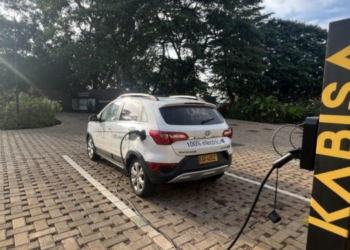
- EV Benefits: Electric vehicles (EVs) have lower maintenance and operational costs, and VAT exemptions are valid until June 2028.
To make an informed decision, consider the total cost of ownership, including purchase price, taxes, and recurring expenses. EVs and hybrids may offer savings over time due to lower fuel and maintenance costs.
Purchase Price and Import Costs
Buying Locally vs. Importing
When deciding how to buy your vehicle, you’ll need to weigh the pros and cons of purchasing from a local dealership versus importing one yourself. Local dealerships offer the convenience of immediate availability and verified documentation, while importing opens up a broader selection of models but involves more steps and waiting time.
If you’re buying locally, prices can vary significantly depending on factors like the car’s age, condition, and mileage. Budget-friendly options like the Toyota Echo or older Corolla models typically range from FRW 4,000,000 to FRW 9,000,000 (around $2,900 to $6,500). For mid-range vehicles, such as the Toyota Yaris or Corolla Hatchback, expect prices between FRW 9,100,000 and FRW 15,000,000 ($6,600 to $10,900). Standard SUVs like the Toyota RAV4 or Fortuner fall in the FRW 21,000,000 to FRW 30,000,000 range ($15,200 to $21,700). If you’re eyeing premium models like the Toyota Prado TXL or Landcruiser V8, prices climb to FRW 34,000,000 to FRW 75,000,000 ($24,600 to $54,300). Newer models, such as those from 2024–2025, start at FRW 45,000,000 and can exceed FRW 150,000,000 ($32,600 to $108,600+).
Toyota remains the go-to brand, thanks to its strong resale value and the availability of spare parts. Vehicles with less than 100,000 km (about 62,000 miles) on the odometer often come with a price premium. Negotiation is a common practice, with sellers typically listing vehicles slightly above their target price – for instance, pricing a car at FRW 12,500,000 when they aim to sell it for FRW 12,000,000.
If you opt to import, be prepared for a shipping timeline of 24–34 days via RoRo (Roll-on/Roll-off) shipping from Japan to ports like Dar Es Salaam or Mombasa, followed by overland transport to Rwanda. Rwanda does not impose an age limit on imported vehicles, but you’ll need to account for shipping fees, customs clearance, and the time involved. Importing can offer access to a wider range of models compared to what’s available locally. The next step is understanding how import duties and taxes will affect your total costs.
Import Duties and Taxes
Import taxes play a major role in determining the final cost of bringing a vehicle into Rwanda. Standard imports are subject to 25% Customs Duty, 18% VAT, and 5% Withholding Tax. However, the taxable value isn’t based on the car’s current market price. Instead, it’s calculated using the original FOB (Free on Board) price when the vehicle was new, adjusted by the EAC harmonized depreciation schedule.
Depreciation reduces the taxable value over time. For example:
- A vehicle 1–2 years old is taxed on 80% of its original value.
- A 3–4-year-old vehicle is taxed on 60% of its original value (reflecting 40% depreciation).
- For vehicles over 10 years old, the taxable value bottoms out at 20% of the original price.
This depreciation system lowers the absolute tax amount for older vehicles, even though the percentage rates remain fixed.
What about tax-exempt vehicles? If you’re purchasing a car locally that previously had IT, CD, CMD, UN, or RIT plates, be aware that you’ll need to pay all applicable Customs Duties during the ownership transfer. These vehicles were initially imported duty-free for diplomatic or organizational use, and the tax responsibility shifts to the new owner unless they also qualify for exemption.
Additionally, the ownership transfer fee for motor vehicles is a flat FRW 60,000 ($43). Factoring in these initial costs is crucial for understanding the broader financial picture, including recurring ownership expenses.
Registration, Transfer, and Annual Fees
Registration and Ownership Transfer
Once you’ve purchased a vehicle, the next step is registration. Head to the Rwanda Revenue Authority (RRA) Customs Services Office in Gikondo (MAGERWA) to get this done. The process is quick – usually completed within 1 day. To register, you’ll need customs clearance documents, proof of payment for the registration fee, and any applicable exemption letters.
Registration fees are a one-time cost and depend on the vehicle’s engine capacity. For instance:
- A compact car with a 1,200cc engine costs FRW 160,000 ($116).
- A mid-size SUV with a 2,500cc engine is FRW 250,000 ($181).
- Larger vehicles, like those above 4,501cc, will set you back FRW 560,000 ($405).
- Special vehicles top the chart at FRW 640,000 ($463).
If you’re buying a used vehicle from another owner, you’ll need to pay a transfer fee of FRW 60,000 ($43). Since October 16, 2023, this process has been streamlined through the RRA’s e-tax portal (etax.rra.gov.rw). Submissions are typically processed within 4 hours.
Before initiating a transfer, ensure the seller has cleared all tax obligations and that the vehicle has no unpaid traffic fines – any unresolved issues will delay the transfer. You’ll also need the following documents:
- A notarized sale contract
- Copies of IDs for both buyer and seller
- The vehicle’s log book (Yellow Card)
- Proof of valid insurance for one year
- A Tax Identification Number (TIN).
Once registered, you’ll need to keep up with annual road levies to maintain compliance.
Annual Road Levies
After registration, annual road levies become a recurring responsibility. These payments are made through the RRA’s domestic tax services. The cost varies depending on vehicle type and engine size – a smaller sedan will incur lower fees compared to a large SUV or pickup truck. Staying up to date with these payments is crucial, as overdue levies can create issues when transferring ownership or renewing your registration.
Recurring Costs: Fuel, Insurance, and Maintenance
Owning a car in Rwanda involves more than just the initial purchase price and registration fees. Recurring expenses like fuel, insurance, and maintenance make up a significant part of the long-term costs.
Fuel Expenses
Fuel is one of the most consistent and impactful costs of car ownership. A new 15% levy, which replaced the fixed FRW 115 per liter, has added to fuel expenses. Starting in the 2025/2026 fiscal year, VAT will further increase fuel prices. The latest fuel pump rates were updated on November 8, 2025.
How much you spend on fuel each year depends on your vehicle and driving habits. A fuel-efficient compact sedan will cost far less to operate than a large SUV or pickup truck. For daily commuters in Kigali, fuel is likely to be a significant monthly expense, especially with the upcoming VAT changes. These fuel costs combine with insurance and maintenance to shape your overall running expenses.
Insurance Premiums
In Rwanda, having valid motor vehicle insurance for one year is a legal requirement for both registration and ownership transfer. The cost of insurance is based on your car’s depreciated value, as determined by the EAC-harmonized schedule. This means newer vehicles typically come with higher premiums.
If you own a commercial vehicle, such as a taxi, additional insurance documentation is required. Factors like your vehicle’s age, value, and purpose influence how much you’ll pay annually for coverage.
Maintenance and Repairs
Maintenance costs can vary a lot depending on your car type. Gasoline and diesel vehicles require regular oil changes, filter replacements, and brake servicing. Hybrids, while generally more efficient, come with dual powertrains that can make maintenance more complex. However, their regenerative braking systems reduce brake wear over time. Electric vehicles (EVs) stand out with their lower maintenance needs – no oil changes and fewer moving parts. Tax exemptions for EVs also help offset some of these costs.
If you own an EV, the cost of charging is influenced by the updated electricity tariffs introduced in October 2025. These costs, while generally lower than fuel, still contribute to your overall expenses.
sbb-itb-7bc66b5
5-Year Cost Comparison: ICE vs. Hybrid vs. EV
5-Year Car Ownership Cost Comparison in Rwanda: ICE vs Hybrid vs EV
Total Ownership Cost Examples
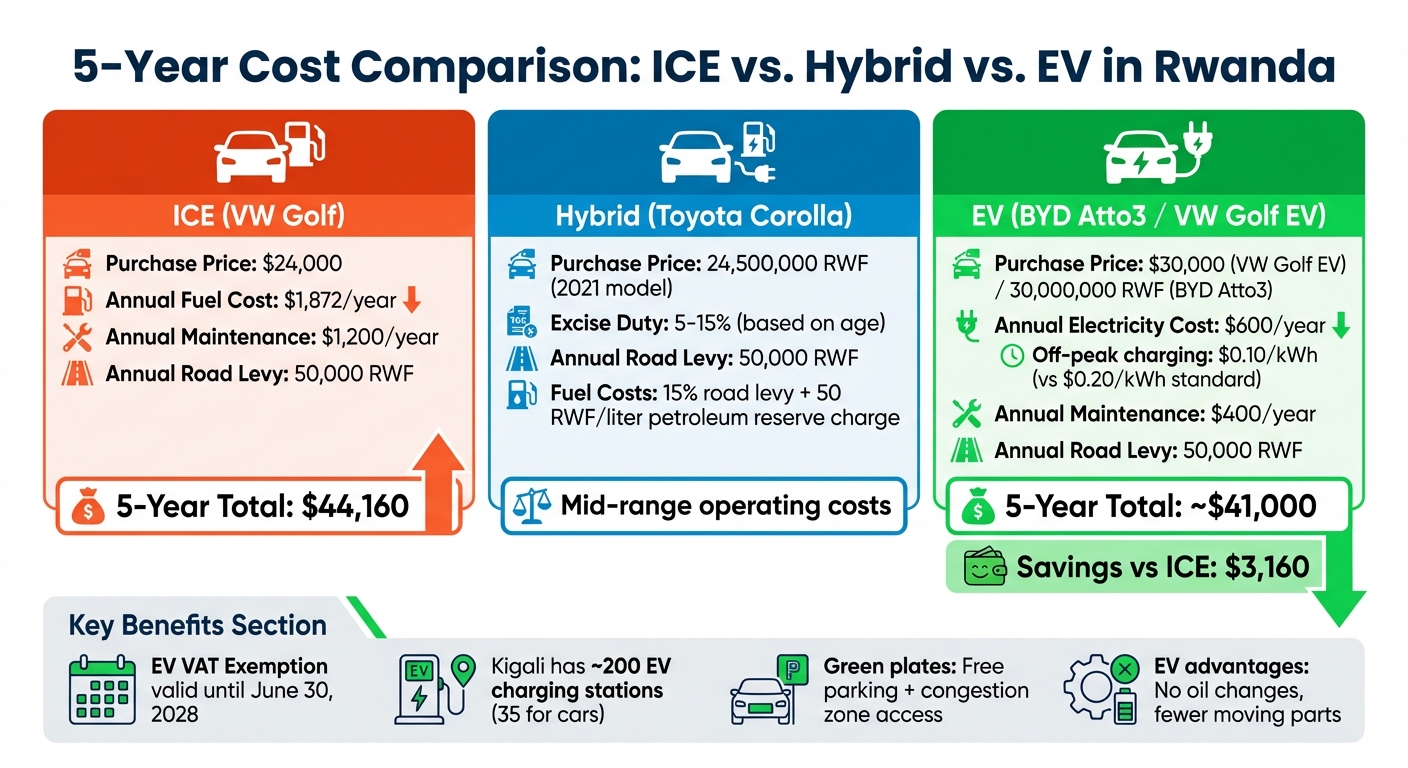
A closer look at 5-year ownership costs reveals clear financial differences between internal combustion engine (ICE), hybrid, and electric vehicles (EVs). Take the VW Golf as an example: the ICE version starts at $24,000, while the EV version costs $30,000. That’s a $6,000 upfront difference. However, when you factor in operating costs over five years, the ICE version totals around $44,160, compared to about $41,000 for the EV – saving you $3,160 with the EV. The savings largely come from lower annual fuel and maintenance costs. Gasoline expenses average $1,872 per year, while electricity costs drop to approximately $600 annually. Maintenance costs also shrink significantly, from $1,200 to $400 per year.
Hybrids tend to fall somewhere in the middle, especially after mid-2025, when Rwanda introduced excise duties on hybrids ranging from 5% to 15%, depending on the vehicle’s age. For instance, a 2021 Toyota Corolla Hybrid is priced at approximately 24,500,000 RWF, while a 2023 BYD Atto3 EV is around 30,000,000 RWF. Regardless of vehicle type, all owners face an annual road levy of 50,000 RWF for cars and jeeps.
Ways to Reduce Costs
If you’re looking to cut down on ownership costs, there are a few strategies to consider. For EV buyers, purchasing before June 30, 2028, could save you a lot, as the current VAT exemption for EVs remains in effect until that date. If a hybrid is more your speed, choosing a model under three years old helps you qualify for the lowest excise duty rate of 5%, avoiding the 15% rate for vehicles older than eight years.
EV owners can also save by charging during off-peak hours, when electricity rates are just $0.10 per kWh – half the standard rate of $0.20 per kWh. Kigali’s growing EV infrastructure, with nearly 200 charging stations (including 35 specifically for cars), adds convenience. Green license plates for EVs often come with perks like free parking and access to congestion zones in Kigali.
On the other hand, ICE and hybrid owners face additional costs, such as a 15% road maintenance levy on fuel value and a 50 RWF per liter charge for petroleum reserves. To manage these costs, adopting fuel-efficient driving habits can make a noticeable difference.
Conclusion
Pricing, recurring fees, and operational costs all play a role in determining the true cost of owning a car in Rwanda. Beyond the purchase price, there are several additional expenses to consider. For instance, registration fees depend on engine size, and you’ll also need to account for transfer fees, duties, and mandatory insurance. These factors can quickly add up, significantly increasing the initial investment.
In the long run, fuel-efficient and electric vehicles can offer notable savings. With gasoline prices increasing as of November 8, 2025, and EV charging stations now stretching from Kigali to Rubavu, the cost gap between conventional and electric cars is becoming more apparent. Electric vehicles not only save on fuel but also have fewer maintenance requirements – no oil changes and fewer moving parts mean lower upkeep costs. These operational savings are key when evaluating the overall cost of a vehicle.
When making a decision, it’s essential to focus on the total cost of ownership rather than just the upfront price. While a vehicle with a higher purchase price may seem expensive initially, lower fuel, maintenance, and registration costs can result in better value over five years. This is particularly relevant in a market where the vehicle price index stands at 115.39, significantly above the global average of 100.
FAQs
What are the benefits of importing a car compared to buying one locally in Rwanda?
Importing a car to Rwanda can open the door to a broader range of options, including newer models or vehicles with specialized features that might not be available locally. If you’re after specific specifications or advanced technology, this route could be worth exploring. Plus, there’s an added financial perk if you’re considering electric vehicles – they’re exempt from excise tax, which can make them a more cost-effective choice.
That said, importing isn’t without its challenges. You’ll need to factor in additional expenses like customs duties, VAT, and shipping fees, which can significantly raise the total cost. On the flip side, buying a car locally is much simpler. The process is faster, the paperwork is easier to handle, and you can drive your car home almost immediately. The downside? Local options are often limited, mostly consisting of used vehicles.
Ultimately, the decision boils down to your priorities. If you value convenience and speed, buying locally might be the way to go. But if variety and customization matter more, importing could be the better choice.
How do taxes and duties impact the cost of owning an imported car in Rwanda?
Taxes and duties have a significant impact on the total cost of owning an imported car in Rwanda. When importing a vehicle, you’ll encounter several charges based on the car’s CIF (Cost, Insurance, and Freight) value. These include a 25% customs duty, an 18% Value-Added Tax (VAT), and a 5% withholding tax. On top of these, there are additional fees like a 1.5% Infrastructure Development Levy and a 0.2% African Union Levy, which further raise the overall cost.
These combined taxes can make the final price of an imported car much higher than its original price in the exporting country. On top of that, registration fees – determined by the engine size – add another layer of expense. When planning to buy a car in Rwanda, it’s crucial to factor in these costs, as they can significantly affect both the initial affordability and the long-term financial commitment of owning the vehicle.
What are the cost advantages of owning an electric vehicle over a gasoline car in Rwanda?
Owning an electric vehicle (EV) in Rwanda can save you money in several ways compared to driving a gasoline-powered car. One of the biggest perks? Lower energy costs. Electricity is typically cheaper than gasoline, which means you’ll spend less to keep your car running over time.
Another advantage is reduced maintenance costs. EVs are built with fewer moving parts than traditional gas engines, so there’s less to repair or replace. This can lead to noticeable savings on repairs and servicing throughout the life of the vehicle. On top of that, Rwanda provides tax incentives for EV owners, which can help offset the upfront purchase price.
Even though EVs might cost more initially, the long-term savings on fuel, maintenance, and the added benefit of government incentives make them a financially smart choice – not to mention a step toward a cleaner environment.
Related Blog Posts
- Car prices in Kigali this year
- Rwanda Vehicle Registration: Tax and Duty Breakdown
- Car Prices in Rwanda in 2025: What to Expect This Year
- Car import duties in Rwanda: Updated costs and procedures for 2025