Rwanda’s electric vehicle (EV) market has grown significantly since the launch of the Volkswagen e-Golf in 2019. With government incentives like tax exemptions, reduced electricity tariffs, and a well-planned charging network, EV ownership is more accessible than ever. This guide outlines three popular EV options in Rwanda for 2026, comparing their costs, features, and practicality:
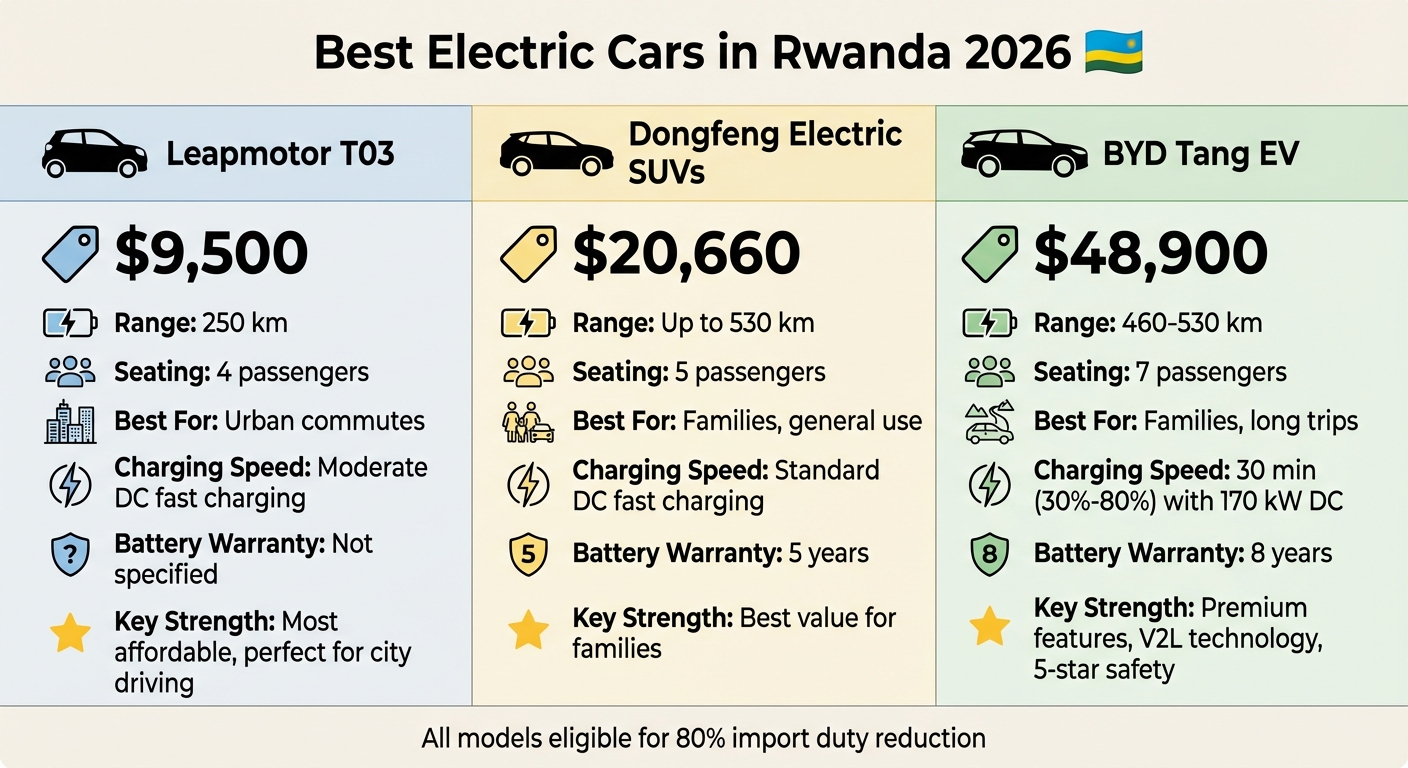
- Dongfeng Electric SUVs: Affordable family-friendly options with ranges up to 530 km and prices starting at $20,660.
- BYD Tang EV: A premium 7-seater SUV with a range of 530 km, priced at $48,900, ideal for families and long trips.
- Leapmotor T03: A compact city car with a range of 250 km, priced at $9,500, perfect for urban commutes.
Quick Comparison
| Feature | Dongfeng Electric SUVs | BYD Tang EV | Leapmotor T03 |
|---|---|---|---|
| Starting Price | $20,660 | $48,900 | $9,500 |
| Battery Range | Up to 530 km | 460–530 km | 250 km |
| Best For | Families, general use | Families, long trips | Urban commutes |
| Seating | 5 | 7 | 4 |
| Charging Speed | Standard DC fast charging | 30 min (30%-80%) | Moderate fast charging |
| Warranty | 5 years (battery) | 8 years (battery) | Not specified |
Rwanda’s EV-friendly policies, renewable energy sources, and growing charging infrastructure make switching to electric vehicles a smart choice in 2026. Whether you’re looking for a budget-friendly city car or a spacious family SUV, there’s an EV to fit your needs.
Rwanda Electric Vehicle Comparison 2026: Price, Range & Features
1. Dongfeng Electric SUV
Dongfeng Motor has established its presence in Rwanda through Carcarbaba, its official dealer for genuine parts and certified maintenance services. The company offers a range of electric SUVs tailored to different needs, including the Aeolus Sky EV01, the Forthing Friday, and the high-performance M-Hero. These models cater to a variety of buyers, from budget-conscious families to those seeking a premium driving experience.
Purchase Price
The Aeolus Sky EV01 provides an affordable entry into the EV market, with a FOB price starting at $20,660. For traditional SUV enthusiasts, the Forthing Friday is priced between $35,000 and $46,000 in comparable markets. At the higher end, the M-Hero – a luxury performance model – commands a price of approximately $132,000 in international markets, placing it alongside premium EVs like the Jaguar I-Pace.
"Rwanda is a beautiful country which is developing extremely fast and we want to grow with Rwanda for Rwandans."
- Huang Sheng Wei, CEO, Dongfeng Africa Export Base
Battery Range
The Aeolus Sky EV01 comes equipped with a 62 kWh battery, delivering a range of 530 km (329 miles) and powered by a 218 HP motor. The Forthing Friday, on the other hand, offers flexibility in its range, depending on the battery configuration. Drivers can expect between 430 km and 630 km (267 to 391 miles), with a 201 HP motor providing the power. These ranges are well-suited for both daily commutes in Kigali and longer intercity trips, ensuring convenience and reliability for Rwandan drivers.
Charging Costs
The Aeolus Sky EV01 supports 50 kW DC fast charging and includes a Mode 3 Type 2 charging cable for home use. Charging costs in Rwanda remain affordable, thanks to home charging options and a growing public charging network. This affordability, combined with reduced maintenance requirements, enhances the overall cost-efficiency of owning an electric SUV.
Maintenance Costs
Dongfeng vehicles come with a three-year/100,000 km warranty and an additional five-year/100,000 km battery warranty. Maintenance costs are lower compared to traditional vehicles due to fewer mechanical parts in EVs. With Carcarbaba’s local presence, Rwandan drivers have access to genuine parts and certified diagnostic services. Features like regenerative braking also help extend the lifespan of brake components, reducing long-term expenses.
Long-Term Value
The Aeolus Sky EV01 stands out as a cost-effective choice for families and businesses, offering a competitive price and an impressive 530 km range, which can significantly cut fuel expenses. Meanwhile, the Forthing Friday combines the practicality of a traditional SUV with the benefits of electric power, appealing to drivers seeking a spacious and versatile vehicle. Together with Rwanda’s growing charging infrastructure, these models offer a lower total cost of ownership and long-term savings for drivers.
sbb-itb-7bc66b5
2. BYD Tang EV
The BYD Tang EV is a 7-seater, all-wheel-drive electric SUV designed for families and those who enjoy a mix of comfort and performance. With its 108.8 kWh Blade Battery, it offers a WLTP range of 530 km (329 miles) and a practical, real-world range of about 460 km (286 miles). The SUV also delivers impressive acceleration, going from 0 to 62 mph in just 4.9 seconds, blending speed with a family-friendly design. Below, we’ll dive into its pricing, battery performance, charging efficiency, and maintenance perks.
Purchase Price
The global price for the 2025/2026 BYD Tang EV AWD 7-Seater is approximately $48,900. While it sits on the higher end of the market, the Tang justifies its cost with extra space, advanced safety features, and premium amenities like a 15.6-inch rotating touchscreen and a 12-speaker Dynaudio sound system. It also boasts a 5-star Euro NCAP safety rating, scoring 87% in both adult and child occupant protection categories.
Battery Range
The Tang’s 108.8 kWh battery is built for versatility, handling both urban commutes and long-distance travel. In moderate weather conditions (around 73°F), the SUV achieves a city range of up to 660 km (410 miles) and a highway range of about 410 km (255 miles). Its combined real-world range is approximately 460 km (286 miles). A built-in heat pump helps conserve energy during climate control use, and the 4 kW Vehicle-to-Load (V2L) capability allows the SUV to power external devices – ideal for camping or off-grid adventures.
Charging Costs
Using a 170 kW DC rapid charger, the Tang can go from 30% to 80% charge in just 30 minutes. For home charging, it comes with an 11 kW on-board charger, taking about 11 hours and 45 minutes for a full charge. In Rwanda, home charging is cost-effective, typically 30% to 50% cheaper than public charging stations due to industrial electricity rates. Buyers of BYD models through CFAO Mobility in Rwanda often receive a 7 kW Level 2 wall charger, although installation by a RURA-licensed electrician costs between 300,000 and 800,000 RWF ($213 to $569). Charging during off-peak hours is encouraged to save on costs and ease pressure on the national grid, which exceeded 136% of its maximum load capacity in 2024.
Maintenance Costs
The Tang includes an 8-year or 250,000 km (155,000 miles) battery warranty, ensuring long-term reliability. Its Blade Battery technology is known for enhanced thermal safety and long-lasting performance. Maintenance is simpler and cheaper compared to traditional gas-powered vehicles. For instance, Rwandan EV owners pay just 50,000 RWF ($36) annually in road taxes, and VAT exemptions on imported charging equipment are available until June 30, 2028.
Long-Term Value
The BYD Tang EV stands out as a spacious, safe, and powerful electric SUV, ideal for large families or businesses. Its 7-seater layout and 4 kW V2L functionality make it suitable for road trips or commercial use requiring mobile power. With Rwanda’s EV fleet expanding from 28 vehicles in 2021 to 6,660 by 2024, the growing charging infrastructure is making EV ownership more convenient. Thanks to its impressive range, fast charging, and strong warranty, the Tang provides an excellent balance between upfront cost and long-term savings.
3. Leapmotor EVs from AUTO24.rw

The Leapmotor T03, available through AUTO24.rw’s EV24.africa network, provides an affordable and compact option for urban mobility in Rwanda. This four-door electric hatchback is designed with city commuting in mind, offering an accessible way to own an electric vehicle.
Purchase Price
The 2024 Leapmotor T03 starts at a FOB price of $9,500. Despite its competitive price, it comes packed with premium features like a panoramic roof, leather seats, and a touchscreen compatible with Android Auto and Apple CarPlay. Essential safety features, including Brake Assist, Stability Control, and Traction Control, are also included. Leapmotor keeps costs low through vertical integration, manufacturing most of the vehicle’s components in-house.
Battery Range
The T03 is equipped with a 41 kWh lithium-ion battery and a 95 HP (70 kW) electric motor, offering an estimated range of 250 km (155 miles) on a full charge. This makes it a perfect fit for daily commutes and navigating Kigali’s urban landscape. It supports 50 kW DC fast charging and comes with a Mode 3 Type 2 charging cable for home use. This range is ideal for short city trips, and the low charging costs add to its practicality.
Charging Costs
Charging at home is the most cost-effective option for T03 owners. The smaller battery size keeps charging expenses low, while the 50 kW DC fast charging capability allows for quick top-ups at public charging stations. This combination of convenience and affordability makes the T03 an economical choice for drivers.
Maintenance Costs
Electric vehicles like the T03 typically have lower maintenance costs compared to gasoline-powered cars. On average, EV owners spend $457 to $485 annually, compared to about $678 for traditional vehicles. Over a decade, this can save owners around $2,416 in maintenance and an additional $7,523 in fuel/electricity costs.
Long-Term Value
For first-time EV buyers or those looking for a practical city car, the Leapmotor T03 offers excellent long-term value. Its compact design is well-suited to Kigali’s urban environment and hilly terrain. Leapmotor’s CEO, Zhu Jiangming, has even hinted at further price reductions as EV technology becomes more cost-efficient:
"it is reasonable for automakers to sell a mid-to-large SUV for 50,000 yuan (7,000 USD) in the future as costs decrease".
For budget-conscious Rwandan drivers who prioritize practicality over extended range, the T03 stands out as a smart, efficient choice for urban commuting.
Advantages and Disadvantages
Electric vehicles (EVs) available to Rwandan drivers come with their own set of strengths and trade-offs. The BYD Tang EV stands out for its family-friendly features, such as a 7-seater layout and a top-tier 5-star Euro NCAP safety rating – perfect for larger households. With a range of 530 km, it’s well-suited for long trips, and its Vehicle-to-Load (V2L) technology (offering 4 kW of discharge capacity) can power external devices, making it handy for off-grid scenarios. However, its higher price tag and recent recall issues have raised some concerns about reliability.
For city dwellers, the Leapmotor T03 is a more practical option. Its compact design is tailored for urban driving, and it offers an affordable solution for daily commutes. That said, its range is more limited, making it less ideal for longer journeys.
Rwanda’s generous tax incentives, such as the 80% reduction on import duties, make EVs more accessible to a broader audience. Additionally, the country’s mild climate helps maintain battery efficiency, which supports more sustainable charging habits. As Bessie Noll, Senior Researcher at ETH Zürich, points out:
"EVs have serious economic potential in most African countries in the not-so-distant future."
The BYD Tang EV’s rapid charging capability – 170 kW DC charging that can go from 30% to 80% in just 30 minutes – aligns well with Rwanda’s growing highway infrastructure. Meanwhile, the Leapmotor T03’s efficient home and moderate DC fast charging options cater to urban drivers.
Here’s a quick comparison of the key features and drawbacks of these EV models:
| Feature | BYD Tang EV | Leapmotor T03 | Dongfeng Electric SUV |
|---|---|---|---|
| Best For | Families and long-distance travel | City commuting and budget-conscious drivers | Urban families and general use |
| Key Strength | 7-seater, 530 km range, V2L technology | Compact design for city driving | Competitive total cost of ownership (TCO) |
| Main Weakness | High cost and recent recalls | Shorter range for urban use | Limited performance data available |
| Charging Speed | 170 kW DC fast charging | Moderate DC fast charging | Standard DC charging |
| Tax Incentives | 80% import duty reduction | 80% import duty reduction | 80% import duty reduction |
Conclusion
Choosing the best electric vehicle (EV) in Rwanda comes down to your driving habits and budget. For those tackling Kigali’s steep streets on daily commutes, compact EVs like the Leapmotor T03 stand out as a practical choice. Real-world tests in Kigali revealed that a 40-minute round trip could use as little as 2% of the battery, making it an efficient option for urban travel. However, if you’re planning longer trips, you’ll need an EV with a more extended range.
For families or those traveling longer distances, vehicles like the BYD Tang EV and Dongfeng’s Aeolus Sky EV01 offer more space, higher ground clearance, and a greater range. Ola Muhammed, Brand Ambassador at KABISA, shared his experience:
"On my trips from Gacicuro to Town and back, I only used up 2% of my battery… when I drove from Muzanze back to Gacicuro, which took a hefty 2 hours and 30 minutes, I only used 17% of my charge. That’s a total game-changer!"
These examples highlight how different EV models cater to varying needs in Rwanda. On top of that, EV ownership in Rwanda benefits from an 80% reduction in import duties and complete VAT exemption. With over half of the country’s electricity coming from renewable sources, most EV owners can charge their vehicles at home or work, meeting 80–90% of their needs while keeping costs low. Rwanda’s mild climate also helps EV batteries perform more efficiently compared to regions with extreme weather.
Compact city EVs, like the Leapmotor T03, tend to have the lowest overall ownership costs. These vehicles are not only affordable to buy but also require minimal maintenance. For instance, one owner compared their EV to a rental internal combustion engine (ICE) vehicle that cost 1.6 million RWF (around $1,300) per month in repairs and noted significantly fewer maintenance issues with their EV. Whether you’re commuting in the city or venturing across the country, Rwanda’s tax incentives and growing charging network make the transition to electric vehicles a smart move in 2026.
FAQs
How much does it cost to charge an EV at home in Rwanda?
Charging an electric vehicle (EV) at home in Rwanda costs around $1.77 per 100 km, making it a far more economical option compared to gasoline, which costs approximately $7.20 for the same distance. This stark difference highlights how EVs can be a budget-friendly choice for everyday commuting.
Can these EVs handle long trips outside Kigali reliably?
Yes, these EVs are dependable for long trips outside Kigali. Models such as the Toyota Prius and Honda CR-V Hybrid, offering ranges exceeding 750 km, perform well. Rwanda’s expanding charging network and its moderate climate, which helps maintain battery efficiency, make these vehicles a practical choice for extended journeys.
What should I budget for charger installation and EV maintenance?
Plan to set aside $300 to $1,000 for installing a charger, depending on the specifics of your setup. When it comes to yearly EV maintenance, expect to spend around $200 to $500. These costs can vary based on the vehicle model and how often it’s used, especially in Rwanda. These figures give you a sense of what it takes to keep your EV running smoothly.
Related Blog Posts
- Top 5 Compact EVs for Rwanda in 2025
- Top 5 Electric Cars sold at AUTO24 Rwanda
- Electric vs Petrol cars in Rwanda
- Best Electric SUVs in Rwanda (2026): Range + Charging Reality