
Rwanda’s 2026 car import rules introduce stricter emissions standards, tax changes, and a fully digital import process. Here’s what you need to know:
- Euro 4 Emissions Compliance: All imported vehicles must meet Euro 4 standards, effectively limiting older models.
- Electric and Hybrid Incentives: Electric vehicles are tax-exempt until mid-2028, while hybrids now face tiered taxes based on age.
- Digital Import System: The Rwanda Electronic Single Window (ReSW) streamlines customs clearance and eliminates paperwork.
- Taxes and Fees: Importers face a 25% customs duty, 18% VAT, and other charges based on engine size and vehicle type.
- No Age Limit: Vehicle eligibility depends on emissions compliance, not age.
- Left-Hand Drive Only: Right-hand drive cars are restricted to temporary use.
These updates aim to reduce pollution, encourage greener vehicles, and simplify the import process. For a smoother experience, focus on electric or hybrid cars and ensure compliance with the new regulations.
The Smart Buyer’s Guide: 10 Things to Know Before Buying a Car in Rwanda in 2026
sbb-itb-7bc66b5
What Changed in Rwanda’s 2026 Car Import Rules
In 2026, Rwanda introduced new car import regulations focusing on emissions standards, tax policies for hybrids and electric vehicles, and a fully digitalized import process. The standout update is the requirement for Euro 4 emissions compliance, which effectively bans older, high-emission vehicles. Hybrid cars are now taxable, while electric vehicles remain exempt from various taxes until mid-2028. Additionally, the import process is now entirely managed through the Rwanda Electronic Single Window (ReSW) platform, aimed at making the system more efficient and transparent.
Euro 4 Emissions Standards Now Required
Rwanda now mandates that all imported vehicles meet Euro 4/IV equivalent emissions standards, aligning with the East African Community‘s (EAC) regional standards (EAS 1047:2022). These limits are strict: gasoline vehicles must emit less than 1.0g/km of Carbon Monoxide (CO) and 0.08g/km of Nitrogen Oxides (NOx), while diesel vehicles face even tougher restrictions, including a Particulate Matter (PM) cap of 0.025g/km.
Given that about 90% of vehicles in the region are imported used cars, this rule effectively restricts older models that can’t meet the emissions criteria. Vehicles manufactured after January 2006 – when Euro 4 standards became mandatory in Europe – are more likely to comply. Importers will need to provide either a certificate of conformity or a logbook explicitly stating Euro 4 compliance as part of the documentation submitted via ReSW.
"Implementation of the standard will ensure that the EAC attracts benefits from advanced vehicle emission technologies for climate and health benefits." – United Nations Environment Programme (UNEP)
This policy underscores Rwanda’s commitment to reducing pollution and prioritizing cleaner vehicle imports.
Tax Breaks for Electric and Hybrid Vehicles Continue
Fully electric vehicles remain exempt from VAT, customs duties, excise duty, and withholding tax until June 30, 2028. This exemption also applies to charging equipment, batteries, and spare parts. However, hybrid vehicles became taxable as of July 2025. They are now subject to an 18% VAT and a tiered excise duty system based on the vehicle’s age:
- 5% for hybrids 0–3 years old
- 10% for those 3–8 years old
- 15% for hybrids over 8 years old
From 2020 to 2024, hybrid imports jumped from zero to over 6,600 units, while electric vehicle imports rose from 19 to 512 units. For those looking to save on taxes, fully electric models or hybrids under three years old are the best options. Additionally, vehicles must have a CIF (Cost, Insurance, and Freight) value of $60,000 or less to qualify for the reduced 25% EAC Common External Tariff. These measures are part of Rwanda’s broader push for environmentally friendly transportation.
Digital Import Process Through ReSW
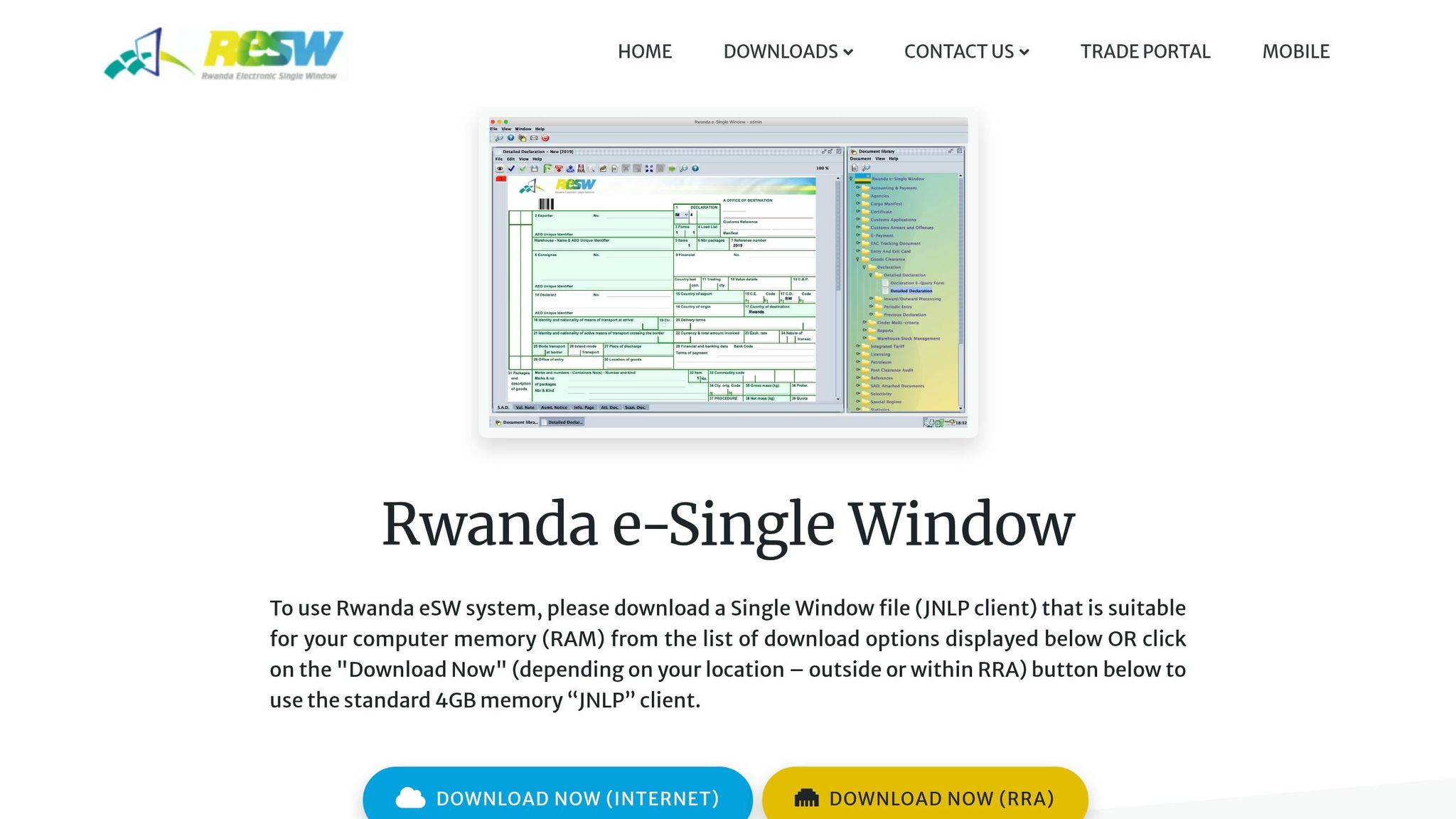
Rwanda has also digitized its entire vehicle import process. The Rwanda Electronic Single Window (ReSW) is now the sole platform for submitting all import-related documentation. This system simplifies and speeds up the process by centralizing tasks like pre-verification of conformity (PVoC), duty calculations, and compliance checks. Importers must upload necessary documents, including the Euro 4 certification and proof of CIF value, on the platform before shipping their vehicles to Rwanda.
These updates reflect Rwanda’s focus on cleaner technologies, greener policies, and more streamlined systems for vehicle imports.
Vehicle Age Limits and Import Requirements
Rwanda is shifting its vehicle import regulations for 2026 to focus on environmental standards rather than the age of vehicles. The key requirement is compliance with Euro 4 emissions standards. Generally, vehicles manufactured after January 2006 meet these standards, but any vehicle – regardless of age – that fails to comply will be rejected. Here’s a closer look at the rules for importing used cars and right-hand drive models.
No Fixed Age Limit for Used Cars
Unlike some neighboring countries that enforce strict age limits, Rwanda takes a different approach by concentrating on emissions compliance. There’s no specific age restriction for importing used cars. However, importers must submit proof through the Rwanda Electronic Single Window (ReSW) system to demonstrate that the vehicle meets Euro 4 standards. On top of that, all vehicles undergo a physical inspection by the Rwanda Standards Board (RSB) to ensure they meet safety and environmental regulations.
Temporary Use for Right-Hand Drive Vehicles
Rwanda only allows left-hand drive vehicles for permanent registration. Right-hand drive models are permitted for a brief two-week period, after which they must be converted to left-hand drive or re-exported. This policy helps maintain consistent traffic flow and improves road safety. To avoid the hassle and expense of conversion or re-export, it’s essential to confirm the steering configuration before importing.
Import Taxes and Fees Breakdown
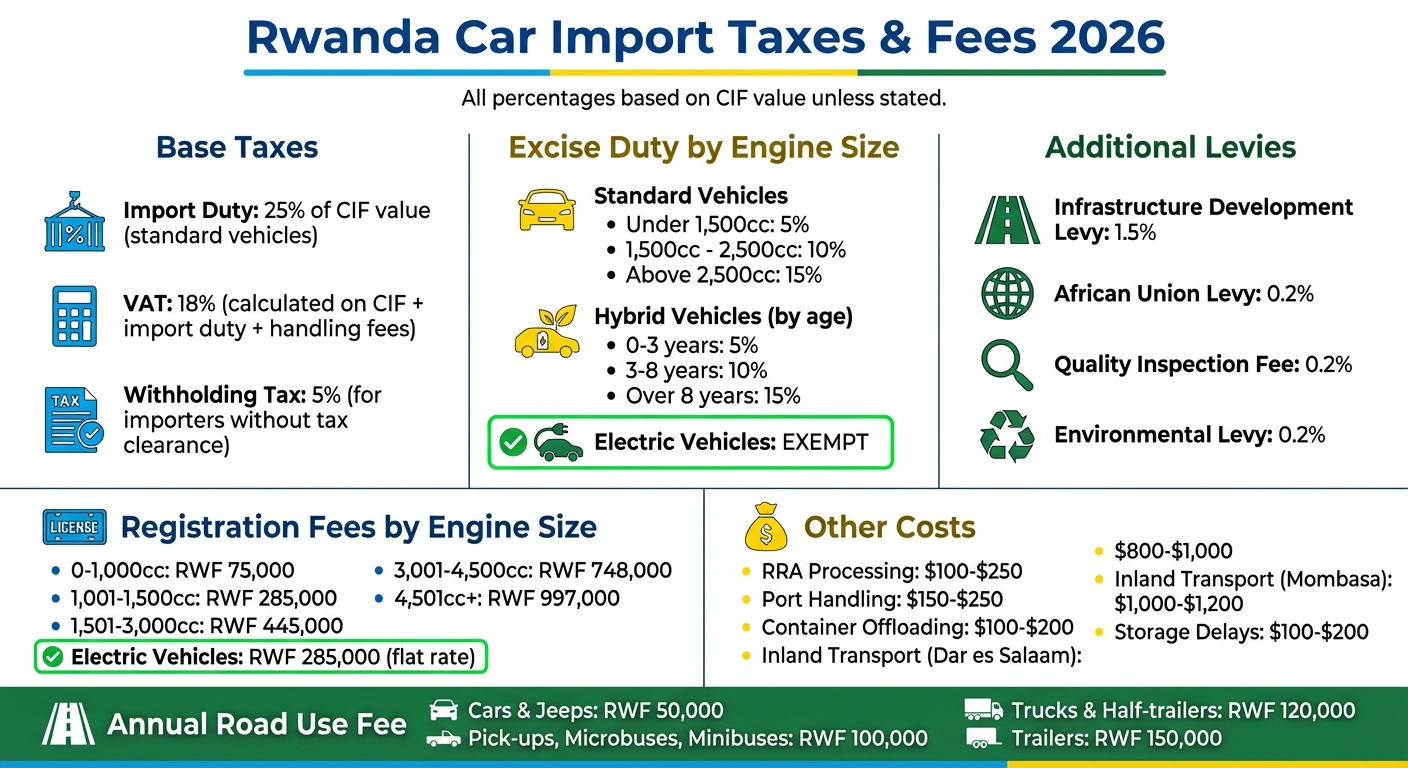
Rwanda Car Import Taxes and Fees Breakdown 2026
Understanding the various taxes and fees involved in importing a vehicle into Rwanda is crucial for accurate cost planning. The process begins with the CIF value (Cost, Insurance, and Freight), which includes the purchase price, shipping, and insurance. This CIF value serves as the foundation for calculating multiple layers of taxes and fees.
Import Duty, VAT, and Withholding Tax Rates
The import duty for most internal combustion engine vehicles is 25% of the CIF value. However, incentives for green vehicles introduce some exceptions. Hybrid vehicles are exempt from import duty starting in the 2025/2026 fiscal year. For electric vehicles, the rules are tiered: those valued above $60,000 are exempt, while those priced at or below $60,000 are subject to a 25% tariff.
Value Added Tax (VAT) is set at 18%, calculated on the combined total of the CIF value, import duty, and handling fees. Additionally, a 5% withholding tax applies to importers who lack a valid tax clearance certificate.
Other charges include:
- Infrastructure Development Levy (IDL): 1.5% of the customs value
- African Union Levy (AUL): 0.2%
- Quality Inspection Fee (QIF): 0.2% for all imports
- Environmental Levy: 0.2% for vehicles with plastic packaging
Excise Duty by Engine Size
Excise duty is calculated based on engine capacity for standard vehicles, with additional considerations for hybrids. For non-hybrid vehicles:
- Under 1,500cc: 5%
- 1,500cc to 2,500cc: 10%
- Above 2,500cc: 15%
For hybrids:
- Three years old or newer: 5%
- Three to eight years old: 10%
- Older than eight years: 15%
Electric vehicles are exempt from excise duties, reflecting Rwanda’s push for eco-friendly transportation. Other exemptions include vehicles assembled in Rwanda, ambulances, and buses with at least 14-passenger capacity. Public transport vehicles also benefit from reduced customs duties: buses with 25–50 seats pay 10%, while those with 50+ seats are fully exempt.
Registration Fees and Other Costs
Registration fees, updated in April 2025, vary by engine size:
- 0–1,000cc: RWF 75,000
- 1,001–1,500cc: RWF 285,000
- 1,501–3,000cc: RWF 445,000
- 3,001–4,500cc: RWF 748,000
- 4,501cc and above: RWF 997,000
Electric vehicles enjoy a flat RWF 285,000 registration fee, regardless of power output.
"Registration fees for regular motorcycles, which are commonly used for transportation, have not increased. Additionally, fees for special vehicles, which previously fell into varying categories, have now been simplified into a more balanced structure." – Batamuliza Hajara, Commissioner for the Domestic Taxes Department, Rwanda Revenue Authority
Importers should also budget for RRA processing fees, which range from $100 to $250 and cover customs paperwork and license plate issuance. Additional costs include:
- Port handling: $150 to $250
- Container offloading and storage: $100 to $200
Since Rwanda is landlocked, inland transport adds another expense. Shipping from Dar es Salaam costs $800 to $1,000, while transport from Mombasa ranges from $1,000 to $1,200. Delays at the port can incur demurrage charges of $100 to $200 beyond the free storage period.
Annual fees include the Road Use Fee (Vehicle Levy):
- RWF 50,000 for cars and jeeps
- RWF 100,000 for pick-ups, microbuses, and minibuses
- RWF 120,000 for trucks and half-trailers
- RWF 150,000 for trailers
How to Import a Car: Step-by-Step Process
If you’re planning to import a car in 2026, the process has been made much more efficient thanks to the Rwanda Electronic Single Window (ReSW). This system has cut clearance times by 40%. Most vehicles are shipped to ports in Dar es Salaam, Tanzania, or Mombasa, Kenya, before being transported overland to Rwanda. To ensure everything goes smoothly, you’ll need to prepare the necessary documents for digital clearance.
Required Documents for Import Clearance
To clear your vehicle through customs, you’ll need to submit several documents via the ReSW platform. These include:
- Bill of Lading
- Commercial invoice
- Title and registration certificates
- De-registration certificate
- Certificate of origin
- PVoC (Pre-Export Verification of Conformity)
Additionally, provide copies of your passport, driver’s license, international insurance policy, and proof of duty payment. The PVoC is crucial as it confirms your car complies with Rwanda’s Euro 4 emissions and safety standards before shipping.
Using the Rwanda Electronic Single Window (ReSW)
Once your documents are ready, the ReSW platform simplifies the entire process. Initially launched in 2012, the ReSW has evolved into a centralized, web-based portal. It allows importers to manage submissions without visiting multiple government offices. Typically, licensed customs agents handle the process, submitting a single electronic declaration that meets all regulatory requirements. The system coordinates with agencies like the Rwanda Revenue Authority (RRA) and the Rwanda Standards Board (RSB).
Here’s how it works:
- Upload clear digital copies of all required documents to the ReSW portal.
- Track your shipment and manage duty payments directly through the platform.
- Customs officials calculate duties based on the vehicle’s CIF (Cost, Insurance, and Freight) value and engine specifications.
- Pay duties and registration fees through the system.
Registration fees vary depending on engine size, starting at RWF 75,000 for vehicles under 1,000cc and going up to RWF 560,000 for engines over 4,501cc. Once everything is settled, you’ll receive your number plates and a Yellow Card registration certificate. To make the process even smoother, consider hiring a certified customs broker to handle digital submissions on your behalf.
Practical Tips for Car Importers in 2026
Focus on Electric and Hybrid Vehicles
In 2026, electric and hybrid vehicles remain a smart choice for importers, thanks to generous tax breaks. These vehicles often qualify for reduced or even zero excise duties, making them a cost-effective option. Plus, importing an electric vehicle lets you skip the Euro 4 emissions standards that apply to internal combustion engines, simplifying the entire process. With these incentives, importing becomes less complicated and more budget-friendly.
Calculate All Costs Before Importing
Before importing, make sure you have a clear picture of all the costs involved. Start by confirming the CIF (Cost, Insurance, and Freight) value with your seller, as this forms the basis for tax calculations. Use the Rwanda Electronic Single Window (ReSW) to track costs in real time and avoid surprises.
Here’s a quick breakdown of typical expenses:
- Taxes: 25% Customs Duty, 18% VAT, and 5% Withholding Tax.
- Processing and fees: RRA processing fees ($100–$250), port charges ($300–$500), and inland transportation ($800–$1,000 from Dar es Salaam or $1,000–$1,200 from Mombasa).
- Storage fees: $100–$200 for delays.
By accounting for these costs upfront, you can better manage your budget and avoid hidden fees.
Work with Certified Agents for Documentation
To ensure a smooth import process, collaborate with a certified customs broker registered with the Rwanda Revenue Authority (RRA). A qualified agent can help you navigate the ReSW system, making sure all submissions comply with regulations and speeding up the clearance process. Always check your agent’s credentials with the RRA and confirm their fees are straightforward. Taking these steps will help you take full advantage of Rwanda’s digital import system while avoiding unnecessary complications.
Summary: Rwanda’s 2026 Car Import Rules
Rwanda’s updated car import rules for 2026 emphasize cleaner transportation and stricter environmental guidelines. A key requirement is that all imported vehicles must comply with Euro 4 emissions standards, with older cars potentially facing higher excise taxes.
The tax framework includes 25% Customs Duty, 18% VAT, and 5% Withholding Tax, but there are notable incentives for eco-friendly vehicles. Electric cars remain fully tax-exempt until June 30, 2028, while hybrid vehicles benefit from reduced import duties and tiered excise rates. These policies aim to encourage the adoption of greener vehicle options.
The Rwanda Electronic Single Window (ReSW) has made the import process fully digital and more efficient. Importers can now track costs in real time, submit documentation online, and collaborate with certified clearing agents registered with the Rwanda Revenue Authority. This ensures smoother compliance with regulations and reduces delays.
To navigate these changes effectively, importers should focus on electric and hybrid vehicles while carefully calculating all related costs beforehand. These new rules combine stricter regulations with streamlined processes, promoting cleaner transportation and a more efficient import system.
FAQs
How do I prove my car meets Euro 4?
To show that your car complies with Euro 4 standards for import into Rwanda, you’ll need to provide official documentation. This could be a certification or an emissions test report issued by either the manufacturer or an authorized testing agency. The document must explicitly confirm that the vehicle meets Euro 4 requirements. Make sure the paperwork is up-to-date and clearly outlines compliance, as this is essential for meeting Rwanda’s import regulations.
What’s my total landed cost in Rwanda?
Your total landed cost is made up of the vehicle’s CIF value (Cost, Insurance, and Freight) along with any applicable taxes and duties. These often include a 25% import duty for standard vehicles, an 18% VAT, and other fees that depend on the vehicle’s type and age. Make sure to include all of these elements when figuring out your final cost.
Can I import a right-hand drive car?
For short-term stays ranging from 4 days to 2 weeks, right-hand drive vehicles are allowed in Rwanda. However, for regular importation, only left-hand drive vehicles are permitted. Make sure to follow these regulations to prevent any complications during the import process.
Related Blog Posts
- Car Imports in Rwanda: What’s Changing in 2025
- Car import duties in Rwanda: Updated costs and procedures for 2025
- Your complete guide to importing a car into Rwanda in 2025
- Special EV Customs Rules: What Importers Need to Know