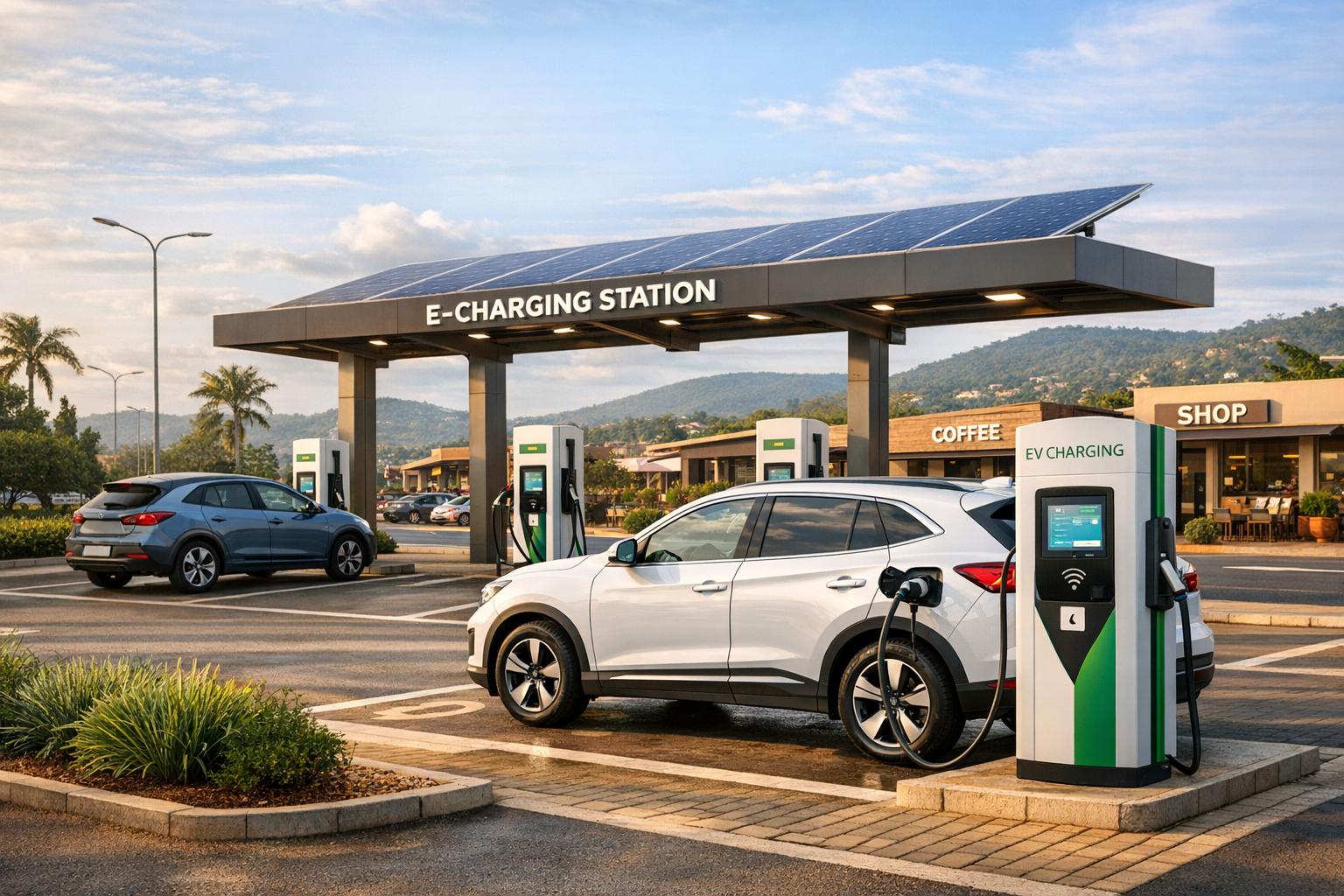
Rwanda’s EV charging network has grown rapidly, making it easier than ever to own and operate electric vehicles (EVs) in 2026. With nearly 200 charging stations in Kigali and a nationwide plan ensuring no driver is more than 31 miles (50 km) from a charger, Rwanda is leading the way in Africa’s transition to electric mobility. Here’s what you need to know:
- Charging Locations: Kigali has 35 car charging stations and 165 for electric motorcycles. Stations are also available along key routes like Kigali–Lake Kivu and Kigali–Akagera National Park.
- Charging Options: Home AC charging, public AC/DC fast charging, ultra-fast charging, and battery swapping (for motorcycles) are all available.
- Costs: Charging costs start at $0.10 per kWh for home charging, making EVs far cheaper to run than gas-powered vehicles.
- Government Incentives: Subsidized electricity rates, tax exemptions, and perks like free parking encourage EV adoption.
To charge efficiently, plan trips using apps like PlugShare, charge during off-peak hours to save money, and avoid overusing fast chargers to extend battery life. Whether commuting in Kigali or taking long trips, Rwanda’s EV ecosystem makes electric driving both accessible and affordable.
Where to Find EV Charging Stations
National Charging Network and Government Plan
Rwanda’s Ministry of Infrastructure has laid out a bold plan to ensure nationwide access to EV charging. Through a geospatial analysis, the government identified over 226 potential sites for charging stations, aiming to eliminate range anxiety by providing reliable access across the country – even in remote areas. This strategy goes beyond urban centers, focusing on creating a truly nationwide network.
"The ministry is working on a master plan to guide investors in developing charging infrastructure and to prevent the development of idle or obsolete stations." – MININFRA
To accelerate this initiative, the government is offering rent-free land for charging station projects, encouraging development in less populated regions. As of late 2024, Rwanda has 24 public charging stations for cars and 49 stations that combine charging with battery-swapping facilities. With more installations in progress, this growing network ensures access not only in Kigali but also across the countryside.
Main Charging Locations in Kigali and Beyond
Kigali serves as the central hub for EV charging, with stations conveniently located at shopping malls, office buildings, and even traditional gas stations – making it easy for drivers to charge during their daily routines.
Several companies are leading the way in Kigali. Kabisa operates ultra-fast charging hubs, while Volkswagen Rwanda has installed chargers at prominent commercial sites. For motorcycle taxis, Ampersand and Spiro have set up battery-swapping stations, which significantly cut downtime compared to plug-in charging.
Outside Kigali, the charging infrastructure is growing to support tourism, regional travel, and local commerce. For example, stations are being added along the Kigali–Lake Kivu route (about 130 km) and the Kigali–Akagera National Park route (about 135 km), catering to eco-tourists and weekend travelers. In Nyamagabe District, charging stations are helping improve transportation efficiency for agricultural goods.
How to Find Charging Stations
With an expanding network, Rwandan EV owners have several tools to locate charging stations easily. Apps like PlugShare offer a color-coded map to distinguish between different types of chargers: green pins for public Level 1-2 chargers (up to 50 kW), orange for rapid DC fast chargers, and brown for private or restricted-access stations. The app also includes user reviews and ratings to help confirm reliability.
ChargeFinder takes it a step further by showing real-time availability – whether a charger is free, occupied, or under maintenance – and includes a route planner that filters stations by connector type (e.g., CCS, Type 2, CHAdeMO). For updates on new stations and infrastructure developments, AutoMag.RW provides local news and insights into Rwanda’s growing EV landscape. Many stations are also listed on Google Maps, making it easy to navigate to the nearest charger.
sbb-itb-7bc66b5
Rwanda’s E-mobility revolution accelerates
Charging Types, Speeds, and Prices
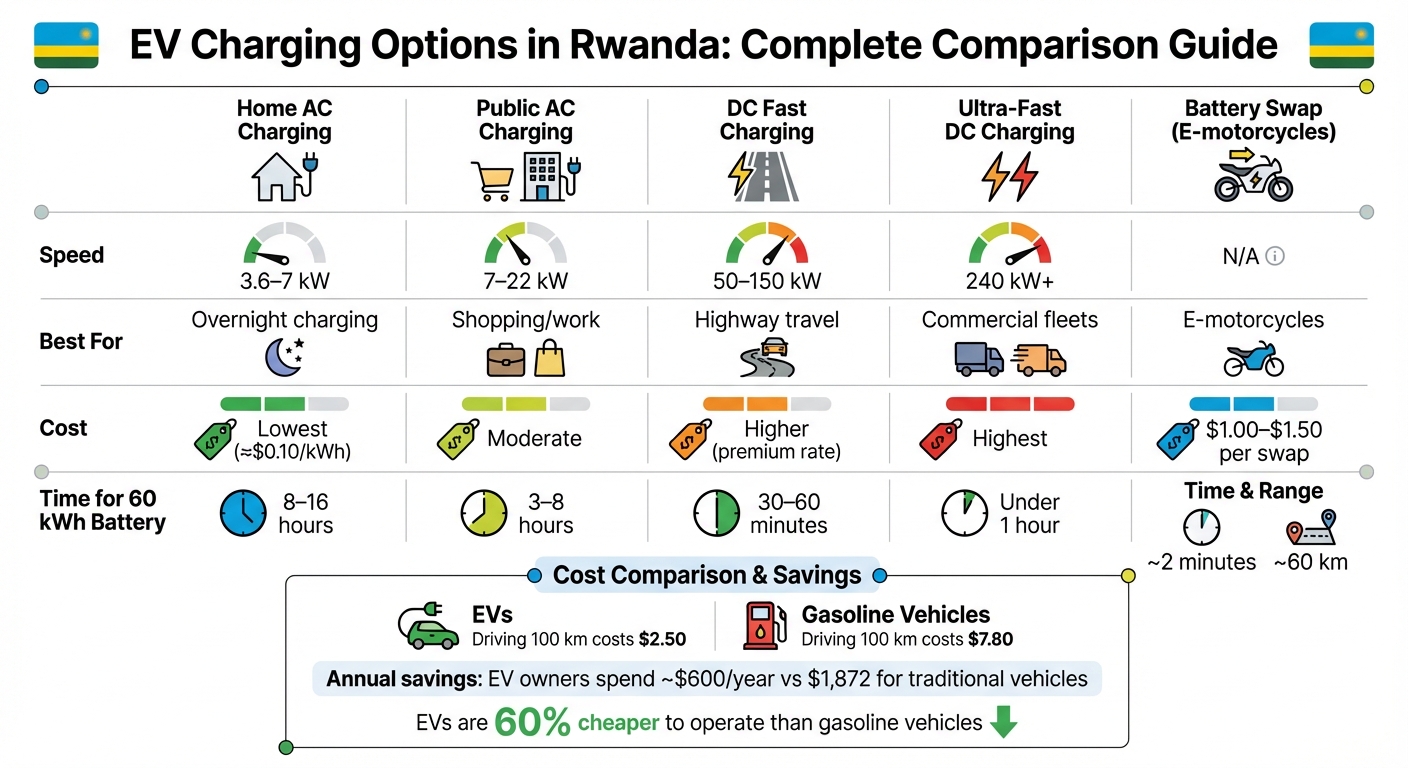
EV Charging Options in Rwanda: Types, Speeds, Costs and Charging Times Comparison 2026
Types of Chargers and Charging Speeds
In Rwanda, EV owners have four main charging options: home AC charging, public AC charging, DC fast charging (including ultra-fast supercharging), and battery swapping for electric motorcycles. Home AC chargers, with speeds ranging from 3.6 to 7 kW, are perfect for overnight charging. For example, a 60 kWh battery can take 8 to 16 hours to fully charge at home. Public AC chargers, typically rated between 7 and 22 kW, are found at commercial locations and can fully charge a vehicle in 3 to 8 hours.
For those needing faster solutions, DC fast chargers (50–150 kW) are strategically placed along major highways and can recharge a battery to 80% in just 30 to 60 minutes. In February 2025, KABISA introduced a 240 kW supercharger with six charging bays, significantly reducing wait times. As Muhoza Pophia, KABISA’s General Manager in Rwanda, explains:
"The supercharger’s ability to charge six vehicles simultaneously at 240 kilowatts ensures a full battery charge in less than an hour, significantly reducing charging times".
For electric motorcycles, battery swapping has become a game-changer. Riders can swap batteries in just two minutes at one of Kigali’s 165 battery-swapping stations. Rwanda has also adopted the CCS2 connector standard for cars, ensuring compatibility across East Africa.
These charging options are supported by government-subsidized electricity rates, making them more affordable for users.
Electricity Rates for EV Charging
Rwanda’s government provides a subsidized electricity rate of $0.10 per kWh for charging station operators, which is half the standard rate of $0.20 per kWh. This initiative helps keep charging costs low. Additional incentives further reduce expenses for operators, encouraging the growth of EV infrastructure.
The country is also moving toward time-of-use pricing to manage grid demand better. With Kigali’s electricity demand expected to grow by 64% by 2030, off-peak charging is likely to become even cheaper. Smart charging practices, such as syncing with solar energy production, could also reduce strain on the grid by as much as 15%.
These measures ensure that EV charging remains economical, benefiting both operators and vehicle owners.
What You’ll Pay to Charge Your EV
Charging costs vary depending on the method, but home charging is the most economical – about one-third the cost of public DC fast charging. Driving 100 km in an EV costs around $2.50, compared to $7.80 for a gasoline-powered vehicle. Annually, EV owners spend about $600 on energy, while traditional car owners typically spend $1,872 on fuel.
| Charger Type | Speed | Best For | Cost Range | Time (60 kWh Battery) |
|---|---|---|---|---|
| Home AC | 3.6–7 kW | Overnight charging | Lowest (≈$0.10/kWh) | 8–16 hours |
| Public AC | 7–22 kW | Shopping/work | Moderate | 3–8 hours |
| DC Fast | 50–150 kW | Highway travel | Higher (premium rate) | 30–60 minutes |
| Ultra-Fast DC | 240 kW+ | Commercial fleets | Highest | Under 1 hour |
| Battery Swap | N/A | E-motorcycles | $1.00–$1.50 per swap | ~2 minutes |
For motorcycle taxis, battery swaps cost between $1.00 and $1.50 per swap, providing about 60 km of range. When factoring in both energy and maintenance costs, EVs are about 60% cheaper to operate than gasoline vehicles.
This cost structure demonstrates how Rwanda’s growing EV infrastructure and supportive policies are making electric mobility a practical and affordable choice.
Planning Your EV Trips
Daily Charging for City Driving
For daily commutes around Kigali, charging your EV at home overnight is the most practical option. With electricity priced at just $0.10 per kWh, it’s an economical choice. If home charging isn’t available, workplace or public charging stations are your next best bet. Use your favorite mapping app to check real-time station availability, and rely on features like the PlugScore system (rated 1–10) to identify stations with the best reliability based on recent user reviews.
One thing to keep in mind: Kigali’s hilly terrain can increase your EV’s energy consumption. To avoid getting caught off guard, plan for a little extra battery capacity, especially on routes with steep climbs.
Charging during off-peak hours not only cuts costs but also reduces stress on the grid. For example, smart charging during low-demand periods can decrease strain on the distribution network by up to 15%. This is especially relevant as Kigali’s peak power demand is projected to grow by 64% by 2030.
If you’re planning trips outside the city, you’ll need to take a more detailed approach.
Long-Distance and Cross-Border Trips
Heading beyond Kigali? Be prepared. For instance, a drive to Lake Kivu covers about 80 miles (130 km) and takes roughly three hours, while reaching Akagera National Park involves an 84-mile (135 km) journey that takes about two and a half hours. Before setting off, confirm the availability of charging stations in rural areas, as they may be less frequent.
Fortunately, Rwanda’s national infrastructure plan aims to make long-distance EV travel more convenient. The Ministry of Infrastructure is working to ensure that no EV will need to travel more than 31 miles (50 km) without access to a charging station. For cross-border trips, check that your EV is compatible with the regional CCS2 or GB/T charging standards, which are becoming the norm across East Africa.
As neighboring countries like Kenya and Ethiopia expand their charging networks, station availability can vary, so plan carefully. Also, Rwanda’s "thousand hills" mean you’ll need to account for higher energy use on hilly terrain. It’s wise to maintain a larger battery reserve and plan for at least one mid-trip charge or ensure you can reach a dependable charging hub.
Whether you’re navigating Kigali’s streets or venturing further afield, understanding how to manage grid conditions and prioritize safety is key.
Grid Reliability and Safety Tips
Charging during off-peak hours is one of the best ways to support the grid and ensure optimal performance for everyone. Tarek Keskes, an energy specialist with the World Bank’s ESMAP program, highlights this point:
"Our analysis shows that Rwanda can achieve its goals if smart charging, cost-reflective tariffs, and integrated planning are prioritized".
Major transit hubs like Nyabugogo Terminal now feature high-capacity chargers (120 to 160 kW) powered by solar energy and battery storage. These setups help reduce reliance on the grid during peak times. When using public chargers, always verify their operational status through your mapping app. Reading recent user comments can save you from the frustration of arriving at a non-functional station.
Tips for EV Charging in Rwanda
Here are some practical suggestions to help you make the most of your EV charging experience in Rwanda.
How to Maintain Your Battery
Limit your use of DC fast chargers. While Level 3 stations can charge your EV up to 80% in just 20 to 30 minutes, frequent use can wear down your battery and shorten its lifespan. Instead, rely on Level 2 (240V) chargers for daily charging. These take 4 to 7 hours but are gentler on your battery.
Avoid standard extension cords when charging your EV. These cords aren’t built to handle high power loads and could lead to overheating, fire hazards, or electric shock. Always use a dedicated EV charging circuit for safety.
If you’re driving on hilly routes, like the 80-mile (130 km) journey from Kigali to Lake Kivu, take advantage of regenerative braking on downhill stretches. Also, avoid charging your battery to 100% regularly. Keeping it between 20% and 80% can significantly extend its lifespan.
Taking these steps not only ensures your battery lasts longer but also helps you save on charging costs.
How to Reduce Charging Costs
Charge during off-peak hours to take advantage of lower electricity rates and reduce strain on the grid. As Rwanda transitions to time-of-use tariffs, late-night charging will become even more economical.
Whenever possible, opt for Level 2 AC charging instead of DC fast charging. Although DC fast chargers are quicker, they’re often more expensive and can be tougher on your battery. For instance, charging a 54 kWh battery at $0.11 per kWh costs about $6, but the cost could rise significantly with frequent fast charging.
Consider using solar-powered charging hubs, like the one at Nyabugogo Terminal. These stations rely on an 800 kW rooftop solar system with battery storage, providing more stable pricing and less dependence on the national grid. Use a charging app to monitor your session and stop charging once you reach your desired level to avoid unnecessary expenses.
These strategies can vary depending on your EV model, so adjust them to suit your specific vehicle.
Tips for Specific Vehicle Types
Electric moto riders can benefit from battery swapping stations run by companies like Ampersand or Spiro. Swapping eliminates the 6 to 8-hour wait for a full charge and avoids the $1,000 upfront cost of buying a battery. Plus, swapping helps maintain battery health.
Commercial fleet operators should focus on overnight charging at dedicated depots equipped with 120 to 160 kW fast chargers. This ensures buses or delivery vehicles are fully charged and ready for daytime operations without mid-day stress on the battery. Scheduling charging during off-peak hours also cuts costs and supports grid stability.
Personal EV owners should ensure their vehicle is compatible with CCS2 or GB/T charging standards, which are becoming common across Rwanda and East Africa. Before heading out on long trips, use apps like PlugShare to confirm connector compatibility and check recent user reviews (PlugScores) to avoid arriving at a station that’s out of order.
Conclusion
Rwanda’s electric vehicle (EV) charging network is growing at an impressive pace, with nearly 200 stations in Kigali alone and a national plan ensuring a station within 31 miles (50 km) across the country. This progress is backed by strong government initiatives, including the adoption of dual international standards (CCS2 and GB/T), subsidized electricity rates at just $0.10 per kWh, and solar-powered hubs like the Nyabugogo Terminal.
To further this momentum, Rwanda has pinpointed 224 to 226 strategic locations nationwide for additional charging stations. Private investors are being encouraged to participate through incentives such as rent-free land and tax exemptions. For EV owners, making the most of this network means charging during off-peak hours, using Level 2 chargers for everyday needs, and ensuring connector compatibility before embarking on longer journeys.
AutoMag.RW is your go-to source for real-time updates on charging station locations, pricing, and policy changes as Rwanda’s EV market continues to evolve. With over 7,000 EVs and hybrids already on the roads, staying informed is key as the country works toward its 2030 goals. Rwanda’s rapid advancements in e-mobility not only highlight its leadership in sustainable transport but also pave the way for exciting developments in the years ahead.
FAQs
How do I find the nearest EV charging station in Rwanda?
Finding an EV charging station in Rwanda is straightforward with apps like PlugShare and EVPlugin. These apps feature interactive maps that pinpoint nearby charging stations, organized by type – whether you’re looking for standard or fast chargers.
To make the most of these tools, activate location services on your device. This allows the map to automatically focus on your current position. From there, you can refine your search by filtering for specific charger types or checking availability. Once you pick a station, you’ll get all the key details: the address, plug type, real-time availability, and pricing (displayed in Rwandan Francs, which you can convert to USD). Plus, you can easily navigate to the station with step-by-step directions using your favorite navigation app.
For broader coverage, it’s a good idea to have both PlugShare and EVPlugin installed, as each app might include stations the other misses.
What are the costs and advantages of different EV charging options in Rwanda?
In Rwanda, electric vehicle (EV) owners have three primary charging options: home charging, public standard chargers (Level 1-2), and public rapid chargers (Level 3). Each option offers a mix of convenience and cost considerations.
Home charging is the most budget-friendly choice, using residential electricity priced at approximately $0.20 per kWh. Plugging in overnight at home is convenient and perfect for meeting daily driving needs. For example, fully charging a 60 kWh battery at home would cost about $12.
Public Level 1-2 chargers, found in various public spaces, are slightly pricier due to small session fees. Charging the same 60 kWh battery at these stations typically costs between $15-$18. While slower than home charging, these chargers are useful during longer stops, such as when shopping or working.
Rapid Level 3 chargers are the quickest option, making them ideal for long-distance travel or commercial use. However, this speed comes at a higher cost, ranging from $20-$25 for a full charge.
By using home charging for everyday needs and relying on public or rapid chargers for longer trips, EV owners in Rwanda can effectively manage costs while taking advantage of the expanding EV infrastructure.
What government incentives are available for electric vehicle adoption in Rwanda?
Rwanda has introduced a variety of government incentives aimed at making electric vehicles (EVs) more accessible and encouraging their adoption. Since 2025, EVs, along with chargers, batteries, and spare parts, have been completely exempt from Value-Added Tax (VAT), customs duties, excise taxes, and withholding taxes. These exemptions, in place until June 30, 2028, significantly lower the initial costs of owning an EV.
On top of that, businesses operating in the e-mobility sector enjoy a reduced 15% corporate income tax rate. This benefit extends to manufacturers, charging station operators, and companies involved in related technologies or energy solutions. These initiatives align with Rwanda’s National Sustainable Mobility Policy and Vision 2050, which focus on achieving carbon neutrality.
By cutting costs for both consumers and businesses, these incentives help level the playing field between EVs and traditional gas-powered vehicles. At the same time, they encourage investments in charging infrastructure, creating a ripple effect of adoption and innovation. This approach supports Rwanda’s environmental and economic objectives, paving the way for a cleaner and more sustainable future.
Related Blog Posts
- Where to charge your electric vehicle in Rwanda: Kigali & beyond
- Rwanda’s EV Road Projects: Progress and Impact
- Electric Cars in Rwanda: Models and Charging Points
- EV Charging vs. Fueling ICE Cars: Cost Analysis