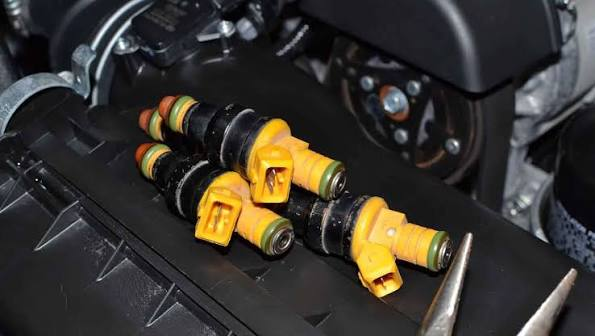
If your car has started idling roughly, hesitating when you press the accelerator, or burning through fuel faster than it used to, the culprit might not be your engine at all — it could be your fuel injectors. These small but critical components are responsible for spraying a fine, precise mist of fuel into your engine, and when they get clogged with carbon and varnish, that spray pattern breaks down, taking your engine’s smoothness and efficiency with it.
The good news is that cleaning fuel injectors is one of the more affordable pieces of car maintenance you can do, with options ranging from a bottle you pour into your fuel tank to a full professional service. Here’s how it all works, and how to know which level of cleaning your car actually needs.
What Fuel Injectors Do, and Why They Get Dirty
Fuel injectors act like miniature, precision spray nozzles. Instead of dumping fuel into the engine in a stream, they atomize it into an extremely fine mist, timed exactly right so it mixes properly with air for clean, efficient combustion. This precision is what gives modern engines their fuel economy and smooth power delivery compared to older carbureted engines.
The problem is that fuel isn’t perfectly clean, and neither is the environment inside an engine. Over time, carbon deposits and varnish build up on the tiny nozzle tips and can even work their way into the internal passages of the injector. This is a normal, gradual process in any petrol or diesel engine, but it happens faster with lower-quality fuel, frequent short trips, or a car that sits unused for stretches at a time — all fairly common realities for many drivers in Rwanda, whether you’re doing daily short hops around Kigali or covering long distances upcountry where fuel quality can vary between stations.
Signs Your Injectors Need Cleaning
Clogged injectors rarely announce themselves with one obvious symptom — instead, you’ll usually notice a combination of the following:
- Rough or uneven idling. A dirty injector delivers fuel unevenly, which can make the engine feel shaky or inconsistent while stopped.
- Hesitation on acceleration. When you press the pedal and the car takes a moment to respond or feels like it’s struggling to deliver power, disrupted fuel spray is a common cause.
- Reduced fuel efficiency. If you’re filling up more often than usual for the same driving, poor atomization means your engine isn’t burning fuel as completely or efficiently as it should.
- Engine misfires or an illuminated check engine light. In more advanced cases, a badly clogged or failing injector can cause a cylinder to misfire entirely.
If you’re noticing more than one of these symptoms together, it’s a reasonably strong signal that your injectors deserve some attention.
Method 1: Fuel Additives (The Simplest Option)
For mild to moderate buildup, a fuel injector cleaning additive is the easiest and cheapest place to start. These are concentrated cleaning solutions, usually built around a detergent called PEA (polyetheramine), that you pour directly into your fuel tank.
How to use them:
- Choose a reputable additive with a good concentration of active cleaning detergent rather than a generic, diluted product.
- Add it to a tank that’s close to empty, then fill up with fuel right after, so the additive mixes thoroughly rather than sitting at the bottom.
- Drive normally. As the treated fuel cycles through your system, the detergent works on dissolving carbon and varnish on the injector tips.
- Repeat this every few thousand kilometres as part of routine maintenance, especially if you do a lot of short-distance city driving, which tends to build up deposits faster than sustained highway driving.
This method is genuinely useful for prevention and mild cases, but it’s a gentler treatment — it won’t fully resolve significant internal blockages on its own.
Method 2: On-Vehicle Cleaning Kits (A Stronger Treatment)
If an additive isn’t cutting it, the next step up is a pressurized on-vehicle cleaning kit, which forces concentrated cleaning solvent directly through the fuel rail and injectors at operating pressure — a much more aggressive treatment than anything mixed into a full tank of fuel.
The general process:
- With the engine off and cooled, disable the fuel pump (often by removing its fuse or relay) to stop regular fuel flow.
- Connect the cleaning kit’s canister to the fuel rail’s test port and fill it with the concentrated cleaning solution.
- Start the engine and let it run entirely on the cleaning solution until the canister empties.
- Reconnect the fuel pump and take the car for a normal drive to test the results.
This method requires some mechanical familiarity and the right connectors for your specific fuel rail, so if you’re not confident doing this yourself, it’s a reasonable job to hand to a trusted local mechanic rather than attempting it without the right equipment.
Method 3: Professional Ultrasonic Cleaning (For Serious Buildup)
For injectors that are heavily clogged or when the first two methods haven’t resolved the issue, professional ultrasonic cleaning is the most thorough option available. This involves physically removing the injectors from the engine and sending them through a specialized cleaning and testing process:
- Electrical and visual inspection — each injector is tested for resistance and checked for cracks or damage before cleaning even begins.
- Ultrasonic bath — the injectors are submerged in a heated cleaning solution while high-frequency sound waves create microscopic bubbles that collapse against the injector’s surfaces, a process called cavitation. This reaches internal passages and nozzle tips that no additive or on-vehicle kit can fully access.
- Flow and spray pattern testing — after cleaning, injectors are tested to confirm they deliver the correct amount of fuel in a proper, evenly atomized cone shape, matching factory specifications.
- New seals and components — worn O-rings, filter baskets, and other small parts are typically replaced as part of the service, since these degrade over time regardless of how clean the injector body is.
This is the option to reach for if you’ve already tried an additive or cleaning kit without success, or if a mechanic’s diagnosis points to injectors that are significantly restricted. It’s more expensive than a bottle of additive, but far cheaper than replacing injectors outright, and it typically restores them close to original performance.
Preventing Buildup in the First Place
A little prevention goes a long way toward keeping your injectors clean for longer:
- Use good-quality fuel where possible. Higher-quality fuels often contain more detergent additives that naturally reduce carbon buildup over time.
- Don’t skip fuel filter replacement. A clean fuel filter keeps debris and contaminants from ever reaching your injectors in the first place.
- Add a cleaning additive periodically, even before you notice symptoms, particularly if you do a lot of stop-and-go city driving or your car sits unused for stretches at a time.
- Address rough idling or hesitation early, rather than waiting for it to develop into a more serious clog or misfire.
If you’re weighing up whether it’s worth investing in injector care on an older vehicle, or considering something newer with a cleaner service history, it’s worth having a look at what’s currently listed on auto24.rw. Fuel-injected models like the Toyota Vitz, Premio, and Axio are common and generally straightforward to maintain, and asking about a car’s fuel system history is a smart question to raise with any seller before you buy.
For more Rwanda-focused maintenance tips and driving guides, automag.rw is worth bookmarking as you keep your car running smoothly for the long haul.
A Note on Electric Vehicles
It’s worth mentioning that this entire maintenance concern disappears if you go electric. EVs have no fuel injectors, no carburetors, and no combustion process to generate carbon deposits in the first place — one of the quieter benefits of the technology that owners rarely have to think about. For Rwandan drivers exploring this shift, EV24.africa offers import options for electric vehicles, expanding the choices available locally for anyone looking to simplify their long-term maintenance routine.
Final Thoughts
Fuel injectors are easy to forget about until your engine starts telling you something’s wrong — rough idling, sluggish acceleration, or a fuel bill that’s crept up without explanation. The fix doesn’t have to be complicated: a good additive handles routine upkeep, a pressurized kit tackles moderate buildup, and professional ultrasonic cleaning is there for the more stubborn cases. Catching the problem early and treating it with the right level of cleaning keeps your engine running smoothly and saves you from a much costlier repair down the line.