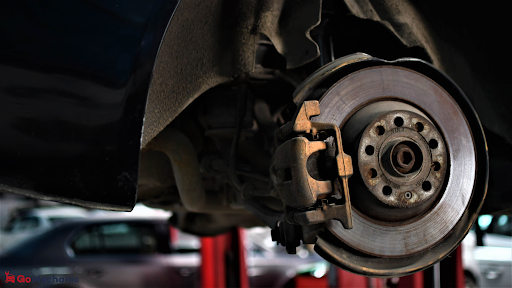
If you’ve ever slammed on the brakes and felt the pedal pulse or judder under your foot, that wasn’t a malfunction — that was your car’s Anti-lock Braking System, or ABS, doing exactly what it’s designed to do. But when a small amber “ABS” light pops up on your dashboard and stays on, that’s a different story, and one that a lot of drivers in Rwanda aren’t sure how to read.
This guide breaks down what ABS actually does, what it means when the warning light comes on, and what steps to take next — whether you’re driving a well-maintained SUV around Kigali or a used import you’re still getting to know.
What ABS Actually Does
Anti-lock brakes exist to solve one specific problem: when you brake hard, and a wheel locks up completely, you lose steering control over that wheel, even though the car is still moving. On a slippery road, loose gravel, or wet tarmac — all common on Rwandan roads, especially in the rainy season — a locked wheel can send you sliding in a straight line even if you’re desperately trying to steer around an obstacle.
ABS prevents this by using a sensor at each wheel to measure how fast that wheel is spinning. If one wheel suddenly slows down much faster than the others — a sign it’s about to lock up — the ABS module rapidly pulses the brake pressure at that wheel, on and off, many times per second. This is what causes the pulsing sensation in the brake pedal during a hard stop. The result is that you keep some rolling traction and steering ability, instead of skidding blindly.
It’s worth being clear about one thing: ABS doesn’t necessarily make you stop in a shorter distance on dry, grippy tarmac. What it does is let you keep control of the steering wheel while braking hard — which, in an emergency, is often more important than shaving off a few extra metres of stopping distance.
Understanding the ABS Warning Light
The ABS light is not the same as your main brake warning light, and the difference matters. A red brake light usually points to something urgent, like low brake fluid or worn-out pads. The ABS light, typically amber or yellow, means specifically that the anti-lock system has detected a fault and has disabled itself as a safety precaution.
Here’s the important part: when the ABS light comes on, your regular brakes still work. You can still stop the car normally. What you lose is the anti-lock function — meaning if you brake hard on a wet or loose surface, your wheels could lock up and you could lose steering control, exactly the situation ABS was designed to prevent.
Common causes of an ABS warning light include:
- A faulty or dirty wheel speed sensor — by far the most common cause. These sensors sit near each wheel hub and are exposed to dust, mud, and road debris constantly, which is a real factor on Rwanda’s less-paved roads and rural routes.
- Damaged sensor wiring — a cut, corroded, or loose wire between the sensor and the ABS module can trigger the same warning as a failed sensor.
- Low brake fluid — many ABS systems share a fluid-level sensor with the main braking system, so low fluid (often caused by worn brake pads) can trigger the ABS light too.
- A failing ABS control module — less common, but if a sensor and its wiring both check out fine and the light persists, the module itself may be the problem.
- The system being switched off — some vehicles let you disable traction control or ABS assist manually, which will also light up the warning.
What to Do When the ABS Light Comes On
- Don’t panic, but don’t ignore it either. Your brakes will still stop the car under normal conditions. Drive carefully, avoid harsh braking where possible, and get it looked at soon rather than putting it off indefinitely.
- Get a diagnostic scan. A mechanic with an OBD-II code reader can pull the exact fault code stored in the car’s computer, which tells you precisely which wheel sensor or circuit is affected, rather than guessing.
- Check for the simple stuff first. Sometimes a wheel speed sensor is just caked in mud or brake dust rather than actually broken. A careful clean can occasionally resolve the fault without any parts needing replacement — worth asking your mechanic to check before authorizing a replacement.
- Address sensor or wiring issues promptly. Wheel speed sensors are a relatively inexpensive and quick fix compared to letting the problem sit — and postponing it means driving without a safety system that matters most in an emergency.
- Be extra cautious in wet or loose conditions until it’s fixed. This applies directly to Rwandan roads: murram sections, wet cobblestones, and steep descents in the rain are exactly where losing ABS function is riskiest.
Why This Matters More on Rwandan Roads
Rwanda’s mix of steep hills, sudden rain showers, and stretches of unpaved or loosely gravelled road make ABS genuinely useful rather than a nice-to-have. A system that keeps your wheels rolling instead of locking up on a wet, hilly descent through Kigali, or on a murram road upcountry, is doing real work — which is exactly why an ABS fault shouldn’t sit unresolved for long.
This is also a detail worth paying attention to when buying a used vehicle. Not every older import has ABS as standard, and on the ones that do, it’s worth confirming the system is functioning rather than just present. When browsing listings on <a href=”https://auto24.rw” target=”_blank” rel=”noopener”>auto24.rw</a>, it’s a good habit to ask sellers directly whether the ABS light has ever come on, and to check for it during a test drive — models like the Toyota RAV4, Premio, and Harrier commonly listed there often come equipped with ABS as standard, but confirming it’s actually working is a five-minute check that can save you a costly surprise later.
Routine Care That Keeps ABS Working Properly
A few habits go a long way toward avoiding ABS problems altogether:
- Keep an eye on brake fluid levels and quality, since fluid issues can trigger the ABS light even when the sensors themselves are fine.
- Have wheel speed sensors inspected during routine brake service, especially if you regularly drive on dusty or muddy roads.
- Don’t ignore a pulsating brake pedal during normal (non-emergency) braking — if it happens on dry roads at moderate speed, that’s not the ABS doing its job; that’s a sign something needs checking.
- Address any dashboard warning light promptly rather than waiting for a second or third light to appear, since ABS, traction control, and stability control systems often share the same sensors and wiring.
For more Rwanda-focused maintenance guidance and driving tips, automag.rw is a solid place to keep learning about keeping your car — and yourself — safer on the road.
Looking Ahead: ABS and the Shift Toward EVs
It’s worth noting that anti-lock braking has become standard safety equipment across nearly all vehicle types today, including electric vehicles, which often pair ABS with regenerative braking systems for smoother, more controlled stops. For Rwandan drivers curious about that shift, EV24.africa offers import options for electric vehicles, giving buyers here more choices as EV adoption slowly expands across East Africa. It’s a different technology path, but the core safety principle — keeping your wheels rolling and steerable under hard braking — remains just as important.
Final Thoughts
ABS is one of those systems you rarely think about until the moment you genuinely need it — hard braking on a wet, hilly road, with an obstacle ahead and no room for the wheels to lock up. Understanding what the warning light means, acting on it quickly rather than ignoring it, and keeping the system well-maintained is a small investment that pays off exactly when it matters most.